QA
QA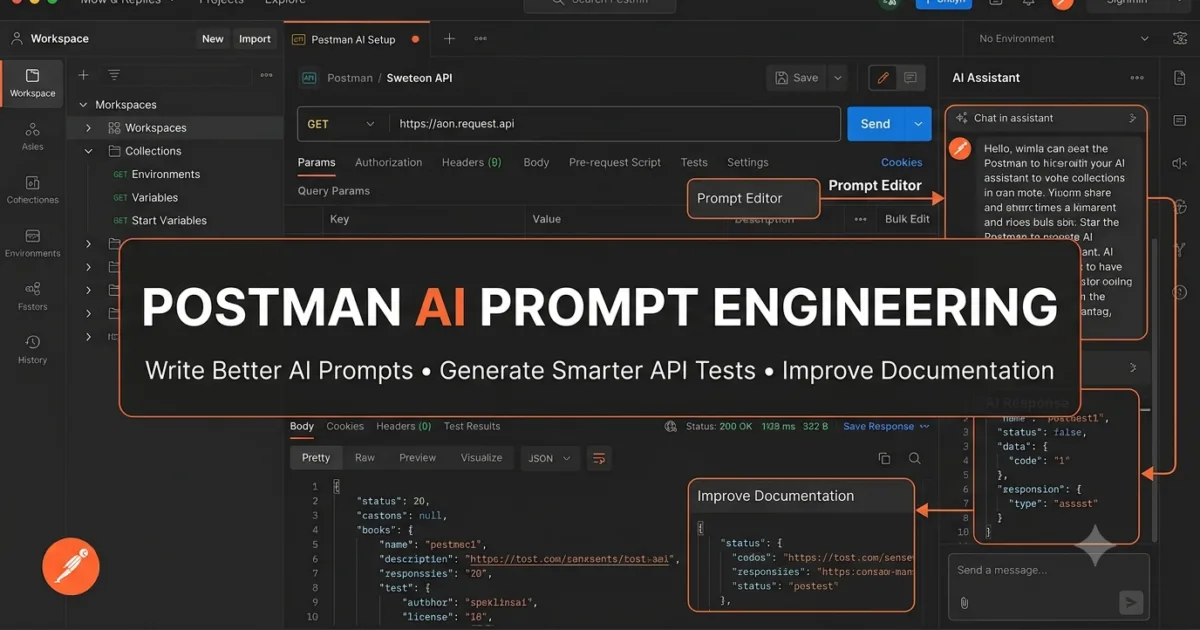
Postman AI Prompt Engineering is the skill of writing clear, structured, and context-rich prompts that help Postman AI generate accurate API documentation, meaningful test cases, better debugging suggestions, and reliable automation guidance. Learning Postman AI Prompt Engineering is one of the biggest productivity upgrades for modern QA engineers, SDETs, backend developers, and API engineers because the quality of AI-generated results depends heavily on the quality of the instructions you provide.
Many engineers believe AI produces inconsistent answers. In reality, the same AI model can generate dramatically different responses depending on how a question is asked. A vague request often leads to a generic answer, while a well-designed prompt produces detailed, structured, and actionable output.
Throughout this lesson, you’ll learn how Postman AI Prompt Engineering works, why it matters, how to write prompts that consistently deliver high-quality results, and how to avoid common mistakes that reduce AI accuracy. By the end of Day 3, you’ll be able to communicate with Postman AI like an experienced engineer instead of treating it like a basic chatbot.
Why Postman AI Prompt Engineering Matters
Artificial intelligence has transformed the way developers interact with APIs, but AI doesn’t automatically know what you’re trying to achieve.
Imagine asking two different engineers the same question.
The first engineer receives this request:
Explain this API.
The second engineer receives:
Explain this REST API endpoint from the perspective of a QA engineer. Describe its business purpose, authentication method, request parameters, response structure, expected HTTP status codes, validation rules, negative scenarios, edge cases, and security considerations.
Which engineer is more likely to produce a complete answer?
The second request provides context, expectations, and direction. Postman AI Prompt Engineering follows exactly the same principle. Better prompts reduce ambiguity, improve response quality, and minimize unnecessary follow-up questions.
Professional engineers don’t rely on AI to guess what they need. Instead, they guide the AI with carefully structured instructions.
What Is Postman AI Prompt Engineering?
Postman AI Prompt Engineering is the process of designing prompts that enable Postman AI to understand your objective, interpret the surrounding API context, and generate responses that are accurate, relevant, and useful.
A prompt is much more than a simple question.
It can be:
- A request for API documentation
- A request for test generation
- A debugging instruction
- A security review
- A JSON explanation
- A request for JavaScript code
- A request for validation rules
- A request for performance recommendations
- A request for automation guidance
Every interaction with Postman AI begins with a prompt, making prompt engineering one of the most valuable skills you’ll develop throughout this series.
How Postman AI Processes Your Prompt
When you submit a prompt, Postman AI evaluates more than just the words you’ve typed.
It also considers the surrounding API context.
Your Prompt
      │
      ▼
Current Request
      │
      ▼
Headers & Authentication
      │
      ▼
Request Body
      │
      ▼
Response Payload
      │
      ▼
Workspace Context
      │
      ▼
Postman AI Analysis
      │
      ▼
Generated Response
Recommended Diagram 1
Title: How Postman AI Processes a Prompt
ALT Text: Postman AI Prompt Engineering workflow showing how prompts are analyzed using API requests, responses, authentication, and workspace context.
Because Postman AI evaluates multiple sources of information, providing better instructions significantly improves the quality of its recommendations.
Why Good Prompts Produce Better Results
Consider these two examples.
Example 1 — Poor Prompt
Explain this API.
This prompt gives almost no information.
Questions immediately arise.
- Which endpoint?
- Which audience?
- What level of detail?
- What should be explained?
AI must make assumptions.
Example 2 — Better Prompt
Explain this REST API endpoint for a QA engineer.

Include:

- Business purpose
- Request parameters
- Required headers
- Authentication
- Response fields
- HTTP status codes
- Validation ideas
- Negative scenarios
- Security considerations
Notice that the second prompt clearly communicates:
- Audience
- Objective
- Scope
- Expected output
This is the foundation of effective Postman AI Prompt Engineering.
The Five Building Blocks of Excellent Prompts
Every professional prompt generally contains five components.
Objective
      │
      ▼
Context
      │
      ▼
Instructions
      │
      ▼
Expected Output
      │
      ▼
Constraints
Recommended Diagram 2
Title: Five Components of Postman AI Prompt Engineering
ALT Text: Postman AI Prompt Engineering framework showing objective, context, instructions, expected output, and constraints.
Let’s understand each component.
1. Objective
Always begin by stating what you want AI to accomplish.
Examples include:
- Explain an endpoint.
- Generate API documentation.
- Review authentication.
- Create test cases.
- Identify risks.
- Suggest improvements.
Without a clear objective, AI has to infer your intent, which often leads to incomplete answers.
2. Context
Context provides background information that helps AI understand your request.
For example:
- This API belongs to an online banking platform.
- This endpoint creates customer accounts.
- OAuth 2.0 is used for authentication.
- The response represents successful order creation.
The richer the context, the more relevant the AI’s response becomes.
3. Instructions
Tell AI exactly what you need.
Instead of writing:
Explain everything.
Write:
Explain:

- Request parameters
- Response body
- Status codes
- Validation rules
- Security risks
Specific instructions reduce ambiguity and improve consistency.
4. Expected Output
Define the format you want.
Examples:
- Table
- Bullet points
- Step-by-step explanation
- Beginner-friendly language
- Technical documentation
- Markdown
- JSON
Formatting expectations help AI organize information more effectively.
5. Constraints
Constraints prevent unnecessary information.
Examples include:
- Keep the explanation under 300 words.
- Focus only on REST APIs.
- Avoid JavaScript examples.
- Explain for beginners.
- Include practical examples.
Good constraints keep AI focused on your actual goal.
Common Prompt Engineering Mistakes
Even experienced developers sometimes struggle because they unknowingly create weak prompts.
The most common mistakes include:
Being Too Generic
Example:
Generate tests.
The AI doesn’t know:
- Which API?
- Which endpoint?
- Positive tests?
- Negative tests?
- Security tests?
Generic prompts almost always produce generic answers.
Missing Business Context
AI performs much better when it understands the business domain.
Instead of:
Explain this endpoint.
Provide additional information.
This endpoint creates insurance claims.

Explain the workflow and identify possible validation scenarios.
Business context allows AI to produce recommendations that align more closely with real-world requirements.
Asking Too Many Questions at Once
Avoid prompts like:
Explain the endpoint, generate documentation, create automation scripts, identify security issues, write assertions, and suggest performance improvements.
This often leads to incomplete or shallow answers.
Instead, divide the task into smaller conversations.
Think Like a QA Engineer
A professional QA engineer doesn’t ask AI to replace critical thinking.
Instead, AI becomes a collaborative assistant.
Rather than saying:
Generate test cases.
Ask:
Generate positive, negative, boundary, and security test cases for this endpoint. Explain why each scenario is important and identify any business risks that should be validated manually.
Notice the difference.
The second prompt doesn’t simply request answers—it requests reasoning.
Understanding the reasoning behind recommendations helps you become a stronger engineer rather than simply copying AI-generated content.
Hands-on Lab
Let’s begin practicing Postman AI Prompt Engineering using your Learning API Collection from Day 2.
Open the Get Users request and ask Postman AI:
Explain this endpoint in beginner-friendly language.
Next, refine the prompt:
Explain this endpoint from the perspective of a QA engineer.

Include:

- Business purpose
- Request parameters
- Response fields
- Validation ideas
- Possible HTTP status codes
Compare both responses.
Observe how additional context changes the quality, depth, and structure of the AI-generated output.
Assignment
Choose any endpoint from your Learning API Collection and write three versions of a prompt.
- A basic prompt using one sentence.
- An improved prompt that includes context and expected output.
- A professional prompt that includes objective, context, detailed instructions, output format, and constraints.
Execute each prompt using Postman AI and compare the responses.
Create a short document describing:
- Which prompt produced the most useful answer?
- What additional information did the improved prompt reveal?
- Which prompt required the fewest follow-up questions?
This exercise will help you experience firsthand why Postman AI Prompt Engineering is one of the most valuable skills for modern API development and testing.
Designing Professional Prompts for Real-World API Development
The fundamentals of Postman AI Prompt Engineering provide a solid foundation, but real productivity comes from applying those principles to everyday development and testing tasks. Professional engineers rarely ask AI random questions. Instead, they create structured prompts that can be reused across projects, teams, and APIs.
A well-designed prompt saves time, improves consistency, reduces repetitive work, and produces responses that are easier to validate. Whether you’re reviewing a new API, preparing documentation, generating test cases, or debugging an unexpected response, the way you communicate with Postman AI directly affects the quality of the output.
Rather than creating every prompt from scratch, experienced engineers develop reusable prompt patterns that can be adapted for different scenarios.
The Professional Prompt Framework
A prompt should guide AI through a logical thought process instead of expecting it to guess your requirements.
The following framework works well for most API-related tasks.
Role
      │
      ▼
Objective
      │
      ▼
Context
      │
      ▼
Task
      │
      ▼
Output Format
      │
      ▼
Constraints
Recommended Diagram 3
Title: Professional Postman AI Prompt Engineering Framework
ALT Text: Postman AI Prompt Engineering framework illustrating role, objective, context, task, output format, and constraints.
This structure gives AI enough information to understand not only what you want, but also how you want the answer presented.
Step 1: Assign a Role
One of the simplest ways to improve Postman AI Prompt Engineering is by assigning AI a specific role.
Instead of asking a generic question, define the perspective AI should adopt.
Examples include:
- Senior QA Engineer
- API Architect
- Backend Developer
- Security Engineer
- Technical Writer
- DevOps Engineer
- Performance Testing Expert
Generic Prompt
Explain this API.
Improved Prompt
Act as a Senior QA Engineer.

Explain this REST API endpoint and identify functional risks,
validation rules, and negative testing opportunities.
Giving AI a role immediately influences the depth and style of the response.
Step 2: Define a Clear Objective
Every prompt should have a single primary objective.
Poor example:
Analyze this API.
Better example:
Review this endpoint and generate functional test scenarios.
Excellent example:
Review this endpoint and generate:

- Positive test cases
- Negative test cases
- Boundary value scenarios
- Error handling validations
- Security-related checks
A focused objective keeps AI aligned with your expectations.
Step 3: Provide Context
Context is one of the most important aspects of Postman AI Prompt Engineering.
Suppose you’re testing an online banking API.
Instead of writing:
Generate tests.
Provide useful context.
This endpoint transfers money between customer accounts.

Authentication uses OAuth 2.0.

The endpoint is business critical.

Suggest validation scenarios that could prevent financial errors.
Context allows AI to understand the business impact of the endpoint.
Step 4: Describe the Task Clearly
Avoid broad requests.
Instead of:
Help me.
Use structured instructions.
Review this API and identify:

- Missing validations
- Invalid input scenarios
- Security concerns
- Performance considerations
- Documentation improvements
Breaking large requests into smaller tasks improves accuracy.
Step 5: Define the Output Format
One of the biggest advantages of Postman AI Prompt Engineering is controlling how information is returned.
Possible formats include:
- Tables
- Markdown
- Bullet points
- JSON
- Checklists
- Step-by-step explanations
- Decision trees
- Technical documentation
Example:
Return the answer as a markdown table with three columns:

Scenario
Reason
Expected Result
The same information becomes much easier to review.
Step 6: Add Constraints
Constraints help eliminate unnecessary responses.
Examples include:
- Maximum 250 words
- Explain for beginners
- Focus only on REST APIs
- Do not generate code
- Use JavaScript examples only
- Avoid assumptions
- Mention security considerations
The more precise the constraints, the more focused the answer becomes.
Building Your First Reusable Prompt Template
Professional teams rarely create prompts from scratch.
Instead, they maintain reusable templates.
Example:
Role:
Senior QA Engineer

Objective:
Review the API endpoint.

Context:
This endpoint belongs to an e-commerce application.

Task:
Generate functional, negative,
boundary, and security test cases.

Output:
Markdown table.

Constraints:
Keep explanations concise.
Avoid duplicate scenarios.
This template can be reused across dozens of API endpoints.
Using Postman AI Prompt Engineering for API Documentation
Documentation is one of the most common AI-assisted tasks.
Example prompt:
Act as a Technical Writer.

Explain this endpoint.

Include:

Business purpose

Request method

Headers

Authentication

Request body

Response body

Status codes

Error responses

Example request

Example response

Best practices
This produces documentation that is easier to refine than starting from a blank page.
Using Postman AI Prompt Engineering for Test Case Generation
Instead of asking AI to “generate tests,” guide it with specific expectations.
Example:
Act as a QA Engineer.

Generate:

10 positive scenarios

10 negative scenarios

Boundary tests

Invalid data tests

Security tests

Rate each scenario by risk.

Present everything as a table.
Notice how this prompt defines both the quantity and structure of the expected output.
Using Postman AI Prompt Engineering for Debugging
Debugging prompts should include sufficient technical context.
Example:
Act as a Backend Engineer.

This request returns HTTP 500.

Authentication succeeds.

Headers are correct.

Review the request and identify
possible root causes.

Rank each cause by probability.
Providing existing observations helps AI narrow its analysis instead of guessing.
Prompt Chaining
Professional engineers rarely expect one prompt to solve everything.
Instead, they use a technique known as prompt chaining.
Prompt 1
Understand API

      │
      ▼

Prompt 2
Generate Documentation

      │
      ▼

Prompt 3
Generate Test Cases

      │
      ▼

Prompt 4
Review Security

      │
      ▼

Prompt 5
Generate Automation Ideas
Recommended Diagram 4
Title: Postman AI Prompt Engineering Chain
ALT Text: Postman AI Prompt Engineering workflow showing sequential prompts for API understanding, documentation, testing, security analysis, and automation.
Breaking complex work into smaller prompts often produces higher-quality results than asking AI to perform multiple unrelated tasks in a single request.
Common Mistakes When Designing Prompts
Avoid these frequent errors:
- Combining multiple objectives into one prompt.
- Omitting business context.
- Not specifying the audience.
- Forgetting to define the output format.
- Expecting AI to infer missing requirements.
- Accepting AI-generated answers without validation.
- Ignoring edge cases and security considerations.
Recognizing these mistakes early will significantly improve your productivity with Postman AI.
Hands-on Lab
Open one endpoint from your collection and create three versions of the same prompt:
- A simple one-line prompt.
- A structured prompt using the Professional Prompt Framework.
- A role-based prompt with context, task, output format, and constraints.
Compare the AI responses by evaluating:
- Completeness
- Accuracy
- Readability
- Actionability
- Relevance to API testing
Document your findings and identify which version provides the greatest value.
Assignment
Create a personal Postman AI Prompt Engineering library containing reusable prompts for:
- API documentation
- Functional testing
- Negative testing
- Boundary testing
- Security review
- Performance considerations
- Debugging
- Automation planning
Store these prompts in a dedicated collection or document. As this series progresses, you’ll continue expanding this library into a practical toolkit that can be reused across future API projects, reducing repetitive work while improving the quality and consistency of AI-assisted development.
Advanced Postman AI Prompt Engineering Techniques for Better API Results
Once you’ve learned the fundamentals of Postman AI Prompt Engineering, the next step is improving the quality of AI responses through advanced prompting strategies. Professional developers rarely rely on a single question. Instead, they continuously refine prompts, provide additional context, and guide AI toward a specific outcome.
Think of AI as a highly knowledgeable teammate who has just joined your project. The more information you provide about the project, business domain, technical requirements, and expected output, the more valuable the collaboration becomes.
Mastering these advanced techniques helps you reduce repetitive work, improve response quality, and create prompts that remain useful across multiple projects.
Context Layering in Postman AI Prompt Engineering
One of the biggest reasons AI produces generic answers is the lack of context.
Instead of providing all information in a single sentence, experienced engineers build context layer by layer.
Business Domain
        │
        ▼
Application Overview
        │
        ▼
API Purpose
        │
        ▼
Endpoint Details
        │
        ▼
Technical Requirements
        │
        ▼
Expected Output
Recommended Diagram 5
Title: Context Layering in Postman AI Prompt Engineering
ALT Text: Postman AI Prompt Engineering context layering process showing business domain, application overview, endpoint details, technical requirements, and expected output.
Poor Example
Generate API tests.
Better Example
This API belongs to an online food delivery platform.

The endpoint creates a new customer order.

Authentication uses JWT.

Generate functional, negative, and security test cases.
Professional Example
Act as a Senior QA Engineer.

The API belongs to a food delivery platform serving multiple cities.

The endpoint creates customer orders.

Authentication uses JWT.

Orders may contain promotional discounts and multiple payment methods.

Generate:

• Functional scenarios
• Boundary scenarios
• Invalid data tests
• Security validations
• Business rule validations
• High-risk scenarios

Present the output as a markdown table.
Notice how every layer adds more useful information for AI to analyze.
Few-Shot Prompting
Few-shot prompting is a technique where you provide AI with one or more examples before asking it to perform a similar task.
Instead of only describing what you want, you demonstrate it.
Example:
Example

Input:
GET /users

Output:
Validate response status
Validate response time
Validate response schema

Now generate similar validations for:

POST /orders
Providing examples significantly improves consistency.
Chain-of-Thought Prompting
Some engineering problems require reasoning rather than direct answers.
Instead of asking:
Why did this API fail?
Guide AI through a structured thought process.
Review this API request step by step.

Analyze:

Authentication

Headers

Parameters

Request Body

Business Rules

Response

Possible Root Causes

Recommend the most likely issue first.
This encourages AI to examine the request systematically instead of jumping to conclusions.
Role-Based Prompt Engineering
One endpoint can be viewed differently depending on the role.
Instead of always using the same prompt, assign different perspectives.
Examples include:
- QA Engineer
- Backend Developer
- API Architect
- Security Engineer
- Technical Writer
- Product Owner
- DevOps Engineer
Example
Act as a Security Engineer.

Review this authentication endpoint.

Identify:

Authentication weaknesses

Rate limiting concerns

Token handling risks

Possible attack vectors

OWASP API Security considerations.
Changing the assigned role often reveals insights that another perspective might overlook.
Iterative Prompt Engineering
Rarely is the first prompt the final one.
Professional engineers improve prompts continuously.
Prompt 1

Understand API

        │
        ▼

Prompt 2

Explain Business Logic

        │
        ▼

Prompt 3

Generate Test Cases

        │
        ▼

Prompt 4

Generate Assertions

        │
        ▼

Prompt 5

Review Security

        │
        ▼

Prompt 6

Suggest Automation Improvements
Recommended Diagram 6
Title: Iterative Postman AI Prompt Engineering Workflow
ALT Text: Postman AI Prompt Engineering iterative workflow showing prompt refinement from API understanding to automation improvements.
Breaking complex work into multiple prompts usually produces far better results than requesting everything at once.
Prompt Engineering for API Documentation
One of the biggest productivity gains comes from documentation generation.
Example:
Act as a Technical Writer.

Generate complete documentation for this endpoint.

Include:

Business Overview

Endpoint Purpose

HTTP Method

URL

Authentication

Headers

Parameters

Request Body

Response Body

Example Request

Example Response

Status Codes

Possible Errors

Limitations

Best Practices
The result is often a strong first draft that can be reviewed and refined.
Prompt Engineering for API Testing
Instead of requesting generic tests, guide AI toward different testing categories.
Generate:

Positive Tests

Negative Tests

Boundary Tests

Invalid Input Tests

Performance Considerations

Security Tests

Regression Tests

Smoke Tests

Prioritize each scenario based on business risk.
This produces a much more structured testing strategy.
Prompt Engineering for Debugging
Debugging becomes easier when AI receives complete technical information.
Example:
This POST request returns HTTP 400.

Headers are correct.

Authentication succeeds.

The payload contains nested JSON objects.

Review the request.

Identify possible validation failures.

Suggest debugging steps.

Recommend logging improvements.
Providing observed behavior allows AI to focus on realistic troubleshooting paths.
Prompt Engineering for API Security Reviews
Security reviews benefit greatly from structured prompts.
Example:
Act as an API Security Engineer.

Review this authentication endpoint.

Identify:

Injection risks

Broken Authentication

Authorization issues

Sensitive Data Exposure

Rate Limiting Problems

Input Validation Issues

Map observations to the OWASP API Security Top 10 where applicable.
This creates more focused security recommendations than a generic security request.
Prompt Engineering for Automation Planning
AI can also assist with automation planning.
Example:
Review this endpoint.

Recommend:

Automation Priority

Regression Coverage

Reusable Test Data

Assertions

Environment Variables

Mock Data

CI/CD Integration Opportunities
This helps teams think beyond individual test cases.
Common Advanced Prompt Engineering Mistakes
Even experienced engineers make avoidable mistakes.
Examples include:
- Adding unnecessary background information.
- Mixing multiple unrelated objectives.
- Using ambiguous terminology.
- Forgetting to define the expected output.
- Ignoring business requirements.
- Trusting AI responses without verification.
- Assuming AI understands undocumented project conventions.
The goal of Postman AI Prompt Engineering is not simply asking better questions—it is designing conversations that consistently produce reliable engineering outcomes.
Hands-on Lab
Choose an endpoint from your Postman collection and create four versions of a prompt:
- Basic prompt.
- Context-rich prompt.
- Role-based prompt.
- Professional prompt using the complete framework.
Compare each AI response based on:
- Accuracy
- Completeness
- Readability
- Testing recommendations
- Security observations
- Documentation quality
Record your findings and identify which prompting strategy provides the highest-quality output.
Assignment
Create a reusable Postman AI Prompt Engineering playbook containing templates for:
- API exploration
- API documentation
- Functional testing
- Negative testing
- Boundary testing
- Security reviews
- Debugging
- Automation planning
- Performance analysis
Organize the templates into categories and save them in a shared document or repository. This prompt library will continue to grow throughout the series and become a valuable resource for real-world API development, testing, and collaboration.
Real-World Applications of Postman AI Prompt Engineering
Learning the theory behind Postman AI Prompt Engineering is only the beginning. The real value comes from applying these techniques to everyday software engineering tasks. Whether you’re building APIs, testing integrations, documenting endpoints, or investigating production issues, Postman AI Prompt Engineering can significantly improve productivity while helping you make better engineering decisions.
Remember an important principle throughout this series:
AI accelerates engineering. It does not replace engineering.
Postman AI should be viewed as an intelligent assistant that helps you think faster, discover overlooked scenarios, and reduce repetitive work. Every recommendation should still be reviewed using engineering knowledge and business requirements.
Applying Postman AI Prompt Engineering Throughout the API Lifecycle
A modern API passes through multiple stages before reaching production.
Business Requirements
          │
          ▼
API Design
          │
          ▼
API Development
          │
          ▼
API Documentation
          │
          ▼
API Testing
          │
          ▼
Bug Fixing
          │
          ▼
Automation
          │
          ▼
CI/CD
          │
          ▼
Production Monitoring
Recommended Diagram 7
Title: Postman AI Prompt Engineering Across the API Lifecycle
Image ALT Text
Postman AI Prompt Engineering across the complete API development lifecycle from design to production monitoring
Every stage benefits from well-designed prompts.
Instead of asking AI random questions, engineers should create prompts that support the current phase of development.
Using Postman AI Prompt Engineering During API Design
Before a single endpoint is implemented, Postman AI Prompt Engineering can help evaluate the overall API design.
Example prompt:
Act as an API Architect.

Review the following API specification.

Identify:

• Naming inconsistencies
• Missing endpoints
• Resource hierarchy improvements
• Versioning recommendations
• REST design violations
• Scalability concerns

Present recommendations in priority order.
This approach encourages architectural thinking before development begins.
Using Postman AI Prompt Engineering During Development
Backend developers frequently need quick explanations, implementation guidance, and validation ideas.
Example:
Act as a Senior Backend Developer.

Review this endpoint.

Explain:

• Request validation
• Business rules
• Response structure
• Error handling
• Common implementation mistakes

Provide recommendations for improving maintainability.
Instead of generating code immediately, AI first explains the reasoning behind implementation decisions.
Using Postman AI Prompt Engineering for API Documentation
Maintaining documentation is often one of the most time-consuming tasks.
Professional prompts can generate a high-quality first draft.
Act as a Technical Writer.

Generate documentation for this endpoint.

Include:

• Business purpose
• HTTP method
• URL
• Authentication
• Required headers
• Parameters
• Request body
• Response body
• Status codes
• Example request
• Example response
• Known limitations
• Best practices
The generated documentation should always be reviewed before publication.
Using Postman AI Prompt Engineering for Functional Testing
Testing is where Postman AI Prompt Engineering becomes especially valuable.
Instead of requesting generic test cases, encourage AI to think from multiple perspectives.
Act as a Senior QA Engineer.

Generate:

• Functional scenarios
• Negative scenarios
• Boundary value tests
• Invalid input tests
• Business rule validations
• Error handling tests

Rank each scenario by business risk.
This produces more meaningful test coverage than a simple request for “test cases.”
Using Postman AI Prompt Engineering for Security Analysis
Security should never be an afterthought.
Example prompt:
Act as an API Security Engineer.

Review this authentication endpoint.

Identify:

• Broken Authentication
• Authorization issues
• Injection risks
• Sensitive data exposure
• Input validation weaknesses
• Rate limiting concerns

Relate findings to the OWASP API Security Top 10 where appropriate.
AI-generated recommendations can help teams discover security considerations earlier in the development lifecycle.
Using Postman AI Prompt Engineering for Performance Reviews
Performance issues are often difficult to identify during initial development.
Example:
Review this endpoint.

Suggest:

• Response optimization
• Payload reduction
• Database optimization ideas
• Caching opportunities
• Pagination improvements
• Compression recommendations
These prompts encourage engineers to think about scalability before production traffic increases.
Using Postman AI Prompt Engineering During Debugging
Debugging becomes far more effective when prompts include technical observations.
Instead of asking:
Why is this failing?
Use:
This request returns HTTP 500.

Authentication succeeds.

Headers are valid.

Database connectivity is confirmed.

Review the request.

Identify the three most likely root causes.

Recommend debugging steps in priority order.
Providing evidence helps AI narrow its analysis.
Using Postman AI Prompt Engineering for Automation Planning
Automation planning requires more than writing assertions.
Example:
Act as an Automation Engineer.

Review this endpoint.

Recommend:

• Test priority
• Automation feasibility
• Assertions
• Reusable test data
• Environment variables
• Mocking opportunities
• CI/CD integration strategy
This produces a broader automation strategy instead of isolated test scripts.
Evaluating AI Responses Critically
One of the most important responsibilities of an engineer is validating AI-generated information.
Never assume an answer is correct simply because it appears confident.
Review every recommendation by asking:
- Does this align with the API specification?
- Does it satisfy business requirements?
- Are security considerations complete?
- Have important edge cases been overlooked?
- Is the suggested solution practical?
- Would this approach scale in production?
Critical thinking remains the engineer’s greatest strength.
Best Practices for Postman AI Prompt Engineering
As you continue building your prompt library, follow these practices consistently.
- Define one objective per prompt.
- Assign a clear engineering role.
- Provide business and technical context.
- Specify the expected output format.
- Add realistic constraints.
- Break large tasks into smaller prompts.
- Review every AI-generated response.
- Validate recommendations against documentation.
- Refine prompts based on previous conversations.
- Save successful prompts for future reuse.
These habits improve both productivity and consistency.
Common Mistakes to Avoid
Avoid the following mistakes when practicing Postman AI Prompt Engineering.
- Asking multiple unrelated questions in one prompt.
- Omitting business context.
- Ignoring API documentation.
- Expecting AI to know undocumented project rules.
- Accepting generated code without review.
- Forgetting security validation.
- Using vague language.
- Not specifying the desired output format.
- Treating AI as a replacement for engineering judgment.
Recognizing these mistakes early will help you become a more effective AI-assisted developer.
Hands-on Lab
Choose three different endpoints from your learning collection.
For each endpoint:
- Create a documentation prompt.
- Create a testing prompt.
- Create a debugging prompt.
- Create a security review prompt.
- Create an automation planning prompt.
Compare the responses.
Evaluate:
- Accuracy
- Completeness
- Technical depth
- Readability
- Practical usefulness
Record which prompt style consistently produces the best engineering outcomes.
Assignment
Create your own Postman AI Prompt Engineering Library.
Organize prompts into the following categories:
- API Exploration
- API Documentation
- Functional Testing
- Negative Testing
- Boundary Testing
- Security Reviews
- Performance Analysis
- Debugging
- Automation Planning
- API Design Reviews
For each prompt, document:
- Objective
- Target audience
- Expected output
- Constraints
- Example response
- Improvements made after refinement
By the end of this exercise, you should have a reusable prompt library that can support future API projects, improve collaboration across teams, and reduce repetitive work. This library will continue expanding throughout the remaining lessons of the Postman AI Zero to Hero series and become one of your most valuable engineering assets.
Conclusion
Postman AI Prompt Engineering is much more than learning how to ask better questions. It is a disciplined approach to communicating with AI so that it produces accurate, structured, and valuable engineering insights. Throughout Day 3, you learned how prompt quality influences AI responses, how to design reusable prompt frameworks, how to apply prompting techniques across documentation, testing, debugging, security, and automation, and why human validation remains essential.
With a strong understanding of Postman AI Prompt Engineering, you are now prepared to use Postman AI more effectively in real-world projects. In Day 4, you’ll build on these skills by learning Postman AI API Testing, where you’ll explore how AI can help design comprehensive API testing strategies, generate high-quality validation scenarios, and improve test coverage while maintaining engineering best practices.
Internal Links:
- Learn MCP – Zero to Hero
- Learn AI Agents for QA – Zero to Hero
- Playwright Automation – Zero to Hero
- LangGraph: Complete Zero to Hero
- Learn Python – Zero to Hero
- OpenAI Codex: Complete Zero to Hero
- Cursor AI: Complete Zero to Hero
- Claude Code Tutorial: Complete Zero to Hero
- Free QA Resources Built From Real Experience
- QA Glossary: Test Automation Terms Every Engineer Should Know
External Resources:
- Postman Official Documentation: https://learning.postman.com/docs
- Postman Learning Center: https://learning.postman.com
- Postman AI Documentation: https://learning.postman.com/docs/postman-ai/postman-ai-overview
- OpenAPI Specification: https://spec.openapis.org/oas/latest.html
- HTTP Semantics (IETF RFC 9110): https://www.rfc-editor.org/rfc/rfc9110
- OWASP API Security Top 10: https://owasp.org/API-Security
People Asked Questions
What is Postman AI Prompt Engineering?
Postman AI Prompt Engineering is the practice of designing structured prompts that help Postman AI generate accurate documentation, API testing ideas, debugging guidance, automation suggestions, and technical explanations.
Why is prompt engineering important for API development?
Effective prompts reduce ambiguity, improve response quality, generate more relevant API insights, and save developers significant time during testing and documentation.
Can beginners learn Postman AI Prompt Engineering?
Yes. Beginners can start with simple prompts and gradually build reusable prompt templates by adding context, objectives, constraints, and expected output formats.
Does Postman AI replace QA engineers?
No. Postman AI assists QA engineers by accelerating repetitive tasks and providing suggestions, but engineers remain responsible for validating outputs and making technical decisions.
What makes a good AI prompt?
A good prompt includes:
- Clear objective
- Relevant context
- Specific task
- Desired output format
- Practical constraints
Can Postman AI generate API test cases?
Yes. Well-designed prompts enable Postman AI to generate functional, negative, boundary, security, and exploratory test scenarios.
How can I improve AI responses?
Improve responses by providing business context, assigning a role, defining expected output, limiting scope, and refining prompts based on previous results.
Should AI-generated responses always be trusted?
No. AI-generated responses should always be reviewed, validated, and compared against API documentation, business rules, and engineering best practices.
Enjoyed this article? Explore more in-depth guides on AI engineering, automation testing, Model Context Protocol, Playwright, and intelligent software quality at www.skakarh.com. Follow QAPulse by SK for practical, production-focused tutorials designed for QA engineers, SDETs, and AI developers.