 QA
QA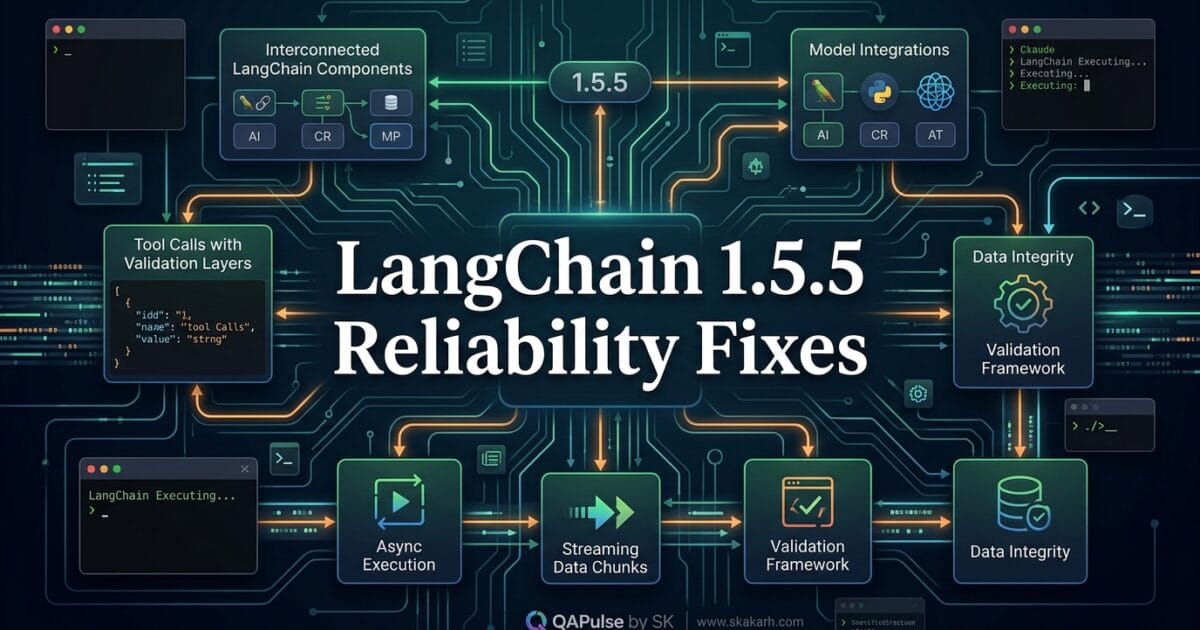
LangChain 1.5.5 is a focused patch release, but the changes are more meaningful than a simple version-number bump. Released on August 14, 2026, this update concentrates on the reliability layer of LangChain Core: asynchronous batching, tool-input validation, streaming chunk merging, model validation, callbacks, caching, prompt values, tool-call examples, and malformed provider content.
For teams building production AI applications, those areas matter because failures in orchestration infrastructure rarely appear as obvious application crashes. A tool may receive incorrectly validated arguments. An async execution path may behave differently from its synchronous equivalent. Streaming output may be merged incorrectly. A callback may retain stale usage metadata after an exception. These are exactly the kinds of issues that can produce intermittent failures that are difficult to reproduce.
The official LangChain release process also distinguishes patch releases from feature and major releases. Within the 1.x line, public API breaking changes are reserved for major releases, while patch releases are intended primarily for bug fixes and smaller improvements.
For engineering teams, that makes LangChain 1.5.5 interesting for a different reason: the release improves the reliability of the machinery underneath an AI application rather than introducing one headline feature.
What Changed in LangChain 1.5.5?
The LangChain 1.5.5 changes are concentrated in langchain-core==1.5.5.
The release includes fixes for:
abatch_iterate()consistency withbatch_iterate()- Pydantic aliases during tool-input validation
- merging streamed chunks
- Pydantic v1 models in asynchronous execution
- tool descriptions when
infer_schema=False - usage metadata callbacks after exceptions
- falsy LLM and chat-model caches
- an explicit
httpxdependency - non-string and non-dictionary values in
DictPromptTemplate - mismatched tool-output lengths
- malformed Anthropic content blocks
That list looks like maintenance work at first glance.
From an engineering perspective, however, it maps directly to several critical layers:
| Change area | Potential production impact | What to test |
|---|---|---|
| Async batching | Different behavior between sync and async execution | Batch size, empty input, zero-size input |
| Tool validation | Incorrect or rejected tool arguments | Aliases, optional fields, invalid payloads |
| Chunk merging | Corrupted or incomplete streamed responses | Multi-chunk streaming |
| Pydantic compatibility | Async validation failures | v1 model schemas |
| Tool descriptions | Incomplete tool metadata | infer_schema=False |
| Callback metadata | Incorrect observability | Exception and retry paths |
| Model caching | Unnecessary model recreation | Falsy cache values |
| HTTPX dependency | Environment-specific import failures | Clean environment installation |
| Prompt templates | Unexpected prompt values | Lists containing mixed types |
| Tool outputs | Agent execution inconsistencies | Multiple tool calls and outputs |
| Provider content | Parsing failures | Malformed Anthropic blocks |
This is why a patch release deserves engineering attention even when it does not introduce a flashy new API.
Why the Async Batching Fix Matters
One of the most practical changes in LangChain 1.5.5 is the fix making abatch_iterate() consistent with batch_iterate() for None and zero-size inputs.
This sounds small until you consider how modern AI applications execute workloads.
A typical application may process:
results = await chain.abatch(
    requests,
    config={"max_concurrency": 10}
)
Now imagine that the input is dynamically generated:
requests = load_pending_requests()

if not requests:
    results = await chain.abatch(requests)
Empty workloads are not unusual in production.
They happen because:
- a queue was already drained
- a database query returned no records
- a previous stage filtered everything
- an API returned an empty collection
- a scheduled job had nothing to process
A robust orchestration framework should behave predictably in these situations.
What should you test?
Instead of testing only the happy path:
async def test_batch():
    result = await chain.abatch(["A", "B", "C"])
    assert len(result) == 3
add boundary cases:
import pytest

@pytest.mark.asyncio
async def test_empty_batch():
    result = await chain.abatch([])
    assert result == []


@pytest.mark.asyncio
async def test_single_item_batch():
    result = await chain.abatch(["A"])
    assert len(result) == 1
This is an important testing principle for AI systems:
Test the orchestration boundaries, not only the model response.
A model can produce a perfectly valid answer while the surrounding workflow still has a correctness defect.


Tool Validation Gets More Reliable
Another important fix addresses Pydantic aliases when validating tool inputs.
Tool calling is one of the most failure-sensitive parts of an agentic application.
Consider a tool with a Python field:
from pydantic import BaseModel, Field

class SearchInput(BaseModel):
    search_query: str = Field(alias="query")
A model may produce:
{
  "query": "LangChain release notes"
}
while the Python application internally works with:
search_queryThat distinction matters.
If validation does not correctly respect aliases, a tool can fail even though the model generated what appears to be a valid payload.
For a simple chatbot, that might be annoying.
For an agent executing multiple tools, it can become an orchestration failure.
A practical tool-validation test
Instead of checking only that a tool executes, explicitly test both the internal field name and the external alias:
def test_tool_alias_validation():
    payload = {
        "query": "LangChain 1.5.5"
    }

    data = SearchInput.model_validate(payload)

    assert data.search_query == "LangChain 1.5.5"
Then test invalid input:
def test_tool_invalid_input():
    payload = {
        "query": 12345
    }

    try:
        SearchInput.model_validate(payload)
        assert False, "Expected validation failure"
    except Exception:
        assert True
The strategic lesson is bigger than this particular fix.
Agent testing should validate the contract between the model and the tool.
That means testing:
LLM output
   ↓
Tool-call arguments
   ↓
Schema validation
   ↓
Tool execution
   ↓
Tool result
   ↓
Agent continuation
Do not treat the entire sequence as one black box.
LangChain 1.5.5 and Streaming Reliability
The release also fixes issues in merging chunks.
This matters because modern AI applications increasingly stream responses rather than waiting for a complete response.
A streaming response can arrive conceptually like this:
"Lang"
"Chain "
"1.5.5 "
"improves "
"core reliability."
The application eventually needs:
LangChain 1.5.5 improves core reliability.The merging layer therefore becomes part of the correctness boundary.
A streaming test should verify both the individual chunks and the final assembled result:
chunks = []

for chunk in chain.stream("Explain LangChain"):
    chunks.append(chunk)

final_output = merge_chunks(chunks)

assert final_output
assert "LangChain" in final_output
For production systems, go further.
Test:
- empty chunks
- consecutive chunks
- metadata-bearing chunks
- tool-call chunks
- partial content
- provider-specific content blocks
- interrupted streams
- final chunks containing usage information
This is particularly important when your application uses streaming UI, agent traces, or real-time automation.
Comparing LangChain 1.5.5 With Other AI Framework Layers
It is useful to distinguish what LangChain is solving from what frameworks such as LangGraph or direct model SDKs solve.
| Capability | LangChain Core | LangGraph | Direct model SDK |
|---|---|---|---|
| Model abstraction | Strong | Uses model integrations | Provider-specific |
| Tool schemas | Strong | Strong through nodes/tools | Usually provider-specific |
| Streaming abstractions | Yes | Yes, through graph execution | Provider-specific |
| Async execution | Yes | Yes | Usually yes |
| Stateful workflows | Limited compared with graph orchestration | Core capability | Usually application-managed |
| Agent orchestration | Yes | More explicit graph control | Usually manual |
| Workflow state | Runnable/application dependent | First-class graph state | Application responsibility |
| Provider portability | High | High through LangChain ecosystem | Lower |
| Best fit | Reusable LLM components | Stateful agent workflows | Maximum provider control |
This distinction matters when deciding whether a LangChain patch affects your architecture.
If your application uses LangChain merely to call a model, the impact may be limited.
If your system uses:
LangChain
   +
tools
   +
structured output
   +
streaming
   +
async execution
   +
agents
then the core reliability fixes become much more relevant.
The infer_schema=False Fix Is Easy to Miss
Another change addresses tool descriptions when infer_schema=False.
This is important because tool schemas are not just documentation.
They influence how an LLM understands what a tool can do.
A tool definition might intentionally avoid inferred schema behavior:
tool = SomeTool(
    name="search",
    description="Search the documentation",
    infer_schema=False
)
If the resulting tool description is incomplete or inconsistent, the model may misunderstand how the tool should be used.
That can lead to:
Correct tool
+
Incorrect understanding
=
Incorrect tool call
From a testing perspective, inspect the generated tool metadata directly.
assert tool.name == "search"
assert tool.description
Then test the complete tool payload exposed to the model.
The goal is not simply:
“Does the tool execute?”
The stronger question is:
“Does the model receive a precise contract that makes correct tool execution likely?”
That is a much more useful test strategy for agentic systems.
Pydantic Compatibility Matters in Async Paths
LangChain 1.5.5 also fixes handling of v1 base models in an asynchronous path.
This is a reminder that compatibility bugs often hide in execution variants.
A test suite might validate:
chain.invoke(...)but never validate:
await chain.ainvoke(...)That creates an obvious blind spot.
A better matrix is:
| Execution mode | Pydantic v1 | Pydantic v2 |
|---|---|---|
| Sync | Test | Test |
| Async | Test | Test |
| Batch | Test | Test |
| Async batch | Test | Test |
| Streaming | Test where applicable | Test where applicable |
The point is not to create thousands of tests.
The point is to identify behavioral dimensions that can interact.
Caching and the Falsy-Value Edge Case
LangChain 1.5.5 also fixes handling of falsy LLM and chat-model caches.
Caching problems are particularly dangerous because they can appear as performance regressions rather than obvious functional failures.
A cache might contain values that Python evaluates as false:
cache = {}

if cache:
    use_cache(cache)
That logic does not necessarily mean the cache is unusable.
A robust implementation should distinguish:
cache existsfrom:
cache is truthyFor an AI application, caching affects:
- latency
- cost
- model initialization
- concurrency
- repeatability
- test execution time
Therefore, regression testing should include cache-enabled and cache-disabled scenarios.
def test_cached_model_is_reused():
    model1 = get_model()
    model2 = get_model()

    assert model1 is model2
The exact assertion depends on your architecture, but the principle remains: verify the behavior you expect from the cache instead of assuming caching works because the application still produces answers.
Provider-Specific Content Should Be Tested Too
The release includes a guard for malformed Anthropic content blocks.
This highlights another important reality of AI engineering: the framework may be provider-neutral, but the data flowing through it is not always perfectly uniform.
Your test strategy should therefore include provider-specific contract tests.
For example:
@pytest.mark.parametrize(
    "provider",
    ["openai", "anthropic", "google"]
)
def test_model_response(provider):
    response = run_model(provider, "Return a short answer")

    assert response is not None
Then add malformed or incomplete payload tests where your mocking layer allows it.
This is especially valuable for systems that support multiple model providers.
What LangChain 1.5.5 Means for Production Teams
The biggest mistake would be to look at LangChain 1.5.5 and conclude:
“It’s only a patch release, so there is nothing to test.”
The better interpretation is:
Patch releases are often where the framework becomes more predictable at the boundaries your production system depends on.
For a new experimental project, you can upgrade quickly and run your standard smoke tests.
For a production agent platform, use a controlled upgrade:
Current version
      ↓
Create isolated environment
      ↓
Install LangChain 1.5.5
      ↓
Run unit tests
      ↓
Run tool-contract tests
      ↓
Run async/batch tests
      ↓
Run streaming tests
      ↓
Run provider integration tests
      ↓
Run representative agent workflows
      ↓
Promote
LangChain’s own release guidance recommends pinning versions for production deployments and reviewing release notes before upgrading.
That is particularly important when langchain, langchain-core, provider packages, and related integrations are installed together.
A Better Upgrade Test Than “It Installed Successfully”
Installation success is not upgrade validation.
This command:
pip install -U langchainonly tells you that the package resolver completed.
It does not tell you:
- whether your tools still validate
- whether async execution behaves correctly
- whether streaming output is intact
- whether callbacks preserve metadata
- whether provider integrations still work
- whether your agent produces the same tool-call sequence
A stronger smoke test could look like:
def test_agent_smoke():
    result = agent.invoke(
        {
            "messages": [
                {
                    "role": "user",
                    "content": "Search for the latest LangChain release"
                }
            ]
        }
    )

    assert result
Then complement it with asynchronous execution:
async def test_agent_async_smoke():
    result = await agent.ainvoke(
        {
            "messages": [
                {
                    "role": "user",
                    "content": "Give me a short explanation of LangChain"
                }
            ]
        }
    )

    assert result
For teams using tools, add an explicit tool-call assertion rather than relying only on the final natural-language response.
The Upgrade Decision
Based on the supplied 1.5.5 changelog, this is a low-risk but worthwhile upgrade candidate for teams already running LangChain 1.x.
The release is particularly relevant if your application uses:
- asynchronous execution
- batch processing
- structured tool inputs
- Pydantic models
- streaming
- model caching
- callbacks and usage metadata
- provider-specific content
- agent tool calling
If your application uses only a small synchronous model invocation, the practical impact is likely smaller.
The key decision should therefore be based on which LangChain Core execution paths your application actually uses, not simply on the version number.
A useful upgrade scorecard is:
| Your application uses | Upgrade priority |
|---|---|
| Simple synchronous LLM call | Medium |
| Structured tool calling | High |
| Async agents | High |
| Batch/async batch workflows | High |
| Streaming | High |
| Multiple model providers | High |
| Pydantic-based tools | High |
| Production agent platform | High |
| Experimental prototype | Medium–High |
The most valuable engineering response to LangChain 1.5.5 is not blindly upgrading production.
It is upgrading deliberately, then using the release itself to strengthen your regression suite around async execution, tool contracts, streaming, caching, and provider boundaries.
LangChain 1.5.5: Testing the Reliability Improvements That Matter in Production
LangChain 1.5.5 is a patch release, but its fixes touch several areas that become critical when an AI application moves from experimentation into production. The release focuses heavily on execution consistency, tool validation, streaming, model caching, callbacks, prompt handling, and provider-specific content.
For developers and SDETs, the important question is not simply whether the package installs successfully. The better question is:
Does your existing AI workflow behave exactly as expected after the upgrade?
That distinction changes how you should validate a framework release.
A basic smoke test might be enough for a prototype:
result = chain.invoke("Explain LangChain")
assert result
A production system needs considerably more coverage:
Model
  ↓
Prompt
  ↓
Tool schema
  ↓
Tool validation
  ↓
Async execution
  ↓
Streaming
  ↓
Callback metadata
  ↓
Provider response
  ↓
Agent decision
LangChain 1.5.5 contains fixes across several of those boundaries, which means your regression strategy should test the boundaries rather than only the final answer.
Async execution deserves dedicated regression coverage
One of the most practical fixes in LangChain 1.5.5 concerns consistency between abatch_iterate() and batch_iterate() for None and zero-size inputs.
This is an excellent example of an edge case that developers can easily overlook.
Imagine a production worker:
requests = load_pending_requests()

results = await chain.abatch(requests)
When requests contains data, everything may work normally.
But production systems regularly encounter empty workloads:
requests = []
That can happen when:
- a queue has already been consumed
- a database query returns no records
- filtering removes every item
- an upstream service returns an empty collection
- a scheduled job has nothing to process
Your regression suite should therefore explicitly cover these states:
import pytest

@pytest.mark.asyncio
async def test_empty_batch():
    result = await chain.abatch([])
    assert result == []
And the normal case:
@pytest.mark.asyncio
async def test_multiple_items():
    result = await chain.abatch(
        ["request-1", "request-2", "request-3"]
    )

    assert len(result) == 3
The strategic lesson is simple:
Do not test only successful AI execution. Test the conditions under which execution has nothing to do.


Tool calling is a contract, not just an API call
The Pydantic alias validation fix is particularly relevant to agent developers.
Consider a tool schema:
from pydantic import BaseModel, Field

class SearchInput(BaseModel):
    search_query: str = Field(alias="query")
The model may produce:
{
  "query": "LangChain 1.5.5"
}
while your Python application expects:
search_query
That is a legitimate schema design, but only if the validation layer understands the alias correctly.
A regression test should validate the actual external payload:
def test_search_alias():
    payload = {
        "query": "LangChain 1.5.5"
    }

    data = SearchInput.model_validate(payload)

    assert data.search_query == "LangChain 1.5.5"
Then test invalid input:
def test_invalid_search_input():
    payload = {
        "query": 12345
    }

    try:
        SearchInput.model_validate(payload)
        assert False
    except Exception:
        assert True
For an AI agent, the contract is effectively:
LLM
 ↓
JSON/tool arguments
 ↓
Schema validation
 ↓
Python object
 ↓
Tool
 ↓
Tool result
A failure anywhere in that chain can look like an “AI problem” even though the underlying defect is deterministic software behavior.
That is why LangChain 1.5.5 should encourage you to test tool contracts explicitly.
infer_schema=False needs more than a superficial test
The release also fixes tool-description handling when infer_schema=False.
This matters because an LLM does not execute your Python implementation directly. It receives a representation of the tool and uses that representation to decide how the tool should be called.
A tool might look conceptually like:
tool = SomeTool(
    name="search",
    description="Search the technical documentation",
    infer_schema=False
)
A test that checks only execution is incomplete.
You should inspect the metadata exposed to the model:
assert tool.name == "search"
assert tool.description
Then validate the complete tool contract.
The more sophisticated your agent becomes, the more important this becomes.
A useful mental model is:
Good implementation
       +
Good tool schema
       +
Good tool description
       +
Correct model interpretation
       =
Reliable tool execution
A bug in the description or schema can therefore produce incorrect behavior without any exception in your application code.
Streaming requires output-integrity testing
LangChain 1.5.5 also addresses issues involving chunk merging.
Streaming is often treated as a user-interface feature, but technically it is a data-integrity problem.
A model might return:
"Lang"
"Chain "
"1.5.5 "
"improves "
"core reliability."
Your application must reconstruct the intended response:
LangChain 1.5.5 improves core reliability.
A basic streaming test can start with:
chunks = []

for chunk in chain.stream("Explain LangChain 1.5.5"):
    chunks.append(chunk)

assert chunks
But a stronger test verifies the assembled output:
final_text = "".join(
    chunk.content
    for chunk in chunks
    if getattr(chunk, "content", None)
)

assert "LangChain" in final_text
assert final_text.strip()
For production applications, consider testing:
| Streaming scenario | Why it matters |
|---|---|
| Empty chunk | Prevents unexpected concatenation failures |
| Multiple chunks | Tests normal reconstruction |
| Metadata chunks | Protects tracing and usage information |
| Tool-call chunks | Important for agents |
| Interrupted stream | Tests recovery |
| Final usage metadata | Protects observability |
| Provider-specific blocks | Protects integration compatibility |
This is one area where an AI regression test should behave more like a distributed-system test than a traditional UI assertion.
Async and synchronous paths should be tested separately
A common mistake is assuming:
chain.invoke(...)
and:
await chain.ainvoke(...)
are automatically equivalent because they represent the same logical operation.
They should be equivalent from the user’s perspective, but they can exercise different implementation paths.
That is why a useful regression matrix looks like this:
| Test dimension | Synchronous | Asynchronous |
|---|---|---|
| Single invocation | ✓ | ✓ |
| Empty input | ✓ | ✓ |
| Batch | ✓ | ✓ |
| Validation | ✓ | ✓ |
| Pydantic models | ✓ | ✓ |
| Tool execution | ✓ | ✓ |
| Streaming | ✓ | ✓ |
You do not necessarily need every combination in every project.
Instead, identify the execution modes your production system actually uses and make those paths first-class regression targets.
Pydantic compatibility is an architecture concern
The fix related to v1 base model validation in an async path is another example of why dependency compatibility should be part of AI testing.
A project can easily contain models created at different points in its dependency lifecycle.
For example:
class UserInput(BaseModel):
    query: str
might eventually interact with:
LangChain Core
        ↓
Pydantic
        ↓
Tool schema
        ↓
Async execution
When a framework supports multiple model-generation patterns or compatibility layers, the execution mode becomes important.
A useful test matrix is:
                Pydantic v1     Pydantic v2

Sync                ✓               ✓
Async               ✓               ✓
Batch               ✓               ✓
Async Batch         ✓               ✓
The objective is not maximum test count.
The objective is maximum coverage of meaningful interaction points.
Callback and usage metadata failures can become observability bugs
LangChain 1.5.5 also addresses usage metadata callback behavior when exceptions occur inside a context manager.
This is easy to underestimate.
Suppose your production system tracks:
- token usage
- model latency
- request count
- tool execution count
- failures
- cost estimates
Then an exception is not merely a functional failure.
It is also an observability event.
Consider:
try:
    result = agent.invoke(request)
except Exception as exc:
    logger.exception("Agent failed", exc_info=exc)
That captures the application failure.
But your telemetry system may also need to know:
Request started
       ↓
Model called
       ↓
Tool called
       ↓
Exception
       ↓
Usage recorded
       ↓
Request closed
If metadata disappears during the exception path, your monitoring dashboards can become misleading.
Therefore, regression testing should include failure scenarios:
def test_usage_metadata_on_failure():
    with expected_failure():
        agent.invoke(invalid_request)

    usage = get_usage_metadata()

    assert usage is not None
The exact implementation will depend on your telemetry architecture, but the principle is broadly applicable:
Test observability during failure, not only observability during success.
Model caching deserves behavioral tests
The release also fixes handling of falsy LLM and chat-model caches.
Caching affects more than speed.
It can influence:
- initialization overhead
- API costs
- latency
- concurrency
- resource consumption
- test execution time
A simplistic test might only verify that a model works:
response = model.invoke("Hello")
assert response
A caching test should verify reuse:
model_a = get_model()
model_b = get_model()

assert model_a is model_b
The exact assertion may differ depending on the cache architecture.
The important question is:
Does the application reuse the resource when the cache says it should?
That is a behavioral requirement.
Prompt templates can hide type-related regressions
LangChain 1.5.5 also includes a fix for preserving non-string and non-dictionary items in DictPromptTemplate list values.
This matters because real applications often construct prompts from structured data rather than simple strings.
For example:
prompt_data = {
    "messages": [
        "system",
        42,
        {"role": "user", "content": "Hello"}
    ]
}
A test should verify that values survive transformation correctly:
assert prompt_data["messages"][1] == 42
assert isinstance(prompt_data["messages"][2], dict)
This is another useful testing principle:
Do not assume that prompt construction is harmless preprocessing.
In agent systems, prompt transformation is part of the execution pipeline.
Tool output counts should be tested explicitly
The release also adds a ValueError when explicit tool-output lengths do not match tool calls in tool_example_to_messages.
This is exactly the kind of validation that prevents ambiguous agent state.
Imagine:
Tool calls:
1. search()
2. calculator()

Tool outputs:
1. search result
The system now has an incomplete correspondence:
search()     → search result
calculator() → ?
That should not silently continue.
A good test deliberately creates the mismatch:
with pytest.raises(ValueError):
    tool_example_to_messages(
        tool_calls=[
            search_call,
            calculator_call
        ],
        tool_outputs=[
            search_result
        ]
    )
This is valuable because negative testing verifies that the framework fails correctly, not merely that it succeeds.
Comparing LangChain 1.5.5 with LangGraph and direct SDK usage
LangChain should also be evaluated in context.
| Capability | LangChain | LangGraph | Direct model SDK |
|---|---|---|---|
| Model abstraction | Strong | Strong through integrations | Provider-specific |
| Tool integration | Strong | Strong | Usually manual/provider-specific |
| Streaming | Yes | Yes | Provider-specific |
| Async execution | Yes | Yes | Usually available |
| Stateful workflows | Limited compared with graph orchestration | Core strength | Application-managed |
| Agent workflows | Strong | Strong with explicit graph control | Usually custom |
| Provider portability | High | High | Lower |
| Workflow state | Application/Runnable dependent | First-class | Application-managed |
| Best use case | LLM components and agents | Stateful agent workflows | Maximum provider control |
The distinction matters when deciding the impact of a patch release.
If you use LangChain only for a basic model invocation:
model.invoke("Hello")
the practical impact may be relatively small.
If you use:
LangChain
  +
tools
  +
structured output
  +
async execution
  +
streaming
  +
callbacks
  +
multiple providers
then the fixes in LangChain 1.5.5 become considerably more important.
A production upgrade strategy
Do not treat this command as the complete upgrade process:
pip install -U langchain
Installation success only proves that your dependency resolver completed.
It does not prove that your application remains correct.
A better process is:
Current environment
       ↓
Create isolated upgrade environment
       ↓
Install LangChain 1.5.5
       ↓
Run unit tests
       ↓
Run tool-contract tests
       ↓
Run async tests
       ↓
Run batch tests
       ↓
Run streaming tests
       ↓
Run provider integration tests
       ↓
Run representative agent workflows
       ↓
Compare telemetry
       ↓
Promote
For production systems, version pinning is also preferable to allowing an uncontrolled dependency update.
For example:
langchain==1.5.5
can make the environment reproducible.
You should also inspect the installed dependency tree:
pip show langchain
pip show langchain-core
pip freeze
This helps identify whether the application is actually running the versions you believe it is running.
Build a release-specific regression suite
A particularly effective strategy is to turn release notes into tests.
For LangChain 1.5.5:
| Release change | Regression test |
|---|---|
| Async batch consistency | Empty and zero-size async batches |
| Pydantic aliases | Alias-based tool input |
| Chunk merging | Multi-chunk streaming |
| Pydantic v1 async path | Async validation |
infer_schema=False | Tool metadata inspection |
| Callback metadata | Exception-path telemetry |
| Falsy caches | Model reuse |
DictPromptTemplate | Mixed list values |
| Tool output mismatch | Expected ValueError |
| Anthropic content blocks | Malformed provider payload |
This approach transforms release notes into an actionable QA asset.
Instead of asking:
“What changed?”
you ask:
“Which production behavior could this change affect, and what test proves that behavior remains correct?”
That is a much stronger engineering question.
Should you upgrade to LangChain 1.5.5?
For applications already using LangChain 1.x, LangChain 1.5.5 is a sensible upgrade candidate because the supplied release notes are predominantly focused on bug fixes and reliability improvements.
The upgrade deserves higher priority when your application uses:
- async agents
- batch processing
- tool calling
- Pydantic schemas
- streaming
- callbacks
- model caching
- multiple providers
- structured tool outputs
For a minimal synchronous prototype, the urgency is lower.
The safest strategy is therefore not “upgrade immediately” or “never upgrade.”
It is:
Understand your execution paths
          ↓
Map them against the release fixes
          ↓
Run targeted regression tests
          ↓
Compare production-like behavior
          ↓
Upgrade with a pinned version
That gives engineering teams a repeatable upgrade methodology instead of relying on intuition.
| Area | Before | LangChain 1.5.5 | Practical Impact |
|---|---|---|---|
| Batch iteration | Inconsistent edge cases | More consistent behavior | Better predictable execution |
| Tool validation | Pydantic alias issues | Fixed | More reliable tool inputs |
| Chunk merging | Known issues | Improved | Better streaming behavior |
| Async validation | v1 model issues | Fixed | More reliable async workflows |
| Tool descriptions | Edge cases with infer_schema=False | Fixed | Better tool metadata |
| Model caching | Falsy cache cases | Fixed | More predictable caching |
| Anthropic content | Malformed blocks could cause problems | Guard added | Better integration resilience |
People Asked Questions
What is LangChain 1.5.5?
LangChain 1.5.5 is a maintenance release focused primarily on fixes and reliability improvements across LangChain Core.
What changed in LangChain 1.5.5?
The release includes fixes for batch iteration, Pydantic aliases, chunk merging, asynchronous validation, tool descriptions, model caching, and malformed Anthropic content blocks.
Should I upgrade to LangChain 1.5.5?
If your application uses LangChain Core, tools, asynchronous execution, streaming, or model integrations affected by these fixes, upgrading is generally worth considering after running your regression tests.
Is LangChain 1.5.5 a breaking release?
The supplied release information is primarily a collection of fixes rather than a major feature release. Nevertheless, applications should run compatibility and regression tests before production deployment.
How do I install LangChain 1.5.5?
Use the appropriate package-management workflow for your project and verify the installed version afterward.
pip install -U langchainFor a controlled production environment, pin the version explicitly after validation.
pip install langchain==1.5.5AI Overview Optimization
LangChain 1.5.5 is primarily a reliability-focused release. Its important fixes address batch iteration consistency, Pydantic tool validation, chunk merging, asynchronous validation, model caching, and malformed Anthropic content handling. Developers using these capabilities should test their applications against the new version before upgrading production environments.
Answer Engine Optimization
What is the biggest practical change in LangChain 1.5.5?
The biggest practical impact is improved reliability across core execution paths rather than a single headline feature.
Who should care about LangChain 1.5.5?
Developers using LangChain tools, async workflows, streaming/chunk processing, Pydantic models, caching, or Anthropic integrations should pay particular attention to this release.
What should you test after upgrading?
Test tool invocation, Pydantic validation, asynchronous chains, streaming responses, cached models, and integrations that process structured content.
Official Resources
- LangChain GitHub Releases
- LangChain documentation
- LangChain GitHub repository
- LangChain Core 1.5.5 release
Internal Links
- LangChain 1.5.4 Released: Important Compatibility, Prompts, Tool Schemas, and Callback Redaction Changes for SDETs
- LangChain 1.5.3 Released: Gateway Authentication Fixes Every QA Engineer Should Know
- LangChain 1.5.2 Released: Essential Stability Improvements Every QA Engineer and AI Automation Expert Should Know
- LangChain 1.5.0 Introduces Standardized Reasoning Controls for Enterprise AI Applications
- LangChain 1.4.9 Released: Critical AI Framework Reliability Improvements Every QA Engineer Must Know
- LangChain 1.4.8 Release: 7 Important Updates AI Testing Engineers Should Know
- LangChain 1.4.7 Released: Important Stability Improvements Every QA Engineer Should Know
- LangChain 1.4.6 Released: Valuable AI Agent Observability Improvements QA Engineers Must Know
- LangChain 1.4.0 Released: AI Engineering Is Becoming Real Software Engineering
- LangChain 1.3.11 Released: Essential AI Framework Improvements Every QA Engineer Should Know
Conclusion
LangChain 1.5.5 demonstrates why patch releases deserve serious engineering attention. The release does not need a major new feature to affect production systems. Improvements to asynchronous batching, tool validation, streaming chunk handling, Pydantic compatibility, callbacks, caching, prompt values, tool-output validation, and provider content can directly influence the reliability of an AI application.
- The most important takeaway is to treat the release notes as a testing roadmap.
- If a release changes tool validation, test tool contracts.
- If it changes async behavior, test asynchronous execution.
- If it changes chunk merging, test streamed output.
- If it changes callbacks, test failure telemetry.
- If it changes caching, test resource reuse.
That strategy is more valuable than simply checking whether your agent can answer one question after the upgrade.
Final Key Takeaways
- LangChain 1.5.5 is primarily a reliability-focused patch release.
- Async batch behavior deserves explicit testing, especially for empty and zero-size inputs.
- Pydantic aliases should be tested at the actual tool-input boundary.
- Streaming tests should verify reconstructed output, not only individual chunks.
infer_schema=Falsemakes tool metadata validation especially important.- Pydantic v1 compatibility should be tested in asynchronous execution paths.
- Callback and usage metadata must remain correct when agents fail.
- Model caching should be tested behaviorally rather than assumed to work.
- Tool-call and tool-output counts should be validated explicitly.
- Provider-specific malformed content should be part of integration testing.
- Release notes can be converted directly into targeted regression tests.
- Production teams should upgrade with a controlled, reproducible dependency strategy.
- The real value of LangChain 1.5.5 is not a headline feature; it is more predictable behavior at the boundaries of production AI workflows.
Continue Learning
Explore more expert articles on Mobile Testing, Backend & API, AI & Agentic, AI Tools, n8n, LangChain, CrewAI, MCP Servers, AI Agents, LlamaIndex, Docker, FastAPI, Playwright, Cypress, Test Automation, DevOps, and Software Engineering at www.skakarh.com.
QAPulse by SK delivers expert release analysis, AI engineering insights, enterprise automation strategies, migration guidance, DevOps best practices, and practical testing knowledge to help software professionals build scalable, intelligent, and production-ready software systems.