 QA
QA
GraphQL 17.0.2 is a small patch release, but its changes highlight an important problem in modern API development: seemingly minor schema behavior can create major compatibility consequences. Released on July 3, 2026, GraphQL 17.0.2 focuses on a bug involving default-value changes on input object fields and a schema-mapping context fix.
For teams building GraphQL APIs, gateways, SDKs, or automated contract-validation pipelines, this is more than a routine patch. It is a reminder that API correctness is not only about whether a query executes successfully. It is also about whether schema changes preserve the assumptions made by clients, tooling, validators, and runtime infrastructure.
The central lesson is simple:
A GraphQL patch release can expose compatibility problems that ordinary API tests never exercise.
What changed in GraphQL 17.0.2?
The release contains two notable changes.
The first is a bug fix for detecting default-value changes on input object fields.
The second fixes the context used by mapSchemaConfig when mapping schema arguments.
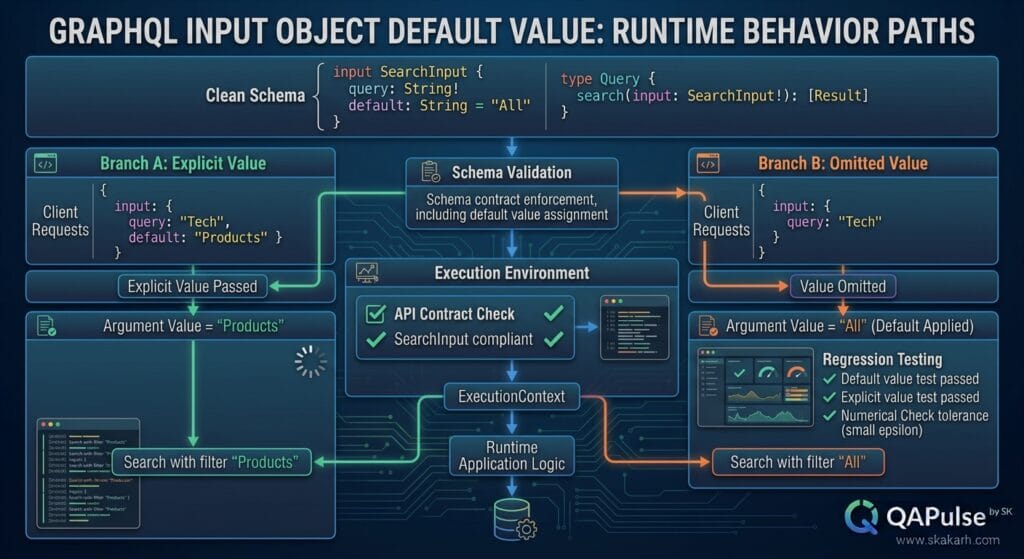
The first change is particularly interesting because default values can influence how clients interpret an API even when the client does not explicitly provide a value.
Consider an input type:
input SearchInput {
    query: String!
    limit: Int = 20
}
A client can send:
query Search($input: SearchInput!) {
    search(input: $input) {
        id
        title
    }
}
with variables:
{
  "input": {
    "query": "kubernetes"
  }
}
The client never sends limit.
The server therefore relies on the schema’s default value.
If that default changes:
input SearchInput {
    query: String!
    limit: Int = 50
}
the GraphQL operation itself may remain completely valid.
That is exactly what makes this class of change interesting.
The request can still return HTTP 200.
The GraphQL document can still pass syntax validation.
The resolver can still execute.
Yet the behavior of the application has changed.
That distinction is critical when designing regression tests.
Why default values deserve more attention
Traditional API regression testing often focuses on obvious breaking changes:
| Change | Typical test visibility | Risk |
|---|---|---|
| Remove a field | High | High |
| Rename a field | High | High |
| Change field type | High | High |
| Remove an argument | High | High |
| Change an input default | Low | Medium/High |
| Change schema-mapping context | Low | Medium |
| Change generated schema metadata | Very low | Medium |
This creates an uncomfortable testing gap.
A test suite may contain hundreds of GraphQL queries and mutations while still failing to detect an important schema-semantic change.
For example:
input PaginationInput {
    page: Int = 1
    size: Int = 20
}
Suppose the backend changes:
input PaginationInput {
    page: Int = 1
    size: Int = 100
}
An existing test might simply verify:
response = client.post("/graphql", json={
    "query": query,
    "variables": {
        "input": {
            "page": 1,
            "size": 20
        }
    }
})

assert response.status_code == 200
The test passes because it explicitly supplies size.
But production clients that omit size now receive different behavior.
A stronger test intentionally verifies the default:
variables = {
    "input": {
        "page": 1
    }
}

response = client.post(
    "/graphql",
    json={
        "query": query,
        "variables": variables
    }
)

assert response.status_code == 200
assert len(response.json()["data"]["search"]["items"]) <= 20
The strategic difference is important:
You are not merely testing the query. You are testing the contract behavior when the client relies on the schema.
GraphQL schema testing versus traditional API testing
GraphQL introduces a different testing surface compared with REST.
In a REST API, a change might be represented by an endpoint contract:
GET /users?page=1&limit=20
A test can directly inspect the request and response.
GraphQL is more schema-driven:
query Users($input: UserSearchInput!) {
    users(input: $input) {
        id
        name
    }
}
The schema determines:
- available operations
- argument types
- input fields
- nullability
- default values
- return types
- directives
- validation behavior
That means schema-level regression deserves its own testing strategy.
| Testing approach | REST | GraphQL |
|---|---|---|
| Endpoint testing | Essential | Less central |
| Status-code validation | Essential | Useful but insufficient |
| Schema validation | Useful | Essential |
| Contract testing | Essential | Essential |
| Input default testing | Less common | Important |
| Resolver testing | Service-specific | Important |
| Query validation | Limited | Critical |
| Introspection/schema diff | Sometimes | Highly valuable |
This is why a tiny release such as GraphQL 17.0.2 can have implications beyond the number of changed lines.
The first practical test: compare schemas
One of the most effective GraphQL regression techniques is to compare the schema before and after a dependency upgrade.
For example, export the schema:
graphql-inspector introspect \
  http://localhost:4000/graphql \
  > schema-after.json
Then compare it against the known-good schema:
graphql-inspector diff \
  schema-before.json \
  schema-after.json
The exact tooling can vary depending on your stack, but the strategy remains the same:
Known-good schema
       ↓
Upgrade dependency
       ↓
Generate new schema
       ↓
Compare schemas
       ↓
Classify changes
       ↓
Run behavioral tests
This is stronger than relying exclusively on application-level tests.
A test can tell you:
“This query still works.”
A schema diff can tell you:
“The contract changed.”
You need both.
A useful compatibility classification
Not every schema change should block deployment.
A practical pipeline can classify changes into three categories.
Safe changes
Examples:
Adding an optional field
Adding a non-required query
Adding documentation
Internal implementation changes
These may be automatically approved.
Review-required changes
Examples:
Changing default values
Adding directives
Changing deprecation metadata
Changing schema descriptions used by generated tooling
These deserve explicit review because their impact depends on client behavior.
Breaking changes
Examples:
Removing a field
Removing an argument
Changing nullability
Changing an input field from optional to required
Changing an incompatible scalar type
These should normally block promotion until compatibility has been demonstrated.
This approach is considerably more useful than treating every schema diff as equally dangerous.
Testing the default-value behavior directly
For GraphQL 17.0.2, default-value handling deserves an explicit regression test.
Consider:
input ProductFilter {
    category: String
    limit: Int = 25
}
Test the explicit value:
variables = {
    "filter": {
        "category": "laptop",
        "limit": 10
    }
}
Then test the omitted value:
variables = {
    "filter": {
        "category": "laptop"
    }
}
The second test is the important one.
It verifies that the system behaves correctly when the client depends on the schema’s default.
A mature test suite should deliberately exercise both:
Explicit value
     +
Omitted value
     +
Null value where permitted
     +
Invalid value
These four cases expose very different classes of GraphQL behavior.
Why mapSchemaConfig matters
The second fix in GraphQL 17.0.2 concerns context handling in mapSchemaConfig.
Schema transformation and mapping tools are often used by applications that need to modify or inspect GraphQL schemas programmatically.
A simplified example might look like:
const transformedSchema = mapSchemaConfig(
    schema,
    {
        arguments: {
            User: {
                id: argument => {
                    return argument;
                }
            }
        }
    }
);
The important testing question isn’t simply:
Does schema transformation complete?
It is:
Does the transformed schema preserve the expected runtime behavior?
That distinction matters for middleware, directives, authorization logic, instrumentation, schema stitching, and other infrastructure built around schema transformation.
A transformation can succeed technically while changing the context available to downstream logic.
That is why infrastructure-level GraphQL tests should validate both structure and behavior.
Structural testing versus behavioral testing
Consider two tests.
Structural test
assert "users" in schema.query_type.fields
This confirms the field exists.
Behavioral test
response = execute_graphql(
    """
    query {
        users {
            id
            name
        }
    }
    """
)

assert response.errors is None
assert response.data["users"] is not None
The structural test is useful.
The behavioral test is more representative of what users experience.
A strong GraphQL upgrade strategy combines both:
Schema structure
      ↓
Schema compatibility
      ↓
Query validation
      ↓
Resolver behavior
      ↓
Client contract tests
      ↓
Production-like workflows
How GraphQL 17.0.2 changes the upgrade mindset
Patch releases are often treated as low-risk:
npm update graphql
Then:
npm test
If everything passes, the upgrade is considered complete.
That workflow is convenient but incomplete.
A better process is:
1. Record current GraphQL version
2. Capture current schema
3. Upgrade GraphQL
4. Generate the new schema
5. Diff schema behavior
6. Run default-value regression tests
7. Run schema transformation tests
8. Run representative client operations
9. Validate generated artifacts
10. Promote only after compatibility checks pass
The important change is moving from version testing to contract testing.
You are not asking:
“Did GraphQL 17.0.2 install successfully?”
You are asking:
“Does my application still behave according to the GraphQL contract after the dependency changed?”
That is a much stronger engineering question.
A practical upgrade test matrix
For teams upgrading GraphQL dependencies, a compact regression matrix can look like this:
| Test area | What to validate | Priority |
|---|---|---|
| Schema generation | Schema builds successfully | High |
| Schema diff | Unexpected changes detected | Critical |
| Input defaults | Omitted values behave correctly | Critical |
| Nullability | Required/optional behavior unchanged | Critical |
| Queries | Existing operations execute | Critical |
| Mutations | Existing workflows execute | Critical |
| Directives | Transformations still work | High |
| Schema mapping | Context remains correct | High |
| Generated clients | Generated code remains compatible | High |
| Error handling | Validation errors remain expected | Medium |
| Introspection | Expected schema is exposed | Medium |
This is where GraphQL upgrade testing becomes much more valuable than simply running a unit-test suite.
The strategic takeaway before upgrading
GraphQL 17.0.2 may look like a small maintenance release, but the nature of its fixes demonstrates why API infrastructure should be tested at multiple levels.
A dependency upgrade can affect:
Schema
 ↓
Validation
 ↓
Client assumptions
 ↓
Resolver execution
 ↓
Generated SDKs
 ↓
Production behavior
If your tests only start at the resolver layer, you may already be testing too late.
The most valuable regression tests are often the ones that verify what happens when clients do not explicitly provide something and the system has to rely on the schema’s rules.
That is precisely the kind of subtle compatibility behavior that can escape conventional happy-path testing.
Testing GraphQL 17.0.2 Without Missing the Subtle Contract Changes
A GraphQL upgrade should not end when the package manager reports success. The real question is whether the application still behaves correctly when schema validation, input defaults, transformations, resolvers, generated clients, and production workflows interact.
For GraphQL 17.0.2, that means paying particular attention to the areas touched by the release rather than treating the upgrade as a generic dependency update.
The strongest strategy is to turn the release notes into executable regression scenarios.
Turn the GraphQL 17.0.2 release notes into tests
The release contains two fixes that deserve direct validation:
- Detection of default-value changes on input object fields.
- Context handling in
mapSchemaConfig.
Instead of simply upgrading and running the existing suite, create tests around those behaviors.
A useful approach is:
Release note
     ↓
Changed behavior
     ↓
Potential failure mode
     ↓
Regression scenario
     ↓
Automated test
     ↓
Deployment gate
For example:
Default-value change
        ↓
Client omits input
        ↓
Server uses schema default
        ↓
Behavior changes unexpectedly
        ↓
Regression test catches it
This approach makes dependency upgrades much more predictable.
Test explicit values and omitted values separately
Consider this input:
input SearchInput {
    query: String!
    limit: Int = 20
}
An explicit request:
{
  "query": "GraphQL",
  "limit": 10
}
is relatively easy to test.
But the more interesting scenario is:
{
  "query": "GraphQL"
}
The client has deliberately omitted limit.
The server now depends on the schema default.
A Python integration test could look like:
def test_search_uses_default_limit(graphql_client):
    query = """
    query Search($input: SearchInput!) {
        search(input: $input) {
            items {
                id
                title
            }
        }
    }
    """

    variables = {
        "input": {
            "query": "GraphQL"
        }
    }

    response = graphql_client.execute(
        query,
        variables=variables
    )

    assert response.errors is None
    assert len(response.data["search"]["items"]) <= 20
Now add the explicit-value scenario:
def test_search_accepts_explicit_limit(graphql_client):
    query = """
    query Search($input: SearchInput!) {
        search(input: $input) {
            items {
                id
                title
            }
        }
    }
    """

    variables = {
        "input": {
            "query": "GraphQL",
            "limit": 5
        }
    }

    response = graphql_client.execute(
        query,
        variables=variables
    )

    assert response.errors is None
    assert len(response.data["search"]["items"]) <= 5
These tests look similar, but they protect different contracts.
| Scenario | What it verifies |
|---|---|
Explicit limit | Client-controlled behavior |
Omitted limit | Schema default behavior |
limit: null | Nullability behavior |
Invalid limit | Input validation |
Negative limit | Business validation |
A mature GraphQL test suite should not assume that one successful query covers all five.
Test schema changes before testing application behavior
One of the biggest mistakes in API upgrade testing is starting with end-to-end tests.
By the time an end-to-end test fails, you may already have several layers involved:
Client
 ↓
Network
 ↓
GraphQL server
 ↓
Schema validation
 ↓
Resolver
 ↓
Database
That makes diagnosis slower.
A schema compatibility test isolates the contract much earlier.
For example, export the schema from the current version and save it as a baseline:
graphql-inspector introspect \
  http://localhost:4000/graphql \
  > schema-before.json
After upgrading:
graphql-inspector introspect \
  http://localhost:4000/graphql \
  > schema-after.json
Then compare:
graphql-inspector diff \
  schema-before.json \
  schema-after.json
The objective isn’t to reject every difference.
The objective is to answer:
Did anything change that existing clients could depend on?
That distinction makes schema diffing much more useful than a simple snapshot comparison.
Use schema snapshots as an upgrade safety net
A repository can maintain a known-good schema snapshot:
schemas/
├── production.graphql
├── staging.graphql
└── generated.graphql
A CI pipeline can then compare the generated schema against the approved version.
For example:
npm run generate-schema
git diff --exit-code schemas/generated.graphql
If a dependency upgrade unexpectedly modifies the schema:
CI
 ↓
Schema generated
 ↓
Snapshot differs
 ↓
Pipeline stops
 ↓
Engineer reviews change
This creates an early warning system.
Without it, the first indication of a schema regression might come from a frontend application or an external API consumer.
GraphQL contract testing versus REST contract testing
GraphQL and REST both benefit from contract testing, but the contract surface is different.
| Area | REST | GraphQL |
|---|---|---|
| Primary contract | Endpoints | Schema |
| Request structure | URL + method + body | Query + variables |
| Response structure | Endpoint-specific | Selection-set driven |
| Input defaults | Less central | Important |
| Schema diffing | Useful | Extremely valuable |
| Query validation | Limited | Core capability |
| Generated clients | Common | Common |
| Resolver behavior | N/A conceptually | Central |
| Introspection | Not universal | Standard capability |
With REST, you might validate:
POST /users
With GraphQL, you need to validate both the operation and the schema that defines what the operation means.
That makes schema-level testing particularly important after a GraphQL dependency upgrade.
Test mapSchemaConfig at the transformation boundary
The mapSchemaConfig fix deserves a different type of regression test.
Schema transformation code often sits between the original schema and the runtime schema.
A simplified transformation could look like:
const transformedSchema = mapSchemaConfig(
    schema,
    {
        arguments: {
            User: {
                id: argument => {
                    return argument;
                }
            }
        }
    }
);
A weak test would only check:
expect(transformedSchema).toBeDefined();
That proves very little.
A stronger test verifies the transformed schema’s actual behavior:
const result = await graphql({
    schema: transformedSchema,
    source: `
        query {
            user(id: "123") {
                id
                name
            }
        }
    `
});

expect(result.errors).toBeUndefined();
expect(result.data.user.id).toBe("123");
The principle is:
Don’t test that transformation completed. Test what the transformed schema does.
This is especially important when schema mapping is used for authorization, instrumentation, directives, federation, middleware, or argument manipulation.
Add negative GraphQL tests
Positive tests answer:
“Can valid requests still work?”
Negative tests answer:
“Does the system still reject invalid requests correctly?”
Both matter after an upgrade.
For example:
query {
    user(id: 123) {
        id
    }
}
If id expects a String, the request should fail validation.
A test could assert:
assert response.errors is not None
assert "String" in response.errors[0].message
You should also test missing required fields:
input UserInput {
    username: String!
    email: String!
}
Then:
{
  "username": "tester"
}
should fail because email is required.
This is where GraphQL validation becomes a valuable safety boundary.
Compare GraphQL 17.0.2 with an ordinary patch upgrade
Not every dependency deserves the same upgrade strategy.
Consider three examples:
| Dependency type | Typical upgrade risk | Recommended testing |
|---|---|---|
| Logging library | Low | Unit + smoke |
| Utility library | Low/Medium | Unit + integration |
| GraphQL runtime | Medium/High | Schema + contract + integration + E2E |
The package version number alone should not determine your testing depth.
A patch release in a critical API infrastructure component can deserve more testing than a minor release of an isolated utility.
This is an important engineering habit:
Risk should be based on dependency responsibility, not only semantic version numbering.
Build a GraphQL upgrade test pyramid
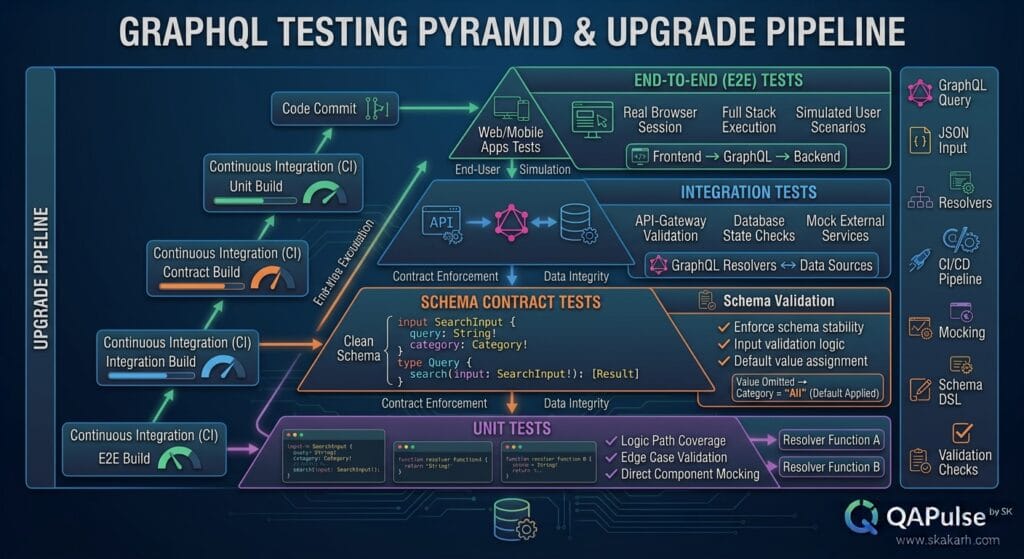
A practical test architecture can be organized into four layers.
Layer 1: Unit tests
Test isolated schema and validation behavior.
def test_default_value():
    assert get_default_value("limit") == 20
These tests are fast and should run constantly.
Layer 2: Schema contract tests
Validate:
Types
Fields
Arguments
Nullability
Defaults
Directives
Deprecations
These tests protect the API contract.
Layer 3: Integration tests
Execute representative queries and mutations against the upgraded runtime.
def test_create_user(graphql_client):
    result = graphql_client.execute(
        """
        mutation {
            createUser(
                input: {
                    name: "Test User"
                }
            ) {
                id
                name
            }
        }
        """
    )

    assert result.errors is None
Layer 4: End-to-end tests
Finally validate realistic user journeys.
For example:
Login
 ↓
Fetch profile
 ↓
Update profile
 ↓
Search
 ↓
Pagination
 ↓
Checkout
This provides broad confidence without forcing every test into the slowest layer.
Create an upgrade gate instead of a checklist
A checklist tells engineers what to do.
An upgrade gate tells the pipeline when an upgrade is allowed to proceed.
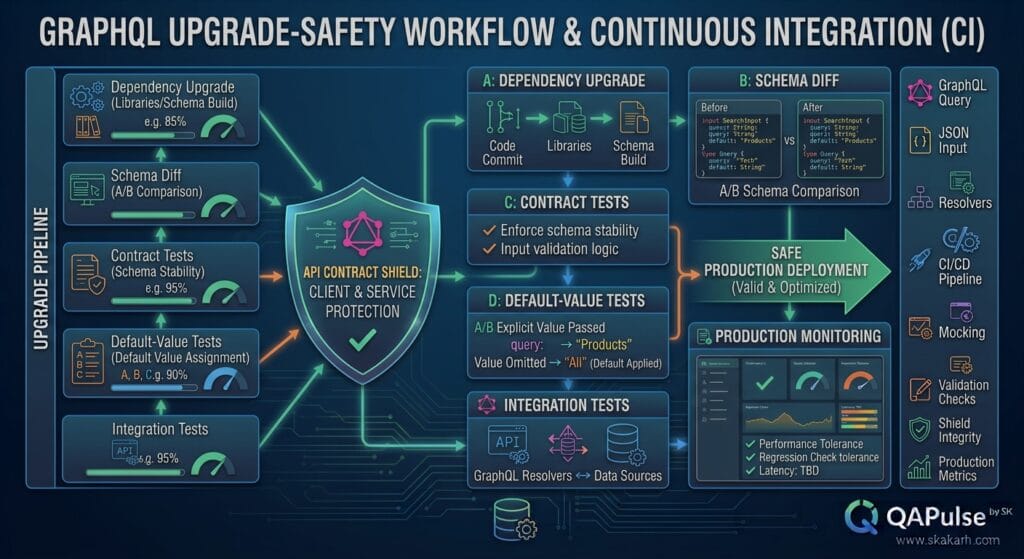
For GraphQL 17.0.2, a production gate could require:
Schema generated successfully
        AND
No unexpected breaking schema changes
        AND
Default-value tests pass
        AND
Schema transformation tests pass
        AND
Critical queries pass
        AND
Critical mutations pass
        AND
Generated clients remain compatible
        AND
End-to-end smoke tests pass
Only then:
             PASS
              ↓
        Deploy candidate
If one critical condition fails:
             FAIL
              ↓
       Stop deployment
              ↓
         Investigate
This is far more reliable than manually reviewing release notes after deployment.
Automate dependency upgrades with GraphQL-specific checks
Tools such as Renovate or Dependabot can automatically create dependency upgrade pull requests.
The danger is allowing the PR to rely only on generic tests.
A GraphQL dependency update should trigger specialized validation:
name: GraphQL Upgrade Validation

on:
  pull_request:

jobs:
  graphql:
    runs-on: ubuntu-latest

    steps:
      - uses: actions/checkout@v4

      - name: Install dependencies
        run: npm ci

      - name: Generate schema
        run: npm run generate-schema

      - name: Validate schema
        run: npm run test:schema

      - name: Run GraphQL contract tests
        run: npm run test:graphql

      - name: Run integration tests
        run: npm run test:integration
The important idea is not the specific CI provider.
The important idea is that dependency automation should automatically trigger dependency-specific validation.
Use production traffic patterns for regression testing
Synthetic tests are useful, but they can miss real client behavior.
Suppose your production clients commonly omit optional input fields.
Your test suite should reproduce that pattern.
For example:
{
  "input": {
    "search": "laptop"
  }
}
instead of always sending:
{
  "input": {
    "search": "laptop",
    "page": 1,
    "limit": 20,
    "sort": "relevance"
  }
}
The second request may hide default-value regressions because every value is explicitly supplied.
This leads to an important testing principle:
Production behavior should influence regression scenarios.
If real clients rely on defaults, your automated tests should rely on defaults too.
Monitor GraphQL behavior after deployment
Passing CI does not guarantee production safety.
After deployment, monitor:
GraphQL error rate
Validation failures
Resolver latency
Request volume
Timeouts
Unexpected null values
Client-generated errors
A useful dashboard might compare:
Before upgrade        After upgrade
──────────────        ─────────────
Error rate            Error rate
P95 latency           P95 latency
Validation errors     Validation errors
Resolver failures     Resolver failures
This gives you an operational feedback loop.
The complete strategy becomes:
Release notes
     ↓
Targeted regression tests
     ↓
Schema compatibility
     ↓
CI upgrade gate
     ↓
Staging validation
     ↓
Production deployment
     ↓
Runtime monitoring
A practical GraphQL 17.0.2 upgrade workflow
For a real project, I would use this sequence:
# 1. Record current dependency
npm list graphql

# 2. Upgrade
npm install graphql@17.0.2

# 3. Install cleanly
rm -rf node_modules
npm ci

# 4. Run unit tests
npm test

# 5. Generate schema
npm run generate-schema

# 6. Run GraphQL contract tests
npm run test:graphql

# 7. Run integration tests
npm run test:integration

# 8. Run production-like smoke tests
npm run test:smoke
Then inspect the schema diff before merging.
The exact commands will depend on your application, but the sequence is broadly applicable.
What should you actually upgrade first?
For a production GraphQL application, the safest strategy is usually:
| Situation | Recommendation |
|---|---|
| No GraphQL contract tests | Add them before upgrading |
| No schema snapshot | Add one |
| Heavy schema transformation | Test transformation behavior explicitly |
| Clients depend on defaults | Add omitted-input regression tests |
| Generated SDKs | Regenerate and compare |
| Large production API | Use staging + canary deployment |
| Small internal API | Targeted regression + smoke may be sufficient |
The important point is not to blindly apply the same process to every system.
Your testing depth should match the blast radius.
| Area | GraphQL 17.0.1 | GraphQL 17.0.2 |
|---|---|---|
| Input default-value change detection | Existing behavior | Fixed |
| Schema mapper context | Existing behavior | Corrected |
| Major new API | No | No |
| Major feature release | No | No |
| Upgrade type | Previous patch | Patch update |
| Primary concern | Existing bugs | Bug fixes/polish |
Internal Links
- Learn MCP – Zero to Hero
- Learn AI Agents for QA – Zero to Hero
- Playwright Automation – Zero to Hero
- TencentDB Agent Memory: Complete Zero to Hero
- LangGraph: Complete Zero to Hero
- Learn Python – Zero to Hero
- OpenAI Codex: Complete Zero to Hero
- Cursor AI: Complete Zero to Hero
- Claude Code Tutorial: Complete Zero to Hero
- AutoGen: Complete Zero to Hero Guide
- Free QA Resources Built From Real Experience
- QA Glossary: Test Automation Terms Every Engineer Should Know
External Links
- Official pandas 3.0.5 release announcement
- GraphQL Official Documentation
- GraphQL.js GitHub Repository
- GraphQL Resource Hub
- GraphQL Backend Resources
- GraphQL Security Resources
People Asked Questions
What is GraphQL 17.0.2?
GraphQL 17.0.2 is a patch release of GraphQL.js that addresses bugs and polish issues, including detection of default-value changes on input object fields.
What changed in GraphQL 17.0.2?
The release fixes detection of default-value changes on input object fields and includes a fix related to mapSchemaConfig context.
Is GraphQL 17.0.2 a breaking release?
The supplied release notes describe bug fixes and polish rather than a major feature release. Nevertheless, applications should run their schema and integration regression suites before upgrading.
Should I upgrade to GraphQL 17.0.2?
For projects already using the GraphQL 17.x line, upgrading to the latest compatible patch release is generally worth evaluating because patch releases address defects. Validate your application and dependencies before production rollout.
How do I install GraphQL 17.0.2?
npm install graphql@17.0.2Why are GraphQL input object default values important?
Default values influence the behavior of inputs when callers omit optional fields. A change can therefore affect application behavior without changing the visible shape of the GraphQL operation.
How should I test a GraphQL upgrade?
Test schema validation, input defaults, resolver behavior, introspection, client compatibility, error responses, and critical production queries.
Conclusion
GraphQL 17.0.2 demonstrates why dependency upgrades should be treated as compatibility exercises rather than package-management tasks.
The release’s fixes around input-object default-value changes and schema-mapping context are subtle examples of behavior that can escape ordinary happy-path API testing.
A strong upgrade strategy therefore combines:
- schema diffing
- contract testing
- default-value regression tests
- schema transformation tests
- positive and negative validation tests
- integration testing
- end-to-end smoke tests
- CI deployment gates
- production monitoring
The most important shift is conceptual.
Don’t ask only:
“Did GraphQL 17.0.2 pass our tests?”
Ask:
“Did our API contract, client assumptions, and runtime behavior remain compatible after the upgrade?”
That question produces much stronger engineering decisions.
Final Key Takeaways
- GraphQL 17.0.2 should be tested as an API-contract change, not merely a dependency update.
- Default values deserve dedicated regression tests, especially when clients commonly omit optional input fields.
- Schema diffing catches contract changes earlier than end-to-end testing.
mapSchemaConfigbehavior should be tested at the runtime boundary, not merely verified as successfully transformed.- Explicit and omitted input values should be tested separately.
- Positive and negative GraphQL tests provide different types of protection.
- Dependency version numbers alone should not determine testing depth.
- Automated upgrade PRs should trigger GraphQL-specific contract validation.
- Production monitoring completes the upgrade safety loop.
- The strongest strategy is to test what clients depend on, not simply what the release notes say changed.
Continue Learning
Explore more expert articles on Mobile Testing, Backend & API, AI & Agentic, AI Tools, n8n, LangChain, CrewAI, MCP Servers, AI Agents, LlamaIndex, Docker, FastAPI, Playwright, Cypress, Test Automation, DevOps, and Software Engineering at www.skakarh.com.
QAPulse by SK delivers expert release analysis, AI engineering insights, enterprise automation strategies, migration guidance, DevOps best practices, and practical testing knowledge to help software professionals build scalable, intelligent, and production-ready software systems.