 QA
QA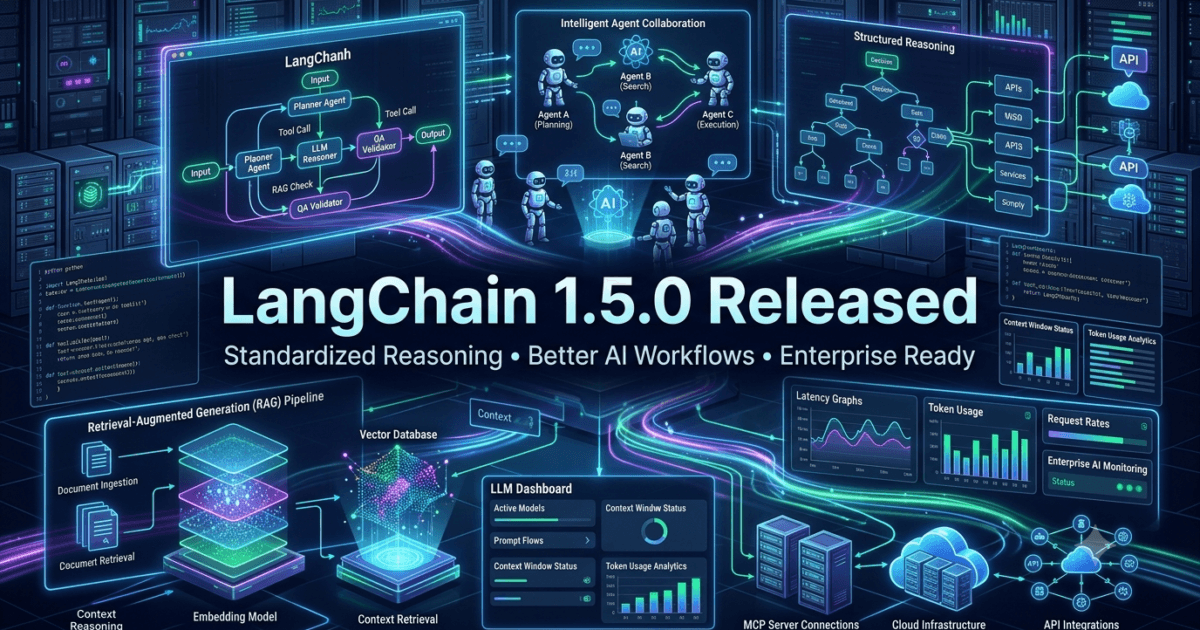
LangChain 1.5.0, released on July 21, 2026, marks an important milestone for developers building production-ready LLM applications, AI Agents, RAG systems, and enterprise AI workflows. While this release is relatively compact in terms of visible changes, it introduces a significant new capability—the standardized reasoning_effort parameter for chat models—which represents another step toward consistent AI model behavior across providers.
Alongside this feature, LangChain 1.5.0 also updates several core dependencies, including Soupsieve and Mistune, improving security, compatibility, and long-term maintainability of the framework. These changes continue LangChain’s commitment to creating a unified developer experience for organizations integrating multiple Large Language Model providers.
For QA Engineers, SDETs, AI Engineers, Automation Engineers, MLOps teams, and Software Architects, this release offers improved control over reasoning-intensive AI workloads while maintaining excellent backward compatibility with existing LangChain applications.
Whether you’re developing Agentic AI, Model Context Protocol (MCP) solutions, CrewAI agents, LangGraph workflows, or enterprise-grade Retrieval-Augmented Generation (RAG) systems, LangChain 1.5.0 lays the foundation for smarter reasoning optimization and more predictable AI application behavior.
Official Release Highlights
According to the official LangChain 1.5.0 release notes, this version includes a focused set of enhancements that improve reasoning capabilities and maintain the framework’s reliability.
Major Updates
- Introduced the standardized
reasoning_effortchat model parameter - Updated Soupsieve dependency from 2.8 to 2.8.4
- Updated Mistune dependency from 3.2.1 to 3.3.0
- General framework maintenance and release improvements
Although the changelog appears concise, the new reasoning parameter has significant implications for developers working with advanced AI models that support configurable reasoning levels.
LangChain 1.5.0 Release Overview
| Category | Details |
|---|---|
| Version | LangChain 1.5.0 |
| Release Date | July 21, 2026 |
| Release Type | Minor Feature Release |
| Major Feature | Standardized reasoning_effort parameter |
| Dependency Updates | Yes |
| Breaking Changes | None Reported |
| Upgrade Recommendation | Recommended |
Why This Release Matters
Modern AI systems are no longer limited to simple text generation. Today’s enterprise AI applications increasingly rely on reasoning models capable of solving multi-step problems, planning workflows, generating structured outputs, performing tool calling, and coordinating multiple AI agents.
Different model providers often expose reasoning controls using inconsistent APIs, making it difficult for developers to build provider-agnostic AI applications.
LangChain addresses this challenge by introducing the standardized reasoning_effort parameter.
Instead of writing provider-specific logic for reasoning configuration, developers can now specify reasoning levels through a consistent LangChain interface. This simplifies application development while making AI workflows more portable across multiple providers.
For organizations building enterprise AI platforms, this standardization reduces maintenance costs and improves long-term code quality.
Standardized Reasoning Effort Improves AI Control
The headline feature of LangChain 1.5.0 is support for the reasoning_effort parameter.
This parameter allows supported reasoning models to control how much computational effort should be invested before generating a response.
Depending on the model provider, reasoning effort may influence:
- Response quality
- Planning depth
- Multi-step reasoning
- Tool selection
- Code generation
- Mathematical problem solving
- Agent decision-making
- Cost optimization
- Latency
- Token consumption
Rather than exposing provider-specific settings, LangChain now provides a unified abstraction that simplifies development while maintaining flexibility.
This is especially valuable for organizations using multiple LLM providers in production.
Better Enterprise AI Development
Enterprise AI platforms increasingly combine models from providers such as OpenAI, Anthropic, Google, Azure OpenAI, Amazon Bedrock, and self-hosted inference servers.
Maintaining separate implementations for each provider can quickly become difficult.
The standardized reasoning interface introduced in LangChain 1.5.0 helps organizations:
- Reduce provider-specific code
- Simplify maintenance
- Improve portability
- Standardize AI workflows
- Enable easier provider switching
- Reduce technical debt
These improvements become increasingly valuable as organizations expand their AI ecosystems.
Dependency Updates Improve Stability
Although dependency upgrades rarely receive much attention, they play a vital role in maintaining secure and stable enterprise software.
LangChain 1.5.0 updates:
Soupsieve
Updated from 2.8 to 2.8.4, improving HTML and CSS selector parsing reliability while incorporating upstream fixes.
Mistune
Updated from 3.2.1 to 3.3.0, bringing enhancements to Markdown parsing used throughout documentation, prompts, and developer tooling.
Keeping dependencies current reduces exposure to known issues while improving long-term framework compatibility.
What This Means for QA Engineers
For QA Engineers, SDETs, and AI Test Automation Engineers, LangChain 1.5.0 provides several practical advantages.
The new reasoning parameter introduces another dimension that should be included within AI application testing strategies.
Instead of validating only model outputs, QA teams should also evaluate how different reasoning effort levels affect:
- Response accuracy
- Execution latency
- Token usage
- Tool invocation
- Function calling
- Structured outputs
- Agent planning
- RAG retrieval quality
- Workflow consistency
- Cost optimization
Testing multiple reasoning configurations helps ensure AI applications behave consistently under different workloads.
QA teams should also execute complete regression testing after upgrading to verify that existing prompts, chains, agents, retrievers, memory systems, and tool integrations continue functioning as expected.
Key Improvement 1 – Standardized Reasoning Across AI Providers
The introduction of reasoning_effort is arguably the most important improvement in this release.
Rather than depending on vendor-specific configuration parameters, developers can now build AI applications using a consistent interface.
Benefits include:
- Cleaner application architecture
- Easier provider migration
- Better maintainability
- Reduced duplicate code
- Improved enterprise portability
For teams building long-term AI platforms, this standardization is a significant architectural improvement.
Key Improvement 2 – Improved Framework Reliability
Dependency updates and maintenance improvements ensure that LangChain continues to evolve as a stable foundation for enterprise AI systems.
Although these updates may not directly introduce new functionality, they contribute to:
- Better compatibility
- Improved security
- Cleaner dependency management
- Reduced technical debt
- Easier framework maintenance
These benefits are particularly important for organizations running production AI services.
Are There Any Breaking Changes?
Based on the official LangChain 1.5.0 release notes, no breaking changes have been reported.
Existing LangChain applications should continue functioning normally after upgrading.
Nevertheless, organizations should validate:
- Prompt templates
- Chains
- Agents
- Memory components
- Output parsers
- Tool calling
- Retrieval pipelines
- LangGraph integrations
- CrewAI integrations
- MCP server interactions
A complete regression cycle remains the recommended approach before deploying to production.
How to Upgrade
Upgrade Using pip
pip install --upgrade langchain
Verify Installed Version
python -c "import langchain; print(langchain.__version__)"
Upgrade Inside Virtual Environment
python -m pip install --upgrade langchain
Upgrade Requirements File
pip install --upgrade -r requirements.txt
Following the upgrade, execute your AI regression suite, validate reasoning-intensive workflows, compare inference behavior across supported models, and monitor latency, token usage, and application performance.
Upgrade Recommendation
LangChain 1.5.0 is a recommended upgrade for organizations already using the 1.x release series.
The introduction of standardized reasoning controls represents an important architectural enhancement that will become increasingly valuable as reasoning-capable AI models continue to evolve.
Teams that will benefit most include:
- QA Engineers
- SDETs
- AI Engineers
- Prompt Engineers
- Automation Engineers
- MLOps Engineers
- Platform Engineers
- Backend Developers
- AI Architects
- Enterprise Software Teams
Although the release is relatively small, it improves the long-term maintainability, consistency, and portability of enterprise AI applications while maintaining excellent backward compatibility.
Enterprise Migration Strategy for LangChain 1.5.0
Although LangChain 1.5.0 is categorized as a minor feature release, organizations running production-grade AI Agents, Retrieval-Augmented Generation (RAG) systems, LLM applications, and Agentic AI workflows should still approach the upgrade using a structured migration strategy. AI applications are inherently probabilistic, and even seemingly small framework enhancements can influence response quality, latency, tool invocation behavior, structured outputs, and overall application reliability.
The introduction of the standardized reasoning_effort parameter is the most significant enhancement in this release. While it does not automatically change the behavior of existing applications, it enables developers to fine-tune reasoning-capable models using a unified LangChain interface. This capability becomes particularly valuable for organizations building applications across multiple LLM providers such as OpenAI, Anthropic, Google Gemini, Azure OpenAI, Amazon Bedrock, Groq, and other emerging reasoning models.
Before upgrading production systems, engineering teams should deploy LangChain 1.5.0 into a staging environment and execute comprehensive regression testing across all AI workflows. Existing prompts, chains, agents, retrievers, vector databases, tool integrations, output parsers, and orchestration pipelines should be validated to ensure that application behavior remains consistent.
A recommended migration strategy includes:
- Back up production prompt libraries and LangChain configurations.
- Upgrade LangChain in a staging environment.
- Execute automated AI regression suites.
- Validate reasoning-intensive prompts across supported LLM providers.
- Compare latency, token usage, and response quality against previous versions.
- Test structured outputs and output parsers.
- Validate Agentic AI workflows and tool-calling behavior.
- Monitor observability dashboards such as LangSmith, OpenTelemetry, or custom telemetry.
- Upgrade production systems during scheduled deployment windows.
- Document benchmark differences and update engineering standards.
This phased approach minimizes operational risk while ensuring enterprise AI applications continue to perform reliably after the upgrade.
What This Means for QA Engineers
For QA Engineers, SDETs, AI Test Engineers, and Automation Engineers, LangChain 1.5.0 introduces an important testing dimension through standardized reasoning controls.
Historically, AI application testing focused on validating generated outputs, tool execution, prompt accuracy, retrieval quality, and response consistency. With the introduction of reasoning_effort, QA teams should also evaluate how different reasoning configurations affect application behavior.
Testing should include:
- Response correctness
- Multi-step reasoning quality
- Tool selection accuracy
- Function calling behavior
- Structured output validation
- JSON schema compliance
- Retrieval precision in RAG systems
- Agent planning consistency
- Hallucination frequency
- Execution latency
- Token consumption
- Cost per request
Organizations using multiple reasoning-capable models should verify that LangChain provides consistent abstractions across providers while preserving expected application behavior.
For enterprise AI systems, validating reasoning levels under both normal and high-load scenarios will become an increasingly important aspect of AI quality assurance.
AI Regression Testing Checklist
Every LangChain upgrade should be accompanied by a comprehensive regression testing cycle to maintain application stability and reliability.
| Test Area | Validation |
|---|---|
| Prompt Templates | Verify prompt rendering |
| Chat Models | Validate response consistency |
| reasoning_effort Parameter | Test multiple reasoning levels |
| Chains | Confirm execution flow |
| Agents | Validate planning and task execution |
| Tool Calling | Ensure correct tool selection |
| Function Calling | Verify structured invocation |
| Output Parsers | Test JSON, XML, Pydantic parsing |
| RAG Pipelines | Validate retrieval accuracy |
| Vector Databases | Confirm embedding retrieval |
| Memory Components | Verify conversation persistence |
| LangGraph Workflows | Test node execution |
| MCP Integrations | Validate server communication |
| CrewAI Integration | Verify agent interoperability |
| LangSmith Tracing | Confirm observability data |
| API Rate Limits | Monitor retry behavior |
| Error Handling | Validate fallback logic |
| Streaming Responses | Confirm incremental output |
| Cost Monitoring | Compare token consumption |
| Performance Benchmarks | Measure inference latency |
Completing this checklist helps ensure that AI systems remain stable after adopting LangChain 1.5.0.
Best Practices for Using reasoning_effort
The new reasoning_effort parameter provides greater flexibility when working with reasoning-capable LLMs, but it should be used strategically.
Use Low Reasoning for Simple Tasks
Simple operations such as summarization, classification, translation, or formatting typically benefit from lower reasoning effort, resulting in faster responses and lower token consumption.
Increase Reasoning for Complex Workflows
Tasks involving planning, code generation, debugging, multi-agent coordination, mathematical reasoning, or business decision-making can benefit from higher reasoning settings where supported by the underlying model.
Benchmark Before Standardizing
Different providers may interpret reasoning effort differently. Organizations should benchmark multiple configurations before defining organization-wide defaults.
Monitor Cost and Latency
Higher reasoning levels can increase computational overhead, affecting both response time and operational costs. Continuously monitor these metrics to achieve the right balance between quality and efficiency.
Production Deployment Best Practices
To maximize the benefits of LangChain 1.5.0 while minimizing deployment risk, engineering teams should follow proven enterprise deployment practices.
Validate Across Multiple LLM Providers
If your application supports multiple AI providers, ensure that reasoning behavior remains consistent where applicable and gracefully degrades when unsupported.
Preserve Prompt Versions
Version control prompts and chains before upgrading. This enables rapid rollback if output quality changes unexpectedly.
Monitor AI Observability
Use platforms such as LangSmith, OpenTelemetry, or internal observability systems to track latency, token usage, reasoning quality, and error rates after deployment.
Compare Baseline Responses
Maintain a repository of baseline prompts and expected outputs. Comparing responses before and after the upgrade helps detect subtle behavioral changes introduced by model or framework updates.
Execute Continuous Regression Testing
Integrate AI regression tests into CI/CD pipelines so that future LangChain upgrades are automatically validated before production deployment.
Comparison: LangChain 1.4.9 vs LangChain 1.5.0
| Feature | LangChain 1.4.9 | LangChain 1.5.0 |
|---|---|---|
| Standardized reasoning_effort | No | Yes |
| Multi-provider Reasoning Control | Limited | Improved |
| Dependency Updates | Previous Versions | Updated |
| Framework Stability | Excellent | Improved |
| Enterprise Maintainability | Strong | Stronger |
| Breaking Changes | None | None |
| Upgrade Complexity | Low | Low |
This comparison highlights that LangChain 1.5.0 focuses on improving developer experience and future-proofing enterprise AI applications rather than introducing disruptive architectural changes.
Are There Any Breaking Changes?
According to the official LangChain 1.5.0 release notes, no breaking changes have been reported.
Existing LangChain applications should continue functioning without modification.
Nevertheless, organizations should validate:
- Prompt templates
- Chat models
- Chains
- Agents
- Output parsers
- Retrieval pipelines
- Tool integrations
- Memory components
- LangGraph workflows
- CrewAI integrations
- MCP servers
- LangSmith tracing
A complete regression cycle remains the recommended best practice before promoting the upgrade to production.
Should You Upgrade?
Upgrade Immediately If You:
- Build enterprise AI applications
- Use reasoning-capable language models
- Develop Agentic AI workflows
- Maintain RAG systems
- Build AI assistants
- Use LangGraph or CrewAI
- Require multi-provider compatibility
- Want standardized reasoning controls
Upgrade After Validation If You:
- Operate regulated production environments
- Maintain customer-facing AI platforms
- Have extensive prompt libraries
- Require formal regression certification
- Support multiple AI providers
Overall Recommendation
Yes. LangChain 1.5.0 is a recommended upgrade for organizations already using the 1.x release series. The addition of the standardized reasoning_effort parameter is an important architectural enhancement that simplifies multi-provider AI development while preparing enterprise applications for the next generation of reasoning-capable Large Language Models. Combined with dependency updates and continued framework stability, this release offers meaningful long-term value without introducing breaking changes.
Official Resources
- Official Release Notes: https://github.com/langchain-ai/langchain/releases/tag/langchain-core%3D%3D1.5.0
- Official Documentation: https://python.langchain.com
More Related Blogs
- LangChain 1.4.9 Released: Critical AI Framework Reliability Improvements Every QA Engineer Must Know
- LangChain 1.4.8 Release: 7 Important Updates AI Testing Engineers Should Know
- LangChain 1.4.7 Released: Important Stability Improvements Every QA Engineer Should Know
- LangChain 1.4.6 Released: Valuable AI Agent Observability Improvements QA Engineers Must Know
- LangChain 1.3.11 Released: Essential AI Framework Improvements Every QA Engineer Should Know
Frequently Asked Questions
What is the biggest feature in LangChain 1.5.0?
The most important enhancement is the introduction of the standardized reasoning_effort parameter, allowing developers to configure reasoning behavior consistently across supported chat models.
Does LangChain 1.5.0 introduce breaking changes?
No. The official release notes report no breaking API changes or migration requirements.
Should QA Engineers test reasoning_effort?
Yes. QA teams should evaluate how different reasoning levels affect response quality, latency, token usage, tool invocation, and structured outputs.
Is LangChain 1.5.0 suitable for production?
Yes. After completing normal regression testing, LangChain 1.5.0 is suitable for enterprise production environments.
Should organizations upgrade immediately?
Most organizations using the LangChain 1.x release series can upgrade confidently after validating AI workflows, prompts, agents, retrieval pipelines, and provider integrations.
Continue Learning with QAPulse by SK
At QAPulse by SK, we continuously analyze the latest releases across LangChain, LangGraph, CrewAI, Model Context Protocol (MCP), n8n, FastAPI, Python, Node.js, Playwright, Selenium, Docker, Locust, k6, and many other technologies shaping the future of AI-powered software engineering.
Our mission is to help QA Engineers, SDETs, AI Engineers, Automation Engineers, Prompt Engineers, DevOps Engineers, Platform Engineers, and Software Architects stay ahead through detailed release analyses, migration guides, regression testing strategies, AI quality engineering best practices, and enterprise automation insights that enable organizations to build scalable, secure, reliable, and production-ready AI applications.