 QA
QA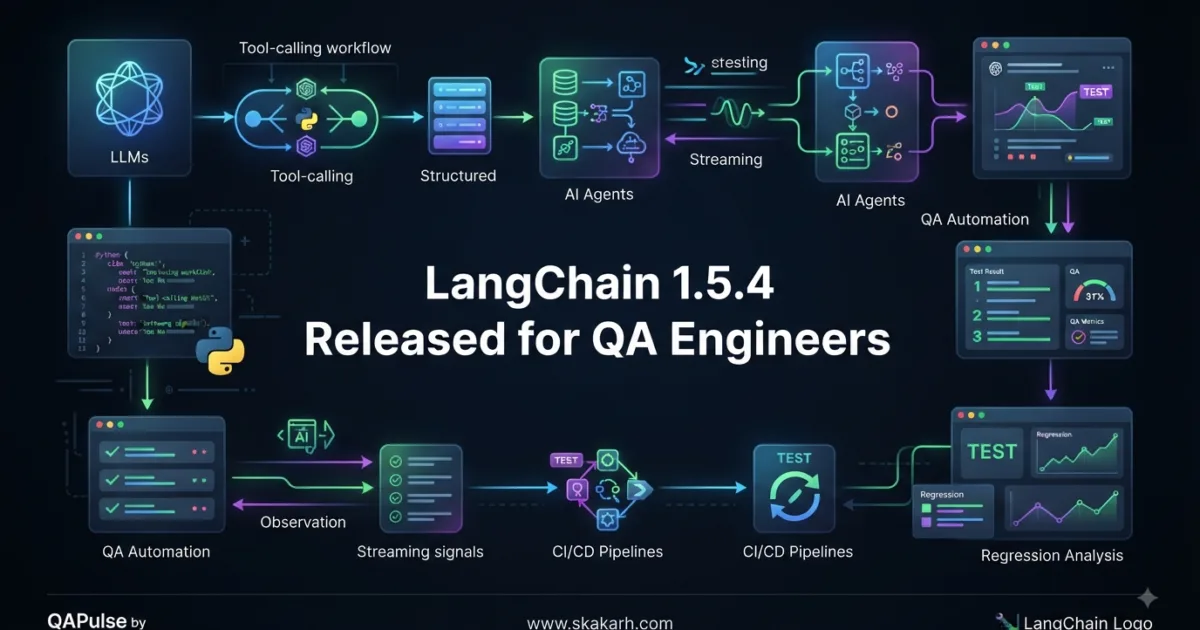
LangChain 1.5.4 Released with a focused set of core fixes that matter more to QA engineers and SDETs than the version number alone suggests. The release addresses compatibility, structured prompts, tool schemas, injected arguments, streaming behavior, callback redaction, and other pieces that sit directly inside AI application infrastructure.
For teams building LLM applications, AI agents, RAG systems, or tool-calling workflows, these changes are important because LangChain Core is part of the execution layer between application code, models, prompts, tools, and observability.
The release is not about introducing one flashy feature.
It is about making the underlying AI application plumbing more predictable.
That makes it particularly interesting from a testing perspective.
What is LangChain 1.5.4?
The release discussed here is langchain-core==1.5.4, with changes listed against langchain-core==1.5.3.
The supplied release notes include fixes for:
- Pydantic 2.14 compatibility
StructuredPromptmutation behavior- RootModel runnable argument schemas
- internally created event loops in streaming tracers
- OpenAI file blocks
- reserved tool argument names
- injected arguments in
BaseToolsubclasses include_injected=Falsebehavior- streaming callback-option redaction
- text stream projections
- package publishing infrastructure
That list might look like a collection of small maintenance changes.
For QA engineers, it is actually a map of potential regression areas.
Think about an AI application as:
User
  ↓
Prompt
  ↓
LangChain Core
  ↓
Runnable
  ↓
Tool
  ↓
LLM
  ↓
Streaming / Callback
  ↓
Application Response
A bug in any layer can produce failures that look like model problems even when the model is behaving correctly.
That is why LangChain 1.5.4 Released is relevant to testing teams.
Why QA Engineers Should Care About a Core Release
Traditional application testing often focuses on predictable inputs and outputs.
AI applications are different.
A single request can travel through:
Prompt
  ↓
Validation
  ↓
Runnable
  ↓
Tool Schema
  ↓
Injected Parameters
  ↓
Model
  ↓
Streaming
  ↓
Callback
  ↓
Final Response
A small framework-level change can therefore affect:
- prompt construction
- tool invocation
- schema validation
- streaming
- callbacks
- tracing
- serialization
- security-related redaction
This creates an important QA principle:
Test the orchestration layer, not only the final LLM response.
A test that checks only:
assert "Paris" in response
may pass while the underlying tool schema, callback behavior, or tracing implementation is broken.
A stronger test strategy checks the complete execution contract.
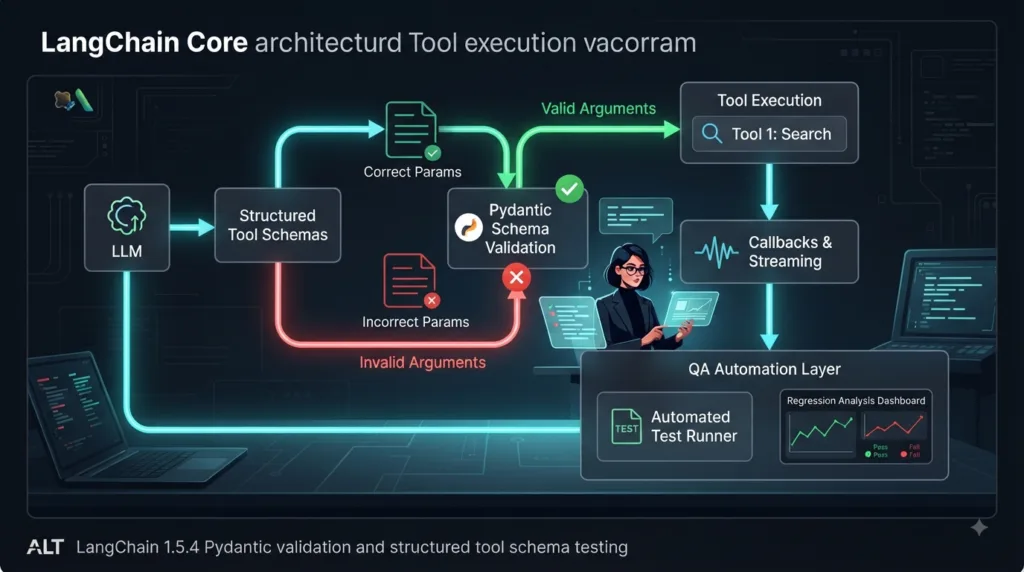
The First Important Change: Pydantic 2.14 Compatibility
One of the listed fixes addresses compatibility with Pydantic 2.14.
This matters because LangChain Core relies heavily on structured Python models and validation.
Consider a simplified tool:
from pydantic import BaseModel, Field


class SearchInput(BaseModel):
    query: str = Field(description="Search query")
    limit: int = Field(default=10, ge=1, le=100)
A QA engineer should not only test the happy path.
Test:
def test_search_input():
    payload = SearchInput(
        query="LangChain testing",
        limit=10,
    )

    assert payload.query == "LangChain testing"
    assert payload.limit == 10
Then validate boundaries:
import pytest
from pydantic import ValidationError


def test_invalid_limit():
    with pytest.raises(ValidationError):
        SearchInput(
            query="LangChain testing",
            limit=0,
        )
Now you are testing the contract that sits underneath the AI workflow.
Why Dependency Compatibility Is a QA Concern
Dependency upgrades are often treated as developer-only concerns.
That is a mistake.
Suppose your stack contains:
Python
   ↓
Pydantic
   ↓
LangChain Core
   ↓
Provider Integration
   ↓
Application
Changing one dependency can alter behavior several layers above it.
A useful compatibility matrix looks like:
| Component | What QA Should Validate |
|---|---|
| Python | Runtime compatibility |
| Pydantic | Validation and serialization |
| LangChain Core | Runnables and schemas |
| Provider package | Model/API integration |
| Application | End-to-end behavior |
| Observability | Traces and callbacks |
This is why dependency upgrades should be treated as testable system changes, not simply package-manager operations.
StructuredPrompt and the Mutation Problem
Another important fix concerns StructuredPrompt no longer mutating caller keyword arguments.
This sounds small.
It is not.
Mutation bugs can create extremely difficult test failures because the first operation changes state that affects the second operation.
Consider the general anti-pattern:
config = {
    "user": "qa-engineer",
    "language": "Python",
}

first_call(config)

second_call(config)
If first_call() unexpectedly changes config, the second call may behave differently.
A QA test should therefore verify not only the output but also input immutability.
def test_input_is_not_mutated():
    original = {
        "user": "qa-engineer",
        "language": "Python",
    }

    before = original.copy()

    # Execute the operation here

    assert original == before
This is an excellent example of a test that catches a framework-level regression that a simple output assertion may miss.
Test for State Isolation
For AI systems, state leakage is particularly dangerous.
Imagine:
Request A
  ↓
Prompt arguments
  ↓
Mutation
  ↓
Request B
  ↓
Unexpected inherited state
The resulting failure may appear nondeterministic.
You might see:
Test 1 → PASS
Test 2 → PASS
Test 3 → FAIL
Test 4 → PASS
A better test strategy is to execute the same operation repeatedly:
def test_repeated_prompt_execution():
    payload = {
        "topic": "software testing",
    }

    for _ in range(100):
        # Execute the prompt workflow
        # Verify the original payload remains stable
        assert payload == {
            "topic": "software testing",
        }
This type of test is especially valuable for shared objects and reusable AI workflows.
RootModel and Tool Schema Testing
The release also includes a fix to preserve flat tool argument schemas for RootModel runnables.
For QA engineers, this is another signal:
tool schemas deserve dedicated contract tests.
Suppose an agent expects:
{
  "query": "playwright testing"
}
but the framework accidentally exposes a different structure:
{
  "root": {
    "query": "playwright testing"
  }
}
The model or tool may fail even though the business logic is correct.
Schema assertions can catch this early.
def test_tool_schema():
    schema = get_tool_schema()

    properties = schema["properties"]

    assert "query" in properties
For agentic systems, schema correctness is often as important as response correctness.
Compare Traditional API Testing With AI Tool Testing
This is where QA engineers need to adjust their mindset.
| Traditional API | AI Agent / LangChain Workflow |
|---|---|
| Fixed request schema | Tool/model-generated arguments |
| Deterministic response | Potentially variable response |
| Status code validation | Tool execution + response validation |
| JSON schema | Structured tool schema |
| API latency | Model + tool + orchestration latency |
| Functional assertions | Functional + semantic assertions |
| Request/response logs | Traces, callbacks, tool calls |
| Mostly deterministic | Partially probabilistic |
This does not mean AI testing should become vague.
Quite the opposite.
The less deterministic the model output becomes, the more deterministic the surrounding contracts should be.
Make Tool Schemas Deterministic
Suppose your agent has a search tool:
class SearchRequest(BaseModel):
    query: str
    limit: int = 10
Test the contract independently:
def test_search_schema():
    request = SearchRequest(
        query="LangChain",
        limit=5,
    )

    assert request.query == "LangChain"
    assert request.limit == 5
Then test the actual tool.
Then test the agent selecting the tool.
Then test the final user-facing response.
This creates layers:
Schema Test
    ↓
Tool Test
    ↓
Agent Test
    ↓
Integration Test
    ↓
End-to-End Test
That is far more maintainable than putting every assertion into one giant agent test.
Injected Arguments Need Explicit Testing
The release notes also include fixes around injected arguments and BaseTool subclasses.
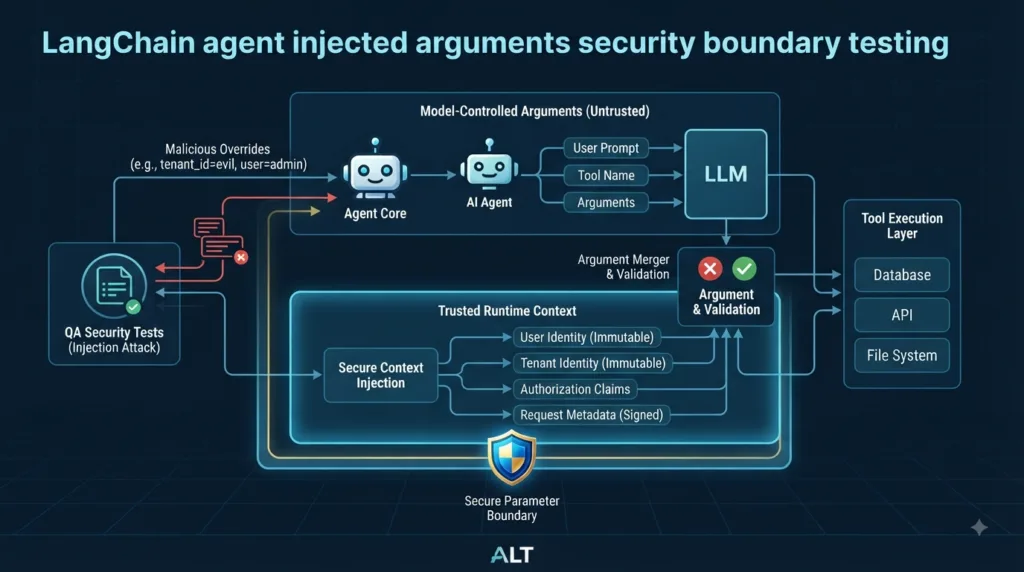
Injected parameters are important because some tool arguments are supplied by the runtime rather than directly by the model.
For example:
LLM
 ↓
Tool Request
 ↓
Runtime Injects:
   user_id
   auth_context
   request_id
 ↓
Tool
This creates a security-sensitive boundary.
You should test:
Can the model control the injected value?
Can the runtime override it?
Is the injected value present?
Is it exposed in the model-visible schema?
Is it logged safely?
A useful security-oriented test might look like:
def test_runtime_controls_user_id():
    model_args = {
        "query": "account balance",
    }

    runtime_context = {
        "user_id": "user-123",
    }

    # Execute tool using model_args + runtime_context

    # Assert the runtime identity is used.
    assert runtime_context["user_id"] == "user-123"
The exact implementation depends on the application architecture, but the testing principle is broadly applicable.
Test What the Model Can and Cannot Control
For tool-calling systems, create two categories.
Model-controlled arguments
query
limit
search_term
sort_order
Runtime-controlled arguments
user_id
tenant_id
authorization_context
request_id
internal_metadata
The security boundary should be explicit.
                Tool
                 │
        ┌────────┴────────┐
        ↓                 ↓
 Model Input        Runtime Context
        ↓                 ↓
 User-controlled     System-controlled
This is an area where QA, security, and AI engineering should collaborate.
Streaming Changes the Testing Model
The release also includes fixes involving streaming tracers and text stream projections.
Streaming applications require a different testing strategy from standard request/response systems.
Instead of:
Request
  ↓
Wait
  ↓
Response
you may have:
Request
  ↓
Token
  ↓
Token
  ↓
Tool Event
  ↓
Token
  ↓
Final Event
Testing only the final response can miss failures in the stream itself.
A better test can validate:
events = []

# Consume stream here

assert len(events) > 0
assert events[-1] is not None
Then add stronger assertions around:
- event ordering
- event types
- partial content
- final content
- callback events
- errors
- cancellation
Test Streaming as an Event Contract
Think of a stream as an event sequence:
START
  ↓
TOKEN
  ↓
TOKEN
  ↓
TOOL_START
  ↓
TOOL_END
  ↓
TOKEN
  ↓
END
Your QA automation can validate that contract.
For example:
expected = [
    "start",
    "token",
    "token",
    "tool_start",
    "tool_end",
    "end",
]

assert event_types == expected
Exact event sequences may vary by application and integration, but the principle is powerful:
Streaming should be tested as a protocol, not just as text.
Why Async Behavior Matters
The release includes a fix related to closing internally created event loops in streaming tracers.
For QA engineers, this points toward another important area: asynchronous resource management.
AI applications frequently combine:
Async HTTP
   +
Streaming
   +
Tool Calls
   +
Callbacks
   +
Tracing
That creates opportunities for:
- event-loop leaks
- hanging tests
- unclosed resources
- intermittent failures
- flaky teardown
A basic asynchronous test should therefore verify clean completion:
import pytest


@pytest.mark.asyncio
async def test_async_workflow():
    result = await run_ai_workflow()

    assert result is not None
But mature suites should also monitor for repeated-run stability.
Find Async Leaks With Repeated Execution
A single successful test does not prove clean resource handling.
Try:
@pytest.mark.asyncio
async def test_repeated_async_execution():
    for _ in range(50):
        result = await run_ai_workflow()

        assert result is not None
If the test becomes slower, hangs, or eventually fails, you may have uncovered a lifecycle problem.
This is particularly useful for:
- streaming agents
- tracing
- long-running workers
- asynchronous tools
- agent loops
Compare LangChain Testing With Direct Model Testing
Some teams test the LLM directly and assume the LangChain layer is covered.
These are different tests.
| Direct LLM Test | LangChain Workflow Test |
|---|---|
| Model response | Orchestration behavior |
| Prompt | Prompt + runnable |
| Token output | Stream + callbacks |
| Model API | Model + tools |
| Basic schema | Tool schema + injection |
| Single call | Multi-step workflow |
A good AI QA strategy should use both.
Model Tests
     +
Component Tests
     +
Tool Tests
     +
Orchestration Tests
     +
E2E Tests
This layered model reduces the temptation to use expensive end-to-end tests for every regression.
The Right Way to Test LangChain 1.5.4
If you are upgrading an existing AI application, do not begin with a full end-to-end suite.
Start with a compatibility baseline.
Record:
Python version
Pydantic version
LangChain Core version
Provider package versions
Model
Tool versions
Test results
Streaming behavior
Tracing behavior
Then run your existing suite before upgrading.
For example:
pytest -q
Capture:
Total tests:
Passed:
Failed:
Skipped:
Duration:
Warnings:
Then upgrade the core package in an isolated environment.
python -m pip install "langchain-core==1.5.4"
Run the same suite.
The comparison becomes:
Before
   ↓
Baseline
   ↓
Upgrade
   ↓
Same Tests
   ↓
After
This gives you evidence instead of assumptions.
Do Not Blindly Upgrade the langchain Package
This distinction is important for this release.
The changes supplied for this article are specifically identified as:
langchain-core==1.5.4
Therefore, QA engineers should verify which LangChain packages their application actually uses before upgrading.
Check the environment:
python -m pip show langchain
python -m pip show langchain-core
Or:
python -m pip freeze | grep -i langchain
This can reveal a dependency tree such as:
langchain
langchain-core
langchain-openai
langchain-community
langsmith
Do not assume that upgrading one package means all related packages should automatically move to their latest versions.
Dependency compatibility should be tested as a system.
Use Version Pinning for Reproducible AI Tests
For production QA environments, avoid uncontrolled dependency drift.
A requirements file can explicitly pin versions:
langchain-core==1.5.4
Then CI installs exactly what the test environment expects.
python -m pip install -r requirements.txt
pytest -q
This produces a much more reproducible pipeline.
Without pinning:
Monday
 ↓
Dependency version A
 ↓
PASS

Friday
 ↓
Dependency version B
 ↓
FAIL
Now the team has to determine whether the application changed or the environment changed.
Reproducibility matters even more in AI systems because model outputs already introduce variability.
Use Three Layers of AI Regression Testing
A practical QA strategy for a LangChain-based application can be structured as:
Layer 1
Contract Tests
   ↓
Layer 2
Component Tests
   ↓
Layer 3
AI Workflow Tests
   ↓
Layer 4
End-to-End Tests
Contract Tests
Validate:
- schemas
- tool arguments
- injected parameters
- configuration
Component Tests
Validate:
- prompts
- tools
- retrievers
- parsers
- callbacks
Workflow Tests
Validate:
- agent decisions
- tool selection
- multi-step execution
- streaming
End-to-End Tests
Validate:
- complete user journeys
- integrations
- production-like behavior
This hierarchy keeps test execution fast while maintaining coverage.
An Interactive Challenge for QA Engineers
Take one AI agent in your project and map its execution path.
Write:
User Request
     ↓
Prompt
     ↓
Runnable
     ↓
Model
     ↓
Tool?
     ↓
Injected Arguments?
     ↓
Streaming?
     ↓
Callback?
     ↓
Final Response
Now ask:
Where would a framework regression appear first?
If your answer is only “the final response,” your test strategy probably has a visibility gap.
Try to identify at least one contract assertion at every important boundary.
For example:
Prompt       → input variables valid
Tool Schema  → expected fields exist
Tool         → correct arguments
Injection    → runtime context protected
Stream       → valid event sequence
Callback     → safe metadata
Response     → expected semantic behavior
That exercise can expose missing tests very quickly.
What Makes This Release Important for SDETs?
The deeper lesson from LangChain 1.5.4 Released is that AI testing is increasingly becoming framework testing plus application testing.
Your application may contain only a few lines of business logic:
agent = create_agent(...)
result = agent.invoke(request)
But underneath that call may exist:
Prompt Templates
       ↓
Runnables
       ↓
Schemas
       ↓
Tools
       ↓
Injected Context
       ↓
Model Provider
       ↓
Streaming
       ↓
Callbacks
       ↓
Tracing
That is a large testing surface.
SDETs who understand these boundaries can create significantly better automation than teams that only assert final LLM text.
A Practical Upgrade Checklist
Before adopting langchain-core==1.5.4, validate:
[ ] Python version
[ ] Pydantic compatibility
[ ] langchain-core version
[ ] Provider integrations
[ ] Prompt behavior
[ ] Structured prompts
[ ] Tool schemas
[ ] RootModel-based tools
[ ] Injected arguments
[ ] Streaming
[ ] Async execution
[ ] Callback behavior
[ ] Tracing
[ ] Sensitive-data redaction
[ ] OpenAI file handling if used
[ ] CI/CD environment
[ ] Regression suite
The goal is not to test every internal implementation detail.
The goal is to test every application contract that depends on those internals.
Initial Upgrade Recommendation
For QA engineers and SDETs, LangChain 1.5.4 Released looks like a maintenance-oriented core update rather than a release that demands an immediate architecture rewrite.
That makes a controlled upgrade the sensible approach.
Prioritize validation if your application heavily uses:
- structured prompts
- Pydantic models
- tool calling
- injected arguments
- streaming
- asynchronous execution
- callbacks
- tracing
- OpenAI file blocks
If your application uses only basic synchronous chains, the practical impact may be smaller.
Either way, the safest approach is the same:
Baseline
   ↓
Upgrade
   ↓
Contract Tests
   ↓
Component Tests
   ↓
Workflow Tests
   ↓
E2E Tests
   ↓
Compare
   ↓
Approve
The important question is not:
“Did the package install successfully?”
It is:
“Did the AI application preserve its behavioral contracts after the framework upgrade?”
That is the question that turns a dependency update into professional QA engineering.
Testing the Changes That Matter Most in LangChain Core
LangChain 1.5.4 Released with several fixes that look small in a changelog but can have a meaningful effect on AI application reliability. For QA engineers, the right approach is to translate each framework-level change into a concrete test risk.
Instead of reading a changelog like this:
fix: preserve flat tool args schema
fix: handle injected args
fix: redact streaming callback options
fix: close internally created event loops
read it like this:
Framework Change
      ↓
Possible Regression
      ↓
Application Risk
      ↓
Test Scenario
      ↓
Observable Evidence
That mindset is useful for every AI framework upgrade.
Turn Release Notes Into a QA Risk Matrix
Before upgrading a dependency, create a small risk matrix.
| Release Area | Possible Risk | QA Test |
|---|---|---|
| Pydantic compatibility | Validation changes | Schema tests |
| StructuredPrompt | Input mutation | Immutability tests |
| RootModel | Wrong tool schema | Schema contract tests |
| Injected arguments | Context leakage | Security tests |
| Streaming | Missing events | Event-sequence tests |
| Async event loops | Resource leaks | Repeated async tests |
| Callback redaction | Sensitive data exposure | Log inspection |
| OpenAI file blocks | File processing regression | File-input tests |
This takes only a few minutes but gives the entire team a testing strategy.
The important lesson is that not every changelog item deserves equal testing effort.
If your application does not use streaming, you do not need to spend the same amount of regression effort on streaming as a team whose entire product depends on streamed AI responses.
Test the Framework Through Your Application Contracts
One common mistake is attempting to test framework internals directly.
For most application teams, that is not the best investment.
Suppose your application uses a LangChain tool:
from pydantic import BaseModel


class CustomerSearch(BaseModel):
    customer_id: str
    include_history: bool = False
Your application contract might be:
customer_id must exist
include_history must be boolean
invalid input must fail safely
runtime identity must remain protected
Write tests around those contracts.
def test_customer_search_contract():
    request = CustomerSearch(
        customer_id="CUST-1001",
        include_history=True,
    )

    assert request.customer_id == "CUST-1001"
    assert request.include_history is True
Then test invalid data separately.
import pytest
from pydantic import ValidationError


def test_customer_id_is_required():
    with pytest.raises(ValidationError):
        CustomerSearch(
            include_history=True,
        )
This gives you protection even if the underlying implementation changes.
Why Contract Testing Is Especially Important for AI Agents
Traditional automation often focuses heavily on endpoints.
AI agents introduce additional contracts.
Consider:
User
 ↓
Agent
 ↓
Tool Selection
 ↓
Tool Schema
 ↓
Runtime Context
 ↓
External System
Each boundary can fail independently.
A model can select the correct tool but provide malformed arguments.
The framework can construct the correct arguments but lose injected context.
The tool can execute correctly but produce an invalid downstream request.
The final answer can still look reasonable.
That is why AI testing needs multiple layers.
Model behavior
      +
Framework behavior
      +
Application behavior
      +
External dependency behavior
Structured Prompts Need Mutation Tests
The StructuredPrompt fix deserves special attention because mutation bugs are often difficult to detect through ordinary end-to-end testing.
Imagine a reusable configuration:
prompt_data = {
    "role": "QA Engineer",
    "topic": "AI testing",
}
You expect:
Call A → same input
Call B → same input
Call C → same input
A mutation defect can produce:
Call A → input modified
Call B → modified input
Call C → unexpected behavior
A useful test pattern is:
def test_prompt_input_remains_unchanged():
    prompt_data = {
        "role": "QA Engineer",
        "topic": "AI testing",
    }

    original = prompt_data.copy()

    execute_prompt(prompt_data)

    assert prompt_data == original
The important assertion is not the generated text.
It is the state of the caller’s data after execution.
Add Repeated-Execution Tests
Mutation bugs can become more visible when the same object is reused.
def test_prompt_is_safe_for_reuse():
    prompt_data = {
        "role": "QA Engineer",
        "topic": "AI testing",
    }

    expected = prompt_data.copy()

    for _ in range(20):
        execute_prompt(prompt_data)
        assert prompt_data == expected
This is a simple but powerful regression technique.
It can expose:
- hidden state
- mutable defaults
- accidental argument modification
- caching problems
- test-order dependencies
For AI applications, these problems can become particularly difficult to reproduce because model calls may already have variable execution times and outputs.
RootModel Tool Schemas Should Be Contract-Tested
The RootModel-related fix is another example where schema testing becomes essential.
Suppose your tool expects:
{
  "query": "Selenium testing"
}
Your test should explicitly inspect the generated schema.
A simplified example:
def test_search_tool_schema():
    schema = search_tool.args_schema.model_json_schema()

    assert "properties" in schema
    assert "query" in schema["properties"]
You can go further:
def test_search_query_is_required():
    schema = search_tool.args_schema.model_json_schema()

    required = schema.get("required", [])

    assert "query" in required
This catches structural regressions before an agent reaches the model.
Schema Testing vs End-to-End Testing
Consider two approaches.
| Approach | Detection Point | Cost |
|---|---|---|
| Schema test | Immediately | Low |
| Tool test | Tool boundary | Low |
| Agent test | Orchestration | Medium |
| E2E test | Full application | High |
If a tool schema is broken, discovering it through an expensive end-to-end test is inefficient.
A mature SDET strategy catches failures as close to their origin as possible.
Schema
 ↓
Tool
 ↓
Agent
 ↓
Application
The earlier the failure is detected, the easier it usually is to diagnose.
Test Injected Arguments as a Security Boundary
Injected arguments deserve more than functional testing.
Suppose an agent tool internally requires:
user_id
tenant_id
request_id
These values should come from trusted runtime context rather than uncontrolled model output.
Think of the architecture as:
                 Agent
                   │
          ┌────────┴────────┐
          ↓                 ↓
    Model Arguments     Runtime Context
          ↓                 ↓
    query / limit       user_id
                        tenant_id
                        request_id
Your test should attempt to violate that boundary.
For example:
def test_model_cannot_override_user_context():
    model_input = {
        "query": "account information",
        "user_id": "attacker-controlled-id",
    }

    runtime_context = {
        "user_id": "trusted-user-id",
    }

    result = execute_tool(
        model_input=model_input,
        runtime_context=runtime_context,
    )

    assert result.user_id == "trusted-user-id"
The exact implementation will differ, but the test idea is universal:
Try to make the untrusted input cross a trusted boundary.
That is a strong security-testing mindset for agentic systems.
Test include_injected=False Behavior
The release notes specifically mention respecting include_injected=False with filter_args.
This is exactly the kind of behavior that should have a focused regression test.
The conceptual requirement is:
Injected argument
      ↓
Should it appear in model-visible schema?
      ↓
Configuration decides
      ↓
Expected visibility
Test both paths.
def test_injected_argument_hidden():
    schema = get_filtered_tool_schema(
        include_injected=False
    )

    assert "user_id" not in schema["properties"]
And:
def test_regular_argument_remains_visible():
    schema = get_filtered_tool_schema(
        include_injected=False
    )

    assert "query" in schema["properties"]
This prevents a security-sensitive configuration from accidentally hiding too much or exposing too much.
Streaming Requires a Different Assertion Strategy
One of the biggest differences between traditional API testing and AI application testing is streaming.
A normal API test might do:
response = client.get("/answer")

assert response.status_code == 200
assert response.json()["answer"]
A streaming workflow needs to observe events.
Conceptually:
events = list(stream_response())

assert events
assert events[-1].type == "end"
You may also want to verify:
First event
↓
Content events
↓
Tool events
↓
Metadata
↓
Final event
The exact event contract depends on your implementation.
The testing principle does not.
Test Partial Responses
A streaming test should not only verify the final answer.
Imagine the server sends:
"The
 capital
 of
 France
 is
 Paris."
A failure halfway through could produce:
"The capital of France"
The final response might still be accepted by a weak assertion.
Instead, test the stream itself.
chunks = collect_stream()

assert len(chunks) > 1
assert all(chunk is not None for chunk in chunks)
Then reconstruct the result:
text = "".join(chunks)

assert "Paris" in text
This separates:
- stream integrity
- final content correctness
That distinction makes failures much easier to diagnose.
Test Callback Redaction
The callback redaction change is especially important from a QA and security perspective.
AI applications can accidentally send sensitive values into:
- traces
- logs
- monitoring systems
- callback payloads
- debugging output
Your test suite should deliberately create sensitive-looking data.
secret = "SUPER-SECRET-VALUE"

result = execute_workflow(
    sensitive_value=secret
)

logs = capture_logs()

assert secret not in logs
For a production-grade test, test multiple representations:
Raw secret
Encoded secret
Nested secret
Secret in metadata
Secret in callback arguments
Secret in exception output
The objective is to prove that sensitive information does not unexpectedly cross an observability boundary.
Security Testing Should Include Negative Cases
A weak security test asks:
Does redaction work?
A stronger test asks:
Under what circumstances could redaction fail?
For example:
Normal callback       → protected
Streaming callback    → protected
Exception             → protected
Nested metadata       → protected
Tool failure          → protected
Retry                 → protected
Async callback        → protected
This is a more strategic way to test observability controls.
Test OpenAI File Blocks Separately
The release also includes a fix to preserve OpenAI file blocks.
If your application processes uploaded documents, files, PDFs, images, or other provider-specific content, add dedicated regression tests.
A conceptual test could be:
def test_file_block_is_preserved():
    message = build_message_with_file(
        file_id="file-123"
    )

    result = process_message(message)

    assert result.file_id == "file-123"
The actual structure depends on the provider integration.
The important point is that file handling should not be tested only through a text-generation assertion.
Test the content representation itself.
Compare Text-Only AI Testing With Multimodal Testing
| Text Workflow | File/Multimodal Workflow |
|---|---|
| Prompt text | Text + file blocks |
| Text output | Text + structured content |
| Simple serialization | Provider-specific blocks |
| Basic assertions | Content-type assertions |
| Smaller payloads | Potentially large payloads |
| Lower integration surface | Larger integration surface |
If your application accepts files, your regression suite should explicitly cover those content types.
Async Testing Should Include Lifecycle Validation
The event-loop fix is another reminder that asynchronous correctness is not just about receiving the right answer.
Consider:
Start event loop
      ↓
Create workflow
      ↓
Stream response
      ↓
Callbacks
      ↓
Tracing
      ↓
Close resources
The final assertion could pass while cleanup is broken.
A useful test strategy is repeated execution:
@pytest.mark.asyncio
async def test_async_workflow_repeatedly():
    for _ in range(25):
        response = await run_workflow()

        assert response is not None
Then monitor:
- execution duration
- memory usage
- open connections
- warnings
- hanging tasks
- event-loop errors
If execution gradually becomes unstable, the problem may be lifecycle management rather than application logic.
Don’t Ignore Warnings
When validating a framework upgrade, warnings are useful evidence.
Run:
pytest -W error -q
This turns many warnings into test failures.
You can also capture the normal run first:
pytest -q
and compare warning output before and after the upgrade.
A framework update that changes:
0 warnings → 25 warnings
deserves investigation even if:
100 tests → 100 passed
A green test suite is not necessarily a clean test suite.
Build a Before-and-After Upgrade Report
For an enterprise QA team, create a simple report.
LangChain Core Upgrade Validation

Previous:
langchain-core = 1.5.3

Target:
langchain-core = 1.5.4

Tests:
Before: 428 passed
After:  428 passed

Duration:
Before: 4m 18s
After:  4m 21s

Warnings:
Before: 3
After:  3

Streaming:
PASS

Tool schemas:
PASS

Injected arguments:
PASS

File blocks:
PASS

Tracing:
PASS
This is far more useful than:
“Upgrade successful.”
It gives developers, QA leads, and release managers evidence they can act on.
Compare LangChain 1.5.4 With Other AI Framework Updates
AI frameworks differ in how much of the application stack they control.
| Area | LangChain | Direct SDK | Custom Orchestration |
|---|---|---|---|
| Prompt abstraction | High | Low | Variable |
| Tool abstraction | High | Provider-dependent | Custom |
| Schema handling | Strong | Provider-dependent | Custom |
| Agent orchestration | Strong | Usually limited | Custom |
| Testing surface | Large | Smaller | Depends |
| Upgrade impact | Potentially broad | Usually narrower | Depends |
| Flexibility | High | High | Very high |
| Maintenance | Framework-dependent | Provider-dependent | Team-dependent |
This does not make one architecture universally better.
It means the QA strategy must match the abstraction level.
The more orchestration a framework owns, the more framework behavior your regression suite should observe.
A Useful Testing Pyramid for LangChain Applications
A practical test distribution might look like:
                 E2E
                /   \
           Workflow Tests
          /             \
      Tool Tests      Integration
       /                   \
  Schema / Contract Tests
The bottom should contain the largest number of fast tests.
The top should contain fewer but more realistic scenarios.
For example:
300+ Contract Tests
100 Component Tests
30 Workflow Tests
10 E2E Journeys
The exact numbers are not important.
The principle is.
Do not make your expensive E2E suite responsible for discovering basic schema regressions.
Interactive Exercise: Find Your Weakest Boundary
Pick one production AI workflow and answer these questions:
1. What input enters the workflow?

2. Which object transforms that input?

3. Which tool can the model call?

4. What arguments can the model control?

5. What arguments does the runtime inject?

6. Does the workflow stream?

7. What callbacks are generated?

8. What information reaches tracing?

9. Where could sensitive information appear?

10. What is the first assertion that would detect
    a regression at each boundary?
If you cannot answer several of these questions, that is not simply a documentation problem.
It is potentially a test-coverage problem.
A Strong CI Strategy for AI Framework Upgrades
Do not run every test at every stage.
Use progressive validation.
Pull Request
     ↓
Contract Tests
     ↓
Component Tests
     ↓
Merge
     ↓
Integration Tests
     ↓
Nightly
     ↓
AI Workflow Tests
     ↓
Release Candidate
     ↓
E2E + Security + Observability
This reduces CI cost while still protecting important behavior.
For example:
steps:
  - name: Install dependencies
    run: pip install -r requirements.txt

  - name: Contract tests
    run: pytest tests/contracts -q

  - name: Component tests
    run: pytest tests/components -q
The pipeline can then run heavier suites on scheduled or release builds.
Use Golden Tests Carefully
AI applications sometimes use golden responses.
For example:
assert response == expected_response
This can be fragile because model outputs may legitimately change.
Prefer structured assertions where possible:
assert result.tool_name == "customer_search"
assert result.customer_id == "CUST-1001"
assert result.status == "success"
For generated text, consider validating:
- required facts
- prohibited content
- structure
- tool usage
- citations
- semantic requirements
rather than demanding exact wording.
This is one of the biggest differences between conventional deterministic testing and AI application testing.
Separate Framework Regressions From Model Variability
Suppose the same test produces two different answers.
Do not immediately blame the framework.
Classify the variability:
Model variability?
Prompt change?
Temperature?
Provider change?
Framework change?
Tool result?
Retrieval result?
External API?
Test data?
This is why deterministic component tests are so valuable.
If your tool schema and orchestration contracts pass, but generated text varies slightly, the evidence points toward model-level variability rather than necessarily indicating a framework regression.
Establish a Dependency Compatibility Contract
For production AI systems, maintain a compatibility record.
Python:
3.x

Pydantic:
2.x

langchain-core:
1.5.4

Provider:
...

Provider SDK:
...

LangSmith:
...

Application:
...
Then connect this information to CI.
The objective is reproducibility.
When a production incident occurs, the team should be able to answer:
Which exact framework and dependency versions were running?
within minutes, not hours.
The Strategic QA Lesson
The biggest lesson from LangChain 1.5.4 Released is that AI framework upgrades should be treated as behavioral contract changes, even when the changelog describes them as fixes.
A small internal change can influence:
Schema
 ↓
Prompt
 ↓
Tool
 ↓
Agent
 ↓
Streaming
 ↓
Tracing
 ↓
Security
That means the QA engineer’s role is not simply to confirm that an agent still returns an answer.
The stronger question is:
Does every important contract around that answer still behave correctly?
That is where AI-focused SDETs can create significant value.
Practical Challenge: Create a Framework Upgrade Test Pack
Before upgrading your production application, create these tests:
[ ] Dependency compatibility

[ ] Pydantic validation

[ ] Structured prompt immutability

[ ] RootModel schema structure

[ ] Required tool arguments

[ ] Injected argument protection

[ ] include_injected behavior

[ ] Streaming event sequence

[ ] Async repeated execution

[ ] Callback redaction

[ ] File block preservation

[ ] Tool execution

[ ] Agent orchestration

[ ] Error handling

[ ] Regression workflow

[ ] End-to-end user journey
Run this pack against the old and new versions.
The comparison is your evidence.
And that is a much stronger upgrade methodology than simply installing the new package and waiting for CI to tell you something broke.
Build a Production-Ready QA Strategy Around LangChain Core
LangChain 1.5.4 Released is a useful reminder that AI framework upgrades should be validated as system changes, not treated as ordinary package updates. Once an application uses structured prompts, tools, streaming, asynchronous execution, callbacks, and tracing, the framework becomes part of the application’s runtime behavior.
The practical challenge for SDETs is therefore bigger than checking whether existing tests remain green.
You need to determine whether the application is still correct, secure, observable, reproducible, and maintainable.
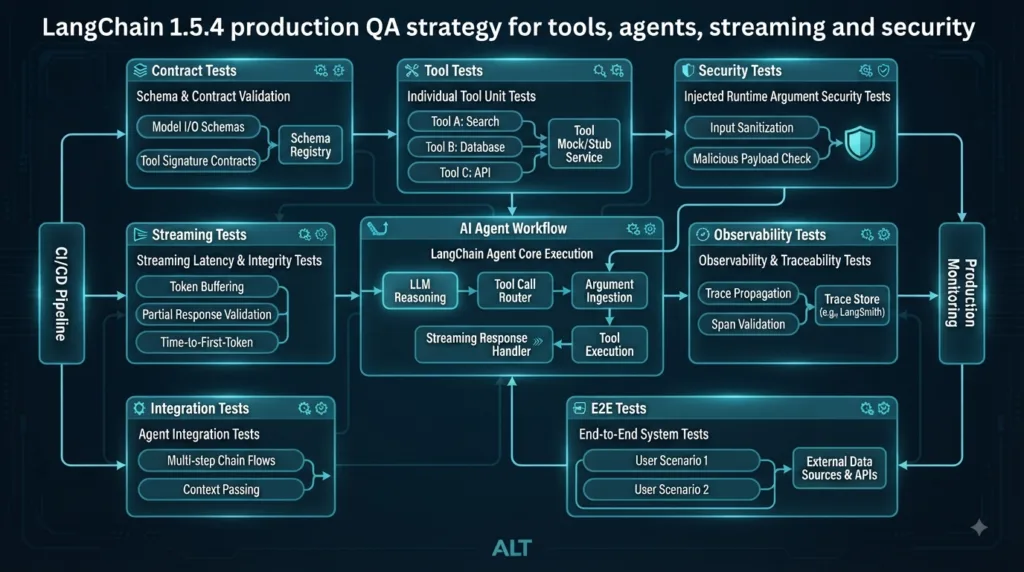
Design Tests Around Failure Boundaries
Start by drawing the execution path of your application:
User Request
     ↓
Input Validation
     ↓
Prompt Construction
     ↓
Runnable
     ↓
Model
     ↓
Tool Selection
     ↓
Tool Schema
     ↓
Runtime Context
     ↓
External Service
     ↓
Streaming / Callback
     ↓
Final Response
Now put a test beside every important boundary.
Input          → validation test
Prompt         → immutability test
Runnable       → execution test
Tool schema    → contract test
Runtime        → security test
External API   → integration test
Streaming      → event test
Callback       → redaction test
Final answer   → semantic test
This approach is much more powerful than having one large end-to-end test.
If an E2E test fails, you know that something is wrong.
If a boundary test fails, you have a much better idea where it is wrong.
Build a Test Matrix Before Upgrading
A mature upgrade should start with evidence.
Create a matrix like this:
| Area | Baseline | Expected After Upgrade | Risk |
|---|---|---|---|
| Prompt rendering | PASS | PASS | Medium |
| Tool schema | PASS | PASS | High |
| Injected arguments | PASS | PASS | High |
| Streaming | PASS | PASS | High |
| Async execution | PASS | PASS | High |
| Callback redaction | PASS | PASS | Critical |
| File blocks | PASS | PASS | Medium |
| Agent workflow | PASS | PASS | High |
| E2E journey | PASS | PASS | High |
This lets you prioritize testing according to application usage.
A team that does not use streaming should not spend hours testing streaming internals.
A team whose product is built around streamed agents should treat streaming as a critical regression area.
Use Risk-Based Testing Instead of Equal Testing
Not every dependency change deserves the same amount of validation.
Use a simple model:
Risk =
Business Impact
×
Usage Frequency
×
Change Sensitivity
For example:
| Feature | Usage | Business Impact | Priority |
|---|---|---|---|
| Basic prompt | High | Medium | High |
| Customer lookup tool | High | Critical | Critical |
| Experimental feature | Low | Low | Low |
| Streaming assistant | High | High | Critical |
| Internal development tool | Low | Low | Low |
This makes your upgrade process strategic.
The goal is not maximum testing.
The goal is maximum confidence per unit of testing effort.
Create Contract Tests for Every Important Tool
Tools are one of the most important boundaries in an agentic application.
Suppose you have:
class SearchRequest(BaseModel):
    query: str
    limit: int = 10
Your contract test should verify the schema:
def test_search_request_schema():
    schema = SearchRequest.model_json_schema()

    assert "query" in schema["properties"]
    assert "limit" in schema["properties"]
    assert "query" in schema["required"]
Then test valid data:
def test_search_request_valid():
    request = SearchRequest(
        query="LangChain",
        limit=10,
    )

    assert request.query == "LangChain"
Then invalid data:
import pytest
from pydantic import ValidationError


def test_search_request_invalid():
    with pytest.raises(ValidationError):
        SearchRequest(
            query="LangChain",
            limit=0,
        )
You now have three distinct contracts:
Schema
 ↓
Valid Input
 ↓
Invalid Input
That is stronger than relying on the agent to discover schema problems during an E2E test.
Test Tool Selection Separately From Tool Execution
An agent can make two different mistakes:
Wrong Tool
     OR
Correct Tool + Wrong Arguments
These should be tested separately.
For example:
def test_agent_selects_search_tool():
    result = run_agent(
        "Find information about LangChain testing"
    )

    assert result.tool_name == "search"
Then:
def test_agent_generates_valid_search_arguments():
    result = run_agent(
        "Find information about LangChain testing"
    )

    assert result.tool_args["query"]
This separation makes debugging dramatically easier.
Protect Runtime Context
Runtime-injected arguments should be treated as trusted data.
Imagine:
Model
 ↓
query = "account balance"
 ↓
Runtime injects
 ↓
user_id = trusted identity
 ↓
Tool
Your tests should attempt to break that assumption.
def test_runtime_identity_cannot_be_overridden():
    model_args = {
        "query": "account balance",
        "user_id": "fake-user",
    }

    runtime_context = {
        "user_id": "real-user",
    }

    result = execute_tool(
        model_args,
        runtime_context,
    )

    assert result.user_id == "real-user"
This is an example of adversarial functional testing.
You are not simply checking whether the system works.
You are asking:
What happens when an untrusted component tries to violate a trusted contract?
Validate Streaming as a State Machine
Streaming should be tested differently from ordinary API responses.
Think of the stream as a state machine:
START
  ↓
CONTENT*
  ↓
TOOL_START?
  ↓
TOOL_END?
  ↓
CONTENT*
  ↓
END
The * means an event may occur multiple times.
A test can capture event types:
events = collect_events()

event_types = [
    event.type
    for event in events
]

assert event_types[0] == "start"
assert event_types[-1] == "end"
Then validate ordering where your application requires it.
assert event_types.index("tool_start") < \
       event_types.index("tool_end")
This is much more robust than testing only the final generated sentence.
Test Streaming Failure Recovery
A mature streaming suite should deliberately introduce failures.
For example:
START
 ↓
TOKEN
 ↓
TOKEN
 ↓
TOOL_FAILURE
 ↓
ERROR
Your test should determine:
- Is the stream closed correctly?
- Does the client receive an error?
- Are resources released?
- Is the error logged safely?
- Is sensitive information redacted?
- Can another request start immediately afterward?
A useful test pattern is:
def test_stream_failure_closes_cleanly():
    result = run_stream_with_failure()

    assert result.completed is False
    assert result.error is not None
    assert result.connection_closed is True
The exact API will vary, but the test objective should remain.
Test Async Workflows for Resource Stability
An async workflow can return the correct result while leaking resources.
Run it repeatedly:
@pytest.mark.asyncio
async def test_async_workflow_stability():
    for _ in range(100):
        result = await run_workflow()

        assert result is not None
Then monitor:
Execution time
Memory
Open connections
Pending tasks
Warnings
Event-loop errors
If execution starts at:
100 ms
and eventually becomes:
300 ms
500 ms
900 ms
you may have discovered a lifecycle problem even though every functional assertion passed.
That is why performance and resource stability belong in AI framework regression testing.
Test Callback Redaction With Realistic Data
Never test redaction only with a single simple string.
Use realistic sensitive structures:
payload = {
    "user": "Muhammad",
    "api_key": "SECRET-123",
    "metadata": {
        "authorization": "Bearer SECRET-456"
    }
}
Then capture callback output:
callback_output = capture_callback_output(payload)

assert "SECRET-123" not in callback_output
assert "SECRET-456" not in callback_output
Also test nested structures.
nested = {
    "request": {
        "metadata": {
            "credentials": {
                "token": "TOP-SECRET"
            }
        }
    }
}
Security testing becomes stronger when your test data resembles real application data.
Compare Logging, Tracing, and Testing
These three concepts are related but not interchangeable.
| Capability | Purpose |
|---|---|
| Logging | Explain events |
| Tracing | Understand execution flow |
| Testing | Prove expected behavior |
| Monitoring | Detect operational changes |
For an AI agent:
Test
 ↓
Expected behavior

Trace
 ↓
Actual execution path

Logs
 ↓
Detailed event evidence

Monitoring
 ↓
Production trend
A mature QA team uses all four.
Use Observability to Make Tests Diagnosable
Suppose this test fails:
Expected:
tool = customer_search

Actual:
tool = generic_search
A test failure tells you what happened.
A trace may tell you why:
Prompt
 ↓
Model decision
 ↓
Tool candidate ranking
 ↓
Selected generic_search
Now the team can investigate the real cause.
This is why observability should not be treated as something that starts after testing.
It should make testing itself easier.
Build a Trace-Aware Test
For important workflows, capture a correlation ID:
request_id = "test-run-001"

result = run_agent(
    request_id=request_id,
    query="Find customer order"
)

trace = get_trace(request_id)

assert trace is not None
assert result is not None
Then validate important execution stages:
assert trace.contains("prompt")
assert trace.contains("tool_call")
assert trace.contains("final_response")
This creates a connection between:
Test Assertion
      ↕
Trace Evidence
      ↕
Application Behavior
That is extremely useful during regression analysis.
Test File Handling With Representative Fixtures
If your application uses files, build a small fixture collection:
fixtures/
├── valid.pdf
├── empty.pdf
├── corrupted.pdf
├── large.pdf
├── image.png
└── unsupported.txt
Then test each category.
@pytest.mark.parametrize(
    "filename",
    [
        "valid.pdf",
        "empty.pdf",
        "corrupted.pdf",
    ],
)
def test_file_processing(filename):
    result = process_file(
        f"fixtures/{filename}"
    )

    assert result is not None
Do not assume a successful text prompt proves that file handling works.
Files introduce additional contracts:
File
 ↓
Content Block
 ↓
Serialization
 ↓
Provider
 ↓
Model
 ↓
Response
Each deserves validation.
Build a Regression Suite Around Real User Journeys
Unit tests are essential, but AI products ultimately serve users.
Create a small set of critical journeys.
For example:
Customer asks question
       ↓
Agent identifies intent
       ↓
Agent calls search tool
       ↓
Runtime injects identity
       ↓
Backend returns data
       ↓
Agent summarizes result
       ↓
Response streams to UI
Then automate the complete journey.
def test_customer_support_journey():
    response = run_customer_workflow(
        "Show my latest order"
    )

    assert response.tool == "order_lookup"
    assert response.success is True
    assert response.answer
This provides confidence that the components work together.
Don’t Overuse End-to-End AI Tests
There is a temptation to test everything through the real model.
That can become expensive and flaky.
Compare:
| Test Type | Speed | Stability | Coverage |
|---|---|---|---|
| Schema | Very high | Very high | Narrow |
| Unit | High | High | Component |
| Tool | High | High | Tool behavior |
| Workflow | Medium | Medium | Orchestration |
| E2E with LLM | Low | Lower | Broad |
Use the real model where model behavior is actually part of the requirement.
Mock or isolate deterministic dependencies where they are not.
Use Deterministic Test Doubles
Suppose your agent uses a weather API.
For a framework regression test, you may not need the real weather API.
Use a controlled result:
fake_weather = {
    "city": "Lahore",
    "temperature": 31,
    "condition": "Clear",
}
Then verify:
result = run_agent_with_weather(
    fake_weather
)

assert "Lahore" in result
assert "31" in result
This isolates the framework behavior.
Use the real service in a smaller number of integration tests.
The strategy becomes:
Many deterministic tests
+
Fewer real integrations
+
Small number of E2E journeys
That is usually faster and more reliable.
Separate Framework Tests From Model Tests
A framework regression can be tested without requiring a sophisticated model judgment.
For example:
Framework Test
 ↓
Tool schema
 ↓
Injected context
 ↓
Streaming events
 ↓
Callback redaction
A model-quality test might instead evaluate:
Instruction following
 ↓
Reasoning quality
 ↓
Response relevance
 ↓
Safety behavior
Keep these concerns separate.
Otherwise, a model-quality change can make a framework regression test fail even though the framework is functioning correctly.
Create Upgrade Gates in CI/CD
You can turn the validation process into an automated gate.
- name: Install pinned dependencies
  run: pip install -r requirements.txt

- name: Contract tests
  run: pytest tests/contracts -q

- name: Tool tests
  run: pytest tests/tools -q

- name: Streaming tests
  run: pytest tests/streaming -q

- name: Security tests
  run: pytest tests/security -q

- name: Workflow tests
  run: pytest tests/workflows -q
A release should not proceed simply because installation succeeded.
The pipeline should answer:
Did contracts pass?
Did security pass?
Did streaming pass?
Did workflows pass?
Did critical journeys pass?
Add a Canary Environment for AI Framework Upgrades
For larger organizations, a canary environment can reduce risk.
Production
   ↑
Canary
   ↑
Release Candidate
   ↑
CI
Deploy the new framework version to a limited environment.
Monitor:
- tool failures
- latency
- streaming errors
- callback failures
- token usage
- application errors
- unexpected traces
Then compare with the current production version.
This is especially valuable when AI workflows are difficult to reproduce locally.
Compare Upgrade Strategies
| Strategy | Risk | Speed | Recommended |
|---|---|---|---|
| Upgrade directly in production | High | Fast | No |
| Upgrade locally only | Medium | Fast | Not enough |
| CI validation | Low-Medium | Medium | Yes |
| Staging validation | Low | Medium | Yes |
| Canary deployment | Very Low | Slower | Excellent for critical systems |
| Full regression + canary | Lowest practical | Slower | Best for critical AI systems |
The correct strategy depends on business criticality.
A prototype can tolerate more experimentation.
A financial, healthcare, or customer-support workflow requires significantly stronger controls.
Measure AI Framework Upgrade Health
Do not limit your upgrade report to pass/fail.
Capture:
Functional pass rate
Tool-call success rate
Streaming success rate
Average latency
p95 latency
Error rate
Callback errors
Trace completeness
Security test results
Token usage
For example:
| Metric | Before | After |
|---|---|---|
| Tool success | 99.2% | 99.5% |
| Streaming success | 98.9% | 99.4% |
| p95 latency | 2.1 s | 2.0 s |
| Callback errors | 12 | 4 |
| Security leaks | 0 | 0 |
This tells a much better story than:
All tests passed.
Watch for Flaky AI Tests
AI test flakiness has many causes.
Classify failures:
Framework
Model
Provider
Network
Tool
Test Data
Timing
Async Lifecycle
Environment
Then track failure frequency.
For example:
@pytest.mark.flaky
def test_streaming_workflow():
    ...
Do not use retries as the first solution.
Retries can hide real problems.
Instead ask:
Why is this test nondeterministic?
Then determine whether the variability is legitimate or a defect.
Use Statistical Thinking for AI Outputs
For deterministic code, one execution may be enough.
For AI systems, repeated evaluation can provide better evidence.
For example:
Run 1 → Tool selected correctly
Run 2 → Tool selected correctly
Run 3 → Tool selected correctly
...
Run 50 → Tool selected correctly
You can calculate:
Tool-selection success rate
rather than relying on one run.
For critical workflows, define an acceptable reliability threshold.
The exact threshold should be based on business risk.
Don’t Turn Probabilistic Testing Into Guesswork
Probabilistic does not mean unstructured.
Define explicit evaluation criteria:
Correct tool?
Correct arguments?
Correct user context?
Valid response?
Required information present?
Forbidden information absent?
Latency within budget?
Stream completed?
Trace available?
Now an AI workflow can be evaluated systematically even when its generated wording varies.
A Practical Release Validation Command Set
A simple local validation flow might look like:
python -m pip show langchain-core

python -m pip install \
  "langchain-core==1.5.4"

pytest tests/contracts -q

pytest tests/tools -q

pytest tests/streaming -q

pytest tests/security -q

pytest tests/workflows -q
Then run your complete regression suite:
pytest -q
Capture the results before and after the upgrade.
Build a Rollback Plan Before Deployment
Every framework upgrade should have a rollback path.
For example:
langchain-core 1.5.3
        ↓
Upgrade
        ↓
langchain-core 1.5.4
        ↓
Validation failure?
        ↓
Restore 1.5.3
If dependencies are pinned:
python -m pip install \
  "langchain-core==1.5.3"
The exact previous version should come from your application’s known-good lockfile or requirements configuration.
Rollback should not require reconstructing the old environment from memory.
What SDETs Should Automate First
If your team is starting AI framework testing from scratch, prioritize these five areas:
1. Tool schemas
Because schema failures are deterministic and easy to catch.
2. Runtime context
Because identity and authorization boundaries are security-sensitive.
3. Streaming
Because partial failures can be invisible in final-response tests.
4. Observability
Because debugging AI workflows without traces and logs is difficult.
5. Critical user journeys
Because component tests alone cannot prove the entire system works.
This gives you a strong foundation without attempting to automate everything immediately.
Interactive Exercise: Design a Regression Test in Five Minutes
Pick one tool used by your AI agent.
Write down:
Input:
__________

Expected Schema:
__________

Runtime Context:
__________

Expected Tool:
__________

Expected Output:
__________

Sensitive Data:
__________

Streaming:
Yes / No

Trace Required:
Yes / No
Now turn each answer into an assertion.
You have just converted an AI workflow into a testable contract.
Repeat this exercise for your three most important tools.
You will quickly discover where your current automation has gaps.
The Strategic Difference Between QA and SDET Thinking
A traditional QA approach might ask:
Does the feature work?
An SDET approach asks:
What contract makes the feature work, where can that contract fail, and how can automation detect the failure as early as possible?
For AI applications, that difference becomes even more important.
The workflow:
Requirement
 ↓
Contract
 ↓
Test
 ↓
Telemetry
 ↓
Failure Evidence
 ↓
Engineering Decision
is much stronger than:
Requirement
 ↓
E2E Test
 ↓
PASS / FAIL
That is the testing philosophy QA engineers should take from LangChain 1.5.4 Released.
The framework is only one dependency.
The real objective is protecting the behavioral contracts of the AI system built on top of it.
Upgrade Decision Framework
Before approving the release, ask:
Does the application use affected features?
        ↓
        YES
        ↓
Create targeted regression tests
        ↓
Run baseline
        ↓
Upgrade
        ↓
Run targeted tests
        ↓
Run full regression
        ↓
Compare telemetry
        ↓
Security validation
        ↓
Approve / Rollback
If the application does not use any affected functionality, the upgrade may be lower risk.
If it heavily depends on structured tools, streaming, async execution, callbacks, or injected arguments, perform deeper validation.
This is a better strategy than applying the same upgrade process to every project.
The Real Value of a Framework Release
A framework release gives QA engineers something extremely valuable:
an opportunity to revisit assumptions.
When a changelog mentions:
schema
streaming
injection
redaction
async
compatibility
those words should trigger questions.
Not:
“Do we need to update?”
But:
“Where do these behaviors exist in our system, and what proves they still work?”
That shift turns release monitoring into proactive quality engineering.
Practical QA Upgrade Checklist
Before approving langchain-core==1.5.4, confirm:
[ ] Version pinned
[ ] Baseline captured
[ ] Pydantic compatibility verified
[ ] Structured prompt behavior verified
[ ] Input mutation tested
[ ] RootModel schemas verified
[ ] Tool contracts verified
[ ] Injected arguments protected
[ ] include_injected behavior verified
[ ] Streaming tested
[ ] Async lifecycle tested
[ ] Callback redaction tested
[ ] File blocks tested where applicable
[ ] Tracing verified
[ ] Critical workflows tested
[ ] CI pipeline passed
[ ] Performance compared
[ ] Security tests passed
[ ] Canary validated where required
[ ] Rollback tested/documented
If these checks are automated, a framework upgrade becomes a repeatable engineering process rather than a risky manual event.
Make LangChain Upgrades a Repeatable Quality Engineering Process
LangChain 1.5.4 Released is not simply a package-version announcement. For a QA engineer or SDET working on an AI application, it is an opportunity to examine whether the application’s contracts still hold across tools, prompts, schemas, streaming, asynchronous execution, security, and observability.
The most important shift is this:
Do not test the version. Test the behavior that the version can influence.
A dependency upgrade becomes much safer when you convert release notes into executable QA risks.
Release Note
     ↓
Affected Capability
     ↓
Application Dependency
     ↓
Risk
     ↓
Regression Test
     ↓
Evidence
     ↓
Release Decision
That process can eventually become part of your engineering culture rather than something the team performs manually whenever a new version appears.
Turn Release Monitoring Into Continuous QA
Many teams discover dependency updates through package managers, GitHub notifications, or developer pull requests.
That is useful, but it is reactive.
A stronger strategy is to maintain an inventory of framework capabilities used by your application.
ai_framework:
  langchain_core: "1.5.4"

capabilities:
  structured_prompts: true
  tool_calling: true
  injected_arguments: true
  streaming: true
  async_execution: true
  callbacks: true
  file_blocks: true
Now a release note can be mapped against actual application usage.
For example:
Release change
      ↓
Injected arguments
      ↓
Application uses injected arguments?
      ↓
YES
      ↓
Run security + schema regression suite
This avoids wasting engineering time on functionality your application does not use.
Create a Dependency Risk Register
For larger projects, maintain a lightweight risk register.
| Dependency Capability | Application Usage | Business Risk | Regression Suite |
|---|---|---|---|
| Tool schemas | Heavy | High | Contract tests |
| Streaming | Heavy | High | Event tests |
| Async | Medium | Medium | Lifecycle tests |
| Callbacks | Heavy | Critical | Security tests |
| File blocks | Low | Medium | File fixtures |
| Prompt construction | Heavy | High | Immutability tests |
This turns framework maintenance into measurable engineering work.
It also gives technical leads a much better answer when someone asks:
“Why do we need regression testing for a minor framework update?”
Because the version may be minor.
The runtime behavior is not necessarily minor.
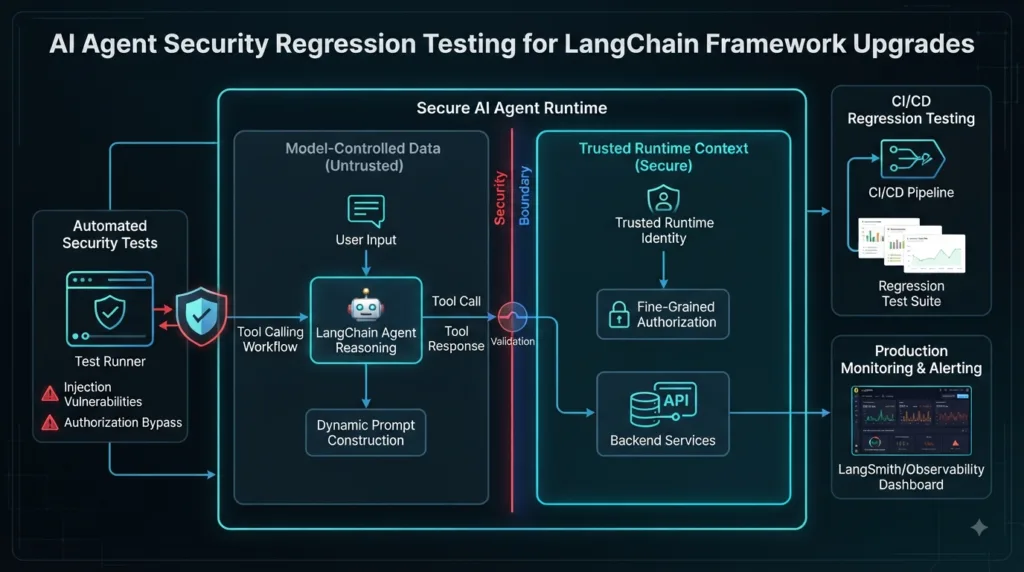
Treat Security as Part of Regression Testing
Security should not be a separate activity that begins after functional tests pass.
For AI systems, security boundaries often exist inside ordinary application flows.
Consider:
User Input
    ↓
LLM
    ↓
Tool Arguments
    ↓
Injected Identity
    ↓
Authorization
    ↓
Backend
A framework change affecting tool arguments can therefore become a security concern.
Test attacks against these boundaries.
def test_model_cannot_change_authorization_context():
    model_args = {
        "customer_id": "CUST-100",
        "user_id": "attacker",
    }

    trusted_context = {
        "user_id": "authorized-user",
    }

    result = execute_customer_tool(
        model_args,
        trusted_context,
    )

    assert result.user_id == "authorized-user"
This is much stronger than simply checking whether the tool returns a response.
Test What Happens When Things Go Wrong
A strong QA suite does not only test successful execution.
For every important workflow, create at least one failure scenario.
For a tool:
Valid input
Invalid input
Missing input
Unauthorized input
Backend failure
Timeout
Malformed response
For streaming:
Normal stream
Empty stream
Interrupted stream
Tool failure
Provider failure
Client disconnect
For asynchronous execution:
Normal completion
Timeout
Cancellation
Repeated execution
Concurrent execution
This gives your regression suite depth.
A framework upgrade can preserve the happy path while changing failure behavior.
Test Concurrent Agent Execution
AI applications frequently serve multiple users simultaneously.
A test that passes for one request does not prove that concurrent requests are isolated.
For example:
import asyncio


async def run_concurrent_tests():
    results = await asyncio.gather(
        run_agent("Customer A"),
        run_agent("Customer B"),
        run_agent("Customer C"),
    )

    return results
Then verify identity isolation:
results = asyncio.run(run_concurrent_tests())

assert results[0].user_id == "Customer A"
assert results[1].user_id == "Customer B"
assert results[2].user_id == "Customer C"
The specific implementation will vary, but the principle is critical:
Concurrency tests should verify isolation, not just throughput.
This is particularly important when runtime context, callbacks, mutable objects, or asynchronous resources are involved.
Test for State Leakage
One of the most dangerous classes of AI application bugs is unintended state persistence.
Imagine:
Request A
user_id = A
     ↓
Agent state
     ↓
Request B
user_id = B
If state is incorrectly reused:
Request B
     ↓
Receives state from A
Create explicit isolation tests.
def test_requests_do_not_share_state():
    first = run_agent(
        user_id="A",
        query="My information",
    )

    second = run_agent(
        user_id="B",
        query="My information",
    )

    assert first.user_id == "A"
    assert second.user_id == "B"
Then run the same test repeatedly and concurrently.
This type of testing can catch bugs that ordinary unit tests miss.
Use Mutation Testing for Your QA Suite
One advanced technique is mutation testing.
The idea is simple:
Intentionally introduce a small defect and check whether your tests detect it.
For example, imagine this production behavior:
return trusted_user_id
A mutation might change it to:
return model_user_id
If your security test still passes, your test suite has a gap.
You can apply the same idea to:
- required schema fields
- tool selection
- redaction
- stream ordering
- authorization
- error handling
A test suite is valuable only when it can detect the failures you care about.
Compare Conventional Regression With AI Regression
| Conventional Application | AI Application |
|---|---|
| API contracts | API + tool contracts |
| Deterministic output | Often variable output |
| Request/response | Events + streams + response |
| Authentication | Authentication + model-controlled actions |
| Logs | Logs + traces + model/tool telemetry |
| Unit tests | Unit + model/workflow evaluation |
| Exact assertions | Structured + semantic assertions |
This does not mean conventional QA techniques become obsolete.
It means they need additional layers.
The strongest AI QA strategy combines traditional software testing with AI-specific evaluation.
Don’t Assert Generated Text Too Literally
This test can become fragile:
assert response == (
    "LangChain is a framework for developing "
    "applications powered by language models."
)
A better approach is to validate important properties:
assert "LangChain" in response
assert len(response) > 20
assert contains_required_concept(response)
For structured output, validate the structure:
assert result["tool"] == "search"
assert result["status"] == "success"
assert result["query"]
For safety-sensitive workflows, test both positive and negative requirements.
assert contains_required_information(response)
assert not contains_sensitive_information(response)
The objective is to make tests strict about behavior without being unnecessarily strict about wording.
Create Evaluation Gates for Critical AI Journeys
For critical workflows, define a quality gate.
Tool Selection       ≥ 99%
Schema Validity      100%
Authorization        100%
Sensitive Leakage    0%
Stream Completion    ≥ 99%
Critical E2E         100%
The thresholds should be determined by business requirements rather than copied from another project.
A customer-support chatbot may tolerate some natural-language variation.
A workflow that executes financial transactions should have much stricter requirements.
Test the Upgrade Under Load
Functional correctness is only one dimension.
Run representative load against the upgraded application.
For example:
10 concurrent agents
50 concurrent agents
100 concurrent agents
Measure:
p50 latency
p95 latency
p99 latency
error rate
tool-call failures
stream interruptions
memory
CPU
A framework upgrade may pass every functional test while changing resource usage.
For production AI systems, that difference matters.
Compare Performance Before and After
Create a baseline:
Version: 1.5.3

p50: 1.2s
p95: 2.4s
p99: 4.1s
Error rate: 0.8%
Then compare:
Version: 1.5.4

p50: 1.1s
p95: 2.3s
p99: 4.0s
Error rate: 0.6%
Now your upgrade decision has measurable evidence.
You can automate this comparison in CI or a performance environment.
Make the Upgrade Reproducible
Never depend on:
pip install langchain-core
for a production release process.
Instead, pin the version in your dependency management strategy.
For example:
langchain-core==1.5.4
Then record:
Python version
Framework version
Provider SDK version
Pydantic version
Operating environment
Application commit
A reproducible environment makes regression investigation dramatically easier.
Maintain a Known-Good Baseline
Your team should always know which combination is currently trusted.
known_good:
  python: "3.x"
  langchain_core: "1.5.3"
  pydantic: "2.x"
  application_commit: "abc123"
When testing the new release:
candidate:
  python: "3.x"
  langchain_core: "1.5.4"
  pydantic: "2.x"
  application_commit: "abc123"
Now you are comparing one controlled variable instead of accidentally changing five dependencies at once.
Avoid the “Upgrade Everything” Trap
A common mistake is doing this:
LangChain upgrade
+
Pydantic upgrade
+
Provider SDK upgrade
+
Python upgrade
+
Application refactor
Then the test suite fails.
What changed?
You do not know.
A better approach is:
Baseline
 ↓
One meaningful dependency change
 ↓
Test
 ↓
Measure
 ↓
Approve
 ↓
Next change
This makes root-cause analysis significantly easier.
Build a Rollback Test, Not Just a Rollback Plan
Teams often document rollback but never verify it.
Test it.
Known Good
    ↓
Deploy Candidate
    ↓
Validation
    ↓
Failure
    ↓
Rollback
    ↓
Critical Tests
Then verify that the rollback version actually restores expected behavior.
A rollback that has never been tested is an assumption.
Create an AI Framework Upgrade Scorecard
A practical scorecard can summarize the entire validation.
| Category | Result |
|---|---|
| Compatibility | PASS |
| Schema contracts | PASS |
| Tool execution | PASS |
| Injected arguments | PASS |
| Streaming | PASS |
| Async stability | PASS |
| Security | PASS |
| Observability | PASS |
| Performance | PASS |
| Critical E2E | PASS |
| Rollback | PASS |
Then add a release decision:
Overall:
APPROVED
or:
Overall:
BLOCKED — streaming regression detected
This gives stakeholders a concise engineering decision without hiding the technical evidence.
A Practical AI Framework Upgrade Workflow
You can standardize the process across projects:
1. Read release notes
        ↓
2. Identify affected capabilities
        ↓
3. Map capabilities to application usage
        ↓
4. Create risk matrix
        ↓
5. Capture baseline
        ↓
6. Upgrade dependency
        ↓
7. Run contract tests
        ↓
8. Run security tests
        ↓
9. Run integration tests
        ↓
10. Run critical E2E tests
        ↓
11. Compare performance
        ↓
12. Validate observability
        ↓
13. Canary if required
        ↓
14. Approve or rollback
Once automated, this workflow becomes reusable for future framework releases.
That is the real return on investment.
Interactive Exercise: Challenge Your Current Regression Suite
Open your existing AI application’s test directory.
Ask yourself:
Do we test tool schemas?
Do we test invalid tool arguments?
Do we test injected context?
Do we test concurrent requests?
Do we test streaming failures?
Do we test callback redaction?
Do we test state isolation?
Do we compare framework versions?
Do we measure performance?
Do we have a tested rollback?
Count the “No” answers.
That number is more useful than the total number of tests in your repository.
A project with 2,000 tests can still have dangerous blind spots.
A smaller suite with strong boundary coverage can provide substantially better protection.
What Should QA Engineers Automate First?
If you have limited engineering capacity, prioritize:
1. Security boundaries
2. Tool contracts
3. Critical workflows
4. Streaming behavior
5. State isolation
6. Observability
7. Performance
8. Broad E2E coverage
Why this order?
Because the first few categories can expose high-impact failures relatively early and deterministically.
The objective is not to create thousands of AI tests.
It is to create the right tests at the right boundaries.
The SDET Opportunity
Framework releases such as LangChain 1.5.4 Released highlight how the role of the SDET is changing.
The modern SDET is increasingly working across:
Test Automation
      +
API Testing
      +
AI Evaluation
      +
Security Testing
      +
Observability
      +
Performance Engineering
      +
CI/CD
This does not mean every QA engineer needs to become an AI researcher.
It means QA engineers need to understand how AI systems behave as software systems.
The strongest skill is not memorizing framework APIs.
It is learning how to identify risk at system boundaries.
Official Resources
- Official Release Notes: https://github.com/langchain-ai/langchain/releases/tag/langchain-core%3D%3D1.5.4
- Official Documentation: https://python.langchain.com
More Related Blogs
- LangChain 1.5.3 Released: Gateway Authentication Fixes Every QA Engineer Should Know
- LangChain 1.5.0 Introduces Standardized Reasoning Controls for Enterprise AI Applications
- LangChain 1.4.9 Released: Critical AI Framework Reliability Improvements Every QA Engineer Must Know
- LangChain 1.4.8 Release: 7 Important Updates AI Testing Engineers Should Know
- LangChain 1.4.7 Released: Important Stability Improvements Every QA Engineer Should Know
- LangChain 1.4.6 Released: Valuable AI Agent Observability Improvements QA Engineers Must Know
- LangChain 1.3.11 Released: Essential AI Framework Improvements Every QA Engineer Should Know
People Asked Questions
1. What is LangChain 1.5.4?
LangChain 1.5.4 is a LangChain Core release containing compatibility improvements, bug fixes, and changes affecting areas such as structured prompts, tool schemas, injected arguments, streaming, callbacks, and asynchronous execution.
2. What changed in LangChain 1.5.4?
The release includes fixes for Pydantic 2.14 compatibility, structured prompt behavior, RootModel runnable schemas, internally created event loops, OpenAI file blocks, tool argument handling, injected arguments, callback redaction, and streaming-related functionality.
3. Is LangChain 1.5.4 safe to upgrade to?
For applications using the affected functionality, the upgrade should be validated through regression testing before production deployment. Teams should particularly test tool schemas, injected arguments, streaming, callbacks, async workflows, and application-specific integrations.
4. Does LangChain 1.5.4 introduce breaking changes?
The supplied release information does not identify a major breaking change. However, QA teams should still run their application’s compatibility and regression suites because a non-breaking framework fix can change runtime behavior.
5. How should QA engineers test LangChain 1.5.4?
Start with dependency compatibility, then test structured prompts, tool schemas, injected arguments, streaming, asynchronous execution, callbacks, file handling, security boundaries, and critical end-to-end workflows.
6. Should I test LangChain tool calling after upgrading?
Yes. Tool calling should be treated as a contract boundary. Test tool selection, required arguments, invalid arguments, schemas, runtime-injected values, authorization context, and tool failure handling.
7. Why should SDETs test injected arguments?
Injected arguments can contain trusted runtime information such as user identity or application context. Tests should ensure model-generated values cannot override trusted runtime values.
8. How can I test LangChain streaming?
Test the complete event lifecycle rather than only the final response. Validate event ordering, partial output, tool events, errors, stream termination, client disconnects, and resource cleanup.
9. How can I test LangChain upgrades in CI/CD?
Pin the candidate version, run contract tests, tool tests, security tests, streaming tests, workflow tests, and the full regression suite. Compare performance and failure metrics against the known-good version before deployment.
10. Should I upgrade LangChain immediately?
Not blindly. If your application does not use the affected functionality, the risk may be relatively low. If your system heavily depends on tools, structured output, streaming, callbacks, or asynchronous execution, perform targeted regression testing first.
11. What should I do before upgrading LangChain?
Capture a known-good baseline, pin your current dependencies, review the release changes, identify affected application capabilities, prepare targeted regression tests, and ensure that rollback is possible.
12. How is AI framework testing different from traditional testing?
Traditional applications often rely heavily on deterministic request/response behavior. AI applications additionally require testing probabilistic outputs, tool selection, agent workflows, streaming events, model behavior, runtime context, traces, and AI-specific security boundaries.
AI Overview / Answer Engine Optimization
LangChain 1.5.4 is a LangChain Core release containing compatibility improvements and bug fixes across structured prompts, tool schemas, injected arguments, streaming, callbacks, asynchronous execution, and file handling. QA engineers should validate the specific capabilities their applications use before upgrading to production.
Conclusion
LangChain 1.5.4 Released demonstrates why AI framework maintenance should be treated as an engineering discipline rather than a simple dependency-management task.
A release may contain fixes involving schemas, Pydantic compatibility, prompts, injected arguments, streaming, callbacks, asynchronous execution, and file blocks. Each change can interact with application behavior in ways that are invisible to a basic “all tests passed” check.
The better approach is to build a layered validation strategy.
Start with deterministic contract tests.
Then validate tools and runtime context.
Add security tests for trust boundaries.
Test streaming as an event-driven workflow.
Validate asynchronous lifecycle and state isolation.
Use traces and logs to make failures diagnosable.
Run critical user journeys.
Compare performance against a known-good baseline.
Finally, use canary deployment and a tested rollback strategy when the business risk justifies it.
The objective is not to prove that a new package installed successfully.
The objective is to prove that the AI system remains trustworthy after the change.
Final Key Takeaways
- Treat framework releases as behavioral changes, not merely version changes.
- Translate every relevant release-note item into a QA risk and test scenario.
- Test tool schemas independently from full agent workflows.
- Treat injected runtime arguments as security boundaries.
- Test streaming as a sequence of events rather than only checking the final response.
- Test asynchronous workflows for resource stability, not just functional correctness.
- Verify that callbacks, logs, and traces do not expose sensitive information.
- Test state isolation under repeated and concurrent execution.
- Prefer structured and semantic assertions over fragile exact-text assertions for AI-generated output.
- Compare performance and reliability against a known-good framework version.
- Pin dependencies and maintain a reproducible baseline.
- Do not upgrade several major dependencies simultaneously unless there is a deliberate reason.
- Make rollback a tested engineering capability rather than a document.
- Use risk-based testing instead of giving every framework feature identical regression effort.
- The strongest AI QA strategy combines traditional automation, security testing, observability, performance engineering, and AI-specific evaluation.
For QA engineers and SDETs, that is the bigger lesson behind LangChain 1.5.4 Released: framework maintenance is not just about keeping dependencies current. It is about continuously proving that the software system built on those dependencies remains reliable, secure, observable, and fit for production.
Continue Learning
Explore more expert articles on n8n, Autogen, Postman AI, Cursor AI, LangChain, CrewAI, MCP Servers, AI Agents, LlamaIndex, Docker, FastAPI, Playwright, Cypress, Test Automation, DevOps, and Software Engineering at www.skakarh.com.
QAPulse by SK delivers expert release analysis, AI engineering insights, enterprise automation strategies, migration guidance, DevOps best practices, and practical testing knowledge to help software professionals build scalable, intelligent, and production-ready software systems.