 QA
QA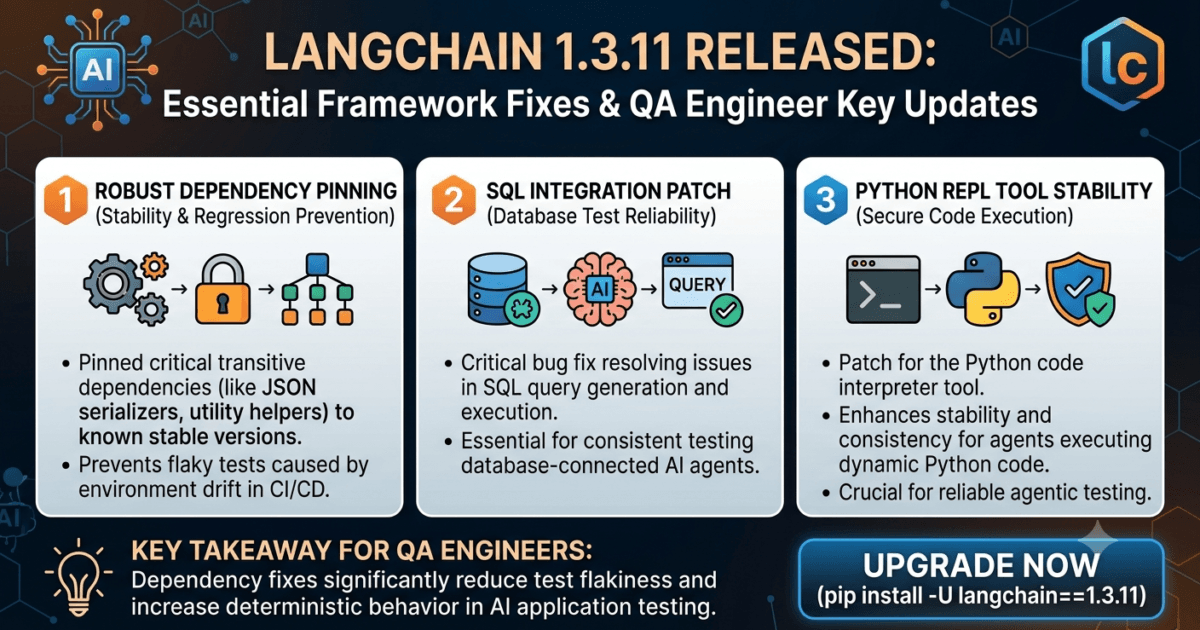
LangChain 1.3.11 Released: Improving Reliability for AI Agent Development
Artificial Intelligence frameworks evolve rapidly, but not every release introduces new chains, agents, or models. Many of the most valuable updates are those that quietly improve compatibility, stability, and developer experience—areas that directly influence production reliability.
Released on June 22, 2026, LangChain 1.3.11 is one such maintenance release.
Instead of introducing headline features, this version focuses on refining how LangChain interacts with OpenAI-compatible models, updating important project dependencies, and improving documentation around prompt design.
Although these changes may appear modest, they solve practical issues encountered by teams building production AI applications. From preventing incorrect tool configurations to keeping supporting libraries current, the release helps developers create more predictable and maintainable AI systems.
For QA engineers and SDETs validating LLM-powered applications, these improvements reduce integration inconsistencies and simplify testing across different AI providers.
What’s New in LangChain 1.3.11?
According to the official release notes, LangChain 1.3.11 includes several important improvements:
- Improved handling of strict=True when using OpenAI-compatible provider strategies.
- Updated pydantic-settings dependency.
- Updated vcrpy dependency.
- Updated LangSmith integration package.
- Improved documentation for summarization prompt contracts.
- General maintenance release for LangChain 1.3.11.
Rather than adding new APIs, the release concentrates on making existing functionality more reliable for production AI workloads.
Release Highlights
| Area | Improvement | Why It Matters |
|---|---|---|
| OpenAI Provider Strategy | Better handling of strict tool configuration | Improves compatibility across OpenAI-compatible providers |
| LangSmith | Updated integration package | Better observability and tracing support |
| Pydantic Settings | Dependency upgrade | Improved configuration reliability |
| vcrpy | Testing dependency update | Better automated testing support |
| Documentation | Summarization prompt guidance | Helps developers build consistent prompt workflows |
The Most Important Fix: OpenAI-Compatible Tool Handling
The standout improvement in LangChain 1.3.11 addresses how strict=True is applied when working with OpenAI-compatible providers.
Previously, strict tool validation could be applied more broadly than intended.
This release ensures that strict=True is only enabled where it is actually supported.
Although this sounds like an internal implementation detail, it has practical implications.
Modern AI applications increasingly switch between providers such as:
- OpenAI
- Azure OpenAI
- Compatible enterprise gateways
- Self-hosted OpenAI-compatible APIs
Small differences in provider behavior can lead to:
- Tool execution failures
- Invalid request payloads
- Unexpected runtime exceptions
- Agent execution inconsistencies
By limiting strict mode to supported providers, LangChain reduces unnecessary compatibility issues and makes multi-provider AI systems more reliable.
Why This Matters for QA Engineers
QA engineers are no longer testing only APIs or user interfaces—they are increasingly validating AI agents that interact with multiple LLM providers.
A single application may use:
- Tool calling
- Function execution
- Retrieval-Augmented Generation (RAG)
- AI agents
- Memory systems
- External APIs
- MCP servers
If provider-specific behavior isn’t handled correctly, automated tests can fail even when business logic is correct.
The improvements in LangChain 1.3.11 help reduce these inconsistencies by ensuring that provider-specific configurations are applied only where appropriate.
This leads to:
- More predictable AI behavior.
- Improved cross-provider compatibility.
- Fewer environment-specific test failures.
- Easier regression testing.
For organizations supporting multiple LLM vendors, this maintenance release contributes directly to greater platform stability.
Dependency Updates That Improve Long-Term Stability
Beyond the OpenAI compatibility fix, LangChain 1.3.11 updates several important project dependencies.
These include:
- pydantic-settings
- vcrpy
- LangSmith
Dependency upgrades are an essential part of maintaining secure and reliable software.
Updated libraries typically provide:
- Security improvements.
- Bug fixes.
- Better compatibility.
- Performance optimizations.
- Improved developer tooling.
For QA teams, staying current with validated dependency versions reduces the likelihood of unexpected issues appearing later in the software lifecycle.
Better Documentation Improves Testing
One of the less visible—but valuable—improvements in this release is updated documentation for summarization prompt contracts.
Clear documentation benefits more than developers.
It also helps QA teams:
- Understand expected model behavior.
- Design better prompt validation tests.
- Verify consistent summarization outputs.
- Create stronger regression suites for AI features.
As prompt engineering becomes a core part of software development, documentation quality plays an increasingly important role in testability and long-term maintainability.
What LangChain 1.3.11 Means for QA Engineers
Although LangChain 1.3.11 is categorized as a maintenance release, it delivers improvements that directly affect how production AI applications behave across different Large Language Model (LLM) providers.
The most important enhancement is the refinement of ProviderStrategy, ensuring that strict=True is applied only to OpenAI-compatible models that actually support strict tool validation. This reduces unexpected runtime errors when applications interact with different AI providers and makes agent behavior more predictable.
For QA engineers, this means fewer false-positive test failures caused by provider-specific implementation differences and greater confidence when validating multi-provider AI systems.
Enterprise Impact
Today’s enterprise AI platforms rarely rely on a single model provider. Organizations often deploy applications across multiple environments using different LLM services for cost optimization, regional compliance, or redundancy.
A typical enterprise AI architecture may include:
- OpenAI GPT models
- Azure OpenAI Service
- OpenAI-compatible enterprise gateways
- Internal inference servers
- LangSmith for tracing and observability
- MCP servers for tool execution
- Vector databases for Retrieval-Augmented Generation (RAG)
Each provider behaves slightly differently when handling function calling, structured outputs, and tool execution.
The ProviderStrategy improvement introduced in LangChain 1.3.11 helps reduce compatibility issues by ensuring strict tool validation is only enabled where it is officially supported.
For enterprise teams managing production AI workloads, this translates into more reliable deployments and fewer provider-specific integration problems.
Why This Matters for AI Testing
Testing AI applications is fundamentally different from testing traditional software.
QA teams now validate:
- AI agents
- Tool calling
- Function execution
- Prompt engineering
- RAG pipelines
- Multi-agent collaboration
- Structured outputs
- LLM provider compatibility
A provider-specific configuration issue can easily cause an otherwise healthy regression suite to fail.
With LangChain 1.3.11, the improved handling of ProviderStrategy reduces these inconsistencies and makes cross-provider testing significantly more predictable.
The updated dependencies also contribute to healthier development environments by keeping core libraries aligned with the latest stable releases.
Should You Upgrade?
Yes.
Although this release introduces no major new features, it improves compatibility and maintainability while reducing the risk of provider-specific tool execution issues.
Reasons to upgrade include:
- Better OpenAI-compatible provider handling.
- More reliable tool execution.
- Updated LangSmith integration.
- Latest Pydantic Settings improvements.
- Updated vcrpy testing dependency.
- Improved documentation for prompt development.
- No reported breaking changes.
For teams actively building AI agents, RAG systems, or LLM-powered applications, this is a recommended maintenance upgrade.
Regression Testing Checklist
Before deploying LangChain 1.3.11, QA teams should validate:
- Tool calling across supported providers.
- AI agent execution workflows.
- Structured output generation.
- Function calling behavior.
- LangSmith tracing integration.
- Prompt-based summarization.
- Existing regression suites.
- Configuration loading using Pydantic Settings.
- Recorded API interactions using vcrpy.
- Multi-provider compatibility testing.
Completing these checks helps ensure the upgrade does not affect production AI workflows.
How to Upgrade
Upgrade LangChain
Using pip:
pip install --upgrade langchain
Upgrade related dependencies if required:
pip install --upgrade langsmith pydantic-settings
After upgrading, rerun your automated AI test suite, validate tool-calling behavior across supported LLM providers, and compare LangSmith traces to confirm expected execution paths.
More Related Blogs
- Claude Code Complete Guide: Features, Workflows, Best Practices & Real-World Use Cases (2026)
- LangChain 1.4.8 Release: 7 Important Updates AI Testing Engineers Should Know
- LangChain 1.4.7 Released: Important Stability Improvements Every QA Engineer Should Know
- LangChain 1.4.6 Released: Valuable AI Agent Observability Improvements QA Engineers Must Know
Official Resources
- Official Release Notes: https://github.com/langchain-ai/langchain/releases/tag/langchain%3D%3D1.3.11
- Official Documentation: https://python.langchain.com
Final Verdict
LangChain 1.3.11 is a reliability-focused release that strengthens one of the most important aspects of modern AI development: consistent behavior across multiple LLM providers. While the release does not introduce new agent capabilities or APIs, refining ProviderStrategy significantly improves tool execution compatibility for OpenAI-compatible models.
The dependency upgrades for LangSmith, Pydantic Settings, and vcrpy further enhance project stability, while improved documentation makes prompt development and testing easier for engineering teams.
For QA engineers and SDETs, this release reduces provider-specific inconsistencies, improves regression testing reliability, and supports more predictable AI application behavior.
Recommendation: Upgrade to LangChain 1.3.11 during your next maintenance cycle. It is a safe, low-risk update that improves compatibility, testing reliability, and long-term maintainability without introducing breaking changes.
Frequently Asked Questions
Does LangChain 1.3.11 introduce breaking changes?
No. The official release notes do not report any breaking changes. This is a maintenance release focused on compatibility improvements and dependency updates.
What is the biggest improvement in LangChain 1.3.11?
The most significant enhancement is the ProviderStrategy fix that applies strict=True only to supported OpenAI-compatible models, improving tool-calling compatibility.
Should production AI applications upgrade?
Yes. Organizations building AI agents, RAG applications, or LLM-powered workflows should upgrade to benefit from improved provider compatibility and updated dependencies.
Is this release important for QA engineers?
Absolutely. Better provider compatibility means more reliable regression testing, fewer environment-specific failures, and improved confidence when validating AI workflows across different LLM providers.
LangChain 1.3.11 Released: Key Takeaways
LangChain 1.3.11 Released focuses on improving compatibility rather than adding new features. The refined ProviderStrategy implementation, updated core dependencies, enhanced LangSmith integration, and improved prompt documentation make this a valuable maintenance release for teams developing production AI systems. QA engineers, AI developers, and SDETs should consider upgrading to benefit from more predictable tool execution and stronger long-term platform stability.
Continue Learning
Explore more expert articles on LangChain, MCP, CrewAI, LlamaIndex, n8n, FastAPI, Docker, Playwright, AI Agents, Test Automation, and Software Engineering at www.skakarh.com.
QAPulse by SK delivers expert release analysis, migration guidance, AI engineering insights, enterprise testing strategies, and practical automation knowledge to help software professionals stay ahead of the rapidly evolving AI ecosystem.