QA
QA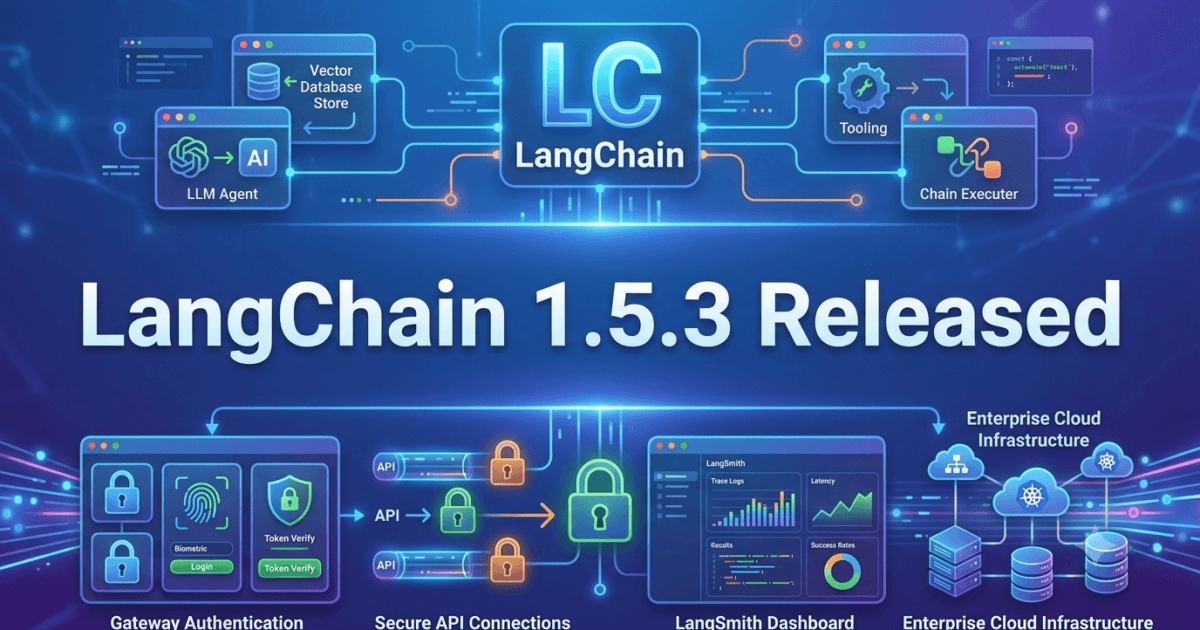
Introduction
LangChain 1.5.3 was officially released on July 30, 2026, bringing a focused but important maintenance update to one of the world’s most widely adopted frameworks for building AI applications, AI agents, Retrieval-Augmented Generation (RAG) systems, and enterprise LLM workflows. While this release does not introduce new APIs or major features, it delivers a critical reliability fix that improves authentication behavior for teams using LangSmith Gateway and enterprise AI development environments.
Patch releases often receive less attention than feature releases, but experienced QA Engineers, SDETs, AI Test Engineers, MLOps Engineers, and Platform Engineers understand that stability updates frequently have the greatest impact on production systems. A single authentication issue can interrupt automated testing pipelines, break deployment workflows, delay AI application releases, and generate unnecessary debugging effort across multiple engineering teams.
LangChain has rapidly evolved into the foundation of countless AI-powered applications, supporting integrations with OpenAI, Anthropic, Google Gemini, Azure OpenAI, Hugging Face, Ollama, vector databases, memory systems, and orchestration frameworks such as LangGraph. As organizations increasingly adopt Agentic AI architectures, maintaining stable authentication and infrastructure compatibility becomes just as important as introducing new AI capabilities.
Version 1.5.3 focuses on improving gateway authentication by allowing LangChain Core to automatically fall back to the LANGSMITH_API_KEY environment variable whenever a dedicated Gateway API key is unavailable. This seemingly small enhancement significantly improves developer experience, deployment reliability, and automation consistency across local development, CI/CD pipelines, staging environments, and enterprise production systems.
For QA teams responsible for validating AI workflows, prompt execution, model orchestration, observability, and automated regression testing, this release removes unnecessary authentication friction while making AI infrastructure more resilient and predictable.
Official Release Highlights
According to the official LangChain release notes, LangChain Core 1.5.3 includes the following changes:
Release Updates
- LangChain Core updated to version 1.5.3
Bug Fix
- Fallback to
LANGSMITH_API_KEYfor Gateway authentication
Although the changelog is intentionally concise, the practical benefits extend far beyond a simple bug fix. Authentication is one of the most critical components of any distributed AI ecosystem, and ensuring seamless credential resolution helps organizations maintain uninterrupted AI operations.
Understanding the Gateway Authentication Fix
Authentication serves as the entry point for virtually every enterprise AI workflow. Whether an organization is executing LLM requests, collecting observability metrics, managing prompt versions, or tracing AI agent executions, secure credential handling is essential.
Before this release, some Gateway authentication scenarios required a dedicated Gateway-specific API key even when a valid LANGSMITH_API_KEY was already configured within the environment.
This created several challenges:
- Additional environment configuration
- Duplicate credential management
- Increased deployment complexity
- CI/CD configuration inconsistencies
- Authentication failures across different environments
LangChain 1.5.3 simplifies this process by automatically checking for the existing LANGSMITH_API_KEY whenever Gateway credentials are unavailable.
For organizations already using LangSmith observability, this means fewer configuration requirements and a more streamlined authentication workflow.
Why This Matters for Enterprise AI Development
Modern AI applications rarely operate within a single environment.
Most enterprise projects include:
- Local developer workstations
- Development servers
- Testing environments
- QA environments
- Staging deployments
- Production infrastructure
- CI/CD pipelines
- Containerized cloud deployments
Each environment requires secure credential management.
When authentication behavior differs between environments, QA teams often spend significant time troubleshooting deployment issues rather than validating application functionality.
The fallback introduced in LangChain 1.5.3 improves consistency across all deployment stages by reducing dependency on redundant environment variables.
This translates directly into:
- Faster deployments
- Simplified infrastructure management
- Reduced configuration errors
- More reliable automated testing
- Improved developer productivity
Improved Experience for QA Engineers
Although this release targets infrastructure rather than end-user functionality, QA Engineers benefit considerably.
AI testing increasingly depends on reproducible environments where credentials are injected automatically through environment variables or secret management systems.
With the new fallback mechanism, automation pipelines become more resilient because they can continue operating even when Gateway-specific credentials are omitted, provided that LANGSMITH_API_KEY is already available.
For QA Engineers testing:
- AI agents
- RAG pipelines
- LangGraph workflows
- Prompt orchestration
- LLM integrations
- AI observability
this reduces environmental inconsistencies that often lead to failed test executions unrelated to application logic.
What This Means for QA Engineers
Key Improvement 1 – More Reliable AI Test Automation
Automated AI testing frequently runs inside GitHub Actions, Azure DevOps, GitLab CI, Jenkins, Docker containers, or Kubernetes clusters.
Managing multiple authentication variables across every environment increases operational complexity.
LangChain 1.5.3 simplifies authentication by intelligently reusing existing LangSmith credentials whenever possible.
This results in:
- More reliable automation pipelines
- Fewer authentication-related failures
- Easier infrastructure maintenance
- Improved deployment consistency
Key Improvement 2 – Better Developer and Platform Experience
Engineering teams maintaining multiple AI services often centralize credentials using environment variables and secret managers.
By reducing unnecessary credential duplication, LangChain 1.5.3 lowers operational overhead while improving the overall developer experience.
Platform engineers, DevOps teams, and QA automation engineers all benefit from simpler configuration management.
Breaking Changes
No breaking changes have been introduced in LangChain 1.5.3.
The update is fully backward compatible and focuses exclusively on improving authentication resilience.
Organizations already running LangChain 1.5.x can upgrade with minimal risk.
Upgrade Recommendation
This update is recommended for:
- QA Engineers
- AI Test Engineers
- SDETs
- Platform Engineers
- DevOps Engineers
- MLOps Teams
- LangSmith users
- LangGraph developers
- Enterprise AI teams
- Organizations deploying LangChain in production
If your applications rely on LangSmith Gateway, observability, or centralized environment variable management, upgrading to LangChain 1.5.3 is strongly recommended.
How to Upgrade
Python
pip install --upgrade langchain
Node.js
npm install langchain@latest
After upgrading, validate:
- LangSmith authentication
- Gateway connectivity
- Prompt execution
- Agent workflows
- RAG pipelines
- CI/CD deployments
- Environment variable configuration
to ensure everything operates as expected.
LangChain 1.5.3 Gateway Authentication Explained: Why This Small Fix Has a Big Impact on AI Testing
Why Authentication Reliability Matters in Modern AI Applications
At first glance, LangChain 1.5.3 appears to be a minor maintenance release because it contains only one functional bug fix. However, experienced QA Engineers, AI Test Engineers, SDETs, MLOps Engineers, and Platform Engineers know that infrastructure improvements often have a much greater impact than new features. Authentication is one of the foundational building blocks of any production AI application, and even a small issue can cause AI workflows, automated tests, deployment pipelines, and observability platforms to fail unexpectedly.
As organizations increasingly deploy LLM-powered applications, AI agents, Retrieval-Augmented Generation (RAG) systems, and multi-agent workflows, maintaining consistent authentication across different environments has become a critical engineering challenge. Developers expect AI frameworks like LangChain to seamlessly connect with services such as LangSmith, cloud-hosted language models, API gateways, vector databases, and monitoring platforms without requiring unnecessary configuration changes.
The primary improvement in LangChain 1.5.3 addresses this challenge by making Gateway authentication more resilient. Instead of failing when a dedicated Gateway API key is unavailable, LangChain now intelligently falls back to the existing LANGSMITH_API_KEY, reducing authentication failures and simplifying enterprise deployments.
Understanding LangSmith and Gateway Authentication
Before exploring the fix, it’s important to understand how LangSmith fits into the LangChain ecosystem.
What Is LangSmith?
LangSmith is the official developer platform for observing, debugging, testing, and evaluating LangChain applications. It provides deep visibility into AI workflows by allowing developers and QA engineers to trace every interaction between prompts, models, tools, memory, and agents.
Key LangSmith capabilities include:
- Prompt tracing
- Agent execution monitoring
- Workflow visualization
- Performance analytics
- Evaluation datasets
- Regression testing
- Production debugging
- AI application observability
For organizations building enterprise AI systems, LangSmith has become an essential component for maintaining quality and reliability throughout the software development lifecycle.
What Is the Gateway?
The Gateway acts as an intermediary layer that securely routes requests between your application and supported AI providers or enterprise services. Instead of every application directly managing connections and authentication, the Gateway centralizes communication, making AI infrastructure easier to secure and monitor.
Typical responsibilities of the Gateway include:
- Authentication
- Request routing
- API management
- Logging
- Usage tracking
- Security enforcement
- Traffic monitoring
- Enterprise governance
Because nearly every AI request passes through this layer, reliable authentication is essential.
The Problem Before LangChain 1.5.3
Prior to this release, some Gateway authentication scenarios expected a dedicated Gateway credential even when a valid LANGSMITH_API_KEY already existed.
Imagine an organization using:
- LangSmith for observability
- LangGraph for orchestration
- OpenAI models
- CI/CD automation
- Docker containers
- Kubernetes deployments
Developers might already configure:
LANGSMITH_API_KEY=xxxxxxxx
However, certain Gateway operations still required additional authentication variables.
This introduced several operational challenges:
- Duplicate secrets
- More environment variables
- Additional deployment configuration
- Higher maintenance costs
- Increased risk of authentication failures
Even though the required credential already existed, the application couldn’t always reuse it automatically.
How LangChain 1.5.3 Solves the Issue
LangChain 1.5.3 introduces a smarter authentication workflow.
When a Gateway-specific credential isn’t available, the framework now automatically checks whether LANGSMITH_API_KEY has already been configured.
If it exists, LangChain uses it without requiring additional configuration.
This creates a much smoother developer experience while reducing operational complexity.
Instead of maintaining multiple credentials for closely related services, organizations can often rely on a single trusted authentication source.
This improvement follows an important engineering principle:
Reuse existing secure configuration whenever possible instead of introducing unnecessary duplication.
Benefits for Enterprise AI Teams
Although the release note contains only one sentence describing the fix, its benefits become much more significant in enterprise environments.
Simpler Environment Management
Modern software teams commonly maintain multiple deployment environments.
Typical deployment stages include:
- Local development
- QA
- Integration testing
- Staging
- Production
- Disaster recovery
Each environment typically stores secrets independently.
Reducing the number of required credentials simplifies:
- Infrastructure provisioning
- Secret management
- Container deployment
- Environment setup
- Configuration reviews
This lowers operational overhead across the entire engineering organization.
Better CI/CD Stability
Continuous Integration pipelines execute automation many times every day.
Authentication failures inside CI pipelines often cause:
- Failed builds
- Delayed releases
- Interrupted regression testing
- Increased debugging effort
By automatically reusing an existing LangSmith credential, LangChain reduces one of the common causes of environment-specific failures.
For QA teams, this translates into more predictable automation execution and fewer false infrastructure failures.
Why QA Engineers Should Care
Many QA professionals assume authentication improvements primarily benefit developers.
In reality, authentication stability directly affects software quality.
Automated testing environments often execute:
- Prompt validation
- Agent workflows
- RAG testing
- Tool integrations
- Memory validation
- Performance benchmarks
- AI regression suites
Every one of these tests depends on successful authentication.
If authentication fails:
- Tests never execute.
- Pipelines fail before validation begins.
- False negatives increase.
- Root cause analysis becomes more difficult.
LangChain 1.5.3 reduces these risks by making authentication behavior more predictable.
Real-World Enterprise Scenario
Consider an organization building an internal AI assistant using:
- LangChain
- LangGraph
- OpenAI GPT models
- LangSmith
- Pinecone
- Docker
- Kubernetes
- GitHub Actions
Previously, developers needed to configure multiple authentication variables across every environment.
Missing just one variable could stop deployment.
With LangChain 1.5.3, existing LangSmith credentials can automatically satisfy Gateway authentication in supported scenarios.
The result is:
- Faster deployments
- Cleaner configuration
- Lower maintenance
- Better portability
- Fewer deployment failures
For organizations operating dozens of AI services, this seemingly small improvement can save significant engineering time over the long term.
Migration Considerations
The good news for existing users is that LangChain 1.5.3 does not introduce breaking changes.
Migration is straightforward.
Before Upgrading
Review your environment variables:
- LANGSMITH_API_KEY
- Gateway credentials
- Secret management
- CI/CD variables
After Upgrading
Validate:
- Gateway connectivity
- LangSmith tracing
- Prompt execution
- Agent workflows
- Model responses
- Integration tests
- Production monitoring
Because the update is backward compatible, most organizations should experience a smooth transition.
Recommendations for QA Teams
After upgrading to LangChain 1.5.3, QA Engineers should include authentication validation within their regression strategy.
Recommended validation includes:
Authentication Tests
- Verify LangSmith connectivity.
- Confirm Gateway authentication.
- Validate secret loading.
- Test credential fallback behavior.
Functional Tests
- Execute prompts.
- Run agent workflows.
- Validate tool calling.
- Verify memory persistence.
Regression Tests
- Compare execution traces.
- Review LangSmith logs.
- Monitor authentication events.
- Confirm no existing functionality regressed.
Official Resources
- Official Release Notes: https://github.com/langchain-ai/langchain/releases/tag/langchain-core%3D%3D1.5.3
- Official Documentation: https://python.langchain.com
More Related Blogs
- LangChain 1.5.0 Introduces Standardized Reasoning Controls for Enterprise AI Applications
- LangChain 1.4.9 Released: Critical AI Framework Reliability Improvements Every QA Engineer Must Know
- LangChain 1.4.8 Release: 7 Important Updates AI Testing Engineers Should Know
- LangChain 1.4.7 Released: Important Stability Improvements Every QA Engineer Should Know
- LangChain 1.4.6 Released: Valuable AI Agent Observability Improvements QA Engineers Must Know
- LangChain 1.3.11 Released: Essential AI Framework Improvements Every QA Engineer Should Know
People Also Ask
What is LangChain 1.5.3?
LangChain 1.5.3 is a maintenance release that improves Gateway authentication by supporting automatic fallback to LANGSMITH_API_KEY.
When was LangChain 1.5.3 released?
LangChain 1.5.3 was released on July 30, 2026.
What changed in LangChain 1.5.3?
The release fixes Gateway authentication by allowing LangChain to reuse LANGSMITH_API_KEY when Gateway credentials are unavailable.
Does LangChain 1.5.3 introduce breaking changes?
No. The release is backward compatible and focuses on authentication reliability.
Should QA Engineers upgrade to LangChain 1.5.3?
Yes. Teams using LangSmith, LangGraph, AI agents, or CI/CD pipelines should upgrade for improved authentication stability.
Is LangChain 1.5.3 suitable for production?
Yes. It is a recommended maintenance release for production AI applications.
Does this release improve LangSmith integration?
Yes. Authentication between LangChain and LangSmith becomes more resilient through automatic credential fallback.
Is migration required?
No significant migration is required because the update preserves existing behavior while improving authentication.
Key Takeaways
- LangChain Core updated to version 1.5.3
- Improved Gateway authentication reliability
- Automatic fallback to
LANGSMITH_API_KEY - Easier enterprise deployment
- Better CI/CD pipeline stability
- No breaking changes
- Recommended upgrade for LangSmith users
- Minimal migration effort
Final Thoughts
LangChain 1.5.3 demonstrates that even a single-line release note can represent a meaningful improvement for enterprise AI engineering. By introducing automatic fallback to LANGSMITH_API_KEY for Gateway authentication, the framework reduces configuration complexity, improves deployment consistency, and strengthens the reliability of AI testing environments.
For QA Engineers, SDETs, and AI platform teams, this release simplifies infrastructure management while ensuring automated test pipelines spend less time failing due to configuration issues and more time validating actual application quality. Although users may never directly notice this enhancement in day-to-day development, its impact becomes increasingly valuable as AI systems scale across multiple environments and production workloads.
If your organization uses LangChain with LangSmith, CI/CD pipelines, or enterprise AI deployments, LangChain 1.5.3 is a recommended upgrade that improves operational resilience with virtually no migration effort.
Continue Learning with QAPulse by SK
At QAPulse by SK, we continuously analyze the latest releases across n8n, LangChain, CrewAI, LangGraph, Model Context Protocol (MCP), FastAPI, Python, Node.js, Docker, Playwright, Selenium, Locust, k6, and many other technologies shaping the future of intelligent automation and AI-powered software engineering.
Our goal is to help QA Engineers, SDETs, Automation Engineers, AI Engineers, DevOps Engineers, Platform Engineers, and Software Architects stay ahead with enterprise-grade release analyses, migration strategies, AI workflow testing guides, regression checklists, production deployment best practices, and practical automation insights that support building secure, scalable, and production-ready automation platforms.