QA
QA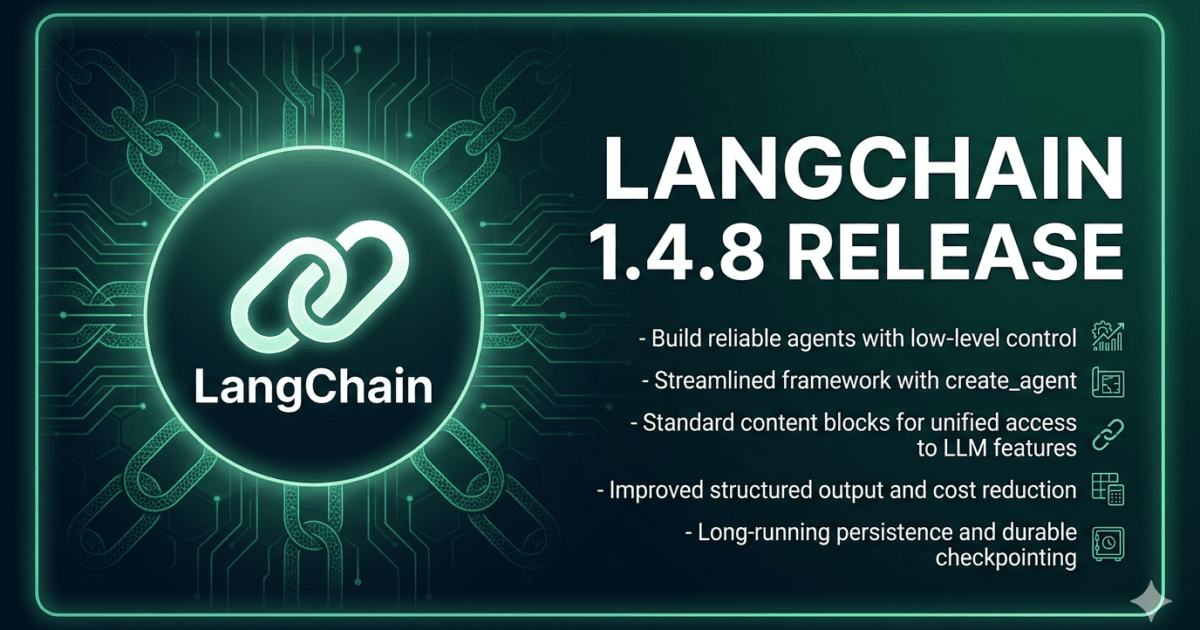
The LangChain 1.4.8 Release, published on June 18, 2026, is more significant than it initially appears. While the release contains no major new agent frameworks or groundbreaking AI features, it includes important performance improvements, security-related dependency updates, streaming fixes, type-safety enhancements, and modernization efforts that directly impact teams building AI applications.
For QA engineers, SDETs, AI testing specialists, and agentic AI developers, this release addresses several areas that influence reliability, observability, and maintainability of LangChain-based systems.
As more organizations build AI agents, Retrieval-Augmented Generation (RAG) applications, MCP integrations, and multi-agent systems using LangChain, even small framework improvements can have measurable effects on testing and production stability.
In this article, we’ll explore:
- What’s new in LangChain 1.4.8
- The most important fixes for AI testing teams
- Performance improvements
- Python compatibility changes
- Migration considerations
- Upgrade recommendations
What is LangChain?
LangChain is one of the most widely adopted frameworks for building AI-powered applications.
Developers use LangChain to create:
- AI Agents
- Multi-Agent Systems
- RAG Applications
- Tool-Calling Workflows
- MCP Integrations
- Conversational AI
- Enterprise AI Platforms
Modern QA teams increasingly test applications built with LangChain because it powers:
- Agent orchestration
- Tool execution
- Context management
- LLM integrations
- Workflow automation
This makes every LangChain release relevant for software quality engineers.
What’s New in LangChain 1.4.8?
The LangChain 1.4.8 Release includes updates across several categories.
Release Summary
| Category | Change |
|---|---|
| Performance | Tool schema caching optimization |
| Streaming | Preserve token usage details |
| Compatibility | Remove Python < 3.10 support |
| Security | Dependency upgrades |
| Type Safety | Generic validation improvements |
| Documentation | README refresh |
| Testing | Explicit deserialization allowlists |
The release primarily focuses on stability, performance, and maintainability.
Key Improvement #1: Faster Tool Schema Processing
One of the most valuable changes in the LangChain 1.4.8 Release is:
perf(core): memoize BaseTool.tool_call_schema subset model and cache model_json_schema
Although this may appear highly technical, it can significantly improve performance in agent-heavy environments.
Why This Matters
Modern AI applications often perform repeated schema generation for:
- Tool Calling
- Agent Execution
- Function Invocation
- MCP Tool Discovery
- API Integrations
Repeated schema creation can introduce overhead.
LangChain now caches these operations to reduce unnecessary work.
Benefits
- Faster tool initialization
- Reduced processing overhead
- Improved agent execution efficiency
- Better scalability
QA Perspective
Teams testing:
- Agent frameworks
- MCP servers
- AI automation platforms
- Tool-calling systems
may observe:
- Faster execution
- Reduced latency
- More predictable performance
Performance regression testing should verify improvements in heavily tool-driven workflows.
Key Improvement #2: Streaming Usage Data Fix
Another important update is:
fix(core): preserve usage token details in v3 streaming events
This is particularly important for AI observability.
Why This Matters
Many organizations track:
- Prompt tokens
- Completion tokens
- Cost metrics
- Usage analytics
- Billing information
If streaming events lose token usage information, teams may struggle to:
- Monitor costs
- Audit AI usage
- Analyze performance
The fix ensures usage details remain available during streaming operations.
QA Perspective
This improvement directly benefits:
- AI testing teams
- FinOps teams
- LLM monitoring systems
- Agent observability platforms
After upgrading, validate:
- Token counts
- Cost reporting
- Streaming telemetry
- Analytics dashboards
Key Improvement #3: Python Modernization
One notable change is:
refactor(langchain-classic): remove code for Python < 3.10What Does This Mean?
LangChain continues moving toward modern Python versions.
Support for older Python implementations is being removed from relevant code paths.
Benefits
- Cleaner codebase
- Better maintainability
- Modern language features
- Reduced technical debt
QA Impact
Organizations still running:
- Python 3.8
- Python 3.9
should review compatibility plans.
While this release may not immediately break environments, it signals a clear modernization direction.
Key Improvement #4: Stronger Type Safety
The release introduces:
fix(core): disallow_any_generics
and:
chore(core): add mypy warn_unreachable
These updates improve internal type validation.
Why This Matters
Type safety helps detect:
- Invalid tool definitions
- Incorrect model structures
- Runtime edge cases
- Serialization problems
For enterprise AI systems, stronger typing improves reliability.
QA Perspective
Type-related improvements often reduce:
- Unexpected runtime failures
- Integration issues
- Agent orchestration bugs
Key Improvement #5: Security and Dependency Updates
The LangChain 1.4.8 Release upgrades several dependencies.
| Dependency | Previous | Updated |
|---|---|---|
| jupyter-server | 2.18.0 | 2.20.0 |
| tornado | 6.5.6 | 6.5.7 |
| bleach | 6.3.0 | 6.4.0 |
These updates improve ecosystem security and maintenance.
Why Security Updates Matter
Many AI systems expose:
- APIs
- Dashboards
- Interactive notebooks
- Agent management interfaces
Keeping dependencies current reduces risk exposure.
Key Improvement #6: Explicit Deserialization Controls
The release updates tests for:
explicit deserialization allowlists
This may appear minor but reflects a broader focus on safer object handling.
QA Perspective
Serialization and deserialization issues can affect:
- Agent memory
- Workflow state
- Tool responses
- Distributed systems
Security-conscious teams should monitor future developments in this area.
What Does the LangChain 1.4.8 Release Mean for QA Engineers?
Let’s evaluate the practical impact.
Impact Assessment
| Area | Impact |
|---|---|
| AI Agents | Medium |
| Tool Calling | High |
| Streaming Applications | High |
| MCP Integrations | Medium |
| Performance Testing | High |
| Security Posture | Medium |
| Existing Applications | Low |
The release is primarily about improving existing capabilities rather than introducing new ones.
Are There Any Breaking Changes?
Potential Compatibility Consideration
The most important change is:
remove code for Python < 3.10
While many modern teams already run Python 3.10+, organizations using older runtimes should review upgrade plans.
Official Breaking Changes
No major breaking changes were announced.
Most applications should continue functioning normally after upgrading.
QA Validation Checklist
After upgrading to the LangChain 1.4.8 Release, validate:
AI Agent Testing
- Agent execution
- Tool invocation
- Tool discovery
- Memory workflows
Streaming Validation
- Token tracking
- Usage reporting
- Streaming responses
- Analytics integration
Performance Testing
- Agent startup time
- Tool execution latency
- MCP integrations
- RAG workflows
Compatibility Testing
- Python runtime validation
- Dependency compatibility
- Existing test suites
- CI/CD pipelines
Migration Guidance
Recommended Upgrade Strategy
- Upgrade in a development environment.
- Run AI workflow regression tests.
- Validate streaming telemetry.
- Verify tool-calling behavior.
- Confirm Python compatibility.
Most organizations should experience a straightforward upgrade process.
Should You Upgrade Immediately?
Recommendation: Yes
For most teams:
✅ Low risk
✅ Useful performance improvements
✅ Better streaming observability
✅ Security dependency updates
✅ Stronger type safety
Upgrade Priority Matrix
| Team Type | Recommendation |
|---|---|
| AI Startups | Upgrade Now |
| Agentic AI Teams | Upgrade Now |
| Enterprise AI Platforms | Staging Validation |
| MCP Developers | Upgrade Now |
| QA Automation Teams | Upgrade Now |
How to Upgrade LangChain
Python
pip install --upgrade langchain
Verify installation:
pip show langchain
Using Requirements File
pip install -r requirements.txt --upgrade
Important Note
LangChain is primarily a Python framework.
The command:
npm install langchain@latest
applies only to the JavaScript/TypeScript LangChain ecosystem and is not equivalent to upgrading Python LangChain.
LangChain 1.4.8 Release Verdict
The LangChain 1.4.8 Release is a quality-focused update that improves performance, observability, maintainability, and ecosystem health.
The most valuable enhancements for QA engineers include:
- Tool schema caching
- Streaming usage preservation
- Dependency security updates
- Improved type safety
Although no major features were introduced, these improvements help build more reliable AI systems and create a better foundation for agentic AI development.
Overall Rating:
| Category | Rating |
|---|---|
| Stability | 9/10 |
| Performance Impact | 8/10 |
| AI Testing Relevance | 9/10 |
| Upgrade Risk | 9/10 |
| Recommended Upgrade | Yes |
Frequently Asked Questions
What is the biggest improvement in LangChain 1.4.8?
The most impactful update is schema caching optimization for tool calling and agent workflows.
Does this release introduce new AI agent features?
No. The release focuses on performance, fixes, security updates, and maintainability improvements.
Are there any breaking changes?
No major breaking changes were announced, but organizations using Python versions older than 3.10 should review compatibility plans.
Why is the streaming token fix important?
It preserves usage metrics used for cost tracking, analytics, monitoring, and observability.
Should AI engineering teams upgrade?
Yes. The release provides meaningful improvements with minimal upgrade risk.
External Resources
Official LangChain Release Notes: https://github.com/langchain-ai/langchain/releases/tag/langchain-core%3D%3D1.4.8
LangChain Documentation: https://python.langchain.com
LangChain GitHub Repository: https://github.com/langchain-ai/langchain
More Related Blogs
- FastAPI 0.137.1 Released: Important API Routing Fixes QA Engineers Should Upgrade For
- PyTest 9.1.0 Released: Critical Fixture Changes QA Engineers Must Understand
- Playwright 1.61.0 Released: Powerful Authentication Testing Features QA Engineers Must Know
- LangChain 1.4.6 Released: Valuable AI Agent Observability Improvements QA Engineers Must Know
Final Thoughts
The LangChain 1.4.8 Release may not introduce flashy new AI capabilities, but it delivers improvements exactly where mature AI platforms need them most: performance, observability, security, and maintainability.
For QA engineers, SDETs, AI testing specialists, and agentic AI developers, the release strengthens the foundation of LangChain-powered systems while reducing operational friction in production environments.
As AI applications become more complex, these kinds of stability-focused releases often provide greater long-term value than headline-grabbing features.