 QA
QA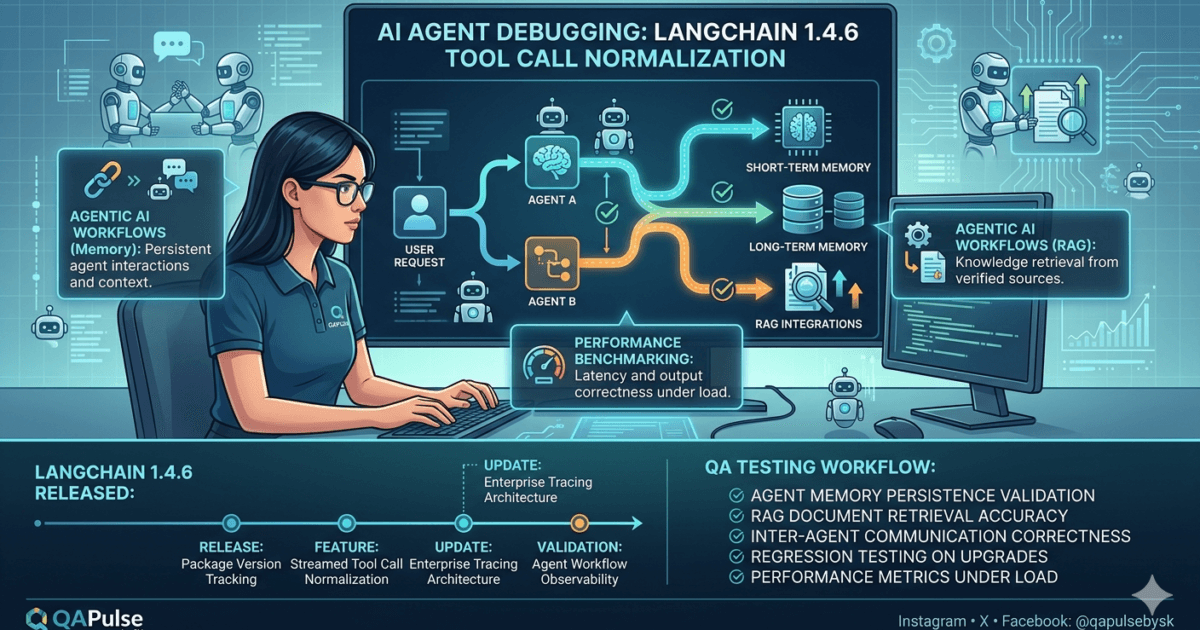
The LangChain team has officially released LangChain 1.4.6, bringing important improvements focused on AI agent observability, tracing metadata, OpenAI tool call consistency, and developer experience.
While this is a relatively small release compared to major feature launches, it addresses an area that is becoming increasingly critical in enterprise AI systems:
Understanding why AI agents behave the way they do.
For QA Engineers, SDETs, AI Test Engineers, Agentic AI Architects, and organizations building production-grade LLM applications, these updates can significantly improve debugging, monitoring, root-cause analysis, and compliance investigations.
What Is LangChain 1.4.6?
LangChain is one of the most widely used frameworks for building:
- AI Agents
- RAG Applications
- LLM Workflows
- Multi-Agent Systems
- Conversational AI Platforms
- Enterprise AI Solutions
It provides abstractions for:
- Prompt management
- Tool calling
- Memory systems
- Retrieval pipelines
- Agent orchestration
- Model integrations
Official Release Notes:
https://github.com/langchain-ai/langchain/releases/tag/langchain-core%3D%3D1.4.6
Official Documentation:
Official Repository:
https://github.com/langchain-ai/langchain
Why LangChain 1.4.6 Matters for QA Engineers
Traditional software testing focuses on:
- Functional correctness
- API responses
- Performance
- Security
AI systems introduce additional challenges:
- Hallucinations
- Tool misuse
- Non-deterministic behavior
- Context corruption
- Retrieval failures
To test these systems effectively, teams need better observability.
LangChain 1.4.6 directly improves this area.
What’s New in LangChain 1.4.6?
Feature #1: Package Version Tracking in Tracing Metadata
The most significant enhancement in LangChain 1.4.6 is:
Package version tracking added to tracing metadata.
Why This Matters
Many organizations run:
- Multiple environments
- Multiple LangChain versions
- Different model providers
- Custom agent frameworks
When issues occur, teams often struggle to determine:
- Which package version generated the trace
- Which dependency introduced the issue
- Whether a regression was introduced after upgrades
Version-aware tracing solves this problem.
QA Benefits
Testing teams can now:
- Track regressions faster
- Compare behavior across versions
- Simplify root-cause analysis
- Improve auditability
This is particularly valuable in enterprise environments.
Why Version Tracking Matters for AI Testing
Imagine this scenario:
Your agent passes all tests in staging.
After deployment:
- Tool execution changes
- Prompt behavior changes
- Retrieval quality drops
Without version-aware tracing, identifying the root cause can take hours.
With package version tracking, teams can quickly determine:
- Which framework version was running
- Which dependencies changed
- Whether behavior changed after an upgrade
This dramatically improves AI observability.
Feature #2: OpenAI Streamed Tool Call Normalization
LangChain 1.4.6 also includes:
Normalization of v1 streamed tool calls.
Why This Is Important
Tool calling is at the heart of modern Agentic AI.
Examples include:
- Database queries
- API requests
- Search operations
- MCP tools
- RAG retrieval systems
Inconsistent streaming behavior can create:
- Parsing errors
- Agent failures
- Tool execution issues
- Debugging challenges
The normalization fix improves consistency when processing streamed tool responses.
QA Testing Areas
Validate:
- Tool invocation
- Streaming outputs
- Function calling
- Multi-step agent execution
- Error handling
Organizations building agent workflows should prioritize this validation.
Infrastructure Improvements
LangChain 1.4.6 also includes:
- mypy 2.1 upgrade
- Unified type-checking configuration
Why This Matters
Although primarily an engineering improvement, stronger type validation often leads to:
- Better code quality
- Fewer runtime defects
- More predictable integrations
This reduces long-term maintenance risk.
Impact on AI Agent Testing
| Area | Impact |
|---|---|
| Agent Observability | High |
| Tracing & Monitoring | High |
| Tool Calling | High |
| Root Cause Analysis | High |
| Multi-Agent Systems | Medium |
| RAG Applications | Medium |
| Developer Productivity | Medium |
Impact on QA Engineers
Teams building AI-powered applications should focus on:
Agent Validation
- Goal completion
- Tool usage
- Error handling
Tracing Validation
- Metadata collection
- Version tracking
- Event correlation
Regression Testing
- Tool call consistency
- Prompt execution
- Response quality
Monitoring Validation
- Observability dashboards
- Distributed traces
- Log integrations
Impact on Agentic AI Platforms
Organizations using:
- LangGraph
- CrewAI
- AutoGen
- MCP Servers
- Custom Agent Frameworks
can benefit from stronger observability because debugging distributed AI workflows remains one of the biggest operational challenges in production.
This release helps address that challenge.
Impact on RAG Testing
While LangChain 1.4.6 does not directly introduce Retrieval-Augmented Generation features, better tracing provides significant benefits.
QA teams can more easily analyze:
- Retrieval failures
- Context quality
- Citation accuracy
- Knowledge source usage
This makes RAG debugging substantially easier.
Migration Guide
Upgrade LangChain
pip install --upgrade langchain
Verify Installation
python -c "import langchain; print(langchain.__version__)"
Validate Critical Areas
After upgrading:
- Tool calling
- Agent workflows
- Tracing exports
- OpenAI integrations
- Monitoring dashboards
Testing Checklist After Upgrading
Functional Testing
✅ Agent execution
✅ Tool invocation
✅ Workflow completion
Observability Testing
✅ Tracing metadata
✅ Version information
✅ Event correlation
OpenAI Testing
✅ Streamed responses
✅ Tool calls
✅ Function execution
Enterprise Testing
✅ Monitoring integrations
✅ Logging systems
✅ Audit trails
LangChain 1.4.6 vs Previous Release
| Feature Area | LangChain 1.4.5 | LangChain 1.4.6 |
|---|---|---|
| Package Version Tracing | No | Yes |
| Tool Call Normalization | Basic | Improved |
| Observability | Standard | Enhanced |
| OpenAI Streaming Consistency | Standard | Improved |
| Type Checking Infrastructure | Previous Version | Updated |
My QA Assessment of LangChain 1.4.6
Biggest Win
Package version tracking in tracing metadata.
Most Valuable Enterprise Improvement
Improved AI observability.
Most Important AI Testing Benefit
Faster root-cause analysis during production incidents.
Upgrade Risk
Very Low.
Enterprise Recommendation
Upgrade during the next maintenance window.
Overall Rating
8.7/10
Although small in size, LangChain 1.4.6 delivers meaningful improvements for organizations building and testing production AI systems.
Relevant Articles
- What is Playwright and Why Everyone is Talking About It
- The Hidden Architecture Behind Scalable QA Platforms in 2026
- AI-Powered Test Automation Framework: Powerful Complete Guide for 2026
External Resources
LangChain Release Notes: https://github.com/langchain-ai/langchain/releases/tag/langchain-core%3D%3D1.4.6
LangChain Documentation: https://python.langchain.com
LangSmith Observability: https://www.langchain.com/langsmith
OpenAI Function Calling: https://platform.openai.com/docs/guides/function-calling
Model Context Protocol: https://modelcontextprotocol.io
Frequently Asked Questions
What is LangChain 1.4.6?
LangChain 1.4.6 is a maintenance release focused on tracing metadata improvements, OpenAI tool call normalization, and developer experience enhancements.
Does LangChain 1.4.6 contain breaking changes?
No major breaking changes were announced.
What is the most important feature?
Package version tracking within tracing metadata.
Why is tracing important for AI systems?
Tracing helps teams understand how AI agents make decisions, execute tools, and interact with external systems.
Should organizations upgrade immediately?
Most teams can safely upgrade after standard validation testing.
What should QA engineers test first?
Tool calling, streaming responses, tracing metadata, and monitoring integrations.
Does this release help RAG applications?
Indirectly yes. Better tracing improves debugging and observability for retrieval pipelines.
Is LangChain still relevant in 2026?
Absolutely. LangChain remains one of the most widely adopted frameworks for AI agents, RAG systems, and enterprise LLM applications.
Final Thoughts
LangChain 1.4.6 may not introduce flashy new AI capabilities, but it addresses one of the most important requirements for enterprise AI adoption: observability.
The addition of package version tracking in tracing metadata and improvements to OpenAI streamed tool call handling provide meaningful benefits for QA Engineers, AI Test Architects, and organizations running production AI systems.
As Agentic AI applications continue to grow in complexity, releases like LangChain 1.4.6 help teams improve reliability, debugging, compliance, and operational visibility.