QA
QA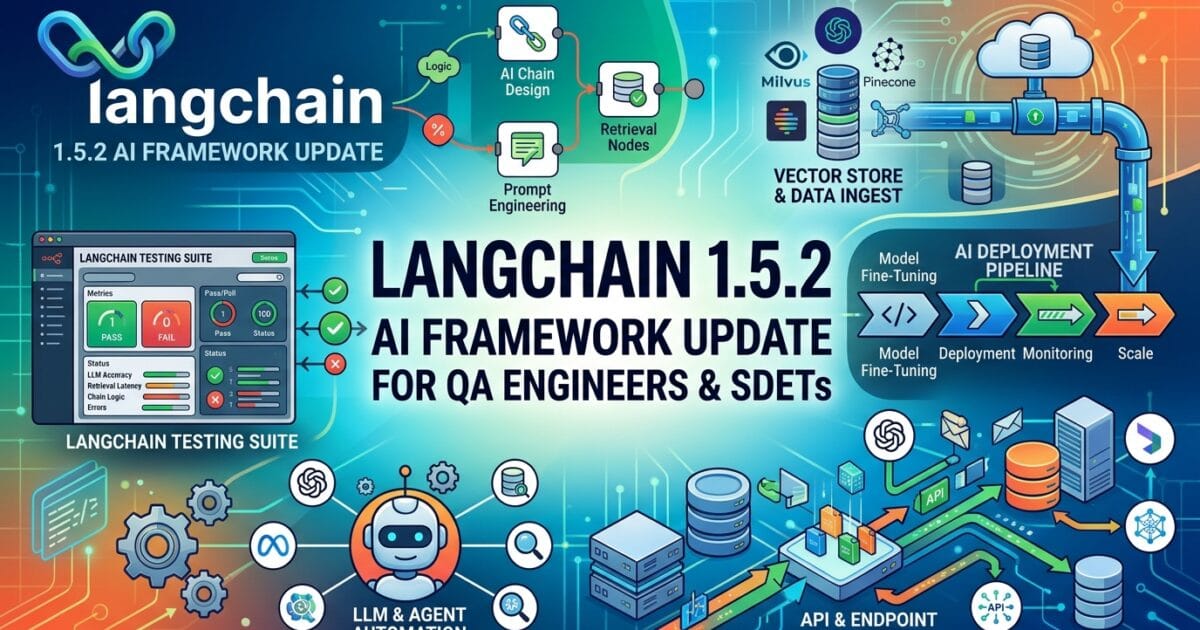
Artificial Intelligence is rapidly transforming software engineering, and frameworks like LangChain have become fundamental building blocks for developing intelligent applications powered by Large Language Models (LLMs). Whether building Retrieval-Augmented Generation (RAG) systems, AI agents, chatbots, code assistants, document analysis platforms, or enterprise automation solutions, LangChain provides developers with a comprehensive toolkit for orchestrating complex AI workflows across multiple models and external services.
For QA engineers and Software Development Engineers in Test (SDETs), LangChain has evolved far beyond an AI development library. It is now a critical component in AI-powered testing strategies, intelligent test generation, automated bug analysis, synthetic test data creation, documentation validation, conversational testing, and autonomous quality engineering workflows. As organizations increasingly adopt Agentic AI and LLM-driven applications, maintaining a stable, secure, and predictable LangChain environment becomes essential for delivering reliable software.
Released on 28 July 2026, LangChain 1.5.2 is a maintenance release focused on improving framework stability, configuration handling, and dependency maintenance. While this version does not introduce major user-facing features, it resolves an important issue involving gateway environment variables and updates several core development dependencies that strengthen the overall reliability of the framework.
Experienced QA professionals understand that maintenance releases often have a greater operational impact than feature-rich updates. Small improvements in configuration management and dependency maintenance can eliminate deployment failures, reduce production incidents, and improve the consistency of AI-powered automation workflows across development, testing, staging, and production environments.
In this article, we will explore everything included in LangChain 1.5.2, explain the significance of the latest changes, analyse their impact on QA engineers and SDETs, and discuss why keeping LangChain up to date remains essential for organisations building enterprise-grade AI applications.
What’s New in LangChain 1.5.2
LangChain version 1.5.2 was officially released on 28 July 2026 as a maintenance update for the LangChain Core library.
Unlike major releases that introduce new abstractions, APIs, or agent capabilities, this version focuses on strengthening the framework’s internal behaviour and improving developer experience through bug fixes and dependency updates.
Although concise, the release contributes to making LangChain more reliable for production deployments, AI orchestration platforms, and enterprise software development.
Official Release Highlights
Core Release
- LangChain Core updated to version 1.5.2.
Bug Fix
- Fixed handling of empty string values in gateway environment variables, improving configuration reliability.
Dependency Updates
- Updated setuptools from 82.0.0 to 83.0.0 within the Core library.
- Updated JupyterLab from 4.5.9 to 4.5.10.
- Updated setuptools from 80.9.0 to 83.0.0 for the Text Splitters library.
Although these updates may appear routine, they strengthen the framework’s foundation by improving compatibility, reducing maintenance overhead, and supporting future development.
Understanding the Gateway Environment Variable Fix
The most important change in LangChain 1.5.2 is the correction of how the framework processes empty string values in gateway environment variables.
Modern AI applications rely heavily on environment variables to store configuration details such as:
- API endpoints
- Authentication credentials
- Gateway URLs
- Proxy configuration
- Feature flags
- Deployment settings
- Cloud provider information
- Model routing preferences
These values allow applications to adapt to different environments without requiring source code modifications.
However, configuration management becomes challenging when an environment variable exists but contains an empty string.
Without proper handling, an application may interpret the empty value as a valid configuration rather than recognising it as effectively unset. This can lead to unexpected runtime behaviour, failed API calls, incorrect routing decisions, or confusing deployment issues that are difficult to diagnose.
LangChain 1.5.2 improves this behaviour by handling empty gateway environment variables more gracefully, ensuring that configuration logic behaves consistently across different deployment scenarios.
For organisations deploying AI systems across multiple environments, this seemingly small improvement can eliminate subtle configuration bugs that previously required significant troubleshooting effort.
Why Environment Variables Are Critical in AI Systems
Environment variables are one of the most widely adopted mechanisms for configuring modern software.
Instead of embedding sensitive information or environment-specific settings directly into source code, applications read configuration values from the operating environment during startup.
This approach offers several advantages:
- Improved security
- Easier deployment automation
- Better configuration management
- Separation between code and infrastructure
- Simplified cloud-native deployments
AI applications typically use environment variables to configure:
- OpenAI API keys
- Anthropic API keys
- Google Gemini credentials
- Azure AI endpoints
- Vector database connections
- Retrieval services
- Embedding providers
- Gateway proxies
- Observability platforms
- Tracing services
When these variables are not handled consistently, deployments may behave differently across development, testing, staging, and production environments.
By improving empty string handling, LangChain helps reduce configuration ambiguity and makes AI applications more predictable and easier to operate.
Why This Fix Matters for Enterprise AI Deployments
Enterprise AI systems rarely consist of a single language model.
Instead, organisations build sophisticated architectures combining multiple services, including:
- Large Language Models
- Retrieval-Augmented Generation (RAG) pipelines
- Vector databases
- Knowledge repositories
- AI gateways
- Observability platforms
- API management layers
- Security services
- Internal business applications
Each component depends on accurate configuration.
An incorrectly processed gateway environment variable can interrupt communication between these services, causing downstream failures that affect the entire AI workflow.
Examples include:
- Failed model requests
- Incorrect gateway routing
- Authentication errors
- Missing tracing information
- Unexpected fallback behaviour
- Inconsistent responses between environments
By ensuring empty string values are interpreted correctly, LangChain 1.5.2 improves deployment consistency and reduces the likelihood of difficult-to-diagnose production issues.
For QA engineers validating AI-powered applications, this translates into more reliable test environments and fewer failures caused by infrastructure configuration rather than application logic.
Dependency Updates That Strengthen the Framework
In addition to the configuration fix, LangChain 1.5.2 updates several core dependencies.
While dependency upgrades often receive less attention than new features, they play an essential role in maintaining a healthy software ecosystem.
Setuptools Upgrade
The update to setuptools 83.0.0 improves Python package management and helps ensure compatibility with the latest Python development ecosystem.
Benefits include:
- Improved package installation reliability.
- Better build consistency.
- Enhanced compatibility with modern tooling.
- Reduced maintenance burden.
JupyterLab Upgrade
The update from JupyterLab 4.5.9 to 4.5.10 improves the notebook development environment commonly used for AI experimentation, data analysis, model evaluation, and prompt engineering.
For teams developing LangChain applications interactively, maintaining current JupyterLab versions helps ensure a smoother development experience and compatibility with evolving Python libraries.
Text Splitters Dependency Maintenance
LangChain’s text splitters are foundational components in Retrieval-Augmented Generation systems.
Updating dependencies within this library helps maintain compatibility, improve long-term stability, and prepare the framework for future enhancements without introducing unnecessary disruption.
Although these changes are largely internal, they demonstrate the LangChain team’s ongoing commitment to maintaining a robust, production-ready ecosystem capable of supporting enterprise-scale AI development.
What LangChain 1.5.2 Means for QA Engineers and SDETs
Although LangChain 1.5.2 is officially classified as a maintenance release, experienced QA engineers know that these updates often have a significant impact on the reliability of AI-powered software. As organizations increasingly adopt Agentic AI, Retrieval-Augmented Generation (RAG), Model Context Protocol (MCP), AI copilots, and autonomous workflows, stability becomes just as important as new features. A single configuration issue can interrupt an entire AI pipeline, resulting in failed requests, inaccurate responses, incomplete workflows, or production incidents that are difficult to reproduce.
Unlike traditional software applications, modern AI systems depend on multiple interconnected services. A typical enterprise AI application may interact with Large Language Models (LLMs), embedding providers, vector databases, observability platforms, API gateways, authentication services, cloud infrastructure, and external business applications. Every component relies on accurate configuration and seamless communication.
The gateway environment variable fix introduced in LangChain 1.5.2 strengthens one of the most important foundations of AI infrastructure—configuration management. By correctly handling empty string values in gateway environment variables, LangChain reduces the risk of deployment inconsistencies and makes AI workflows more predictable across development, testing, staging, and production environments.
For QA engineers and SDETs responsible for validating enterprise AI applications, this improvement means fewer infrastructure-related failures, more reliable automated testing, and greater confidence when promoting AI solutions through the software delivery lifecycle.
Why Configuration Management Is Critical for AI Testing
Configuration management has always been important in software engineering, but it becomes even more critical in AI applications because the behaviour of an AI system is heavily influenced by external services rather than application code alone.
A single LangChain workflow may depend on:
- OpenAI or Anthropic models
- Google Gemini APIs
- Azure AI Foundry services
- Vector databases such as Pinecone, Weaviate, or Milvus
- Redis caching layers
- AI gateways
- Cloud storage
- Authentication providers
- Observability and tracing platforms
- Internal enterprise APIs
Every one of these integrations typically uses environment variables for configuration.
If an application incorrectly interprets an empty environment variable as a valid value instead of treating it as missing or undefined, unexpected runtime behaviour may occur.
Examples include:
- Requests being routed to the wrong gateway
- Authentication failures
- Missing API endpoints
- Incorrect fallback logic
- AI model connection failures
- Tracing information not being captured
- Broken observability dashboards
These issues often appear only after deployment because production environments frequently contain different configuration values from local development systems.
By improving environment variable handling, LangChain 1.5.2 helps QA teams validate AI systems with greater confidence while reducing deployment-specific defects.
Key Improvement 1 – More Reliable AI Infrastructure Across Multiple Environments
One of the biggest operational benefits of LangChain 1.5.2 is improved consistency across different deployment environments.
Enterprise software rarely operates within a single environment.
Most organisations maintain separate environments for:
- Local development
- Shared development
- Integration testing
- Quality assurance
- User acceptance testing
- Staging
- Production
- Disaster recovery
Each environment may use different:
- AI providers
- API gateways
- Authentication credentials
- Proxy servers
- Feature flags
- Monitoring services
If configuration handling behaves inconsistently, QA teams may experience situations where an application works perfectly during testing but fails immediately after deployment.
The gateway environment variable fix reduces this risk by ensuring empty configuration values are interpreted correctly.
For enterprise QA engineers, this results in:
Improved Deployment Predictability
Applications behave more consistently regardless of deployment environment.
Reduced Configuration Defects
Teams spend less time diagnosing environment-specific failures caused by invalid configuration values.
Better Regression Stability
Automated AI regression suites become more dependable because infrastructure behaves consistently across multiple test executions.
Key Improvement 2 – Stronger Foundation for Agentic AI and Intelligent Automation
LangChain has become one of the most widely adopted frameworks for building autonomous AI systems.
Modern organizations use LangChain to develop:
- AI agents
- Multi-agent systems
- AI copilots
- Intelligent assistants
- Knowledge retrieval platforms
- Enterprise search applications
- Document analysis systems
- Automated customer support
- Software engineering assistants
- AI-powered quality engineering solutions
These applications execute long-running workflows involving numerous external services.
A configuration issue affecting a gateway can interrupt the entire reasoning process.
For example, an AI quality engineering assistant may perform the following workflow:
- Retrieve a user story from Jira.
- Generate test scenarios using an LLM.
- Query a vector database for historical defects.
- Produce Playwright automation code.
- Execute regression tests.
- Analyse failures.
- Generate a quality report.
- Notify the engineering team through Slack.
If gateway configuration fails at any stage, the workflow may terminate unexpectedly despite the application code itself being correct.
LangChain 1.5.2 improves reliability by reducing the likelihood of configuration-related interruptions, allowing autonomous AI workflows to execute more consistently.
Impact on QA Automation Frameworks
Modern QA automation extends far beyond browser automation.
Today’s quality engineering platforms integrate:
- Playwright
- Cypress
- Selenium
- Appium
- Pytest
- Robot Framework
- LangGraph
- MCP servers
- AI agents
- LLM evaluation tools
- Observability platforms
- CI/CD pipelines
LangChain frequently acts as the orchestration layer connecting these components.
Examples include:
- Generating automated test cases
- Summarising regression failures
- Analysing logs using AI
- Producing release readiness reports
- Performing intelligent root cause analysis
- Creating synthetic test data
- Evaluating AI model outputs
Configuration reliability directly affects every one of these workflows.
The improvements introduced in LangChain 1.5.2 contribute to a stronger automation foundation, reducing infrastructure instability and allowing QA teams to focus on validating application behaviour rather than troubleshooting configuration problems.
Dependency Updates That Benefit Enterprise Development
The dependency updates included in LangChain 1.5.2 also provide long-term value.
Although upgrading libraries such as setuptools and JupyterLab may appear routine, these improvements support:
Better Python Ecosystem Compatibility
Keeping build tools current helps maintain compatibility with modern Python versions and package management practices.
Improved Development Experience
Updated dependencies provide better tooling, more reliable package installation, and smoother development workflows for engineers building AI applications.
Reduced Technical Debt
Regular dependency maintenance prevents organisations from accumulating outdated libraries that become increasingly difficult to upgrade later.
For enterprises operating long-lived AI platforms, these incremental improvements contribute significantly to maintainability.
Migration Considerations for Existing LangChain Projects
One of the strengths of LangChain 1.5.2 is its straightforward upgrade path.
Because the release focuses primarily on bug fixes and dependency maintenance, most applications should continue operating without requiring code changes.
Nevertheless, every framework upgrade should include structured validation.
Recommended migration activities include:
Validate Environment Configuration
Review:
- Gateway variables
- API endpoints
- Authentication tokens
- Cloud configuration
- Proxy settings
Ensure empty configuration values behave as expected.
Execute AI Regression Suites
Run automated validation covering:
- Prompt execution
- Retrieval workflows
- Agent interactions
- Tool calling
- Memory management
- Structured output generation
Verify External Integrations
Confirm connectivity with:
- LLM providers
- Vector databases
- AI gateways
- Observability platforms
- Enterprise APIs
Review CI/CD Pipelines
Validate build, deployment, and automated testing pipelines after upgrading to LangChain 1.5.2.
Are There Any Breaking Changes?
According to the official release information, LangChain 1.5.2 does not introduce significant breaking changes.
The update focuses on improving configuration handling and maintaining internal dependencies rather than modifying public APIs or introducing architectural changes.
However, organisations using custom gateway implementations or specialised environment configuration logic should validate production deployments after upgrading to ensure compatibility with the updated behaviour.
Expert Recommendation: Should You Upgrade to LangChain 1.5.2?
For most organisations, the answer is yes.
Although LangChain 1.5.2 does not introduce major new capabilities, it improves one of the most critical aspects of enterprise AI development—reliable configuration management. Correctly handling empty gateway environment variables reduces deployment inconsistencies, improves interoperability, and strengthens the stability of AI applications running across multiple environments.
Teams should prioritise upgrading if they:
- Develop enterprise AI applications.
- Build Retrieval-Augmented Generation (RAG) systems.
- Implement AI agents or multi-agent architectures.
- Use LangChain within CI/CD pipelines.
- Integrate multiple LLM providers.
- Deploy AI workloads across cloud environments.
- Build AI-assisted QA automation frameworks.
For smaller development teams, the upgrade is equally worthwhile because it introduces minimal migration risk while improving the overall reliability of the framework.
While the official release notes contain only a handful of changes, the operational value of LangChain 1.5.2 extends well beyond those entries. Stable configuration handling, healthier dependencies, and improved framework consistency help QA engineers and SDETs build AI-powered testing solutions that are easier to maintain, more resilient in production, and better prepared for the rapidly evolving landscape of intelligent software engineering.
Official Resources
- Official Release Notes: https://github.com/langchain-ai/langchain/releases/tag/langchain-core%3D%3D1.5.2
- Official Documentation: https://python.langchain.com
More Related Blogs
- LangChain 1.5.0 Introduces Standardized Reasoning Controls for Enterprise AI Applications
- LangChain 1.4.9 Released: Critical AI Framework Reliability Improvements Every QA Engineer Must Know
- LangChain 1.4.8 Release: 7 Important Updates AI Testing Engineers Should Know
- LangChain 1.4.7 Released: Important Stability Improvements Every QA Engineer Should Know
- LangChain 1.4.6 Released: Valuable AI Agent Observability Improvements QA Engineers Must Know
- LangChain 1.4.0 Released: AI Engineering Is Becoming Real Software Engineering
- LangChain 1.3.11 Released: Essential AI Framework Improvements Every QA Engineer Should Know
People Asked Questions
What is LangChain 1.5.2?
LangChain 1.5.2 is a maintenance release that improves gateway environment variable handling and updates core development dependencies to strengthen framework stability and reliability.
What changed in LangChain 1.5.2?
The release fixes empty string handling in gateway environment variables and updates key dependencies, including setuptools and JupyterLab.
Does LangChain 1.5.2 include breaking changes?
According to the official release information, LangChain 1.5.2 does not introduce significant breaking changes. Most existing AI applications should upgrade smoothly after standard validation.
Why is the gateway environment variable fix important?
It improves configuration consistency by correctly handling empty environment variable values, reducing deployment issues and ensuring more reliable AI workflows across different environments.
Should QA engineers upgrade to LangChain 1.5.2?
Yes. QA engineers building AI-powered testing frameworks, RAG applications, AI agents, or enterprise automation workflows should upgrade after validating their integrations and regression suites.
Is LangChain suitable for enterprise AI applications?
Yes. LangChain provides a comprehensive framework for building enterprise AI systems, including AI agents, RAG pipelines, LLM orchestration, tool integration, memory management, and workflow automation.
Continue Learning with QAPulse by SK
At QAPulse by SK, we continuously analyze the latest releases across n8n, LangChain, CrewAI, LangGraph, Model Context Protocol (MCP), FastAPI, Python, Node.js, Docker, Playwright, Selenium, Locust, k6, and many other technologies shaping the future of intelligent automation and AI-powered software engineering.
Our goal is to help QA Engineers, SDETs, Automation Engineers, AI Engineers, DevOps Engineers, Platform Engineers, and Software Architects stay ahead with enterprise-grade release analyses, migration strategies, AI workflow testing guides, regression checklists, production deployment best practices, and practical automation insights that support building secure, scalable, and production-ready automation platforms.