 QA
QA
What’s New in LangChain 1.4.0
LangChain version langchain-core==1.4.0 was officially released on May 11, 2026.
And this release is far more important than it initially looks.
Because beneath the dependency bumps and infrastructure updates…
👉 There’s a clear signal emerging:
AI frameworks are maturing into production-grade engineering ecosystems.
Most people will skim the changelog and see:
- Dependency updates
- Streaming changes
- Security hardening
- Tracer improvements
But experienced AI engineers will notice something deeper:
👉 LangChain is evolving from:
"Prompt experimentation framework"
To:
"Production AI systems infrastructure"
And that shift changes everything for QA engineers and SDETs.
Official Release Notes of LangChain 1.4.0
Changes since langchain-core==0.3.86
chore(infra): merge v1.4 into master (#37350)
chore: bump urllib3 from 2.6.3 to 2.7.0 in /libs/core (#37329)
fix(core): avoid eager pydantic.v1 import in @deprecated (#37308)
chore: bump mistune from 3.1.4 to 3.2.1 in /libs/core (#37237)
chore: bump jupyter-server from 2.17.0 to 2.18.0 in /libs/core (#37204)
release(core): 1.3.3 (#37198)
fix(core): set deprecation since to 1.3.3 to match release (#37200)
fix(core, langchain): harden load() against untrusted manifests (#37197)
chore: bump notebook from 7.5.0 to 7.5.6 in /libs/core (#37109)
chore: bump types-pyyaml from 6.0.12.20250915 to 6.0.12.20260408 in /libs/core (#37129)
fix(core): preserve structured inputs on tool runs in tracers (#37108)
release(perplexity): 1.2.0 (#37091)
chore(docs): update x handle references (#37081)
fix(core): make removal optional in warn_deprecated (#37056)
fix(core): validate batch_size in _batch and _abatch to prevent infinite loop (#36663)
chore(core): mark stream_v2/astream_v2 as beta (#36992)
release(core): 1.3.2 (#36990)
feat(core): add content-block-centric streaming (v2) (#36834)
release(core): 1.3.1 (#36972)
feat(core): allow _format_output to pass through list of ToolOutputMixin instances (#36963)
chore: bump nbconvert from 7.17.0 to 7.17.1 in /libs/core (#36923)
feat(core): Update inheritance behavior for tracer metadata for special keys (#36900)
chore: bump langsmith from 0.7.13 to 0.7.31 in /libs/core (#36813)
release(core): releas…
How to Upgrade LangChain 1.4.0
# For Python tools
pip install langchain --upgrade

# For Node.js tools
npm install langchain@latest
Full release notes: https://github.com/langchain-ai/langchain/releases/tag/langchain-core%3D%3D1.4.0
Biggest Themes in LangChain 1.4.0
This release heavily focuses on:
- Streaming architecture
- Security hardening
- Stability improvements
- Observability
- Structured tool execution
- Runtime safety
Which honestly reflects where the entire AI industry is heading.
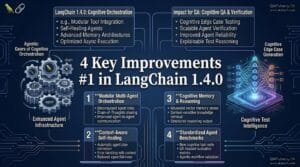
Key Improvement #1 in LangChain 1.4.0 — Content-Block-Centric Streaming (v2)
One of the most important additions:
feat(core): add content-block-centric streaming (v2)
Most developers will underestimate this.
But this is HUGE for:
- AI UX systems
- Real-time agent orchestration
- Streaming observability
- Partial response handling
Why This Matters for LangChain 1.4.0
Traditional streaming was mostly:
token → token → token
But modern AI systems increasingly need:
👉 Structured streaming
👉 Multi-block responses
👉 Tool-aware streaming
👉 Partial execution visibility
Especially for:
- AI copilots
- Autonomous agents
- Multi-agent workflows
- Interactive debugging systems
Streaming is evolving from “typing effect”
to “real-time execution architecture.”
Why SDETs Should Care
Testing AI systems becomes dramatically harder when responses stream dynamically.
Now QA engineers must validate:
- Partial state rendering
- Tool-call ordering
- Multi-block consistency
- Streaming interruption recovery
That’s not traditional automation anymore.
That’s:
👉 AI interaction testing
Key Improvement #2 in LangChain 1.4.0 — Security Hardening Against Untrusted Manifests
This change is extremely important:
fix(core, langchain): harden load() against untrusted manifests
This reflects a growing reality in AI engineering:
AI systems increasingly execute external configurations, tools, manifests, and workflows dynamically.
And that creates serious risk.
Why This LangChain 1.4.0 Matters More Than People Think
Modern AI agents often:
- Load tools dynamically
- Parse external configs
- Execute workflows automatically
- Interact with third-party systems
Without proper hardening…
👉 You create attack surfaces.
This release shows LangChain is taking:
- Runtime trust
- Input validation
- Execution safety
Much more seriously.
AI systems are now security-sensitive infrastructure.
Key Improvement #3 in LangChain 1.4.0 — Structured Input Preservation in Tool Runs
This fix is underrated but extremely valuable:
fix(core): preserve structured inputs on tool runs in tracers
This improves:
- Trace debugging
- Tool observability
- AI execution visibility
And honestly?
This is one of the biggest missing pieces in many AI systems today.
The Hidden Problem in AI Engineering
Most AI workflows currently fail like this:
Agent failed somewhere.
Good luck debugging it.
No structured visibility.
No clear execution path.
No reproducibility.
That’s dangerous in production systems.
Better Tracing = Better AI Reliability
With stronger tracing:
👉 You can inspect:
- Tool inputs
- Tool outputs
- Agent decisions
- Execution chains
Which means:
👉 Faster debugging
👉 Better reproducibility
👉 More trustworthy systems
Observability is becoming the backbone of AI engineering.
Key Improvement #4 in LangChain 1.4.0 — Infinite Loop Protection in Batch Processing
This is a mature engineering fix:
validate batch_size in _batch and _abatch to prevent infinite loop
This might sound “small.”
It’s not.
Infinite loops in AI systems are extremely dangerous because:
- They silently consume tokens
- Burn infrastructure cost
- Stall pipelines
- Create runaway execution
And in agentic systems?
👉 Looping behavior becomes even riskier.
AI Systems Are Becoming Operational Systems
This release strongly signals:
👉 AI engineering is no longer “just prompting.”
It’s now about:
- Runtime control
- Failure handling
- Resource protection
- System observability
- Execution governance
That’s real software engineering.
The Pydantic Fix Matters Too
avoid eager pydantic.v1 import
This reflects a broader ecosystem challenge:
👉 Dependency compatibility chaos.
AI frameworks today sit on top of:
- Pydantic
- FastAPI
- asyncio
- tracing systems
- notebook ecosystems
- vector DBs
- observability platforms
Meaning:
👉 Version stability matters massively.
Any Breaking Changes?
Good news:
✅ No catastrophic breaking API shifts announced
✅ Mostly stabilization + architecture evolution release
However…
This release touches many sensitive areas:
- Streaming
- Tool execution
- Tracing
- Batch handling
- Dependency management
Meaning teams should STILL validate:
- Agent orchestration flows
- Streaming behavior
- Custom tracer integrations
- Structured output systems
Should You Upgrade LangChain 1.4.0 Immediately?
My Recommendation:
✅ YES — especially for active AI engineering projects
Why?
Because this release improves:
- Reliability
- Security
- Observability
- Runtime safety
And those are foundational for production AI systems.
But Don’t Upgrade LangChain 1.4.0 Blindly
Before deploying:
✅ Run agent regression tests
✅ Validate streaming workflows
✅ Check tool integrations
✅ Review tracing systems
✅ Test batch-processing behavior
Because AI systems fail differently than traditional apps.
Bigger Industry Shift (Most Important Insight)
This release reflects a major transformation happening right now.
Old AI Development
- Prompt engineering
- Simple chatbots
- Experimental workflows
New AI Engineering
- Runtime governance
- Secure tool execution
- Observability layers
- Streaming architectures
- Agent orchestration systems
That’s an entirely different engineering discipline.
What Smart QA Engineers Should Learn NOW
Future SDETs working with AI systems will increasingly need skills in:
- AI observability
- Agent testing
- Streaming validation
- Security hardening
- Tool execution tracing
- Autonomous workflow validation
Because modern AI systems are becoming:
👉 Dynamic distributed systems
Not just “smart chat.”
More Relevant Articles
- What’s New in n8n 2.21.7 — AI Workflow Fixes for QA Engineers
- Selenium 4.44.0 Released: Why Selenium Still Refuses to Die
- Playwright 1.60.0 Released: The Future of Intelligent Test Automation
- What is Playwright and Why Everyone is Talking About It
- AI-Powered Test Automation Framework: Powerful Complete Guide for 2026
- The Most Powerful Framework of 2026: Pytest + FastAPI + GPT-5 for Full-Stack Intelligent Testing
- Why Smart QA Engineers are Quietly Becoming AI Workflow Architects
- AI Red Team Testing: Building Adversarial Test Suites for Enterprise AI Systems
Let’s Talk
👉 Are your current AI systems observable enough to debug properly?
👉 How are you testing streaming AI behavior today?
Drop your thoughts below 👇
Final Line
AI engineering is no longer becoming software engineering.
It already is.