QA
QA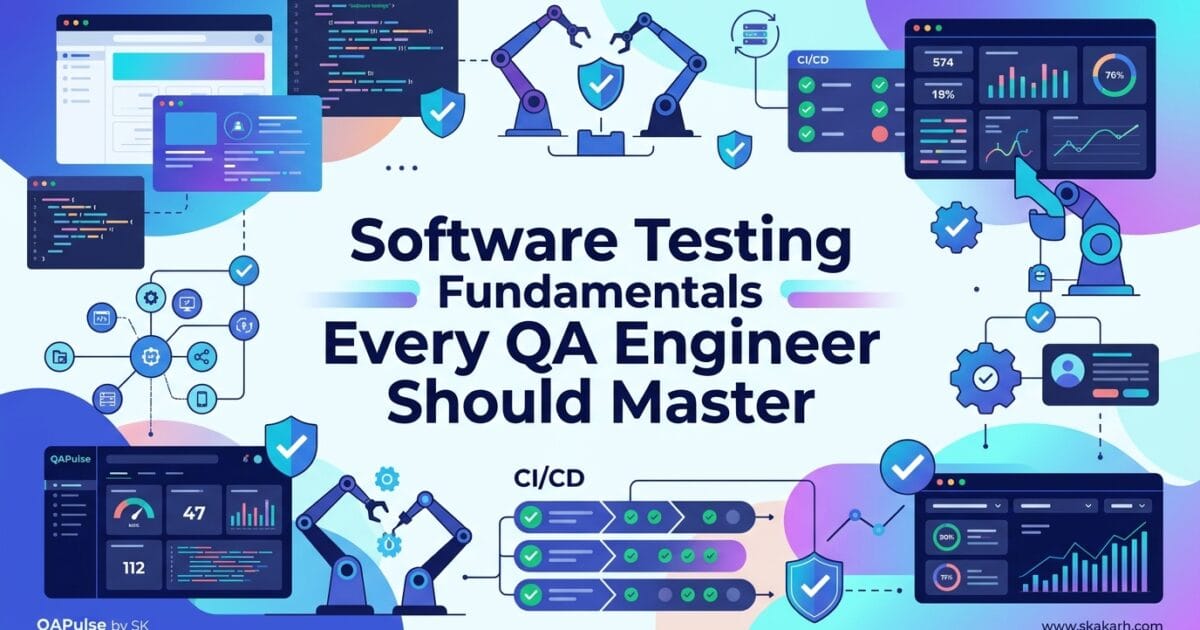
Software Testing Fundamentals are the foundation behind every reliable QA strategy, whether you are testing a simple web application, a distributed API platform, a mobile application, or an AI-powered system.
Tools change. Frameworks change. Programming languages change. AI changes how tests are created and analyzed. But the underlying engineering questions remain remarkably consistent:
- What should we test?
- Why does it matter?
- What could fail?
- Where should validation happen?
- How much confidence do we need?
- What evidence proves the system works?
- Which risks remain untested?
A QA Engineer who understands these questions can move between Selenium, Playwright, Cypress, API automation, mobile testing, performance testing, and AI-assisted testing without rebuilding their testing knowledge from scratch.
The mistake many engineers make is learning tools before understanding the system they are trying to validate.
For example, knowing how to write this Playwright test is useful:
import { test, expect } from '@playwright/test';

test('user can log in', async ({ page }) => {
  await page.goto('/login');

  await page.getByLabel('Email').fill('qa@example.com');
  await page.getByLabel('Password').fill('Password123');
  await page.getByRole('button', { name: 'Login' }).click();

  await expect(page.getByText('Dashboard')).toBeVisible();
});
But the more important question is whether this test actually proves that authentication works.
What happens when:
- the password is incorrect?
- the account is locked?
- the API returns a 500 response?
- the session expires?
- the user is authenticated but lacks permission?
- two login requests happen simultaneously?
- the authentication service is unavailable?
That distinction separates test execution from quality engineering thinking.
What Are Software Testing Fundamentals?
Software testing fundamentals are the core principles, techniques, processes, and reasoning skills used to evaluate whether software behaves as expected and whether important risks are sufficiently controlled.
They include concepts such as:
- Requirements analysis
- Test planning
- Test scenarios
- Test cases
- Test data
- Functional testing
- Non-functional testing
- Risk-based testing
- Regression testing
- Integration testing
- API testing
- UI testing
- Exploratory testing
- Defect management
- Test automation
- Test reporting
- Test environments
- Quality metrics
But these concepts should not be treated as isolated definitions.
A strong QA Engineer connects them.
Requirement
    ↓
Risk
    ↓
Test Condition
    ↓
Test Design
    ↓
Test Execution
    ↓
Evidence
    ↓
Defect / Confidence
    ↓
Quality Decision
This is the real foundation.
A test is valuable because it helps the team make a better decision—not simply because it exists.
Testing Is Not the Same as Proving Software Is Perfect
One of the most important principles in testing is that testing cannot prove the complete absence of defects.
Suppose an application accepts an age between 18 and 100.
Testing only these values:
18
50
100
does not prove that every possible input works correctly.
A stronger approach considers boundaries:
17   → invalid
18   → valid
19   → valid
50   → valid
99   → valid
100  → valid
101  → invalid
You could also test:
null
empty
negative
decimal
very large number
string
special characters
The objective is not to test every possible input.
The objective is to choose high-value evidence that provides confidence about the behavior that matters.
Requirements Are the Starting Point of Good Testing
Weak testing often starts with the UI.
Strong testing starts with understanding the requirement.
Consider:
Users can transfer money between eligible accounts.
A superficial test might be:
Login
→ Open transfer page
→ Enter amount
→ Click Transfer
→ Verify success
A QA Engineer should immediately ask:
What makes an account eligible?

Can the amount be zero?

Can the amount exceed the balance?

Are decimal amounts supported?

What happens if the destination account is invalid?

What happens if the request times out?

Can the same transfer be submitted twice?

What happens if the payment service succeeds
but the application loses the response?
This is where requirements analysis becomes one of the most valuable software testing fundamentals.
The quality of your testing strategy is heavily influenced by the quality of the questions you ask before execution begins.
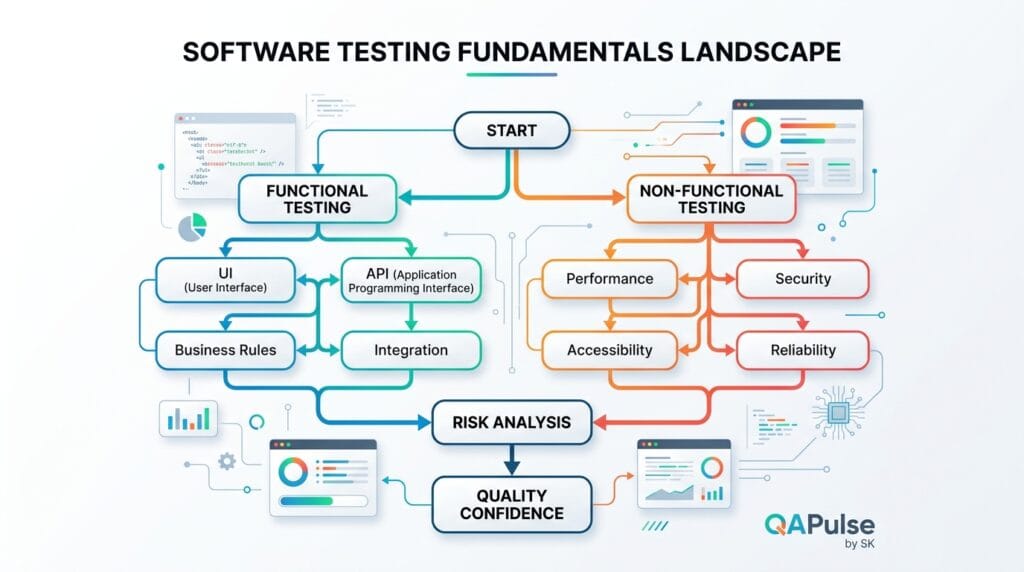
Functional Testing vs Non-Functional Testing
A common beginner mistake is treating testing as equivalent to checking whether features work.
Functional testing asks:
Does the system perform the required function?
Non-functional testing asks:
How does the system behave under important conditions?
Consider an e-commerce checkout.
Functional validation
Product selected
→ Cart updated
→ Payment submitted
→ Order created
→ Confirmation displayed
Non-functional validation
How fast is checkout?

What happens under heavy traffic?

Is customer data protected?

Can the system recover from failures?

Is the UI accessible?

Does the service remain reliable?

Can the application scale?
Both matter.
A checkout that produces the correct order but takes 40 seconds to respond may technically function while still producing unacceptable user experience.
Verification and Validation Are Different
These two concepts are often confused.
Verification asks:
Are we building the product correctly?
Validation asks:
Are we building the correct product?
For example, suppose a requirement states:
The checkout page must prevent orders when payment authorization fails.
Verification can examine whether the implementation follows the requirement.
Validation can examine whether the behavior actually meets the user’s and business’s needs.
A useful model is:
Verification
Requirements
Design
Code
Implementation
    ↓
"Built correctly?"

Validation
Product
Behavior
User Need
Business Outcome
    ↓
"Built the right thing?"
Good QA thinking requires both perspectives.
Test Levels: Where Should Validation Happen?
Not every behavior should be tested through the UI.
Modern systems often contain multiple layers:
              UI
               ↑
          Integration
               ↑
             API
               ↑
          Component
               ↑
             Unit
A simple business rule might be inexpensive to validate at the unit level.
A service contract may belong at the API or integration level.
A critical customer journey may justify an end-to-end UI test.
This creates a critical strategic question:
Where is the cheapest reliable place to detect this failure?
That question is more useful than automatically converting every scenario into a browser test.
Test Pyramid and Test Distribution
The classic test pyramid encourages a larger number of fast, lower-level tests and fewer expensive end-to-end tests.
             /\
            /UI\
           /----\
          / API  \
         /--------\
        / Unit     \
       /------------\
The exact shape is not a universal law.
Modern systems may also use:
- Component tests
- Contract tests
- Service-level tests
- Integration tests
- API tests
- End-to-end tests
- Synthetic production checks
The important principle is feedback efficiency.
Compare two strategies.
| Strategy A | Strategy B |
|---|---|
| 1,000 UI tests | 150 UI tests |
| Slow execution | Fast feedback |
| High maintenance | Lower maintenance |
| Difficult diagnosis | Better diagnostics |
| Browser-heavy | Layered validation |
| Large flaky surface | Risk-focused coverage |
Strategy B may provide better engineering value even with fewer tests.
More automation does not automatically mean more quality.
Test Case Design: From Happy Path to Risk
A basic test often validates the happy path.
For a login page:
Valid email
+
Valid password
=
Successful login
That is necessary, but insufficient.
A stronger test model considers:
Positive scenarios
Valid credentials
Successful authentication
Correct redirect
Correct session
Negative scenarios
Invalid password
Unknown account
Locked account
Expired credentials
Missing fields
Boundary scenarios
Minimum password length
Maximum password length
Long email address
Boundary character limits
Security-oriented scenarios
Session handling
Authorization
Account enumeration
Brute-force protection
Input handling
Reliability scenarios
Authentication service unavailable
Network timeout
Slow response
Duplicate submission
This layered thinking transforms a simple test case into a risk model.
Equivalence Partitioning
Equivalence partitioning reduces unnecessary testing by grouping inputs that should behave similarly.
Suppose an application accepts a quantity from 1 to 50.
Instead of testing every number, create partitions:
Invalid:  quantity < 1
Valid:    1–50
Invalid:  quantity > 50
Representative values could be:
0
1
25
50
51
This approach provides broader logical coverage without brute-force execution.
It is one of the software testing fundamentals that remains useful regardless of the automation framework being used.
Boundary Value Analysis
Defects frequently occur around boundaries.
For the same quantity rule:
0    → invalid
1    → valid
2    → valid
49   → valid
50   → valid
51   → invalid
The boundary values are often more valuable than randomly selecting values such as 17, 29, and 43.
A strategic tester asks:
Where does the system’s behavior change?
That question can expose defects faster than simply increasing test volume.
Decision Tables for Complex Business Rules
Decision tables are useful when multiple conditions affect the outcome.
Suppose a discount depends on membership and purchase amount.
| Member | Purchase | Discount |
|---|---|---|
| No | < $100 | 0% |
| No | ≥ $100 | 5% |
| Yes | < $100 | 10% |
| Yes | ≥ $100 | 15% |
The table makes combinations visible.
It also reveals missing requirements.
What if the purchase amount is negative?
What if membership status is unknown?
What if the currency is different?
This is where test design becomes a requirements-analysis technique.
State Transition Testing
Many applications are not simple request-response systems.
They are state machines.
Consider an order:
Created
   ↓
Confirmed
   ↓
Paid
   ↓
Shipped
   ↓
Delivered
But what happens when payment fails?
Created
   ↓
Payment Failed
   ↓
Retry
   ↓
Paid
What about cancellation?
Confirmed
   ↓
Cancelled
And what if cancellation happens after shipment?
Shipped
   ↓
Cancellation rejected
These transitions represent behavior that conventional happy-path testing can miss.
As applications become more distributed and event-driven, understanding states and transitions becomes increasingly important.
Exploratory Testing
Exploratory testing is not random clicking.
Effective exploratory testing combines:
Learning
+
Test Design
+
Execution
+
Observation
+
Adaptation
A tester might start with a checkout workflow and discover:
The application allows users to modify the cart while payment authorization is processing.
That observation creates a new testing path:
Start payment
     ↓
Modify quantity
     ↓
Payment completes
     ↓
Compare charged amount
vs
Final cart amount
The tester is simultaneously learning about the system and designing tests.
This is especially valuable where requirements are incomplete or behavior is difficult to predict.
Regression Testing Is About Change Risk
Regression testing is often misunderstood as:
Run everything again.
That is not necessarily the best strategy.
Suppose a developer changes the payment calculation module.
A risk-focused regression strategy might prioritize:
Payment calculation
      ↓
Order total
      ↓
Discounts
      ↓
Tax
      ↓
Invoice
      ↓
Refund
The affected dependency graph helps determine what deserves attention.
A good regression suite should evolve with the architecture.
It should not simply grow forever.
Retesting vs Regression Testing
These terms should not be mixed.
Retesting verifies whether a specific defect has been fixed.
Example:
Defect:
Discount incorrectly applied twice.

Fix deployed.

Retest:
Verify the exact defect scenario now behaves correctly.
Regression testing asks:
Did the change unintentionally break something else?
For the same fix:
Discount
↓
Cart total
↓
Tax
↓
Payment
↓
Invoice
↓
Refund
The first validates the fix.
The second checks surrounding behavior.
Test Data Is Part of Test Design
A strong test with poor data can still produce weak results.
Consider an API accepting customer information.
{
  "name": "Ali",
  "email": "ali@example.com",
  "age": 30
}
Useful test data should also consider:
Null values
Empty strings
Maximum-length strings
Unicode
Special characters
Duplicate records
Invalid formats
Boundary values
Expired data
Large datasets
Conflicting states
Test data should represent the risk model.
If production contains millions of customer records, testing only three clean records tells you very little about data-related behavior.
Defect Reporting Is an Engineering Skill
A useful defect report should help another engineer reproduce and diagnose the problem.
Weak:
Checkout is broken.
Strong:
Title:
Checkout creates duplicate orders after payment retry

Environment:
Staging / Chrome / Build 8421

Precondition:
Payment provider responds with a timeout after authorization

Steps:
1. Add product to cart
2. Start checkout
3. Submit payment
4. Simulate timeout
5. Retry payment

Expected:
One successful order is created.

Actual:
Two orders are created with the same payment reference.

Evidence:
Request IDs, trace ID, API response, database record
This is much more valuable than simply assigning a severity label.
Severity and Priority Are Different
A defect can be technically severe but not immediately prioritized.
For example:
| Defect | Severity | Priority |
|---|---|---|
| Application crashes for every user | Critical | Critical |
| Minor typo on homepage | Low | Low |
| Rare financial calculation error | Critical | High |
| Cosmetic issue on an internal page | Low | Low |
| Major issue affecting a feature launching tomorrow | High | Critical |
Severity describes the impact.
Priority describes how urgently the organization should address it.
The exact definitions vary between organizations, but the distinction remains useful.
Automation Should Follow Strategy, Not Replace It
One of the most important software testing fundamentals for modern QA Engineers is understanding that automation is an implementation strategy—not a substitute for test design.
Before automating, ask:
Is this scenario stable?

Is it valuable?

Will it run repeatedly?

Can failure be diagnosed?

Is the expected result deterministic?

What is the maintenance cost?

Is there a cheaper test layer?
A test that takes five minutes to automate and saves thousands of hours may be an excellent candidate.
A fragile test requiring constant maintenance may be a poor candidate even if it can technically be automated.
A Practical Automation Decision Model
Use this simple evaluation:
Business Risk
      +
Execution Frequency
      +
Stability
      +
Repeatability
      +
Automation Value
      -
Maintenance Cost
      =
Automation Priority
This prevents the common mistake of measuring automation success by the percentage of test cases automated.
The better measurement is the amount of useful quality feedback generated.
The QA Engineer’s Real Foundation
A modern QA Engineer should eventually be able to move through this chain:
Requirement
   ↓
Understand behavior
   ↓
Identify risk
   ↓
Design coverage
   ↓
Select test level
   ↓
Create meaningful data
   ↓
Execute
   ↓
Analyze evidence
   ↓
Report defects
   ↓
Automate valuable scenarios
   ↓
Monitor quality signals
That is the foundation on which advanced automation, AI-assisted testing, performance engineering, API testing, and quality engineering can be built.
The tools come later.
The reasoning comes first.
Building a Risk-Based Testing Strategy
Software testing fundamentals become significantly more valuable when they are used to make decisions rather than memorized as terminology. A mature QA Engineer does not simply ask, “What test cases should I execute?” The better question is, “Which failures would matter most, and what evidence do I need to detect them?”
Consider an online banking application. Testing the login button is necessary, but the higher-risk scenarios may involve:
- Incorrect authorization
- Duplicate transactions
- Session expiration
- Concurrent requests
- Transaction rollback
- Incorrect account balances
- Service failures
- Data corruption
This is why risk should influence testing depth.
A practical risk model can be expressed as:
Risk = Probability of Failure × Impact of Failure
The formula does not need to be mathematically precise to be useful. Its purpose is to help the QA team prioritize limited testing time.
A payment calculation defect deserves considerably more attention than a cosmetic alignment issue.
Risk-Based Testing in Practice
Imagine a checkout system containing these components:
| Area | Failure Impact | Testing Priority |
|---|---|---|
| Payment authorization | Very High | Critical |
| Order creation | Very High | Critical |
| Inventory deduction | High | High |
| Discount calculation | High | High |
| Search filtering | Medium | Medium |
| Footer alignment | Low | Low |
This does not mean low-risk functionality should never be tested.
It means testing effort should reflect business risk.
A useful exercise for a QA team is to take the next sprint’s major features and ask:
If this feature fails in production tomorrow, what is the actual business consequence?
That question often reveals where the test strategy needs to become stronger.
Test Coverage Is More Than a Percentage
“95% test coverage” sounds impressive, but coverage percentages can be misleading.
Suppose a team has 1,000 automated tests but most validate simple happy paths.
Another team has 300 carefully designed tests covering:
- Business rules
- Boundaries
- Error handling
- API contracts
- Authorization
- Integration failures
- Critical user journeys
The second suite may provide considerably more confidence.
Coverage should therefore be considered from multiple perspectives.
Code Coverage
      +
Requirement Coverage
      +
Risk Coverage
      +
Behavior Coverage
      +
Integration Coverage
      +
Environment Coverage
      =
Meaningful Quality Coverage
Code coverage can tell you which lines executed.
It cannot tell you whether the right business risks were tested.
That distinction is one of the most important software testing fundamentals for engineers moving from basic test execution toward quality engineering.
Test Scenario vs Test Case
These terms are sometimes used interchangeably, but they represent different levels of detail.
A test scenario describes what should be validated.
Example:
Verify that an expired payment card cannot be used to complete an order.
A test case describes how to validate it.
Precondition:
Customer has an active cart.

Test data:
Expired card

Steps:
1. Open checkout.
2. Enter expired card details.
3. Submit payment.

Expected:
Payment is rejected.
No order is created.
The user receives an appropriate message.
The distinction becomes especially useful when designing large test suites.
A scenario describes the intent.
A test case describes the execution.
Positive Testing and Negative Testing
Positive testing checks expected valid behavior.
Negative testing deliberately supplies invalid or unexpected conditions.
For an API endpoint:
POST /api/users
Content-Type: application/json
A positive request might be:
{
  "name": "Sara",
  "email": "sara@example.com",
  "age": 28
}
A negative test could send:
{
  "name": "",
  "email": "not-an-email",
  "age": -5
}
The expected behavior is not simply “the API fails.”
A well-designed negative test determines whether the API:
- Returns the correct status code
- Provides useful validation information
- Avoids exposing sensitive information
- Leaves the database unchanged
- Maintains a predictable response contract
Negative testing therefore examines the quality of failure behavior.
API Testing Should Not Depend on the UI
Suppose a web application creates an account through this workflow:
Browser
   ↓
Frontend
   ↓
API
   ↓
Service
   ↓
Database
Testing the complete workflow through the browser validates many layers simultaneously.
But if account creation fails, diagnosis may be slower.
An API-level test can isolate the service contract:
const response = await request.post('/api/users', {
  data: {
    name: 'Sara',
    email: 'sara@example.com'
  }
});

expect(response.status()).toBe(201);

const body = await response.json();

expect(body.email).toBe('sara@example.com');
The browser test still has value.
The strategic decision is not “UI testing is bad.”
It is:
Validate each behavior at the most appropriate layer.
That produces faster feedback and clearer failures.
Contract Testing and Integration Confidence
Modern applications increasingly depend on services communicating through APIs.
Consider:
Order Service
     ↓
Payment Service
     ↓
Inventory Service
     ↓
Notification Service
An individual service can pass its unit tests while the overall system still fails because two services disagree about a contract.
For example:
{
  "customerId": 12345
}
The consumer expects a numeric ID.
The provider unexpectedly changes it to:
{
  "customerId": "12345"
}
The individual services might still appear healthy, but the integration contract has changed.
Contract testing helps detect this kind of incompatibility earlier.
This is an important extension of software testing fundamentals into distributed-system quality.
Integration Testing vs End-to-End Testing
These approaches answer different questions.
| Integration Testing | End-to-End Testing |
|---|---|
| Validates connected components | Validates complete user/business flow |
| Usually faster | Usually slower |
| Easier diagnosis | More realistic |
| Smaller test scope | Larger test scope |
| Useful for service boundaries | Useful for critical journeys |
For example:
Integration test:
Order API
   ↓
Payment Service
End-to-end test:
User
 ↓
Browser
 ↓
Login
 ↓
Product
 ↓
Cart
 ↓
Checkout
 ↓
Payment
 ↓
Order
 ↓
Confirmation
A mature test strategy uses both where appropriate.
The Importance of Test Oracles
One underrated testing concept is the test oracle.
A test oracle is the mechanism or source of truth used to determine whether the observed result is correct.
For a login test:
Input:
Valid credentials

Expected:
Authenticated session
That is straightforward.
But consider a recommendation engine.
Input:
Customer purchase history

Output:
Recommended products
What exactly makes the recommendation “correct”?
There may not be a single expected value.
The QA strategy might instead evaluate:
- Business rules
- Ranking constraints
- Safety requirements
- Data consistency
- Response structure
- Relevance thresholds
- Model evaluation metrics
This becomes increasingly important in AI-enabled systems, where deterministic expected values are not always available.
Deterministic vs Non-Deterministic Testing
Traditional software frequently provides deterministic outputs.
2 + 2 → 4
Repeated execution should produce the same result.
AI systems, recommendation systems, distributed systems, and asynchronous workflows may behave differently.
For example:
Prompt
  ↓
AI model
  ↓
Generated response
The exact wording may change while the response remains acceptable.
Testing therefore needs to distinguish between:
Exact equality
and:
Behavioral correctness
Instead of asserting:
assert response == "Your account is active."
a broader evaluation might verify:
assert "active" in response.lower()
assert contains_no_sensitive_information(response)
assert response_meets_policy(response)
The exact implementation depends on the system, but the underlying principle is universal:
Your assertion strategy must match the nature of the system being tested.
Assertions Are Evidence, Not Decoration
A weak automated test can technically pass while proving almost nothing.
For example:
await page.click('#submit');
This executes an action but contains no meaningful validation.
A stronger test verifies an observable outcome:
await page.getByRole('button', { name: 'Submit' }).click();

await expect(
  page.getByRole('heading', { name: 'Order confirmed' })
).toBeVisible();
Even better, the test may validate a business outcome through the API or database where appropriate.
Think of an assertion as evidence.
The question becomes:
What fact does this assertion prove?
If the answer is unclear, the test probably needs improvement.
Flaky Tests Are a Quality Problem
A flaky test passes and fails without a meaningful change in the product.
Common causes include:
- Timing assumptions
- Race conditions
- Shared test data
- Unstable environments
- External dependencies
- Poor synchronization
- Random test ordering
- Incomplete cleanup
- Network instability
Consider:
await page.waitForTimeout(3000);
await expect(page.locator('.result')).toBeVisible();
This may appear to solve a timing issue.
It does not necessarily solve the underlying synchronization problem.
A better approach is to wait for a meaningful condition:
await expect(page.locator('.result')).toBeVisible();
The goal is not to make the test slower.
The goal is to synchronize with observable application behavior.
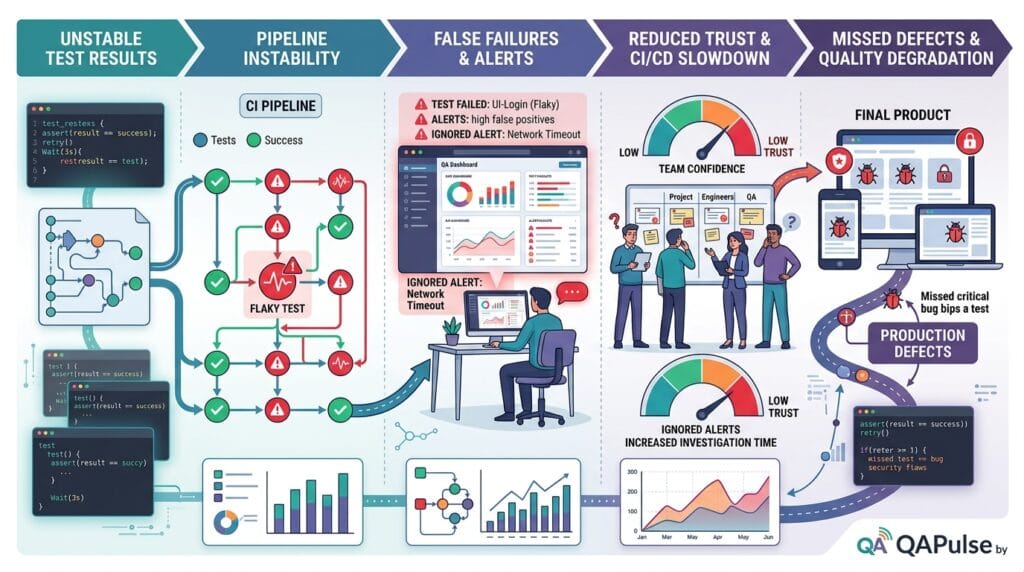
Why Flaky Tests Destroy Trust
Suppose a CI pipeline reports:
Build 1 → 12 failures
Build 2 → 0 failures
Build 3 → 8 failures
Build 4 → 1 failure
Build 5 → 0 failures
If engineers cannot determine whether failures represent real product defects, they eventually stop trusting the suite.
That creates a dangerous situation:
Flaky Tests
    ↓
False Failures
    ↓
Ignored Failures
    ↓
Reduced Trust
    ↓
Missed Real Defects
Test stability is therefore not simply an automation-maintenance concern.
It is part of the organization’s quality feedback system.
Test Isolation Is a Foundation of Reliable Automation
Tests should ideally be independent.
Consider two tests:
Test A:
Create user "john@example.com"

Test B:
Expect user "john@example.com" not to exist
If Test B depends on Test A’s cleanup behavior, execution order becomes significant.
A better design gives each test control over its own data.
Test A
 ↓
Create isolated data
 ↓
Execute
 ↓
Cleanup

Test B
 ↓
Create isolated data
 ↓
Execute
 ↓
Cleanup
This improves parallel execution and makes failures easier to reproduce.
Parallel Testing Changes the Economics of Automation
As test suites grow, sequential execution becomes expensive.
Suppose 1,000 tests require 30 minutes sequentially.
With appropriate isolation:
1 Worker   → 30 min
5 Workers  → ~6 min
10 Workers → ~3 min
Actual performance depends on infrastructure, setup time, resource contention, and test design.
Parallelization is not simply “add more workers.”
The suite must be designed to support concurrency.
That requires attention to:
- Test data
- Database state
- File systems
- Ports
- External services
- Authentication sessions
- Shared resources
This is another reason test architecture matters as much as individual test scripts.
Test Environment Is Part of the Test
A passing test in one environment does not automatically guarantee production quality.
Consider:
Developer
   ↓
QA
   ↓
Staging
   ↓
Production
Each environment can differ in:
- Configuration
- Database size
- Network topology
- Feature flags
- Third-party integrations
- Authentication
- Infrastructure capacity
- Logging
- Caching
A QA Engineer should therefore understand what the environment can and cannot prove.
A staging test may demonstrate application behavior.
It may not demonstrate production-scale performance.
Observability Strengthens Testing
Modern testing should not stop at pass/fail.
When a test fails, engineers need evidence.
Useful signals include:
Test Result
    +
Application Logs
    +
Metrics
    +
Traces
    +
Request IDs
    +
Screenshots
    +
Network Data
For example, an end-to-end test might report:
Test: Checkout payment
Result: Failed

Trace ID: 8fd91a
API: POST /payments
Response: 502
Payment Service: Timeout
Database: No order created
That is far more actionable than:
Expected element to be visible.
Actual: not found.
The latter tells you what the test observed.
The former begins explaining why.
Testing in CI/CD
A modern quality strategy integrates validation into the delivery pipeline.
A simplified pipeline might look like:
Commit
  ↓
Build
  ↓
Unit Tests
  ↓
Static Analysis
  ↓
API / Integration Tests
  ↓
UI Smoke Tests
  ↓
Security / Performance Gates
  ↓
Deployment
Not every test belongs on every pull request.
A useful distribution is:
Fast Feedback
    ↓
Unit + Component
    ↓
API + Integration
    ↓
Critical UI
    ↓
Broader Regression
    ↓
Production Monitoring
The objective is continuous risk reduction.
Shift-Left Does Not Mean Test Everything Earlier
“Shift-left” is often interpreted as:
Move all testing to developers.
That is too simplistic.
The deeper idea is to identify defects as early as economically useful.
Examples include:
- Reviewing requirements before coding
- Validating API contracts during development
- Running unit tests on every commit
- Performing security analysis before deployment
- Testing integration boundaries continuously
- Using production feedback to improve test coverage
Quality becomes a shared engineering responsibility.
The QA Engineer’s role evolves from merely finding defects toward helping the team prevent and detect them efficiently.
Shift-Right Complements Shift-Left
Production is another source of quality evidence.
Consider:
Development
    ↓
Testing
    ↓
Deployment
    ↓
Production
    ↓
Telemetry
    ↓
Real User Behavior
    ↓
New Risks
    ↓
Improved Tests
Production monitoring can reveal scenarios that pre-production testing did not anticipate.
Examples include:
- Unexpected traffic patterns
- Rare user workflows
- Regional failures
- Third-party outages
- Performance degradation
- Resource exhaustion
The strongest quality systems connect these signals back into engineering and testing.
Testing Strategy Should Evolve With the Product
A test suite created two years ago may no longer represent today’s product.
New architecture creates new risks.
For example:
Monolith
   ↓
Microservices
   ↓
Event-driven architecture
   ↓
Distributed workflows
   ↓
AI-enabled services
Each transition changes what should be tested.
A mature QA Engineer periodically reviews:
What changed?

What new dependencies exist?

Which risks increased?

Which tests became obsolete?

Where are the new failure boundaries?

What production incidents occurred?

What should be automated now?
This prevents the test suite from becoming historical documentation instead of current quality protection.
Comparing Traditional Testing With Engineering-Led Testing
| Traditional Approach | Engineering-Led Approach |
|---|---|
| Test cases first | Risks and behavior first |
| UI-heavy | Layered validation |
| Execute everything | Prioritize by risk |
| Pass/fail focused | Evidence focused |
| Automation percentage | Feedback value |
| Defect detection | Defect prevention + detection |
| Test suite grows continuously | Test suite evolves |
| Production treated separately | Production feedback informs testing |
| Failures handled manually | Observability supports diagnosis |
| Tools drive strategy | Strategy drives tool selection |
The second approach does not eliminate traditional testing techniques.
It puts them into a broader engineering context.
A Practical QA Exercise
Take a feature you are currently testing.
Write down five things:
1. Most important business risk
2. Most likely failure
3. Most damaging failure
4. Cheapest layer to detect it
5. Strongest evidence of correctness
Then map each risk to a validation layer.
Example:
| Risk | Best Initial Layer | Supporting Layer |
|---|---|---|
| Invalid calculation | Unit | API |
| Broken service contract | Contract | Integration |
| Incorrect authorization | API | UI |
| Checkout workflow failure | Integration | E2E |
| Slow response | Performance | Production telemetry |
This exercise forces the tester to think beyond individual test cases.
How These Fundamentals Connect to Modern QA Engineering
The fundamentals form a progression:
Testing Concepts
      ↓
Test Design
      ↓
Risk-Based Strategy
      ↓
Automation
      ↓
CI/CD
      ↓
Observability
      ↓
Quality Engineering
      ↓
AI-Assisted Quality
AI can help generate test ideas, analyze failures, create synthetic data, identify coverage gaps, and accelerate automation.
But AI does not eliminate the need to understand:
- Requirements
- Risk
- Testability
- Expected behavior
- Evidence
- Failure modes
- System architecture
In fact, stronger fundamentals make AI-assisted testing more useful because the engineer can evaluate whether an AI-generated test is actually valuable.
The Most Important Shift for a QA Engineer
The biggest career transition is moving from:
“I execute tests.”
to:
“I engineer confidence in software quality.”
That shift changes how you approach every activity.
Instead of asking:
How many tests did we run?
ask:
What risks did we reduce?
Instead of:
How much automation do we have?
ask:
What valuable feedback does our automation provide?
Instead of:
Why did the test fail?
ask:
What evidence can tell us whether this is a product defect, environment problem, test defect, or data problem?
Instead of:
Can this be automated?
ask:
Should this be automated, and at which layer?
Those questions are the practical application of software testing fundamentals in modern engineering teams.
Internal Blog Links
- 50 Playwright Commands Every QA Engineer Should Know
- What is QA Engineering? A Practical Guide to Modern Software Quality
- What is Playwright? A Powerful Guide to Modern Web Testing and QA Engineers
- QA Engineer vs SDET vs Quality Engineer: What’s the Difference?
- QA Engineer Portfolio: 7 Powerful Projects That Get Interviews in 2026
- Graph Engineering: The Powerful Layer After Loop Engineering
- Graph Testing: The Critical QA Layer After Loop-Based Test Automation
- Agentic Test Creation vs AI Test Generation: What’s the Real Difference?
- AI Test Automation With Humans in the Loop: Governance, Metrics, and the Practical Guide
Internal Series Links
- Learn MCP – Zero to Hero
- Learn AI Agents for QA – Zero to Hero
- Playwright Automation – Zero to Hero
- TencentDB Agent Memory: Complete Zero to Hero
- LangGraph: Complete Zero to Hero
- Learn Python – Zero to Hero
- OpenAI Codex: Complete Zero to Hero
- Cursor AI: Complete Zero to Hero
- Claude Code Tutorial: Complete Zero to Hero
- AutoGen: Complete Zero to Hero Guide
- Free QA Resources Built From Real Experience
- QA Glossary: Test Automation Terms Every Engineer Should Know
External Links
- Testing Terminology: ISTQB Testing Glossary
- Software Testing Concepts: ISO/IEC/IEEE 29119-1:2022
- Risk Based Testing: ISO/IEC/IEEE 29119-2:2021
- Web Security Testing: OWASP Web Security Testing Guide
- Test Automation: Playwright test documentation
- Observability: OpenTelemetry observability primer
AI Overview Optimization
What are software testing fundamentals?
Software testing fundamentals are the core principles, techniques, and practices used to evaluate whether software behaves as expected, manages risks effectively, and provides reliable evidence of quality. They include requirements analysis, test design, test levels, test types, risk-based testing, automation, defect analysis, CI/CD validation, and production feedback.
Why are software testing fundamentals important?
They help QA Engineers make better testing decisions instead of simply executing more test cases. Strong fundamentals help teams identify risks, select appropriate testing layers, design meaningful test scenarios, automate valuable checks, investigate failures, and continuously improve software quality.
What should a QA Engineer learn first?
A practical learning order is:
- Requirements analysis
- Test scenarios and test cases
- Testing techniques
- Functional and non-functional testing
- Test levels
- Risk-based testing
- API testing
- Automation fundamentals
- CI/CD testing
- Test reporting and observability
- Quality engineering
- Test coverage and test oracles
- Test data and test isolation
- Flaky-test management and observability
- Shift-left and shift-right testing
What is risk-based testing?
Risk-based testing prioritizes testing according to the probability and impact of potential failures. Critical business functionality receives deeper testing than low-impact functionality, helping teams use limited testing time where it provides the greatest reduction in risk.
Is test automation part of software testing fundamentals?
Yes, but automation is one component rather than the entire discipline. Effective automation depends on test design, risk analysis, appropriate test layers, stable test data, reliable assertions, maintainability, and meaningful feedback.
AEO Optimization
What is risk-based testing?
Risk-based testing prioritizes testing according to the likelihood and impact of potential failures. Critical workflows such as authentication, payments, authorization, and data integrity normally receive more testing attention than low-impact cosmetic functionality.
People Asked Questions
What are software testing fundamentals?
Software testing fundamentals are the core concepts and practices used to evaluate software quality, identify risks, detect defects, validate requirements, and provide evidence that a system behaves as expected.
What are the basic concepts of software testing?
The basic concepts include requirements analysis, test scenarios, test cases, test conditions, test data, test oracles, test levels, test types, defect management, test coverage, risk analysis, and test reporting.
What should a QA Engineer know about software testing?
A QA Engineer should understand test design, risk-based testing, functional and non-functional testing, API and integration testing, automation, CI/CD, test environments, test data, debugging, observability, and quality engineering principles.
What is risk-based testing?
Risk-based testing prioritizes testing according to the likelihood and business impact of potential failures. High-risk functionality receives greater testing attention and stronger validation.
Is automation the same as software testing?
No. Automation is a technique used to execute certain validations efficiently and repeatedly. Software testing is broader and includes analysis, test design, exploratory testing, risk assessment, validation, investigation, and quality decision-making.
What is the difference between integration testing and end-to-end testing?
Integration testing focuses on interactions between connected components or services, while end-to-end testing validates a complete business workflow across multiple layers of the application.
Why are flaky tests a problem?
Flaky tests produce inconsistent results without meaningful product changes. They create false failures, reduce confidence in CI pipelines, consume engineering time, and can eventually cause teams to ignore legitimate failures.
What is test coverage?
Test coverage measures how much of a selected testing target has been exercised. Useful coverage can include code, requirements, risks, behaviors, integrations, and environments. A high percentage alone does not guarantee effective testing.
What is shift-left testing?
Shift-left testing means introducing quality activities earlier in the software development lifecycle so defects and risks can be identified sooner and more economically.
What is shift-right testing?
Shift-right testing extends quality validation into production through monitoring, observability, real-user behavior, experiments, and operational feedback.
How does CI/CD improve software testing?
CI/CD automatically executes appropriate validation during software delivery, providing faster feedback about regressions and quality risks before changes reach later environments or production.
Will AI replace software testing fundamentals?
No. AI can accelerate test creation, analysis, automation, and failure investigation, but engineers still need testing knowledge to determine what should be tested, evaluate AI-generated results, identify risks, and decide whether evidence is sufficient.
Conclusion
Software testing fundamentals are not a collection of definitions that a QA Engineer memorizes and then leaves behind after learning automation.
They are the reasoning framework behind effective quality engineering.
Requirements analysis tells you what matters. Risk analysis tells you where to focus. Test design helps you select valuable scenarios. Test levels help you place validation where it is most efficient. Automation provides repeatable feedback. CI/CD delivers that feedback continuously. Observability provides evidence when systems fail. Production signals reveal risks that controlled environments cannot always expose.
The most effective QA Engineers therefore do not measure their contribution by the number of test cases they execute.
They measure it by the quality of the decisions their testing enables.
Final Key Takeaways
- Software testing fundamentals remain relevant even as testing tools and technologies evolve.
- Start with requirements and risks, not automation scripts.
- Use positive, negative, boundary, state-transition, and exploratory techniques to build meaningful coverage.
- Choose the cheapest reliable testing layer for each behavior.
- Do not confuse test-count or code-coverage percentages with genuine risk coverage.
- API, integration, contract, component, and UI testing should complement rather than compete with one another.
- A test should provide evidence, not merely execute actions.
- Flaky automation reduces confidence and can become a serious engineering problem.
- Test isolation and appropriate test data are essential for scalable automation.
- CI/CD should provide fast feedback while broader validation continues at appropriate stages.
- Production observability can reveal risks that pre-production testing misses.
- Shift-left and shift-right work best as complementary quality strategies.
- Automation should follow testing strategy—not replace it.
- AI-assisted testing becomes significantly more effective when the engineer already understands testing fundamentals.
- The ultimate objective is not more tests; it is better evidence, better risk coverage, faster feedback, and stronger engineering decisions.
Continue Learning
Explore more expert articles on Mobile Testing, Backend & API, AI & Agentic, AI Tools, n8n, LangChain, CrewAI, MCP Servers, AI Agents, LlamaIndex, Docker, FastAPI, Playwright, Cypress, Test Automation, DevOps, and Software Engineering at www.skakarh.com.
QAPulse by SK delivers expert release analysis, AI engineering insights, enterprise automation strategies, migration guidance, DevOps best practices, and practical testing knowledge to help software professionals build scalable, intelligent, and production-ready software systems.