QA
QA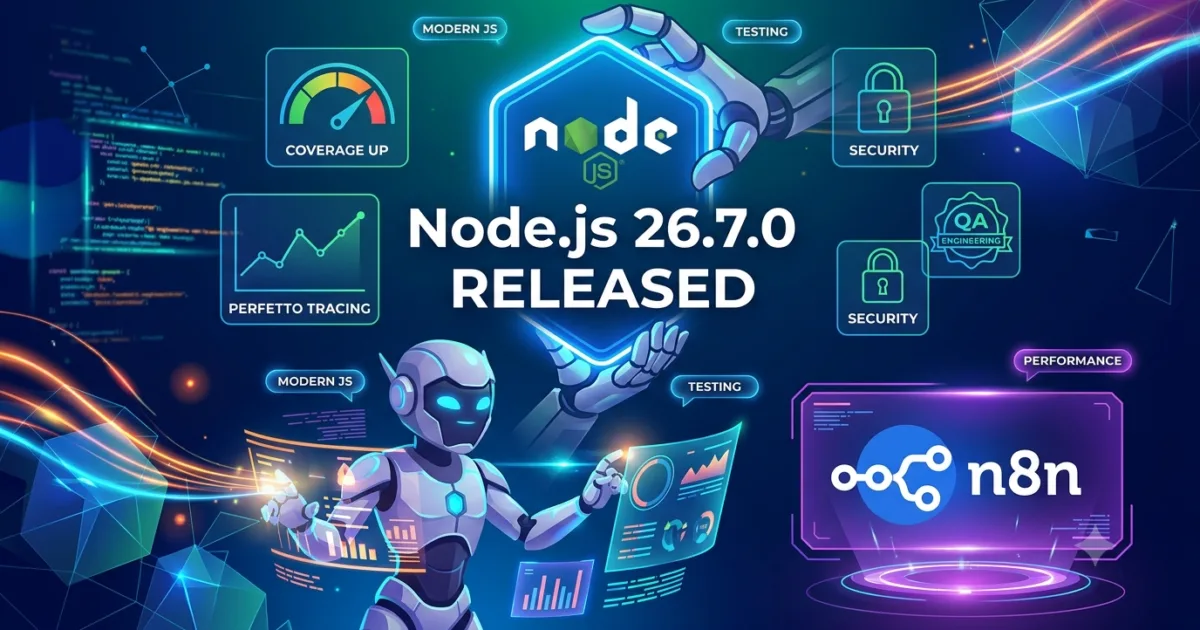
The Node.js team has released Node.js 26.7.0, introducing improvements to the built-in Test Runner, cryptography, module lifecycle management, performance profiling, and runtime security. As a SEMVER-MINOR release, Node.js 26.7.0 adds several new capabilities while maintaining compatibility with existing Node.js 26.x applications.
For QA Engineers, SDETs, Automation Engineers, and JavaScript developers, this release offers meaningful enhancements that improve test coverage reporting, strengthen security, simplify resource management, and provide deeper performance analysis for modern testing frameworks and CI/CD pipelines.
What’s New in Node.js 26.7.0
According to the official release notes, Node.js 26.7.0 delivers improvements across multiple core components of the runtime.
The most notable updates include:
- Support for loading private keys through STORE loaders in the crypto module.
- Updated root certificates to NSS 3.125.
- Built-in Perfetto performance tracing support.
- Implementation of Symbol.dispose in ModuleHooks.
- New –test-coverage-include-all option for the built-in Test Runner.
- Numerous bug fixes and internal runtime improvements.
Although these enhancements target different parts of the platform, together they improve developer productivity, runtime security, debugging capabilities, and automated testing.
Why This Release Matters for QA Engineers
Node.js is the runtime behind many popular testing frameworks, including Playwright, Cypress, WebdriverIO, Jest, Vitest, Newman, Mocha, and Puppeteer. Every improvement in the runtime can directly influence the reliability and performance of automated testing projects.
The additions in Node.js 26.7.0 are especially valuable for organizations using the built-in Test Runner, security-sensitive applications, or performance monitoring tools.
For QA teams, this release provides:
- Better test coverage reporting.
- Improved runtime security.
- Enhanced performance profiling.
- More reliable cryptographic capabilities.
- Better resource lifecycle management.
These enhancements contribute to a stronger and more maintainable automation ecosystem.
Key Improvement 1 — Enhanced Test Coverage Reporting
One of the most valuable additions for QA Engineers is the new --test-coverage-include-all option in the built-in Node.js Test Runner.
Coverage metrics are an important part of modern software quality. Teams rely on them to identify untested code paths, enforce quality gates, and monitor test effectiveness over time.
The new option allows coverage reporting to include files that were not executed during testing, giving teams a more accurate picture of overall project coverage.
Benefits include:
- More comprehensive coverage reports.
- Better identification of untested code.
- Improved quality gate enforcement.
- More accurate testing metrics.
- Enhanced CI/CD reporting.
Organizations adopting the built-in Test Runner will find this feature particularly valuable for maintaining high-quality codebases.
Key Improvement 2 — Better Security and Performance Analysis
Node.js 26.7.0 introduces several improvements aimed at strengthening security and simplifying performance investigations.
The runtime now supports loading private keys through STORE loaders, expanding flexibility for applications that rely on secure key management.
Additionally, root certificates have been updated to NSS 3.125, ensuring compatibility with current certificate authorities and improving secure communications.
Another important enhancement is built-in Perfetto support, allowing developers to capture and analyze runtime performance more effectively.
Together, these updates provide:
- Improved security.
- Better certificate management.
- Easier performance profiling.
- Enhanced diagnostics.
- Greater confidence in production deployments.
These capabilities are particularly useful for enterprise environments where security and performance monitoring are critical.
Module Lifecycle Improvements
The implementation of Symbol.dispose within ModuleHooks improves resource cleanup and lifecycle management.
As applications become more modular and complex, predictable cleanup behavior helps prevent resource leaks and simplifies framework development.
Although this enhancement primarily targets advanced developers, it also benefits organizations building custom testing frameworks and development tools.
Are There Any Breaking Changes?
The official release notes do not report any breaking changes in Node.js 26.7.0.
The release introduces several SEMVER-MINOR features while maintaining compatibility within the Node.js 26.x release line.
Even without reported breaking changes, organizations should validate:
- Existing applications
- Automation frameworks
- CI/CD pipelines
- Package compatibility
- Build processes
- Test execution
- Custom tooling
A phased rollout remains the recommended deployment strategy.
Should QA Teams Upgrade Immediately?
For organizations already using the Node.js 26.x release series, Node.js 26.7.0 is a recommended maintenance update.
The improvements to the Test Runner, cryptography, performance tracing, and runtime capabilities provide meaningful benefits without introducing significant migration complexity.
Recommended For
- QA Engineers
- SDETs
- Automation Engineers
- JavaScript Developers
- DevOps Engineers
- Platform Engineers
- Framework Developers
- Enterprise Development Teams
Upgrade Recommendations
Before deploying Node.js 26.7.0 into production:
- Upgrade development environments first.
- Execute smoke tests.
- Run complete regression suites.
- Validate Playwright and Cypress projects.
- Verify API automation.
- Confirm dependency compatibility.
- Test CI/CD pipelines.
- Monitor runtime behavior after deployment.
Following these validation steps helps ensure a smooth transition while minimizing operational risk.
Key Takeaways
Node.js 26.7.0 is a valuable incremental release that enhances the Node.js platform with stronger test coverage capabilities, improved cryptographic support, updated security certificates, built-in performance tracing, and better module lifecycle management. While the release does not introduce disruptive changes, it delivers practical improvements that benefit modern software development and testing workflows.
For QA Engineers, SDETs, Automation Engineers, and JavaScript developers, Node.js 26.7.0 offers better observability, stronger security, improved testing capabilities, and enhanced runtime diagnostics. Teams already using the Node.js 26.x release series should evaluate the update, validate their automation frameworks and CI/CD pipelines, and adopt Node.js 26.7.0 as part of their regular maintenance strategy to maintain a secure, reliable, and high-performing development environment.
Deep Dive into Node.js 26.7.0 for QA Engineers and Test Automation Teams
Node.js 26.7.0 continues the evolution of the Node.js runtime with enhancements focused on testing, security, performance analysis, and developer productivity. While this is a minor release within the Node.js 26.x series, it introduces several capabilities that directly benefit software quality teams building and maintaining JavaScript and TypeScript automation frameworks.
For QA Engineers and SDETs, these improvements help create more accurate test coverage reports, strengthen application security, improve performance investigations, and provide a more robust foundation for modern CI/CD pipelines.
Why Node.js Updates Matter for QA Teams
Most JavaScript testing frameworks rely on Node.js as their execution environment. Whether you’re testing web applications, APIs, microservices, or server-side applications, the runtime directly impacts automation reliability and execution performance.
Popular testing tools built on Node.js include:
- Playwright
- Cypress
- WebdriverIO
- Appium
- Jest
- Vitest
- Mocha
- Newman
- Puppeteer
- ESLint
- TypeScript
Keeping Node.js updated ensures these tools continue benefiting from runtime improvements, security updates, and new platform capabilities.
Enhanced Test Coverage Reporting
One of the most valuable additions in Node.js 26.7.0 is the new --test-coverage-include-all option for the built-in Test Runner.
Traditional coverage reports often include only files that were executed during testing. This can create an overly optimistic picture of test completeness because files that were never executed may be excluded entirely.
The new coverage option helps generate more comprehensive reports by including all relevant project files, making it easier to identify untested areas of the codebase.
For QA Engineers, this improvement offers several advantages:
- More accurate coverage metrics
- Better visibility into untested code
- Stronger quality gate enforcement
- Improved release readiness assessments
- Better compliance with enterprise quality standards
Organizations using automated coverage thresholds in CI/CD pipelines can especially benefit from these enhanced reporting capabilities.
Stronger Cryptography Support
Security remains a critical component of modern software development.
Node.js 26.7.0 introduces support for loading private keys through STORE loaders, expanding the flexibility of secure key management within applications.
In addition, the update refreshes the runtime’s trusted root certificates to NSS 3.125, ensuring compatibility with current certificate authorities and improving secure communications.
These enhancements help organizations:
- Strengthen application security
- Improve certificate compatibility
- Simplify secure authentication workflows
- Support enterprise security requirements
- Reduce potential certificate-related issues
For teams testing authentication systems, secure APIs, and encrypted communications, these improvements contribute to a more reliable runtime.
Built-In Perfetto Performance Tracing
Another significant enhancement is the introduction of built-in support for Perfetto, Google’s open-source performance tracing platform.
Performance analysis plays an increasingly important role in software quality. Understanding how applications consume CPU, memory, and system resources helps engineers identify bottlenecks before they affect production users.
With native Perfetto support, developers and QA teams gain access to richer runtime diagnostics without relying solely on external profiling tools.
Potential use cases include:
- Performance benchmarking
- Runtime profiling
- Memory analysis
- CPU utilization tracking
- Performance regression investigations
Organizations focused on application performance testing will find this addition particularly valuable.
Improved Module Lifecycle Management
The implementation of Symbol.dispose in ModuleHooks improves how modules manage resource cleanup during execution.
Although primarily intended for framework and library developers, predictable lifecycle management reduces the likelihood of resource leaks and simplifies the development of advanced tooling.
Benefits include:
- Cleaner resource management
- Improved framework development
- Better module reliability
- Easier maintenance of long-running applications
- More predictable runtime behavior
These improvements strengthen the overall reliability of the Node.js ecosystem.
Recommended Validation After Upgrading
Before adopting Node.js 26.7.0 across production environments, QA teams should execute a structured validation process.
Recommended validation activities include:
- Verify the installed Node.js version.
- Execute smoke tests.
- Run complete regression suites.
- Validate Playwright projects.
- Validate Cypress projects.
- Test API automation.
- Review code coverage reports.
- Verify dependency compatibility.
- Execute CI/CD pipelines.
- Monitor runtime logs after deployment.
Completing these checks helps ensure existing automation frameworks continue operating correctly after the upgrade.
Validation Checklist
| Validation Area | Purpose |
|---|---|
| Runtime Installation | Confirm Node.js 26.7.0 is installed correctly |
| Dependency Compatibility | Verify project packages remain compatible |
| Test Execution | Ensure automation suites run successfully |
| Coverage Reporting | Validate the new coverage option behaves as expected |
| Performance Profiling | Test Perfetto integration if applicable |
| Security Validation | Verify TLS and certificate functionality |
| Build Process | Confirm project builds complete successfully |
| CI/CD Pipeline | Validate automated workflows |
| Reporting Tools | Verify test reports remain accurate |
| Runtime Monitoring | Detect unexpected behavior after deployment |
Following this checklist helps minimize upgrade risks while maintaining reliable automation environments.
Best Practices for Enterprise Teams
Organizations adopting Node.js 26.7.0 should follow a structured rollout strategy.
Recommended best practices include:
- Upgrade development environments before production.
- Review official release notes thoroughly.
- Validate automation frameworks after upgrading.
- Execute regression testing across supported platforms.
- Monitor performance after deployment.
- Confirm dependency compatibility.
- Document environment-specific observations for future upgrades.
A phased deployment strategy helps ensure a smooth transition while reducing operational risk.
Expert Recommendation
From a QA and automation perspective, Node.js 26.7.0 is a recommended maintenance update for teams already using the Node.js 26.x release line. The enhanced Test Runner coverage capabilities, stronger cryptographic support, updated root certificates, built-in Perfetto tracing, and module lifecycle improvements provide practical value for both development and testing teams.
Organizations should validate their applications, execute comprehensive regression testing, confirm CI/CD compatibility, and review coverage reporting after upgrading. Incorporating Node.js 26.7.0 into a regular maintenance schedule helps maintain a secure, observable, and high-performing runtime for modern software testing and application development.
Real-World Impact of Node.js 26.7.0 on QA and Development Teams
Node.js serves as the execution engine for many of today’s most widely used development and testing tools. Every improvement to the runtime has the potential to influence application performance, test reliability, security, and developer productivity.
With Node.js 26.7.0, the focus is on strengthening the built-in testing experience, enhancing cryptographic capabilities, improving performance analysis, and refining runtime behavior. These updates help organizations build more reliable applications while giving QA teams better tools for validating software quality.
Better Test Quality Through Improved Coverage Reporting
One of the most valuable additions in this release is the new --test-coverage-include-all option for the built-in Test Runner.
In many projects, code coverage reports only include files executed during automated tests. This can unintentionally hide areas of the application that have never been tested.
The new option allows teams to generate more complete coverage reports by including all relevant source files, making it easier to identify testing gaps.
For QA Engineers, this leads to:
- More accurate quality metrics
- Better visibility into untested modules
- Stronger release confidence
- Improved compliance with coverage policies
- More effective regression planning
Organizations that rely on coverage thresholds as part of their CI/CD pipelines will benefit from more meaningful reporting.
Improved Security for Modern Applications
Security continues to be a priority for every software organization.
The cryptography improvements introduced in Node.js 26.7.0, including support for loading private keys through STORE loaders and updated root certificates based on NSS 3.125, strengthen the runtime’s security capabilities.
These updates are particularly valuable for applications that rely on:
- HTTPS communication
- Secure API authentication
- Certificate-based authentication
- Digital signatures
- Enterprise identity systems
Keeping runtime security components up to date helps reduce compatibility issues while maintaining secure communication across distributed applications.
Performance Analysis Made Easier
Performance optimization has become an important part of software quality.
The addition of Perfetto support gives engineering teams another powerful option for understanding runtime behavior, analyzing execution timelines, and investigating performance bottlenecks.
QA and performance testing teams can use these capabilities to:
- Investigate slow test execution
- Analyze application startup times
- Identify CPU-intensive operations
- Study memory utilization
- Detect performance regressions
These insights help improve both application performance and automation efficiency.
More Reliable Framework Development
The implementation of Symbol.dispose in ModuleHooks contributes to cleaner resource management within Node.js.
Although this feature primarily benefits framework and library developers, it also improves the overall reliability of applications that depend on modular architectures.
Better lifecycle management can help reduce:
- Resource leaks
- Memory retention issues
- Inconsistent cleanup behavior
- Long-running process instability
- Framework maintenance complexity
These improvements strengthen the ecosystem used by many modern JavaScript testing tools.
Benefits Across Engineering Teams
The enhancements introduced in Node.js 26.7.0 provide value across multiple technical roles.
QA Engineers benefit from improved coverage reporting and stronger runtime reliability during automated testing.
SDETs gain better support for maintaining enterprise-scale automation frameworks and CI/CD quality gates.
Developers receive enhanced security features, improved module lifecycle management, and new performance analysis capabilities.
DevOps Engineers benefit from updated runtime security, improved diagnostics, and easier production monitoring.
Platform Engineers can leverage improved observability and runtime enhancements to maintain more reliable infrastructure.
Recommended Validation Before Production Deployment
Although Node.js 26.7.0 does not introduce reported breaking changes, production upgrades should always follow a structured validation process.
Recommended validation activities include:
- Execute smoke tests.
- Run full regression suites.
- Verify Playwright and Cypress projects.
- Review code coverage reports.
- Validate API automation.
- Confirm package compatibility.
- Test CI/CD pipelines.
- Monitor runtime performance after deployment.
A systematic validation process reduces deployment risk while ensuring continued application stability.
Common Upgrade Mistakes
Even incremental runtime updates require careful planning.
Common mistakes include:
- Upgrading production without testing.
- Ignoring dependency compatibility.
- Skipping regression testing.
- Failing to validate coverage reporting.
- Overlooking CI/CD pipeline verification.
- Neglecting runtime monitoring after deployment.
Avoiding these issues helps ensure a successful upgrade with minimal operational disruption.
Best Practices for QA Teams
To maximize the benefits of Node.js 26.7.0, organizations should adopt a consistent runtime maintenance strategy.
Recommended best practices include:
- Keep Node.js versions aligned across development, staging, and production.
- Review official release notes before upgrading.
- Validate automation frameworks after every runtime update.
- Monitor coverage metrics continuously.
- Test security-sensitive functionality thoroughly.
- Benchmark application performance after upgrades.
- Maintain comprehensive regression test suites.
These practices help organizations maintain a secure, stable, and high-performing software development environment.
Suggested Internal Links
- Node.js 26.6.0 Released: New Test Runner Features & Upgrade Guide
- Node.js 26.5.1 Released: Critical Security Update Every QA Engineer and Developer Should Install
- Node.js 26.5.0 Released: Performance, Streams & ESM Improvements for QA Engineers
- Node.js 26.4.0 Released: Powerful Runtime Improvements Every QA Engineer Should Know
- Node.js 26.3.0 Released: Important Performance and Security Improvements QA Engineers Should Know
Authoritative External Resources
- Official Node.js Website: https://nodejs.org/
- Node.js Documentation: https://nodejs.org/docs/latest-v26.x/api/
- Node.js Security Releases: https://nodejs.org/en/security
People Asked Questions
What is Node.js 26.7.0?
Node.js 26.7.0 is a SEMVER-MINOR release published on August 05, 2026. It introduces improvements to the built-in Test Runner, cryptography, performance tracing, module lifecycle management, and runtime security.
What are the major features in Node.js 26.7.0?
The release includes:
- New
--test-coverage-include-alloption for the built-in Test Runner - Support for loading private keys through STORE loaders
- Updated root certificates to NSS 3.125
- Built-in Perfetto performance tracing support
Symbol.disposeimplementation in ModuleHooks- Various runtime bug fixes and internal improvements
Does Node.js 26.7.0 introduce breaking changes?
No. The official release notes do not report any breaking changes. As a SEMVER-MINOR release, Node.js 26.7.0 maintains compatibility within the Node.js 26.x release line while introducing new capabilities.
Why is the new Test Runner coverage option important?
The --test-coverage-include-all option allows coverage reports to include files that were not executed during testing. This provides a more accurate representation of project-wide code coverage and helps teams identify untested areas.
What is Perfetto support in Node.js?
Perfetto is an open-source performance tracing framework. Native support in Node.js enables developers and QA teams to analyze runtime performance, investigate bottlenecks, and troubleshoot performance-related issues more effectively.
Why should QA Engineers upgrade to Node.js 26.7.0?
QA Engineers benefit from improved code coverage reporting, stronger runtime security, enhanced performance diagnostics, and better support for modern testing frameworks and CI/CD pipelines.
Which teams benefit the most from this release?
This update is recommended for:
- QA Engineers
- SDETs
- Automation Engineers
- JavaScript Developers
- Backend Developers
- DevOps Engineers
- Platform Engineers
- Framework Developers
What should organizations validate after upgrading?
Organizations should verify:
- Test execution
- Code coverage reporting
- Playwright and Cypress compatibility
- API automation
- Package compatibility
- Build processes
- CI/CD pipelines
- Runtime performance
- Security-sensitive workflows
Key Takeaways
- Released on August 05, 2026
- Adds
--test-coverage-include-allto the built-in Test Runner - Introduces native Perfetto performance tracing support
- Enhances cryptography with STORE loader support
- Updates trusted root certificates to NSS 3.125
- Improves module lifecycle management with
Symbol.dispose - No reported breaking changes
- Recommended maintenance update for Node.js 26.x users
Final Verdict
Node.js 26.7.0 is a well-rounded maintenance release that introduces practical improvements across testing, security, performance analysis, and runtime lifecycle management. While it does not introduce disruptive platform changes, it delivers meaningful enhancements that support modern software engineering and quality assurance practices.
For QA Engineers, SDETs, Automation Engineers, and JavaScript developers, Node.js 26.7.0 provides more accurate test coverage reporting, stronger cryptographic capabilities, improved performance diagnostics, and a more reliable runtime foundation. Organizations already using the Node.js 26.x release series should evaluate this update, validate their automation frameworks and production workloads, and incorporate Node.js 26.7.0 into their regular maintenance cycle to maintain a secure, efficient, and future-ready development ecosystem.
Continue Learning with QAPulse by SK
Stay ahead of the rapidly evolving software engineering landscape with QAPulse by SK, your trusted source for expert insights on Node.js, Playwright, Cypress, FastAPI, Docker, LangChain, CrewAI, MCP Servers, n8n, Locust, k6, AI Agents, DevOps, Cloud Computing, Performance Engineering, and Test Automation.
Whether you’re building enterprise automation frameworks, optimizing CI/CD pipelines, testing AI-powered applications, or mastering modern backend development, QAPulse by SK provides practical tutorials, release analyses, implementation guides, and best practices to help QA professionals and software engineers build faster, more secure, and more reliable applications.