QA
QA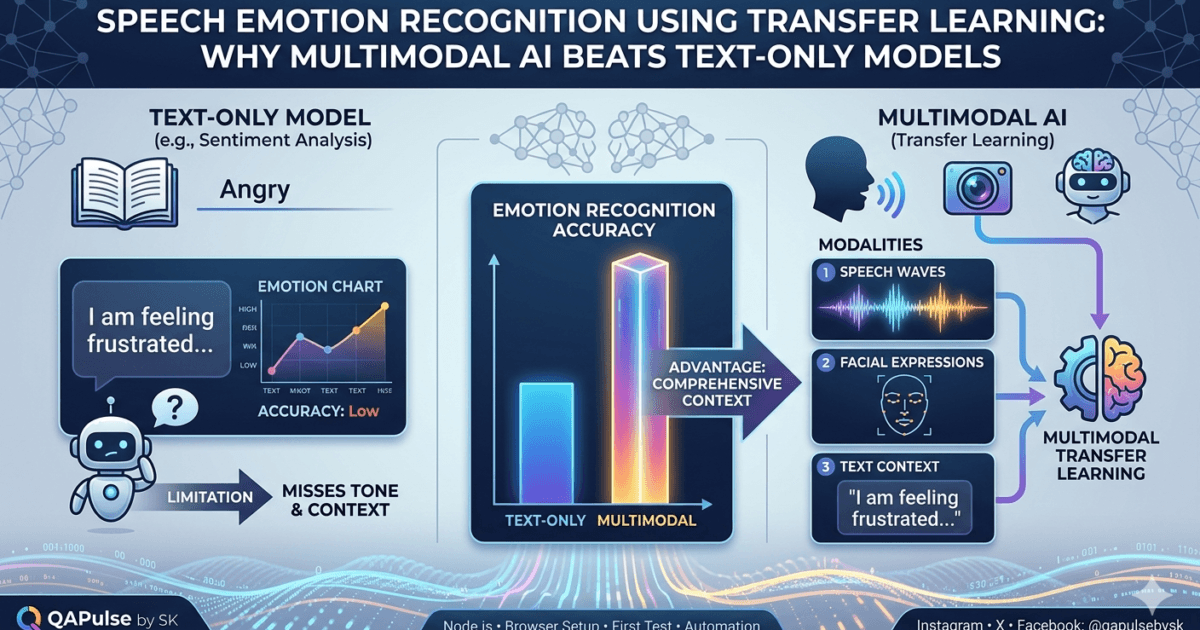
Artificial Intelligence has become increasingly capable of understanding what humans say. The next challenge is understanding how humans say it. Speech Emotion Recognition Using Transfer Learning can help understanding it.
A sentence like:
“That’s great.”
can express happiness, sarcasm, disappointment, frustration, or excitement depending on tone, pitch, emphasis, and context.
This challenge is known as Speech Emotion Recognition (SER).
To explore this problem, I built an open-source project that compares text-only, audio-only, and multimodal transfer learning approaches for Speech Emotion Recognition using modern AI models including RoBERTa, wav2vec2, WavLM, HuBERT, Whisper, and Cross-Attention Fusion.
GitHub Repository:
https://github.com/ShahnawazKakarh/speech-emotion-recognition-transfer-learning
Hugging Face URL:
https://huggingface.co/spaces/Shahnawazkakarh/speech-emotion-recognition
The project benchmarks multiple approaches across standard research datasets including:
- RAVDESS
- MELD
- IEMOCAP
and provides reproducible experiments, evaluation pipelines, Gradio demos, and Hugging Face deployment support.
What is Speech Emotion Recognition?
Speech Emotion Recognition (SER) is the task of automatically identifying human emotions from speech signals.
Common emotion categories include:
- Happy
- Sad
- Angry
- Fearful
- Neutral
- Disgust
- Surprise
Unlike traditional Natural Language Processing, SER requires understanding both:
Linguistic Content
What was said?
Example:
“I am fine.”
Paralinguistic Signals
How was it said?
Example:
- Pitch
- Intonation
- Energy
- Voice quality
- Speaking rate
This makes SER one of the most interesting multimodal AI challenges today.
Why Transfer Learning is Essential for Speech Emotion Recognition
One major challenge in Speech Emotion Recognition is the lack of labeled training data.
For example:
| Dataset | Size |
|---|---|
| RAVDESS | 1,440 audio clips |
| IEMOCAP | ~12 hours |
| MELD | ~13,000 utterances |
Compared with modern LLM datasets containing billions of examples, these datasets are tiny.
Training a deep neural network from scratch would lead to poor generalization.
Instead, modern SER systems rely on Transfer Learning.
This project leverages:
Text Models
- RoBERTa
- DeBERTa
Speech Models
- wav2vec2
- WavLM
- HuBERT
ASR Models
- Whisper
These pretrained models already understand language and speech representations before fine-tuning on emotion recognition tasks.
Architecture Overview
The system processes audio through two independent pathways.
Text Pathway
Audio → Whisper → Transcript → RoBERTa
This branch captures:
- Semantic meaning
- Context
- Word choice
- Linguistic emotion cues
Audio Pathway
Audio → wav2vec2 / WavLM / HuBERT
This branch captures:
- Pitch
- Prosody
- Vocal energy
- Speaking style
Multimodal Fusion
The outputs are combined using Cross-Attention Fusion.
This allows the model to learn relationships between:
- Spoken content
- Vocal characteristics
instead of relying on only one modality.
Experimental Approaches Compared
| Approach | Encoder | Captures |
|---|---|---|
| Text Only | RoBERTa | Semantic emotion cues |
| Audio Only | wav2vec2 / WavLM / HuBERT | Prosody and speech characteristics |
| Multimodal | RoBERTa + wav2vec2 | Both modalities |
The goal was not simply to achieve high accuracy.
The goal was to understand:
Which modality contributes most to emotion recognition?
RAVDESS Results: Multimodal Wins
Using a proper speaker-independent split:
| Model | WF1 | Accuracy |
|---|---|---|
| Multimodal | 0.728 | 0.729 |
| Audio Only | 0.659 | 0.667 |
| Text Only | 0.031 | 0.133 |
The results clearly show that multimodal fusion outperforms audio-only models while text-only approaches perform near chance levels.
Key Finding
Multimodal learning improved Weighted F1 by:
+6.9 percentage points
compared to audio-only models on unseen speakers.
A Surprising Discovery: Text-Only Models Failed
Many NLP practitioners assume that Large Language Models can solve emotion recognition problems.
Our experiments tell a different story.
The text-only RoBERTa model performed close to random guessing on RAVDESS.
Why?
Because RAVDESS contains only a few fixed sentences.
The words barely change.
Emotion is carried almost entirely through:
- Voice
- Tone
- Pitch
- Delivery
This demonstrates an important lesson:
Understanding language is not the same as understanding emotion.
Speaker Leakage: The Hidden Problem in SER Research
One of the most important findings from this project involves speaker leakage.
Random dataset splits produced:
| Split Type | WF1 |
|---|---|
| Random Split | 0.858 |
| Speaker Independent | 0.728 |
A difference of approximately:
13 percentage points.
This means many published SER results may be artificially inflated if speakers appear in both training and testing sets.
For researchers, this is a critical lesson.
Always evaluate speaker-independent performance whenever possible.
MELD Results: When Text Beats Multimodal
The MELD dataset produced a completely different outcome.
| Approach | WF1 |
|---|---|
| Text Only | 0.609 |
| Multimodal | 0.590 |
| Audio Only | 0.357 |
Here, text-only models actually outperformed multimodal fusion.
Why Did This Happen?
MELD contains conversations from TV shows.
The dialogue carries rich emotional context.
Meanwhile:
- Background noise exists
- Multiple speakers appear
- Audio quality varies
In this environment, language becomes the stronger signal.
This demonstrates a critical AI lesson:
Multimodal is not always better.
The effectiveness of fusion depends on signal quality.
Why This Project Matters for AI Engineers
This project demonstrates several practical lessons:
Lesson 1
Transfer Learning dominates Speech Emotion Recognition.
Lesson 2
Multimodal fusion often outperforms single-modality systems.
Lesson 3
Speaker-independent evaluation is essential.
Lesson 4
Dataset characteristics determine model success.
Lesson 5
Text alone cannot capture all emotional information.
Technologies Used
The project combines several modern AI technologies:
| Technology | Purpose |
|---|---|
| PyTorch Lightning | Training pipeline |
| Hugging Face Transformers | Model loading |
| RoBERTa | Text encoding |
| wav2vec2 | Speech representation |
| WavLM | Speech representation |
| HuBERT | Speech representation |
| Whisper | Speech-to-text |
| Gradio | Interactive demo |
| Hugging Face Spaces | Deployment |
How to Run the Project
Clone the repository:
https://github.com/ShahnawazKakarh/speech-emotion-recognition-transfer-learning
Create a virtual environment:
python -m venv .venv
Install dependencies:
pip install -e ".[dev,demo]"
Launch the demo:
python demo/gradio_app.py --pretrained
The project also includes:
- Automated training pipelines
- Evaluation scripts
- Dataset preparation scripts
- CI/CD integration
- Hugging Face deployment support
Related Resources
Internal Reading
- What is Playwright and Why Everyone is Talking About It
- The Hidden Architecture Behind Scalable QA Platforms in 2026
- AI-Powered Test Automation Framework: Powerful Complete Guide for 2026
- AI Agent Testing: 12 Critical Strategies Every QA Engineer Must Master in 2026
External Resources
- https://huggingface.co
- https://pytorch.org
- https://lightning.ai
- https://openai.com/research/whisper
- https://huggingface.co/docs/transformers
My Assessment
The most interesting contribution of this project is not the final accuracy score.
It is the evidence that:
- Speaker leakage significantly inflates benchmark results.
- Multimodal fusion improves generalization to unseen speakers.
- Text-only approaches can completely fail when emotional information is primarily acoustic.
These findings have practical implications for:
- Conversational AI
- Contact center analytics
- Mental health applications
- Human-computer interaction
- AI assistants
Frequently Asked Questions
What is Speech Emotion Recognition?
Speech Emotion Recognition is the task of identifying human emotions from speech signals using machine learning and deep learning models.
Why use Transfer Learning for SER?
Emotion datasets are small. Transfer learning allows models like RoBERTa, wav2vec2, and WavLM to leverage knowledge learned from large datasets.
Is multimodal learning always better?
No. This project shows multimodal models outperform audio-only models on RAVDESS but not on MELD.
Why did text-only models fail on RAVDESS?
The dataset contains only a few fixed sentences, so linguistic content carries very little emotional information.
What is speaker leakage?
Speaker leakage occurs when the same speakers appear in both training and testing sets, causing artificially inflated results.
Which model performed best?
The multimodal cross-attention model achieved the strongest speaker-independent performance on RAVDESS.
Answer Engine Optimisation
What is Speech Emotion Recognition?
Speech Emotion Recognition is the task of identifying human emotions from speech signals using machine learning and deep learning models.
Final Thoughts
Speech Emotion Recognition remains one of the most fascinating challenges in Artificial Intelligence because emotions are communicated through both language and voice.
This project demonstrates that modern Transfer Learning approaches using RoBERTa, wav2vec2, WavLM, Whisper, and multimodal fusion can significantly improve emotion recognition performance while also exposing common pitfalls such as speaker leakage and overreliance on text-based approaches.
If you’re interested in NLP, multimodal AI, speech processing, transfer learning, or applied machine learning research, this project provides a practical and reproducible foundation for experimentation.