QA
QA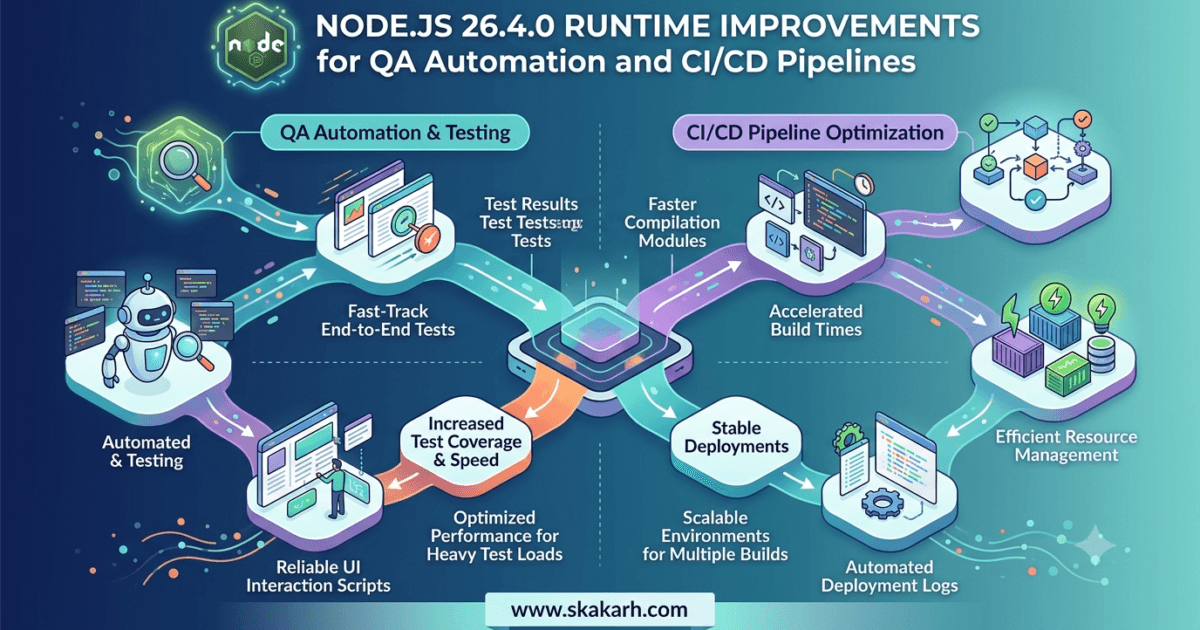
The Node.js 26.4.0 Released update delivers another significant step forward for one of the world’s most widely used JavaScript runtimes. While this isn’t a major version release, it introduces several runtime improvements that enhance filesystem performance, networking reliability, module resolution, TLS capabilities, and virtual filesystem support.
For software developers, these may appear as incremental enhancements. For QA engineers and SDETs, however, they represent changes that can directly influence application behavior, automation frameworks, API performance, and CI/CD environments.
Modern test automation increasingly relies on Node.js. Frameworks such as Playwright, Cypress, WebdriverIO, Vitest, Jest, Next.js, and countless internal automation tools all execute on top of the Node.js runtime.
Because of that, even relatively small runtime updates deserve careful evaluation before enterprise adoption.
In this article, we’ll examine the most important changes introduced in Node.js 26.4.0, explain what they mean for QA engineers, discuss migration considerations, and provide practical recommendations for testing teams.
What’s New in Node.js 26.4.0?
According to the official release notes, Node.js 26.4.0 introduces improvements across several core runtime components.
Some of the most notable updates include:
- Support for caller-supplied buffers in
readFile() - Improved HTTP connection cleanup
- Package Maps implementation for the module loader
- Enhanced TCP keep-alive configuration
- TLS certificate compression support
- Virtual filesystem improvements
- Documentation maturity updates
Although none of these changes introduce breaking JavaScript syntax, several of them improve runtime efficiency, developer flexibility, and networking behavior.
For enterprise environments running thousands of automated tests every day, these optimizations can contribute to more stable execution pipelines.
Why This Release Matters for QA Engineers
QA engineers often focus on frameworks like Playwright or Cypress while overlooking the runtime that powers them.
That runtime is Node.js.
Every automated browser test, API validation script, CLI utility, build process, and JavaScript-based testing framework ultimately depends on Node.js for execution.
When Node.js evolves, the effects eventually ripple through the entire testing ecosystem.
For example:
- Browser automation executes faster.
- Network communication becomes more reliable.
- File operations improve.
- Module resolution changes.
- Security capabilities evolve.
- CI/CD environments become more efficient.
Understanding runtime releases helps QA teams identify potential compatibility issues long before they affect production pipelines.
Faster File Operations with Improved readFile() Buffers
One of the most practical improvements in Node.js 26.4.0 is support for caller-supplied buffers when using readFile().
Traditionally, Node.js allocated memory internally whenever files were read.
With this update, developers have greater control over memory allocation by supplying their own buffers.
Why does this matter?
Large automation frameworks frequently read:
- JSON test data
- API payloads
- CSV datasets
- XML files
- Configuration files
- Screenshots
- Logs
- Performance reports
Reducing unnecessary memory allocation can improve execution efficiency, especially in long-running automation suites processing thousands of files.
While individual improvements may appear small, enterprise-scale automation benefits significantly from optimized resource usage.
Better HTTP Connection Management
Another noteworthy enhancement improves how Node.js handles idle HTTP connections.
The runtime now closes pre-request sockets more effectively when closeIdleConnections() is called.
For QA engineers, this matters because many automation environments execute thousands of HTTP requests during:
- API testing
- Contract testing
- Load testing
- Integration testing
- Service virtualization
- Mock server validation
Poor socket management can occasionally produce intermittent failures, resource exhaustion, or inconsistent network behavior.
Improving connection cleanup contributes to more predictable testing environments and healthier backend services.
Package Maps Modernize Module Resolution
Perhaps the most developer-focused enhancement in this release is the implementation of Package Maps within the Node.js module loader.
Package Maps improve how JavaScript applications resolve dependencies and organize modules.
Large enterprise applications often contain:
- Shared libraries
- Internal SDKs
- Monorepositories
- Microservices
- Private npm packages
- Workspace-based architectures
As these projects grow, dependency management becomes increasingly complex.
Package Maps provide additional flexibility for organizing imports while simplifying dependency resolution.
For QA engineers maintaining large automation repositories, this capability can eventually lead to cleaner project structures and fewer module resolution issues.
Networking Improvements Strengthen Production Reliability
Networking remains one of the most critical aspects of distributed software systems.
Node.js 26.4.0 introduces expanded support for TCP_KEEPINTVL and TCP_KEEPCNT through setKeepAlive().
These options provide more granular control over TCP keep-alive behavior.
Although backend developers may be the primary beneficiaries, QA engineers involved in:
- Performance testing
- Network resilience testing
- Chaos engineering
- Long-running API validation
- Microservice integration testing
can benefit from more predictable network behavior during extended execution sessions.
Stable networking reduces intermittent failures that are notoriously difficult to reproduce.
TLS Certificate Compression Improves Secure Communication
Security continues to evolve across modern software platforms.
Node.js 26.4.0 introduces support for certificateCompression within the TLS subsystem.
TLS certificate compression can reduce handshake overhead during secure connections while maintaining encrypted communication.
For organizations operating secure APIs, cloud-native services, financial platforms, and enterprise applications, improvements like these contribute to stronger and more efficient communication between distributed systems.
While most QA engineers won’t interact with this feature directly, teams responsible for security testing and infrastructure validation should be aware of the new capability.
Virtual Filesystem Improvements Support Modern Development
Another valuable enhancement expands Virtual Filesystem (VFS) support by enabling node:fs/promises to dispatch requests to mounted VFS instances.
Although this primarily targets advanced development scenarios, virtual filesystems are becoming increasingly important in:
- Cloud-native development
- Containerized applications
- Remote development environments
- Build systems
- Testing sandboxes
- AI-assisted development tools
As organizations continue moving toward cloud-first architectures, improvements in filesystem abstraction help create more flexible development and testing environments.
Impact on Popular QA Automation Frameworks
Although Node.js 26.4.0 is primarily a runtime release, its improvements will eventually benefit nearly every JavaScript-based testing ecosystem. If your organization depends on modern automation tools, upgrading Node.js after proper validation can provide incremental improvements in stability, networking, and runtime efficiency.
Some of the most commonly used QA frameworks running on Node.js include:
- Playwright
- Cypress
- WebdriverIO
- Jest
- Vitest
- Newman
- Pact
- Lighthouse CI
- TestCafe
- Allure CLI
- Custom internal automation frameworks
Every one of these tools relies on Node.js for execution. While no framework-specific APIs have changed in this release, improvements to HTTP handling, filesystem operations, TLS, and module loading indirectly enhance the environments in which these tools operate.
For organizations executing thousands of automated tests every day, runtime stability is just as important as framework features.
What Should QA Teams Test Before Upgrading?
One of the biggest mistakes teams make is assuming that a runtime upgrade is always “safe” simply because the release notes contain no breaking API changes.
Every runtime update deserves regression testing.
Before promoting Node.js 26.4.0 into production pipelines, validate:
CI/CD Pipelines
Verify that:
- GitHub Actions
- Azure DevOps
- GitLab CI
- Jenkins
- CircleCI
- TeamCity
continue executing builds successfully.
Check for unexpected runtime warnings, dependency issues, or package installation failures.
Browser Automation
Execute your complete regression suite across:
- Chromium
- Firefox
- WebKit
Watch for:
- timing differences
- asynchronous execution changes
- flaky waits
- screenshot inconsistencies
- trace generation
- report generation
Even when Playwright or Cypress hasn’t changed, the runtime underneath them has.
API Automation
Run:
- REST API suites
- GraphQL validation
- Contract tests
- Mock servers
- Authentication workflows
Pay particular attention to:
- HTTPS requests
- TLS negotiation
- keep-alive connections
- timeout handling
- retry logic
Networking improvements should never introduce regressions—but verifying them is always good engineering practice.
File-Based Test Execution
Since Node.js 26.4.0 introduces improvements around filesystem handling, validate automation that reads or writes:
- JSON fixtures
- CSV datasets
- XML payloads
- screenshots
- video recordings
- HAR files
- logs
- downloaded reports
Large enterprise automation projects often process thousands of files during execution.
Performance Benchmarks
If your automation framework includes performance-sensitive workloads, compare:
- execution duration
- startup time
- memory usage
- CPU utilization
- build completion time
While gains may be modest, they accumulate across large CI/CD environments.
Are There Any Breaking Changes?
The good news is that Node.js 26.4.0 introduces no major breaking changes for application developers or QA engineers.
Most updates are additive improvements to the runtime.
However, organizations should still evaluate:
- internal packages
- native modules
- custom Node.js extensions
- enterprise build scripts
- monorepo tooling
before deploying the update across production infrastructure.
As always, production upgrades should be validated in staging environments before organization-wide rollout.
Upgrade Recommendation
Recommended for: ✅ Most development and QA environments
Immediate production rollout: ✅ Yes, after normal regression testing
High-risk upgrade: ❌ No
Breaking API changes: ❌ None announced
Migration complexity: ⭐ Low
For most organizations, this is a maintenance upgrade focused on improving runtime capabilities rather than introducing disruptive behavior.
If your automation stack depends on Playwright, Cypress, WebdriverIO, Jest, or other Node.js tooling, this release is worth adopting after completing your standard validation process.
How to Upgrade Node.js 26.4.0
The installation method depends on how Node.js is managed in your environment.
Using Node Version Manager (Recommended)
nvm install 26.4.0
nvm use 26.4.0
Verify Installation
node --version
npm --version
Update Project Dependencies
npm install
or
pnpm install
or
yarn install
If your CI/CD pipeline uses Docker images, remember to update the Node.js base image as well to keep build environments consistent.
Final Verdict
Node.js 26.4.0 may not introduce headline-grabbing features, but it strengthens the runtime in areas that matter to enterprise engineering teams. Better filesystem performance, improved HTTP connection handling, enhanced TLS capabilities, package map support, and networking refinements all contribute to a more reliable foundation for modern JavaScript applications.
For QA engineers, the biggest takeaway is that runtime upgrades should never be overlooked. Stable automation depends not only on testing frameworks like Playwright or Cypress but also on the runtime executing them. Keeping Node.js current helps reduce technical debt, improves long-term compatibility, and ensures your automation platform is ready for future framework releases.
Our recommendation is to validate Node.js 26.4.0 through your regular regression pipeline and plan adoption during your next maintenance window.
Frequently Asked Questions
Is Node.js 26.4.0 a major release?
No. It is a minor release that introduces new runtime capabilities and performance improvements without significant breaking changes.
Should QA engineers upgrade immediately?
Most teams can upgrade after completing standard regression testing across CI/CD pipelines, browser automation suites, and API tests.
Does Node.js 26.4.0 improve Playwright or Cypress directly?
Not directly. However, improvements to the underlying runtime can enhance stability, networking behavior, and filesystem performance for frameworks built on Node.js.
Are there any migration risks?
There are no widely reported breaking changes, but organizations using native modules, custom tooling, or complex monorepos should validate compatibility before production rollout.
Suggested Internal Links
- Locust 2.44.3 Released: Important Build Stability Fix Performance Testers Should Know
- FastAPI 0.137.2 Release: 5 Important Updates for QA Engineers
- CrewAI 1.14.7 Released: Powerful Agentic AI Improvements QA Engineers Must Know
- Locust 2.44.1 Released: Valuable Observability Improvements Performance Test Engineers Will Love
- PostgreSQL 19 Beta 1 Released: Powerful Database Updates QA Engineers Must Know
Authoritative External Resources
- Official Node.js Website: https://nodejs.org/
- Node.js 26.4.0 Release Notes: https://github.com/nodejs/node/releases/tag/v26.4.0
- Node.js Documentation: https://nodejs.org/docs/latest-v26.x/api/
- Node.js Security Releases: https://nodejs.org/en/security
This article is published by QAPulse by SK at www.skakarh.com, where we cover software testing, QA engineering, AI-assisted automation, Playwright, Cypress, Selenium, Python, FastAPI, MCP, Agentic AI, DevOps, and the latest engineering releases to help testing professionals stay ahead.