 QA
QA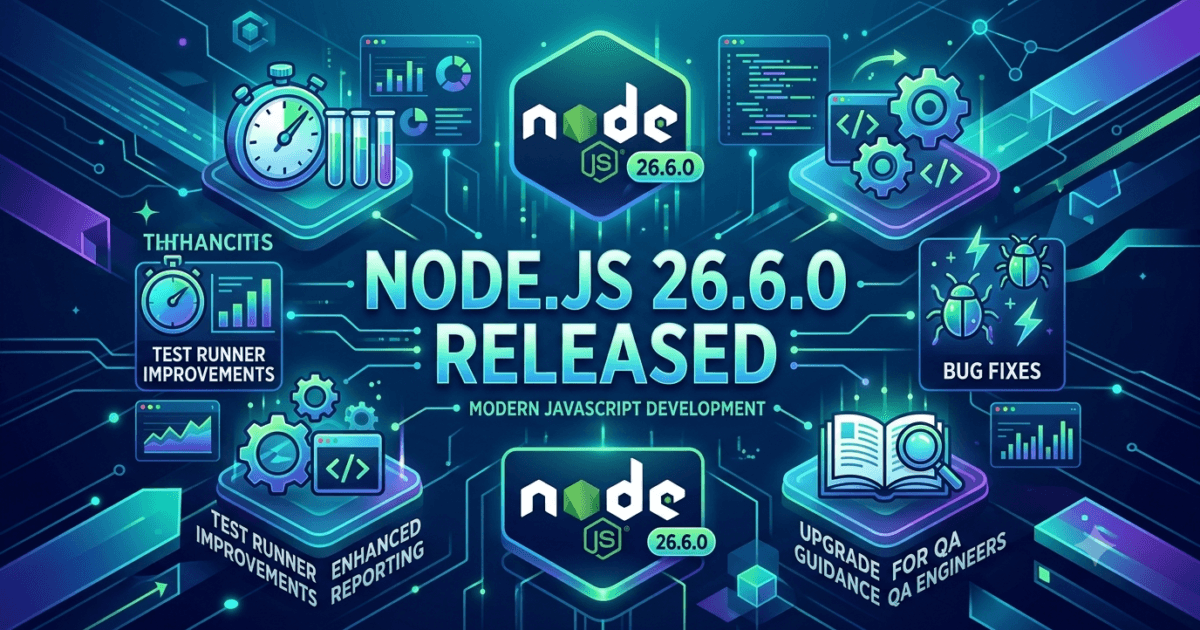
The Node.js team has released Node.js 26.6.0, introducing several developer-focused improvements, enhancements to the built-in test runner, updates to the Foreign Function Interface (FFI), and numerous bug fixes across core modules. While this is a minor release, it contains features that can improve testing workflows, debugging capabilities, and automation infrastructure for QA Engineers and SDETs.
As more testing frameworks—including Playwright, Cypress, WebdriverIO, Appium, Jest, Vitest, and many AI-powered developer tools—run on Node.js, keeping up with runtime improvements is essential for maintaining reliable automation pipelines.
For teams building modern test automation frameworks, the improvements in Node.js 26.6.0 provide better observability, improved diagnostics, and enhanced integration capabilities without requiring major migration efforts.
What’s New in Node.js 26.6.0
Node.js 26.6.0 delivers several notable enhancements, with the most significant changes centered around the built-in Node.js Test Runner and the Foreign Function Interface (FFI) API.
Highlights include:
- New
context.log()support in the built-in test runner. - A new
test:logevent for richer test reporting. - Test stream events now include the
entryFileproperty. - A new
getCurrentEventLoop()API for the FFI module. - Numerous bug fixes and internal improvements across Node.js core modules.
Although many updates target developers building tooling and runtime integrations, they also benefit QA engineers who rely on robust testing infrastructure.
Why This Release Matters for QA Engineers
Modern test automation is no longer limited to writing assertions. QA teams increasingly require detailed execution logs, better debugging capabilities, structured reporting, and seamless CI/CD integration.
The enhancements in Node.js 26.6.0 support these objectives by improving the built-in testing ecosystem and providing additional runtime visibility.
Whether you’re maintaining Playwright test suites, API automation frameworks, custom CLI tools, or internal testing utilities, these improvements can help make automated testing easier to monitor and troubleshoot.
Key Improvement 1 — Enhanced Built-in Test Runner Logging
One of the most valuable additions in Node.js 26.6.0 is the introduction of context.log() together with the new test:log event.
These additions allow developers to generate structured log messages directly from within test execution while enabling external tools and reporters to consume those logs more effectively.
For QA Engineers, this means:
- Better debugging during test execution.
- Cleaner test output.
- More structured reporting.
- Easier integration with CI/CD reporting systems.
- Improved visibility into failed test scenarios.
As the Node.js Test Runner continues to mature, these capabilities make it increasingly attractive for teams seeking lightweight alternatives to external testing frameworks.
Key Improvement 2 — Better Test Reporting with Entry File Information
Another useful enhancement is the addition of the entryFile property to TestStream events.
For organizations running thousands of automated tests across multiple repositories, identifying the originating test file quickly becomes essential during debugging and reporting.
This improvement helps:
- Improve test traceability.
- Simplify custom reporting.
- Enhance dashboard integrations.
- Speed up failure investigations.
- Support enterprise-scale testing environments.
Teams building internal reporting tools or analytics dashboards can now associate test events with their originating files more easily.
Additional Runtime Enhancement — FFI Improvements
Node.js 26.6.0 also introduces the new getCurrentEventLoop() API for the Foreign Function Interface (FFI).
Although this feature primarily targets advanced runtime integrations and native module developers, it expands the capabilities available to engineers building high-performance tooling, monitoring utilities, and system-level integrations.
While most QA Engineers may not directly interact with the FFI API, organizations developing custom testing infrastructure or performance analysis tools may benefit from these enhancements.
Are There Any Breaking Changes?
The official release identifies the new features as SEMVER-MINOR additions rather than breaking changes.
This means existing applications and automation frameworks should continue working without modification in most environments.
Even so, best practices recommend validating:
- Existing automation suites.
- Build pipelines.
- Custom Node.js utilities.
- Test reporting integrations.
- Third-party packages.
- CI/CD workflows.
Executing a complete regression suite before upgrading production environments remains the safest approach.
Should QA Teams Upgrade Immediately?
For organizations already using the Node.js 26.x release line, Node.js 26.6.0 is a recommended upgrade.
The release focuses on improving developer experience, strengthening the built-in testing framework, and expanding runtime capabilities while maintaining backward compatibility.
Recommended For
- QA Engineers
- SDETs
- Automation Engineers
- DevOps Engineers
- Platform Engineers
- Tool Developers
- Framework Maintainers
Upgrade Recommendations
Before rolling out the update across production systems:
- Upgrade a development environment first.
- Execute smoke tests.
- Run the complete regression suite.
- Validate Playwright, Cypress, and other automation frameworks.
- Confirm CI/CD pipelines complete successfully.
- Review custom reporting integrations.
- Monitor runtime behavior after deployment.
Following this staged approach minimizes operational risk while allowing teams to benefit from the latest improvements.
Key Takeaways
Node.js 26.6.0 is a valuable maintenance and feature update that continues strengthening the Node.js ecosystem for developers and QA professionals alike. The improvements to the built-in Test Runner—particularly context.log(), test:log events, and enhanced TestStream metadata—provide better observability and make debugging automated tests significantly easier.
Combined with ongoing runtime improvements and core bug fixes, this release helps teams build more reliable automation frameworks and maintain healthier CI/CD pipelines. For QA Engineers and SDETs already working within the Node.js 26.x ecosystem, Node.js 26.6.0 is a worthwhile upgrade that should be evaluated and adopted following standard validation procedures.
Deep Dive into Node.js 26.6.0 for QA Engineers and Test Automation Teams
Node.js 26.6.0 continues the evolution of the Node.js runtime with improvements that directly benefit developers building testing frameworks, automation tools, and modern CI/CD pipelines. While this release is not a major version upgrade, it introduces enhancements that improve debugging, test reporting, runtime capabilities, and overall developer productivity.
For QA Engineers and SDETs, these incremental improvements contribute to more maintainable automation frameworks and better visibility into test execution, particularly for teams adopting the built-in Node.js Test Runner.
Why Node.js Updates Matter for Test Automation
Node.js serves as the foundation for many of today’s most popular testing frameworks and automation tools. Whether you’re writing browser automation, API tests, performance scripts, or custom testing utilities, your automation stack depends on the stability and performance of the Node.js runtime.
Common tools built on Node.js include:
- Playwright
- Cypress
- WebdriverIO
- Appium
- Jest
- Vitest
- Mocha
- Newman
- Puppeteer
- ESLint
- TypeScript
Keeping the runtime updated ensures better compatibility, improved performance, and access to the latest platform capabilities.
Enhanced Test Runner Logging
One of the most significant additions in Node.js 26.6.0 is the introduction of context.log() together with the test:log event in the built-in Test Runner.
Logging plays a critical role in automated testing. When a test fails in a CI/CD pipeline, detailed logs often provide the fastest path to identifying the root cause.
The new logging capabilities allow developers to generate structured messages during test execution, making debugging more efficient and improving integration with custom reporting solutions.
For QA teams, this provides several practical benefits:
- Better visibility into test execution
- More informative failure diagnostics
- Cleaner debugging workflows
- Improved integration with reporting tools
- Enhanced developer productivity
As the Node.js Test Runner continues to mature, these capabilities make it increasingly attractive for teams looking to simplify their testing stack.
Improved Test Reporting
Another notable enhancement is the addition of the entryFile property to TestStream events.
In enterprise environments, automation projects often contain thousands of test files distributed across multiple modules or repositories. Identifying the originating test file quickly can significantly reduce debugging time.
This improvement supports:
- Better custom reporting
- Faster failure investigation
- Improved analytics dashboards
- Enhanced traceability
- Easier test management
Organizations building internal quality dashboards can leverage this metadata to produce richer execution reports.
FFI Enhancement for Advanced Integrations
Node.js 26.6.0 also introduces the getCurrentEventLoop() API for the Foreign Function Interface (FFI).
Although this feature primarily targets developers working with native libraries and low-level integrations, it expands the capabilities available for advanced tooling and runtime analysis.
Potential use cases include:
- Native module development
- Performance monitoring
- Runtime instrumentation
- Custom diagnostics
- System-level integrations
Most QA Engineers may not interact directly with this API, but organizations developing internal automation platforms or performance tools may benefit from its availability.
Bug Fixes Across Core Modules
In addition to the new features, Node.js 26.6.0 includes multiple bug fixes affecting core modules such as assertions, buffers, benchmarking utilities, and runtime components.
These fixes contribute to:
- Improved runtime stability
- Better standards compliance
- More predictable application behavior
- Reduced edge-case failures
- Enhanced platform reliability
Even when individual fixes appear minor, they collectively improve the quality of the runtime that powers modern automation frameworks.
Recommended Validation After Upgrading
Before adopting Node.js 26.6.0 across development or production environments, QA teams should execute a structured validation process.
Recommended validation activities include:
- Verify Node.js version installation
- Execute smoke tests
- Run the complete regression suite
- Validate Playwright projects
- Validate Cypress projects
- Test API automation
- Review test reporting
- Verify custom CLI tools
- Validate package installation
- Execute CI/CD pipelines
Completing these checks helps ensure existing automation continues to operate correctly after the upgrade.
CI/CD Considerations
Node.js updates should always be validated within the same Continuous Integration environment used by development teams.
Verify the following areas:
| Validation Area | Why It Matters |
|---|---|
| Runtime Installation | Confirms the correct Node.js version is available |
| Package Installation | Ensures dependencies install successfully |
| Test Execution | Verifies automation frameworks remain compatible |
| Build Process | Confirms application builds complete successfully |
| Test Reporting | Validates reporting integrations |
| Linting and Formatting | Ensures developer tools continue working |
| Artifact Generation | Confirms build outputs remain consistent |
| Deployment Pipeline | Verifies release automation remains functional |
Executing production-equivalent CI pipelines provides confidence before organization-wide adoption.
Best Practices Before Upgrading
To reduce migration risk, consider the following recommendations:
- Upgrade development environments before production systems.
- Review official release notes for new runtime features.
- Update project dependencies to compatible versions.
- Validate custom automation utilities.
- Test reporting integrations thoroughly.
- Monitor CI/CD pipelines after deployment.
- Document any compatibility observations for future upgrades.
These practices help maintain a reliable automation ecosystem while reducing operational disruptions.
Who Should Upgrade?
Node.js 26.6.0 is particularly beneficial for:
- QA Engineers
- SDETs
- Test Automation Engineers
- DevOps Engineers
- Platform Engineers
- Framework Developers
- Teams using the built-in Node.js Test Runner
- Organizations maintaining large JavaScript or TypeScript automation projects
Expert Recommendation
From a QA and automation perspective, Node.js 26.6.0 is a recommended upgrade for teams already using the Node.js 26.x release line. The enhanced Test Runner capabilities, improved logging support, richer reporting metadata, and ongoing runtime improvements provide practical benefits without introducing significant migration complexity.
Organizations should validate their automation frameworks, execute full regression testing, and confirm CI/CD compatibility before deployment. Adopting Node.js 26.6.0 as part of a regular maintenance strategy helps ensure a stable, modern, and efficient foundation for software testing and automation.
Real-World Impact of Node.js 26.6.0 on QA and Test Automation
While Node.js 26.6.0 is a minor release, the improvements introduced in the built-in Test Runner and runtime infrastructure can have a meaningful impact on modern testing workflows. For organizations that rely on automated testing throughout the software development lifecycle, better logging, improved reporting, and enhanced runtime capabilities translate into faster debugging and more reliable CI/CD pipelines.
As JavaScript and TypeScript continue to dominate web development and test automation, keeping the underlying runtime current helps ensure long-term stability and compatibility across the entire testing ecosystem.
Better Test Diagnostics
One of the biggest challenges in automated testing is diagnosing failures quickly. A failed test without sufficient context often requires engineers to reproduce the issue locally, increasing investigation time and delaying software delivery.
The new logging capabilities introduced in the built-in Test Runner help improve the quality of diagnostic information available during test execution.
For QA teams, better diagnostics can lead to:
- Faster root cause analysis
- More meaningful execution logs
- Reduced debugging time
- Improved collaboration between developers and testers
- Higher confidence in automated test results
As automation suites continue to grow, detailed logging becomes increasingly important for maintaining efficient testing processes.
Improved Test Reporting and Traceability
Large automation projects often generate thousands of test execution events during every CI/CD run. Identifying exactly where a failure originated is essential for maintaining productivity.
The addition of entry file information to TestStream events improves traceability by making it easier to associate execution events with the corresponding test files.
This enhancement benefits organizations by providing:
- Better reporting accuracy
- Easier navigation through test results
- Improved dashboard integration
- Faster investigation of failed executions
- Enhanced visibility into large automation suites
These improvements are particularly valuable for enterprise teams managing multiple repositories or monorepo-based testing frameworks.
Supporting Modern Automation Frameworks
Although many teams use third-party testing frameworks, those tools ultimately depend on the Node.js runtime.
Automation frameworks commonly used by QA Engineers include:
- Playwright
- Cypress
- WebdriverIO
- Appium
- Jest
- Vitest
- Mocha
- Puppeteer
- Newman
Maintaining an up-to-date Node.js version helps ensure these frameworks continue to benefit from runtime optimizations, bug fixes, and compatibility improvements delivered by the Node.js project.
Impact on CI/CD Pipelines
Continuous Integration pipelines execute automated tests every time code changes are committed. Any instability within the runtime can affect pipeline reliability, increase reruns, and slow software delivery.
After upgrading to Node.js 26.6.0, organizations should validate their CI/CD workflows to confirm that builds, automated tests, reporting, and deployment stages continue to operate as expected.
Key areas to verify include:
- Dependency installation
- Test execution
- Code quality checks
- Build generation
- Test reporting
- Artifact creation
- Deployment automation
A successful pipeline validation provides confidence that the runtime upgrade has not introduced unexpected compatibility issues.
Benefits for Different Engineering Roles
Different members of a software delivery team will benefit from this release in different ways.
QA Engineers gain improved visibility into automated test execution, making it easier to investigate failures and validate application behavior.
SDETs benefit from enhanced reporting capabilities and improved runtime reliability while maintaining large-scale automation frameworks.
Automation Engineers can take advantage of richer execution metadata to improve custom reporting tools and automation dashboards.
DevOps Engineers benefit from more dependable CI/CD pipelines and improved runtime stability across build environments.
Framework Developers gain additional capabilities through enhancements to the built-in Test Runner and FFI APIs, enabling more advanced tooling and integrations.
Recommended Validation After Upgrading
Even though Node.js 26.6.0 does not introduce significant breaking changes, every upgrade should be validated thoroughly before deployment into production environments.
A recommended validation process includes:
- Verify the installed Node.js version.
- Execute smoke tests for critical workflows.
- Run complete regression suites.
- Validate browser automation projects.
- Test API automation.
- Verify package installation.
- Confirm reporting integrations.
- Execute production-equivalent CI/CD pipelines.
- Monitor application logs after deployment.
Following these steps helps reduce operational risk while ensuring a smooth upgrade process.
Common Upgrade Mistakes
Minor releases are generally straightforward to adopt, but teams should still avoid several common mistakes.
These include:
- Skipping regression testing because the release appears small.
- Ignoring updates to internal testing utilities.
- Failing to validate custom reporting solutions.
- Deploying directly to production without testing.
- Overlooking dependency compatibility.
- Assuming all CI/CD environments behave identically.
A disciplined validation process helps prevent these issues from affecting production systems.
Best Practices for QA Teams
To maximize the benefits of Node.js 26.6.0, organizations should adopt a consistent upgrade strategy.
Recommended best practices include:
- Keep Node.js updated within supported release lines.
- Review official release notes before upgrading.
- Validate automation frameworks after each runtime update.
- Test custom utilities and reporting integrations.
- Monitor CI/CD pipelines following deployment.
- Maintain separate development and production upgrade schedules.
- Document environment-specific observations for future maintenance cycles.
Following these practices helps create a stable and maintainable automation ecosystem.
Suggested Internal Links
- Node.js 26.5.1 Released: Critical Security Update Every QA Engineer and Developer Should Install
- Node.js 26.5.0 Released: Performance, Streams & ESM Improvements for QA Engineers
- Node.js 26.4.0 Released: Powerful Runtime Improvements Every QA Engineer Should Know
- Node.js 26.3.0 Released: Important Performance and Security Improvements QA Engineers Should Know
Authoritative External Resources
- Official Node.js Website: https://nodejs.org/
- Node.js Documentation: https://nodejs.org/docs/latest-v26.x/api/
- Node.js Security Releases: https://nodejs.org/en/security
People Asked Questions
What is Node.js 26.6.0?
Node.js 26.6.0 is a minor release published on August 03, 2026, introducing improvements to the built-in Test Runner, enhancements to the Foreign Function Interface (FFI), and multiple bug fixes across the runtime.
What are the major features in Node.js 26.6.0?
Key highlights include:
context.log()support in the built-in Test Runner- New
test:logevent for structured test logging entryFileproperty added to TestStream eventsgetCurrentEventLoop()API for the FFI module- Numerous bug fixes and runtime improvements
Does Node.js 26.6.0 include breaking changes?
No major breaking changes have been announced. The new functionality is introduced as SEMVER-MINOR, making it compatible with existing Node.js 26.x projects in most cases.
Why is the built-in Test Runner important?
The built-in Test Runner continues to evolve into a powerful testing solution. New logging and reporting capabilities help QA teams improve debugging, execution visibility, and integration with CI/CD pipelines.
Should QA teams upgrade to Node.js 26.6.0?
Yes. Teams already using the Node.js 26.x release series should evaluate the update after validating their automation frameworks, dependencies, and CI/CD pipelines.
Which testing frameworks benefit from Node.js 26.6.0?
Many popular JavaScript testing tools run on Node.js, including:
- Playwright
- Cypress
- WebdriverIO
- Appium
- Jest
- Vitest
- Mocha
- Puppeteer
- Newman
Is Node.js 26.6.0 suitable for enterprise environments?
Yes. The release improves runtime capabilities, enhances test diagnostics, and strengthens reporting features, making it valuable for enterprise automation and large-scale CI/CD workflows.
How should organizations prepare for the upgrade?
A recommended upgrade strategy includes testing in a development environment, validating automation frameworks, executing regression suites, confirming dependency compatibility, and monitoring CI/CD pipelines after deployment.
Key Takeaways
- Released on August 03, 2026
- Introduces enhanced built-in Test Runner logging
- Adds
test:logevents for structured reporting - Includes
entryFilesupport in TestStream events - Expands FFI capabilities with
getCurrentEventLoop() - Contains multiple runtime bug fixes
- Recommended upgrade for Node.js 26.x users after validation
Final Verdict
Node.js 26.6.0 is a valuable incremental release that strengthens the Node.js platform with improvements to the built-in Test Runner, enhanced execution logging, richer reporting metadata, and additional runtime capabilities. While the release does not introduce disruptive changes, it provides meaningful improvements that support modern testing and automation practices.
For QA Engineers, SDETs, and Automation Engineers already using the Node.js 26.x release series, this update is recommended after completing standard validation procedures. Organizations that maintain Playwright, Cypress, WebdriverIO, Appium, or other JavaScript-based automation frameworks can benefit from the improved observability, better debugging experience, and ongoing runtime stability delivered by Node.js 26.6.0.
Continue Learning with QAPulse by SK
Stay ahead of the rapidly evolving software engineering landscape with QAPulse by SK, your trusted source for expert insights on Node.js, Playwright, Cypress, FastAPI, Docker, LangChain, CrewAI, MCP Servers, n8n, Locust, k6, AI Agents, DevOps, Cloud Computing, Performance Engineering, and Test Automation.
Whether you’re building enterprise automation frameworks, optimizing CI/CD pipelines, testing AI-powered applications, or mastering modern backend development, QAPulse by SK provides practical tutorials, release analyses, implementation guides, and best practices to help QA professionals and software engineers build faster, more secure, and more reliable applications.