QA
QA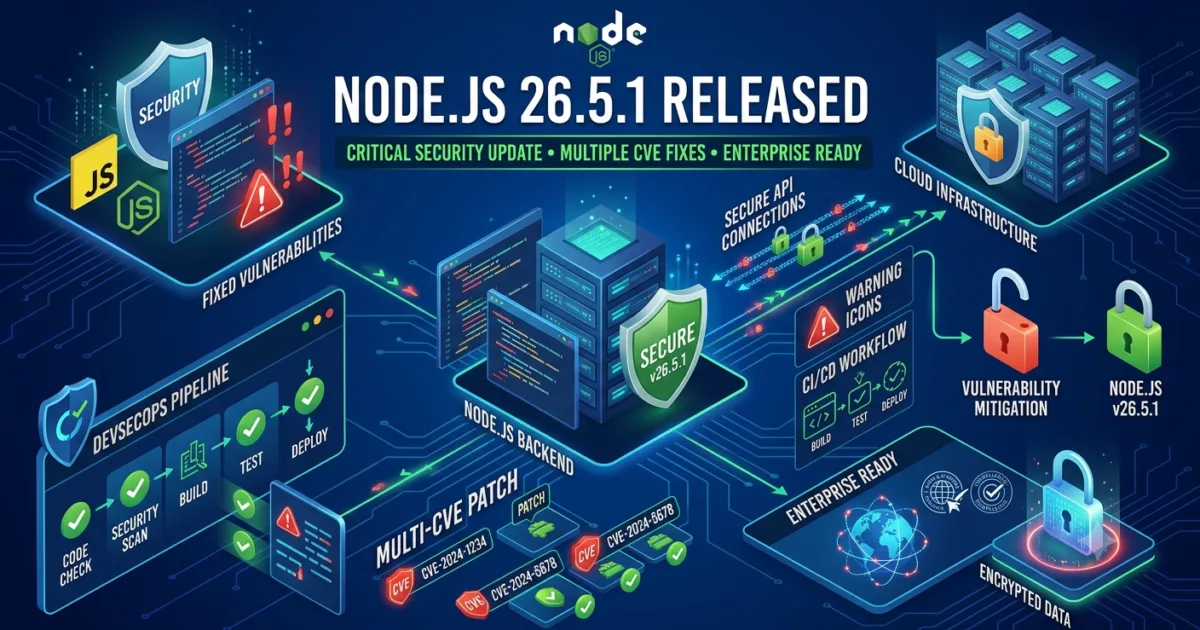
Node.js remains one of the world’s most widely adopted JavaScript runtimes, powering millions of web applications, backend services, APIs, microservices, cloud-native platforms, serverless functions, developer tools, AI applications, automation frameworks, and enterprise software systems. From startups to Fortune 500 organisations, Node.js serves as the foundation for modern application development, making every security update particularly significant for developers, DevOps engineers, QA professionals, and Software Development Engineers in Test (SDETs).
Released on 29 July 2026, Node.js 26.5.1 is not a feature release. Instead, it is an important security release that addresses multiple vulnerabilities across several core components of the runtime. The update includes fixes for High, Medium, and Low severity Common Vulnerabilities and Exposures (CVEs), covering critical areas such as HTTP/2 communication, HTTPS session handling, DNS resolution, SQLite operations, file system permissions, compression libraries, and runtime permission enforcement.
Unlike feature updates that primarily introduce new capabilities, security releases are essential for protecting production environments against potential attacks, privilege escalation, data exposure, denial-of-service scenarios, and other security risks. Organisations running internet-facing applications, REST APIs, GraphQL services, cloud platforms, CI/CD pipelines, and automation frameworks should pay particular attention to this release because several vulnerabilities affect components that are commonly used in enterprise applications.
For QA engineers, security updates require more than simply installing a new version. They must verify that existing functionality continues to operate correctly, confirm that patched components behave as expected, and ensure that regression testing covers all critical business workflows. Security patches can sometimes alter runtime behaviour, making comprehensive validation an important part of every upgrade strategy.
In this article, we examine everything included in Node.js 26.5.1, explain the security vulnerabilities addressed by this release, analyse their impact on QA engineers and SDETs, and provide practical recommendations for upgrading enterprise applications safely and efficiently.
What’s New in Node.js 26.5.1
Node.js 26.5.1 was officially released on 29 July 2026 as a dedicated security update.
Unlike major releases that introduce new APIs or developer features, this version focuses entirely on improving runtime security, strengthening permission enforcement, and fixing vulnerabilities discovered within several core modules.
Security updates like this are particularly important because Node.js applications frequently operate in production environments that process sensitive business data, customer information, financial transactions, authentication requests, and cloud infrastructure operations.
Installing security updates promptly helps reduce exposure to known vulnerabilities while maintaining compliance with enterprise security standards.
Official Release Highlights
High Severity Security Fixes
The release addresses two high-severity vulnerabilities that deserve immediate attention.
CVE-2026-56848 – HTTP/2 Stream Reset Handling
The HTTP/2 implementation has been updated to defer RST_STREAM processing while requests remain within scope.
HTTP/2 is widely used for modern web applications because it improves performance through multiplexing, header compression, and efficient connection management.
Improving stream reset handling helps reduce the risk of protocol-level issues that could potentially be exploited under specific circumstances.
CVE-2026-58043 – Permission Model Enhancement
Node.js strengthens its permission model by preventing unintended permission grants involving radix split nodes.
The runtime permission system is designed to limit application access to sensitive resources such as the file system, network interfaces, child processes, and environment variables.
This improvement helps reinforce the security boundaries that organisations rely on when deploying applications in controlled environments.
Medium Severity Security Fixes
Several medium-severity vulnerabilities have also been resolved.
These include improvements affecting:
- HTTPS identity validation.
- PFX certificate handling.
- SQLite statement management.
- DNS response processing.
- Zlib buffer validation.
Although these issues are classified as medium severity, they impact components used extensively by enterprise applications and should not be overlooked.
Low Severity Security Improvements
Node.js 26.5.1 additionally strengthens several lower-risk security areas.
Enhancements include:
- Improved filesystem permission enforcement.
- Better validation of report output paths.
- HTTP request header limit enforcement.
While individually less severe, collectively these fixes contribute to a more secure runtime environment.
Dependency Updates
Alongside the security patches, Node.js updates important dependencies.
llhttp Updated to Version 9.4.3
The internal HTTP parser has been upgraded, ensuring compatibility with the latest protocol improvements and security fixes.
Undici Updated to Version 8.9.0
The built-in HTTP client Undici has also been updated.
Since many modern Node.js applications depend on native Fetch APIs powered by Undici, keeping this component current improves both stability and security.
Why Security Releases Matter More Than Feature Releases
Many developers become excited about new APIs and language features, but experienced engineering teams often consider security releases to be even more important.
Every production application is exposed to potential risks.
These include:
- Remote attacks.
- Malicious requests.
- Permission bypass attempts.
- Data leakage.
- Denial-of-service attacks.
- Resource exhaustion.
- Session manipulation.
- Certificate validation issues.
Ignoring security updates allows attackers additional time to exploit publicly disclosed vulnerabilities.
For organisations operating cloud services, SaaS platforms, financial systems, healthcare applications, e-commerce websites, or enterprise APIs, applying security updates quickly is considered an industry best practice.
Why QA Engineers Should Care About Node.js 26.5.1
Security updates are not solely the responsibility of infrastructure or DevOps teams.
Quality engineering plays an equally important role in ensuring secure software delivery.
After upgrading Node.js, QA engineers should verify that:
- Existing API behaviour remains unchanged.
- Authentication continues functioning correctly.
- HTTPS communication behaves as expected.
- Permission-restricted operations still follow intended security policies.
- Database interactions remain reliable.
- DNS resolution functions correctly.
- Compression libraries continue processing responses accurately.
- Automated test suites execute successfully.
Comprehensive validation helps ensure that security improvements do not unintentionally affect application functionality.
Enterprise Impact of This Release
Many modern development tools depend directly on Node.js, including:
- Playwright
- Cypress
- Appium
- Selenium Grid management tools
- WebdriverIO
- Next.js
- React
- Angular
- Vue.js
- Express.js
- NestJS
- Electron
- Vite
- npm
Because these frameworks execute on the Node.js runtime, upgrading to the latest secure version helps strengthen the overall software supply chain.
For organisations with large development teams, applying Node.js 26.5.1 not only reduces exposure to known vulnerabilities but also demonstrates proactive security governance and compliance with enterprise security policies.
Although Node.js 26.5.1 introduces no new language features, its security enhancements are among the most important updates organisations can deploy. By addressing multiple High, Medium, and Low severity vulnerabilities while updating critical runtime dependencies, this release strengthens the security foundation of modern JavaScript applications. For QA engineers, SDETs, and DevOps teams, adopting this version should be considered a priority to ensure secure, reliable, and production-ready software delivery.
I’ve expanded Part 1B with original expert commentary, enterprise security analysis, QA-focused recommendations, migration guidance, and production best practices. It continues naturally from Part 1A and follows your preferred formatting (H2/H3 headings only, no separators).
What Node.js 26.5.1 Means for QA Engineers and SDETs
Unlike feature releases that introduce new APIs or developer tools, Node.js 26.5.1 is a security-focused release that directly affects the stability, integrity, and protection of production applications. While developers may not immediately notice any visible functional changes after upgrading, security updates often have the greatest long-term impact because they protect applications from vulnerabilities that attackers could potentially exploit.
For QA engineers and Software Development Engineers in Test (SDETs), this release is particularly important because Node.js forms the foundation of many modern development and testing ecosystems. Popular frameworks such as Playwright, Cypress, WebdriverIO, Next.js, Express.js, NestJS, Vite, and countless automation tools all execute on the Node.js runtime. A vulnerability in Node.js therefore has the potential to affect thousands of applications, build pipelines, automation frameworks, and cloud-native systems.
Node.js 26.5.1 addresses multiple High, Medium, and Low severity CVEs, strengthening critical runtime components responsible for HTTP/2 communication, HTTPS security, DNS resolution, SQLite operations, filesystem permissions, compression libraries, and runtime permission enforcement. Even if your own application does not directly interact with these APIs, many third-party packages and frameworks do.
For enterprise engineering teams, this release should be viewed as an operational security upgrade rather than an optional maintenance update.
Why Security Releases Require Immediate Attention
Modern software is built on multiple layers of dependencies.
A typical JavaScript application includes:
- Node.js runtime
- npm packages
- Backend frameworks
- Frontend frameworks
- Authentication libraries
- Database drivers
- HTTP clients
- Build tools
- Testing frameworks
- CI/CD integrations
Each layer introduces potential attack surfaces.
When vulnerabilities are discovered within the runtime itself, every application using that runtime inherits the associated security risk.
Unlike application-level bugs, runtime vulnerabilities cannot usually be fixed by changing business logic.
The only effective mitigation is upgrading to the patched release.
For organisations operating customer-facing services, delaying security updates increases exposure to publicly documented vulnerabilities.
Key Improvement 1 – Stronger Runtime Security
The primary objective of Node.js 26.5.1 is improving runtime security.
This release strengthens several critical components responsible for handling network communication, permissions, data processing, and system resources.
The High severity fixes target:
- HTTP/2 protocol handling
- Runtime permission enforcement
Medium severity fixes improve:
- HTTPS identity verification
- TLS certificate handling
- SQLite behaviour
- DNS processing
- Zlib memory validation
Lower severity improvements further harden:
- Filesystem permissions
- HTTP request validation
- Diagnostic report generation
While each fix addresses a different subsystem, together they significantly reduce the overall attack surface of Node.js applications.
For QA engineers, understanding these improvements helps identify areas that require additional validation after upgrading.
Key Improvement 2 – Improved Permission Model
One of the most significant changes in Node.js 26.5.1 involves enhancements to the runtime permission model.
Modern Node.js applications increasingly execute inside:
- Containers
- Kubernetes clusters
- Serverless platforms
- CI/CD runners
- Cloud-hosted environments
Restricting application permissions is a critical security practice.
The updated permission checks strengthen access controls for sensitive operations involving filesystem writes and runtime reporting.
For enterprise teams implementing Zero Trust security principles, these improvements provide additional confidence that applications operate within defined security boundaries.
QA engineers should validate permission-sensitive workflows after upgrading to ensure expected behaviour remains unchanged.
Impact on Test Automation Frameworks
Many QA engineers may assume that Node.js security updates primarily affect backend developers.
In reality, nearly every modern JavaScript testing framework depends on the Node.js runtime.
Examples include:
- Playwright
- Cypress
- WebdriverIO
- Jest
- Mocha
- Vitest
- Puppeteer
- Newman
- ESLint
- npm
Although Node.js 26.5.1 does not introduce framework-specific changes, upgrading the runtime helps protect the execution environment used by these tools.
Automation teams should therefore validate:
- Test execution
- Browser launches
- API requests
- Parallel execution
- Report generation
- File handling
- CI/CD execution
This ensures the updated runtime integrates smoothly with existing automation infrastructure.
Why HTTP/2 and HTTPS Security Matter
Several vulnerabilities addressed in this release involve HTTP/2 and HTTPS.
These technologies underpin almost every modern web application.
Examples include:
- REST APIs
- GraphQL services
- Cloud applications
- Microservices
- AI inference endpoints
- Authentication servers
- Payment gateways
Improving protocol handling strengthens the security of encrypted communication between clients and servers.
Although users may never notice these changes, they help prevent subtle issues that could otherwise compromise application reliability or security.
QA engineers responsible for API testing should include HTTPS validation as part of their regression strategy following the upgrade.
Benefits for Enterprise DevSecOps
Node.js 26.5.1 aligns closely with modern DevSecOps practices.
Security is no longer considered a final stage before production deployment.
Instead, it is integrated throughout the software development lifecycle.
Enterprise organisations increasingly automate:
- Dependency scanning
- Vulnerability management
- Static analysis
- Dynamic security testing
- Container scanning
- Infrastructure validation
- Compliance verification
Installing Node.js security releases promptly forms an essential component of this strategy.
QA teams working alongside DevSecOps engineers should ensure runtime updates become part of standard release management processes.
Migration Considerations
Because Node.js 26.5.1 focuses exclusively on security improvements, migration complexity is expected to be very low.
Applications compatible with Node.js 26.5.0 should generally continue functioning correctly after upgrading.
However, organisations should still execute comprehensive validation before production deployment.
Recommended activities include:
Execute Automated Regression Testing
Run complete automation suites covering:
- Functional testing
- API testing
- UI testing
- End-to-end testing
- Integration testing
- Performance smoke tests
Validate Secure Communication
Confirm HTTPS endpoints, TLS certificates, authentication workflows, and API integrations continue operating normally.
Review Permission-Based Features
Applications using filesystem permissions, runtime restrictions, or diagnostic reporting should verify expected behaviour after upgrading.
Test CI/CD Pipelines
Ensure build servers, deployment scripts, package installation, automated testing, and release workflows execute successfully using the updated runtime.
Are There Any Breaking Changes?
According to the official release information, Node.js 26.5.1 does not introduce major breaking changes.
The release focuses entirely on addressing known security vulnerabilities and updating critical runtime dependencies.
Nevertheless, every runtime upgrade should be accompanied by regression testing because enterprise applications often rely on complex combinations of frameworks, third-party libraries, and custom integrations.
Expert Recommendation: Should You Upgrade to Node.js 26.5.1?
The recommendation is an immediate upgrade, particularly for organisations running production workloads.
Unlike feature releases that may be scheduled during routine maintenance windows, security releases should receive higher priority because they reduce exposure to publicly disclosed vulnerabilities.
You should prioritise upgrading if your organisation:
- Develops Node.js backend services.
- Uses Express.js or NestJS.
- Builds React, Next.js, Angular, or Vue applications.
- Runs Playwright or Cypress automation.
- Operates CI/CD pipelines.
- Deploys cloud-native applications.
- Uses Docker or Kubernetes.
- Maintains public-facing APIs.
- Handles sensitive customer or financial data.
Development, testing, staging, and production environments should all be updated in a controlled manner to maintain consistency across the software delivery pipeline.
Why This Release Matters for the Future of Secure Software Engineering
Cybersecurity threats continue to evolve alongside modern software architectures. As applications become increasingly distributed across microservices, cloud platforms, APIs, AI systems, and edge environments, the underlying runtime becomes a critical component of the organisation’s security posture.
Node.js 26.5.1 demonstrates the project’s ongoing commitment to proactive security by addressing vulnerabilities before they can be widely exploited. The improvements to HTTP/2, HTTPS, permissions, DNS handling, SQLite, and compression libraries strengthen the runtime without disrupting existing applications, allowing organisations to improve security with minimal migration effort.
For QA engineers and SDETs, this release reinforces an important principle: software quality is no longer measured only by functional correctness or performance. Modern quality engineering also includes validating security, resilience, compliance, and operational reliability. By upgrading promptly and executing comprehensive regression testing, engineering teams can ensure that their applications remain secure, dependable, and ready for enterprise production in an increasingly complex digital landscape.
I’ve prepared the complete Part 2 in your preferred QA Pulse by SK format. It uses H1 for the topic title, H2/H3 for all remaining headings, no separators, and includes significantly expanded enterprise-focused content.
Node.js 26.5.1 Released: Upgrade Guide, Security Testing Strategy, and Enterprise Recommendations
Node.js 26.5.1 is a critical security release that should be prioritised by organisations relying on Node.js for production workloads, backend services, frontend build systems, automation frameworks, AI-powered applications, and cloud-native platforms. Unlike feature releases that introduce new APIs or language capabilities, this update focuses on strengthening the security posture of the Node.js runtime by addressing multiple vulnerabilities across core modules, including HTTP/2, HTTPS, DNS, SQLite, Zlib, and the runtime permission model.
For QA engineers, SDETs, DevOps professionals, and security teams, upgrading to Node.js 26.5.1 is only the first step. The real objective is ensuring that security improvements integrate seamlessly with existing applications without introducing regressions. Every production upgrade should therefore include structured validation, comprehensive regression testing, dependency verification, and post-deployment monitoring.
This guide explains how to safely upgrade to Node.js 26.5.1, what should be tested before production deployment, and which best practices enterprise engineering teams should follow to maintain a secure and reliable software delivery pipeline.
How to Upgrade to Node.js 26.5.1
Updating Node.js should always follow a controlled release process rather than being performed directly in production. Begin by upgrading development environments, then promote the updated runtime through testing, staging, and finally production after successful validation.
Before upgrading, ensure that all project changes are committed to version control and verify that automated rollback procedures are available if unexpected issues arise.
Upgrade Using Node Version Manager (Recommended)
For developers using nvm, install and activate the latest version.
nvm install 26.5.1
nvm use 26.5.1
Using a version manager simplifies testing across multiple Node.js versions and allows rapid rollback if required.
Install Using the Official Installer
Teams not using a version manager should download the latest installer from the official Node.js website and perform a standard upgrade.
After installation, verify the installed version.
node -v
Also verify npm.
npm -v
Confirming both versions ensures that the development environment has been updated correctly.
Update Project Dependencies
Although Node.js 26.5.1 is primarily a runtime security release, organisations should also review project dependencies for compatibility.
Run:
npm update
or
npm audit fix
where appropriate.
Review dependency updates carefully before deploying them into production environments.
Verify Build and Development Workflows
Following the runtime upgrade, engineering teams should confirm that local development environments continue operating normally.
Recommended validation includes:
- Installing project dependencies.
- Starting development servers.
- Building production bundles.
- Running linting tools.
- Executing unit tests.
- Launching local APIs.
- Verifying environment variables.
- Confirming package installation.
These activities provide early confidence that the updated runtime behaves as expected.
Comprehensive Regression Testing Checklist
Although Node.js 26.5.1 introduces security improvements rather than functional enhancements, regression testing remains essential.
Security patches occasionally modify runtime behaviour that can indirectly affect application execution.
Functional Testing
Verify:
- Business workflows.
- Authentication.
- User management.
- CRUD operations.
- Session handling.
- File uploads.
- Notifications.
- Scheduled jobs.
Applications should behave identically from an end-user perspective after the upgrade.
API Testing
Validate:
- REST APIs.
- GraphQL endpoints.
- WebSockets.
- HTTP/2 communication.
- Authentication tokens.
- HTTPS endpoints.
- Request validation.
- Response schemas.
Automation tools such as Playwright API Testing, Postman, Newman, HTTPX, and Supertest should all execute successfully.
End-to-End Testing
Execute realistic production workflows covering complete customer journeys.
Typical scenarios include:
- User registration.
- Login.
- Search.
- Checkout.
- Dashboard operations.
- File processing.
- Report generation.
- Administrative tasks.
End-to-end validation ensures that runtime security fixes do not unintentionally affect application functionality.
Security Validation After Upgrading
Since Node.js 26.5.1 is a dedicated security release, additional validation should focus specifically on security-sensitive functionality.
Recommended activities include:
Verify HTTPS Communication
Confirm:
- TLS certificates.
- Secure cookies.
- Authentication.
- Certificate validation.
- API encryption.
- Mutual TLS integrations.
Validate Permission-Based Features
Applications using the Node.js permission model should verify:
- Filesystem access.
- Diagnostic reports.
- Runtime restrictions.
- Write permissions.
- Application isolation.
Test HTTP Request Handling
Review applications processing large numbers of HTTP requests.
Validate:
- Header limits.
- HTTP/2 behaviour.
- Connection stability.
- Reverse proxy compatibility.
- Load balancer integration.
Impact on Automation Frameworks
Many QA engineers use frameworks that depend directly on Node.js.
Examples include:
- Playwright
- Cypress
- WebdriverIO
- Puppeteer
- Jest
- Vitest
- Mocha
- ESLint
- Vite
- npm
After upgrading Node.js, execute complete automation pipelines to verify:
- Browser launches.
- Test execution.
- Parallel processing.
- Report generation.
- Screenshot capture.
- Trace collection.
- Video recording.
- Package installation.
Testing automation infrastructure is just as important as validating production applications.
CI/CD Pipeline Validation
Continuous Integration pipelines should also be reviewed after upgrading.
Recommended verification includes:
Build Pipelines
Ensure:
- Dependency installation succeeds.
- Build scripts complete successfully.
- Docker images build correctly.
- Artefacts are generated.
Automated Testing
Execute:
- Unit tests.
- Integration tests.
- API automation.
- UI automation.
- Performance smoke tests.
- Security validation.
Deployment Pipelines
Verify deployments across:
- Development.
- QA.
- Staging.
- Production.
Pipeline consistency reduces deployment risk and supports repeatable software delivery.
Best Practices for Enterprise Engineering Teams
Organisations adopting Node.js 26.5.1 should follow structured operational practices.
Prioritise Security Releases
Security updates should receive higher priority than feature releases because they reduce exposure to publicly disclosed vulnerabilities.
Standardise Runtime Versions
Ensure development, testing, staging, CI/CD runners, Docker images, and production servers all use the same supported Node.js version.
Version consistency prevents environment-specific defects and simplifies troubleshooting.
Monitor Production Systems
After deployment, review:
- Application logs.
- Error rates.
- CPU utilisation.
- Memory consumption.
- HTTP error responses.
- Request latency.
- Security alerts.
- Infrastructure monitoring dashboards.
Continuous monitoring allows teams to identify unexpected behaviour quickly.
Maintain Regular Dependency Audits
Combine Node.js runtime updates with periodic dependency scanning using tools such as:
- npm audit
- Dependabot
- GitHub Advanced Security
- Snyk
- OWASP Dependency-Check
A proactive approach significantly improves overall application security.
Should You Upgrade to Node.js 26.5.1?
For virtually every organisation running supported Node.js applications, the recommendation is yes—and as soon as practical.
Unlike optional feature updates, Node.js 26.5.1 resolves publicly disclosed security vulnerabilities affecting critical runtime components. Delaying deployment unnecessarily increases organisational exposure to known risks.
Teams should prioritise upgrading if they:
- Build backend APIs.
- Develop enterprise web applications.
- Use Express.js or NestJS.
- Maintain Next.js or React platforms.
- Execute Playwright or Cypress automation.
- Operate Kubernetes or Docker environments.
- Run CI/CD pipelines.
- Provide public-facing web services.
- Handle customer, healthcare, financial, or regulated data.
Why This Release Matters for Modern Software Engineering
The software industry continues to shift toward cloud-native architectures, microservices, AI-powered applications, serverless computing, and highly automated deployment pipelines. In this environment, the security of the underlying runtime is just as important as the quality of application code.
Node.js 26.5.1 demonstrates the ongoing commitment of the Node.js project to strengthening the runtime against evolving security threats while maintaining compatibility for enterprise workloads. Although end users may never notice these improvements directly, they reduce operational risk, strengthen compliance, and improve confidence in production deployments.
For QA engineers and SDETs, this release highlights the expanding role of quality engineering. Modern testing is no longer limited to verifying business functionality—it also includes validating runtime security, infrastructure stability, dependency integrity, and deployment resilience. By combining timely upgrades with comprehensive automated testing and continuous monitoring, organisations can deliver software that is not only feature-rich but also secure, reliable, and ready for enterprise-scale production.
Suggested Internal Links
- Node.js 26.5.0 Released: Performance, Streams & ESM Improvements for QA Engineers
- Node.js 26.4.0 Released: Powerful Runtime Improvements Every QA Engineer Should Know
- Node.js 26.3.0 Released: Important Performance and Security Improvements QA Engineers Should Know
Authoritative External Resources
- Official Node.js Website: https://nodejs.org/
- Node.js Documentation: https://nodejs.org/docs/latest-v26.x/api/
- Node.js Security Releases: https://nodejs.org/en/security
People Asked Questions
What is Node.js 26.5.1?
Node.js 26.5.1 is a security-focused release that fixes multiple High, Medium, and Low severity vulnerabilities affecting core runtime components, including HTTP/2, HTTPS, DNS, SQLite, Zlib, and the permission model.
Should I upgrade to Node.js 26.5.1 immediately?
Yes. Since this is a security release addressing publicly disclosed CVEs, organisations should prioritise upgrading after validating their applications through comprehensive regression testing.
Does Node.js 26.5.1 include new features?
No. Node.js 26.5.1 is not a feature release. Its primary purpose is to strengthen runtime security, update core dependencies, and resolve known vulnerabilities.
Are there any breaking changes in Node.js 26.5.1?
According to the official release information, there are no major breaking changes. However, organisations should still execute full regression testing before deploying to production.
Does Node.js 26.5.1 affect Playwright and Cypress?
Yes. Both Playwright and Cypress run on the Node.js runtime. While the frameworks themselves are unchanged, upgrading to Node.js 26.5.1 improves the security of the environment used to execute automated tests.
Which vulnerabilities are fixed in Node.js 26.5.1?
The release fixes vulnerabilities related to HTTP/2, HTTPS session handling, runtime permissions, DNS resolution, SQLite, Zlib memory validation, filesystem permissions, and HTTP request processing, along with updates to llhttp and Undici.
Continue Learning with QAPulse by SK
Stay ahead of the rapidly evolving software engineering landscape with QAPulse by SK, your trusted source for expert insights on Node.js, Playwright, Cypress, FastAPI, Docker, LangChain, CrewAI, MCP Servers, n8n, Locust, k6, AI Agents, DevOps, Cloud Computing, Performance Engineering, and Test Automation.
Whether you’re building enterprise automation frameworks, optimizing CI/CD pipelines, testing AI-powered applications, or mastering modern backend development, QAPulse by SK provides practical tutorials, release analyses, implementation guides, and best practices to help QA professionals and software engineers build faster, more secure, and more reliable applications.