 QA
QA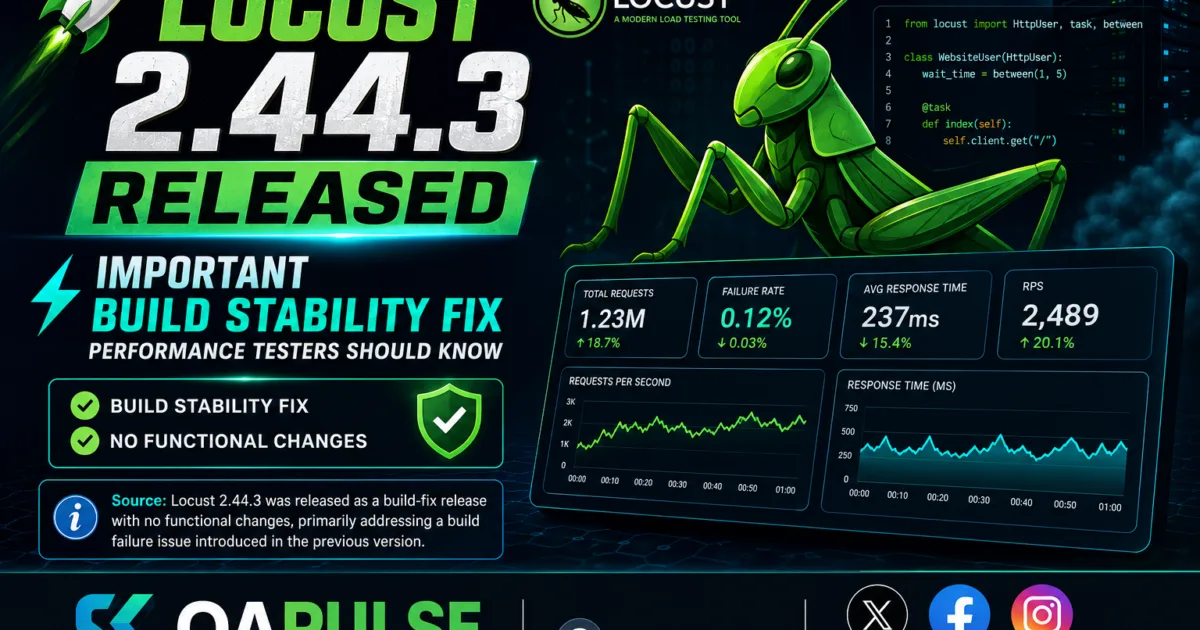
The Locust team has officially released Locust 2.44.3, a maintenance release focused entirely on resolving a build issue introduced in version 2.44.2.
According to the official release notes:
“Fix build fail in 2.44.2, no real changes.”
At first glance, this may appear to be a minor update. However, for QA Engineers, SDETs, Performance Test Engineers, and DevOps teams, build-related fixes can often be more important than feature releases because they directly affect installation reliability, CI/CD execution, and test environment stability.
What is Locust?
Locust is one of the most popular open-source load testing frameworks used to evaluate the performance, scalability, and reliability of modern applications.
Teams use Locust for:
- Performance Testing
- Load Testing
- Stress Testing
- Scalability Testing
- API Performance Validation
- Microservices Testing
- Cloud Performance Engineering
- AI Application Load Testing
Official Documentation:
Official Repository:
https://github.com/locustio/locust
Release Notes:
https://github.com/locustio/locust/releases/tag/2.44.3
What’s New in Locust 2.44.3?
The release contains one primary change:
Build Failure Fix
The Locust team resolved a build issue that affected version 2.44.2.
No new:
- Features
- APIs
- CLI Commands
- Configuration Changes
- Breaking Changes
were introduced.
The goal of 2.44.3 is simply to restore build reliability.
Why Build Fixes Matter for QA Engineers
Many engineers underestimate build-related releases.
In reality, build failures can impact:
- CI/CD pipelines
- Docker images
- Automated deployments
- Test execution environments
- Dependency management
- Package installation
A broken build can prevent entire testing pipelines from running.
Impact on Performance Testing Teams
Organizations running automated performance testing often execute Locust inside:
- Jenkins
- GitHub Actions
- Azure DevOps
- GitLab CI/CD
- Kubernetes
- Docker Containers
If a package build fails, teams may experience:
- Failed deployments
- Blocked testing environments
- Missed release deadlines
- Broken automation workflows
Locust 2.44.3 helps eliminate these risks.
Why Locust 2.44.3 Matters More Than It Appears
Many enterprise teams follow a simple rule:
Never stay on a broken build.
When a release exists solely to fix packaging or build issues, upgrading often becomes the safest path forward.
This is especially true when:
- No breaking changes are introduced
- No API behavior changes occur
- No migration work is required
Locust 2.44.3 fits this category.
Impact on CI/CD Pipelines
Performance testing is increasingly integrated into release pipelines.
Typical workflow:
Build Application
→ Deploy Test Environment
→ Execute Locust Tests
→ Validate SLAs
→ Release to Production
If Locust cannot build correctly, the entire validation process can fail.
This release restores confidence in automated pipeline execution.
Impact on Cloud-Native Testing
Modern organizations run Locust on:
- Docker
- Kubernetes
- AWS
- Azure
- Google Cloud
Build issues frequently surface first in these environments.
By resolving the 2.44.2 build problem, Locust 2.44.3 improves deployment reliability across cloud-native infrastructures.
Impact on AI and MCP Testing Platforms
Many organizations now use Locust to test:
- LLM APIs
- Agentic AI Workflows
- MCP Servers
- RAG Platforms
- Vector Database APIs
Examples include:
- CrewAI services
- LangChain APIs
- FastAPI AI backends
- OpenAI-compatible endpoints
For these systems, stable test infrastructure is critical.
A broken performance testing framework can delay production readiness assessments.
Locust 2.44.3 vs Locust 2.44.2
| Area | Locust 2.44.2 | Locust 2.44.3 |
|---|---|---|
| Build Reliability | Issue Present | Fixed |
| Performance Features | Same | Same |
| CLI Commands | Same | Same |
| API Support | Same | Same |
| Breaking Changes | None | None |
| Upgrade Risk | N/A | Very Low |
Should QA Teams Upgrade?
Upgrade Immediately If
✅ You experienced build issues with 2.44.2
✅ You maintain CI/CD pipelines using Locust
✅ You deploy Locust through Docker
✅ You run automated load testing regularly
Additional Testing Recommended
Only basic validation is required:
✅ Installation
✅ Test execution
✅ Reporting
✅ CI/CD integration
No extensive regression testing should be necessary.
Migration Guide
Upgrade Locust
pip install --upgrade locust
Verify Installation
locust --version
Run Smoke Test
locust -f locustfile.py
Confirm:
- Installation succeeds
- Test execution starts
- Reports generate correctly
Testing Checklist After Upgrading
Environment Validation
✅ Package installation
✅ Virtual environments
✅ Docker images
Framework Validation
✅ Existing test scripts
✅ User classes
✅ Task execution
CI/CD Validation
✅ GitHub Actions
✅ Jenkins
✅ GitLab CI
✅ Azure DevOps
Reporting Validation
✅ HTML reports
✅ Statistics
✅ Metrics export
My QA Assessment of Locust 2.44.3
Biggest Improvement
Build reliability restoration.
Most Valuable Outcome
Reduced CI/CD failures.
Breaking Changes
None.
Upgrade Risk
Extremely Low.
Enterprise Recommendation
Upgrade immediately if running 2.44.2.
Overall Rating
9.0/10
Although this release introduces no new functionality, restoring build stability makes it an important update for organizations relying on Locust in production testing environments.
More Related Blogs
- FastAPI 0.137.1 Released: Important API Routing Fixes QA Engineers Should Upgrade For
- PyTest 9.1.0 Released: Critical Fixture Changes QA Engineers Must Understand
- Playwright 1.61.0 Released: Powerful Authentication Testing Features QA Engineers Must Know
- LangChain 1.4.6 Released: Valuable AI Agent Observability Improvements QA Engineers Must Know
External Resources
Locust Documentation: https://docs.locust.io
Locust Release Notes: https://github.com/locustio/locust/releases/tag/2.44.3
Locust GitHub Repository: https://github.com/locustio/locust
Python Performance Testing: https://www.python.org
Frequently Asked Questions
What is Locust 2.44.3?
Locust 2.44.3 is a maintenance release that fixes a build failure introduced in version 2.44.2.
Does Locust 2.44.3 introduce new features?
No. The release focuses solely on resolving build-related issues.
Are there breaking changes?
No breaking changes have been announced.
Should teams upgrade immediately?
Yes, particularly if running Locust 2.44.2 or experiencing installation and build issues.
Does this affect existing test scripts?
No. Existing Locust test scripts should continue working without modification.
Is regression testing required?
Only minimal smoke testing is recommended because no runtime functionality has changed.
Final Thoughts
Locust 2.44.3 demonstrates that not every important release introduces flashy features. Sometimes the most valuable update is simply restoring stability and reliability.
For QA Engineers, Performance Testers, and DevOps teams, reliable builds are essential to maintaining healthy CI/CD pipelines and trustworthy performance testing environments.
If your organization uses Locust for load testing, API performance validation, or cloud-scale testing, upgrading to Locust 2.44.3 is a straightforward and low-risk decision.