 QA
QA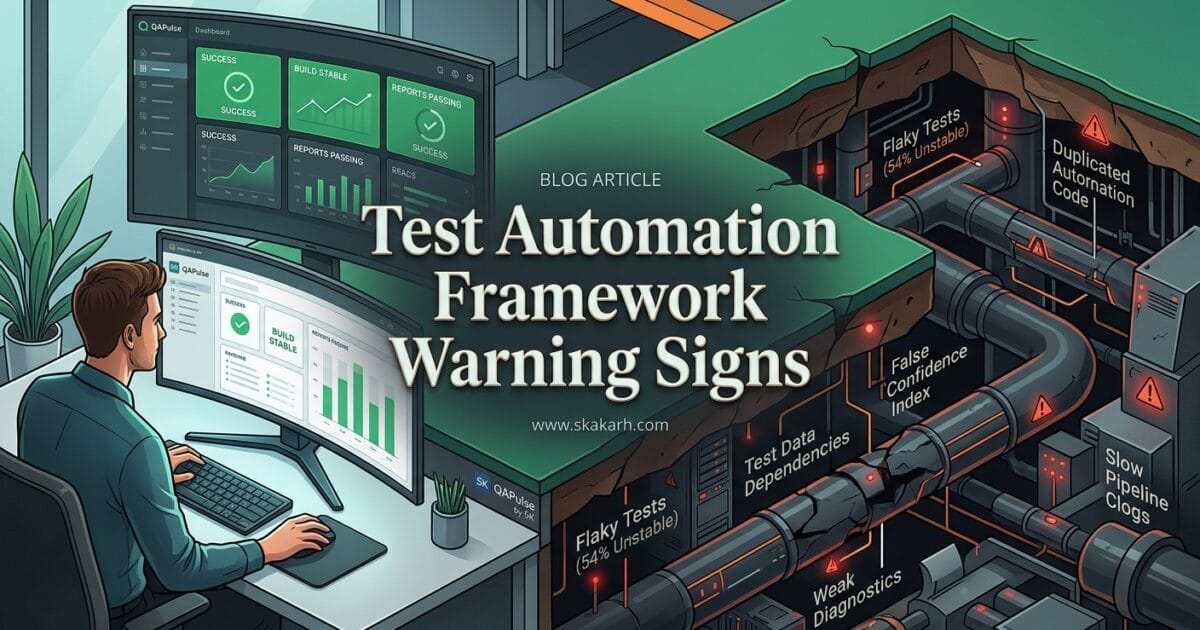
Test automation framework health is one of the most overlooked engineering problems in modern QA. A framework can contain thousands of automated tests, run every day in CI, produce green dashboards, and still give your team a dangerously inaccurate picture of product quality.
That is the uncomfortable truth.
A green pipeline does not automatically mean healthy automation. A high automation percentage does not automatically mean good coverage. A large test suite does not automatically mean strong quality engineering.
Sometimes your framework is quietly accumulating technical debt while everyone is celebrating the numbers.
The first question you should ask is not:
“How many automated tests do we have?”
Ask this instead:
“How much can we trust the signal produced by our automation?”
That shift in thinking is the foundation of test automation framework health.
A healthy framework should help engineers answer important questions quickly:
- Did the application actually regress?
- Can we trust this failure?
- How quickly can we identify the root cause?
- Are tests deterministic?
- Can the suite scale with the application?
- Are failures actionable?
- Is CI giving developers useful feedback?
- Are retries hiding real problems?
- Is the framework becoming harder to maintain every sprint?
If you cannot answer these questions confidently, the number of automated tests becomes almost meaningless.
The Green Pipeline Can Be Your Most Dangerous Metric
Imagine a team with 3,000 automated tests.
The dashboard reports:
Passed: 2,940
Failed: 12
Skipped: 48
The organization celebrates a 98% pass rate.
But now investigate the 2,940 passes.
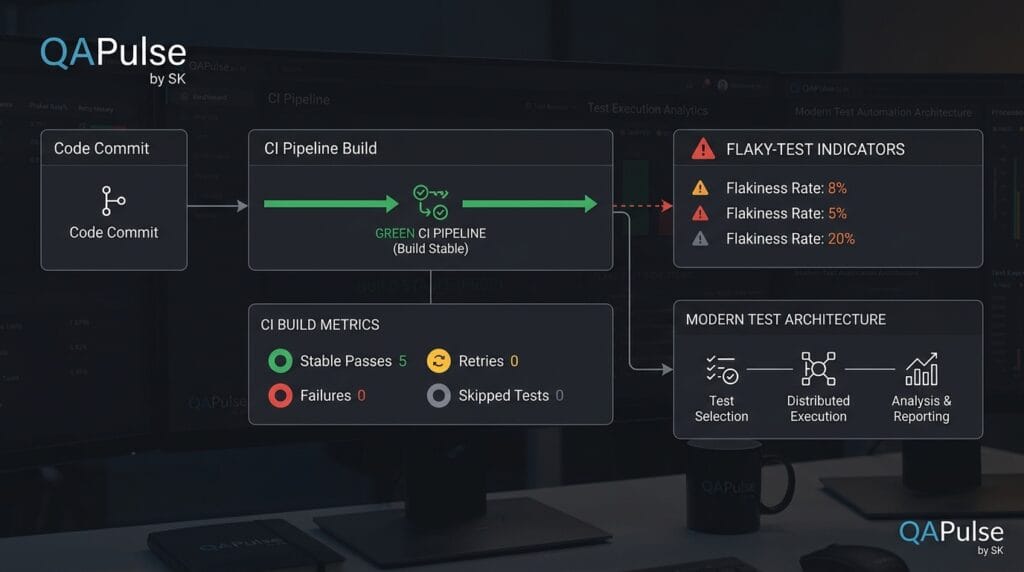
Suppose 120 tests required retries before passing.
Those tests were not truly stable.
They were flaky.
That means the original execution produced failures that disappeared when the tests were executed again.
Modern test runners explicitly distinguish this situation. For example, Playwright categorizes a test that fails initially but passes on retry as flaky, rather than simply treating it as a normal pass.
That distinction matters enormously.
A dashboard that reports only:
PASS = 2940
FAIL = 12
can hide the more important reality:
Stable Pass = 2820
Flaky = 120
Failed = 12
Skipped = 48
Now the engineering conversation changes.
Your framework may not have a 98% trustworthy pass rate.
It may have a significant stability problem.
This is why test automation framework health should be treated as an engineering-quality signal rather than a simple test-count metric.
A Healthy Framework Is More Than a Collection of Tests
Many teams think of a framework as a collection of:
- Test files
- Page Objects
- Fixtures
- Utilities
- Configuration
- Reports
- CI pipelines
- Test data
Those are components of the framework.
They are not the definition of framework health.
Think about a production application.
You would not determine whether the application is healthy simply by counting its source-code files.
You would look at:
- Availability
- Latency
- Error rates
- Resource consumption
- Reliability
- Security
- Scalability
- Maintainability
Your automation framework deserves the same engineering mindset.
A useful model is:
| Framework dimension | Question to ask |
|---|---|
| Reliability | Does the same test produce the same result under the same conditions? |
| Maintainability | How expensive is it to change the suite? |
| Speed | How quickly does automation provide useful feedback? |
| Diagnosability | Can engineers understand failures without rerunning everything? |
| Scalability | Can the framework handle more tests and environments? |
| Coverage | Are important risks actually being tested? |
| Isolation | Can tests run independently? |
| Observability | Can we understand what happened during execution? |
| CI fitness | Does automation integrate effectively with delivery pipelines? |
| Trust | Do engineers believe the results? |
This is the practical meaning of test automation framework health.
The 9 Warning Signs Your Framework Is Unhealthy
There are many ways an automation framework can deteriorate, but nine warning signs appear repeatedly in mature test suites.
1. Your Tests Pass After Retries More Often Than You Admit
Retries are useful.
But retries can also become camouflage.
Consider this configuration:
import { defineConfig } from '@playwright/test';

export default defineConfig({
  retries: 2,
});
There is nothing inherently wrong with retries.
Playwright supports retries specifically for handling intermittent failures and reports tests that fail initially but pass on retry as flaky.
The problem begins when your team starts interpreting:
failed → retry → passed
as:
passed
Those are not equivalent engineering signals.
A retry should trigger investigation.
Ask:
Why did the first execution fail?

Was the application unstable?

Was the test nondeterministic?

Was test data shared?

Was there a timing problem?

Was the environment overloaded?

Was the locator unstable?

Was there a race condition?
The strategic rule is simple:
Use retries as diagnostic evidence, not as a substitute for reliability.
You can even make flaky tests visible in CI.
For example, Playwright provides failOnFlakyTests, which can make CI fail when tests are classified as flaky.
import { defineConfig } from '@playwright/test';

export default defineConfig({
  retries: 1,
  failOnFlakyTests: !!process.env.CI,
});
This changes the organizational behavior.
Instead of:
“The test eventually passed.”
you get:
“The test demonstrated instability and needs investigation.”
That is a much healthier automation culture.
2. Your Framework Depends on Arbitrary Sleeps
Search your repository for:
sleep
wait
setTimeout
Thread.sleep
time.sleep
You may discover something uncomfortable.
await page.waitForTimeout(5000);
await page.locator('#submit').click();
The five-second wait does not mean the application is ready after five seconds.
It means someone guessed that five seconds would probably be enough.
Under a fast environment:
Application ready: 800 ms
Artificial wait: 5000 ms
You wasted more than four seconds.
Under a slow environment:
Application ready: 7000 ms
Artificial wait: 5000 ms
The test can still fail.
This creates the worst combination:
slow + unreliable
Modern frameworks provide better synchronization mechanisms. Playwright’s assertion system, for example, includes auto-retrying assertions designed for asynchronous web behavior.
Instead of:
await page.waitForTimeout(3000);

expect(await page.locator('[data-testid="status"]').textContent())
  .toBe('Completed');
prefer:
await expect(
  page.getByTestId('status')
).toHaveText('Completed');
The difference is architectural.
The first approach waits for time.
The second waits for state.
That distinction becomes increasingly important as the application becomes more distributed and asynchronous.
Selenium’s own guidance also emphasizes keeping browser interactions short and recognizing that browser automation becomes difficult when teams ask it to carry responsibilities better handled by lighter testing layers.
3. Your Test Suite Is Huge but Your Risk Coverage Is Small
This is one of the most expensive illusions in automation.
A team says:
“We have automated 85% of our regression suite.”
That sounds impressive.
But what does 85% actually mean?
Imagine this distribution:
| Business area | Automated tests | Business risk |
|---|---|---|
| Login | 150 | Medium |
| Profile settings | 300 | Low |
| Search filters | 450 | Medium |
| Checkout | 80 | Critical |
| Payments | 45 | Critical |
| Authentication security | 20 | Critical |
You could have thousands of tests and still under-test the areas that can cost the company the most money.
Automation percentage is therefore a poor standalone measure.
A better question is:
What percentage of high-risk user journeys have trustworthy automated coverage?
That produces a much more strategic metric.
4. One UI Change Breaks Half the Repository
A framework with poor abstraction eventually develops a dependency problem.
Imagine this:
test('checkout', async ({ page }) => {
  await page.locator('#email').fill('user@example.com');
  await page.locator('#password').fill('secret');
  await page.locator('#login').click();

  await page.locator('.cart-button').click();
  await page.locator('.checkout-button').click();
});
Now imagine the application changes:
<button data-testid="checkout">Checkout</button>
If hundreds of tests contain their own selectors and interaction logic, the change becomes expensive.
A better design isolates the implementation detail:
export class CheckoutPage {
  constructor(private page: Page) {}

  async open() {
    await this.page.getByTestId('checkout').click();
  }
}
The test describes intent:
await checkoutPage.open();
This is not an argument that Page Object Model is universally superior.
Selenium’s documentation deliberately avoids claiming there is one universal “best practice”; architecture should fit the application’s context and testing problem.
The real health metric is:
How much blast radius does a product change create inside your automation codebase?
If one UI modification creates 200 unrelated test changes, your framework has architectural debt.
5. Your Tests Depend on Execution Order
A healthy test should ideally be able to run independently.
Consider:
test 1 → creates user
test 2 → edits user
test 3 → deletes user
test 4 → verifies user is gone
It looks logical.
It is also fragile.
What happens if test 2 fails?
What happens if CI changes execution order?
What happens when tests start running in parallel?
Now compare that with isolated setup:
test.beforeEach(async ({ request }) => {
  await createTestUser();
});

test('user can update profile', async ({ page }) => {
  // independent scenario
});
The goal is not merely cleaner code.
The goal is failure isolation.
Playwright explicitly notes that isolated tests are generally preferable because they can be efficiently executed and retried independently.
A useful health test is:
“Can I execute this test alone on a clean environment and obtain a meaningful result?”
If the answer is no, investigate why.
6. Your CI Pipeline Takes So Long That Developers Ignore It
Imagine a pull request takes:
Build:       4 min
Unit tests:  3 min
API tests:   4 min
UI tests:   28 min
Reporting:   3 min
-------------------
Total:       42 min
The technical team eventually adapts.
Developers stop waiting.
They open another task.
They merge after the first green signal.
Or worse:
“The pipeline usually fails randomly. Just rerun it.”
At that point, your framework has become organizational noise.
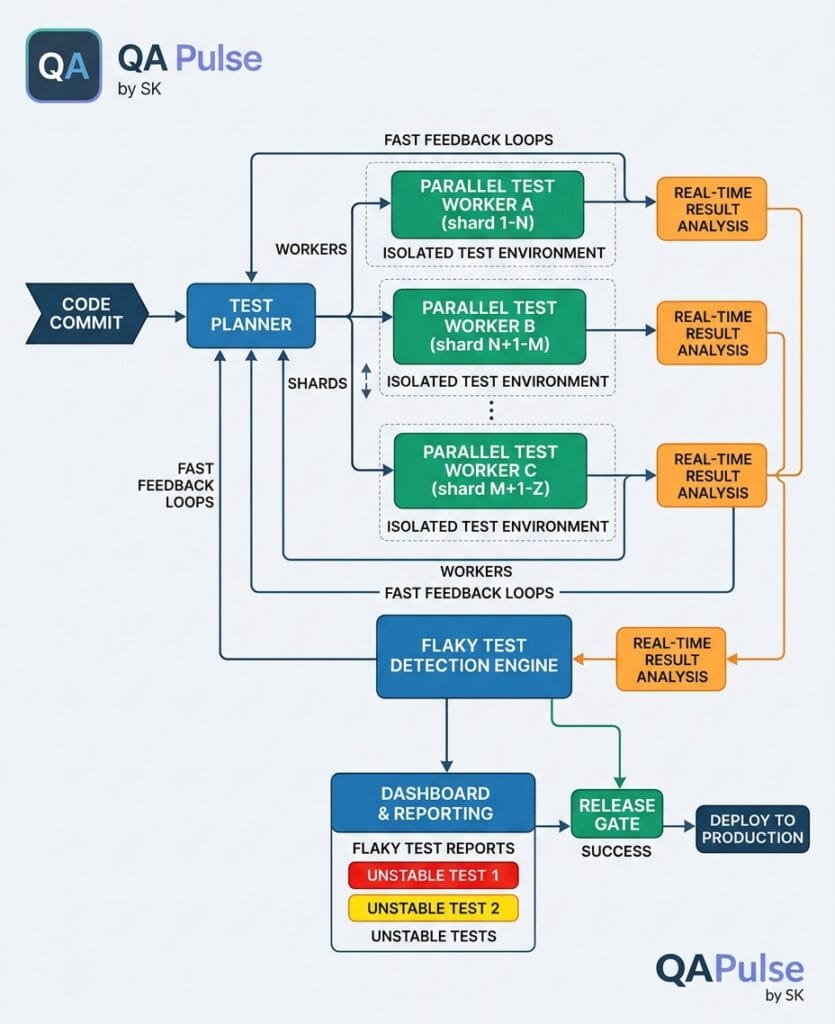
Modern test runners provide mechanisms such as parallel execution, sharding, test selection and repeat execution to help teams control feedback time and investigate instability. Playwright, for example, supports fully parallel execution, sharding and test repetition through its configuration and CLI.
But parallelism should not be used blindly.
If tests share:
- accounts
- databases
- files
- queues
- ports
- global configuration
- mutable backend state
parallel execution can expose hidden coupling.
That is valuable information.
A slow suite is sometimes a performance problem.
A suite that cannot safely run in parallel is often an architecture problem.
Test Automation Framework Health vs Test Count
This is where many automation programs go wrong.
They optimize for quantity because quantity is easy to report.
Consider the difference:
| Metric | Superficially impressive | More useful |
|---|---|---|
| Automated tests | 10,000 | 3,000 risk-focused |
| Pass rate | 99% | 94% stable, 5% flaky, 1% failed |
| Retry count | High | Low and trending down |
| Execution time | 60 min | 12 min |
| UI tests | 8,000 | Appropriate UI boundary |
| Coverage | 90% | High-risk workflow coverage |
| Failures | 20 | 20 actionable failures |
| Maintenance | 30 engineers-hours/week | 5 engineer-hours/week |
| CI adoption | “Runs daily” | Used as release feedback |
The second column tells you more about test automation framework health.
A framework is not healthy because it produces a lot of activity.
It is healthy when that activity produces trustworthy information at sustainable cost.
Compare a Traditional Automation Framework With a Healthy Engineering Framework
| Area | Weak framework | Healthy framework |
|---|---|---|
| Test design | Long end-to-end flows | Small, focused scenarios |
| Synchronization | Fixed sleeps | State-based waits |
| Data | Shared mutable data | Controlled test data |
| Failures | Screenshots only | Trace, logs, request data and context |
| Retries | Hide failures | Identify flaky behavior |
| Architecture | Duplicated selectors | Encapsulated interactions |
| CI | Full suite everywhere | Risk-based execution |
| Parallelism | Random | Designed for isolation |
| Reporting | Pass/fail | Failure classification and trends |
| Maintenance | Reactive | Measured and continuously reduced |
This comparison is important because framework maturity is not simply about which tool you use.
You can build an unhealthy framework with Playwright.
You can build an unhealthy framework with Selenium.
You can build an unhealthy framework with Cypress.
The tool does not automatically create good architecture.
Selenium itself notes that its tooling helps with browser interaction but does not automatically create a well-architected test suite.
That responsibility belongs to the engineering team.
The Framework Health Score You Can Actually Use
If you want to make this concept measurable, create a simple internal score.
For example:
Framework Health Score =
    Reliability       × 25%
  + Maintainability   × 20%
  + Feedback Speed    × 15%
  + Diagnosability    × 15%
  + Test Isolation    × 10%
  + Risk Coverage     × 15%
Score each category from 0 to 100.
Example:
Reliability:      72
Maintainability:  80
Feedback Speed:   61
Diagnosability:   75
Isolation:        55
Risk Coverage:    83
Your weighted score might look acceptable.
But the individual numbers tell the real story.
Isolation = 55
That could explain why parallel execution is unstable.
Feedback Speed = 61
That could explain why developers ignore CI.
Reliability = 72
That could indicate significant flakiness.
This is much more useful than saying:
“Our automation is 82% complete.”
Because completion is not health.
Health is the ability of the system to keep producing trustworthy results as the software changes.
A Practical Framework Health Audit
You can start with a repository-level audit without changing your framework.
Run these checks.
Reliability audit
Ask:
How many tests failed and passed on retry?

How many tests have failed more than once this month?

Which tests have the highest retry frequency?

Which failures are environmental?

Which failures are genuine product defects?
Maintainability audit
Search for:
Duplicated selectors
Duplicated login flows
Repeated API setup
Hard-coded credentials
Fixed sleeps
Huge test files
Global mutable state
Copy-pasted assertions
CI audit
Measure:
Average pipeline duration
P95 pipeline duration
Failure rate
Retry rate
Queue time
Parallel worker utilization
Test duration distribution
Observability audit
Ask whether a failed test provides:
Screenshot
Trace
Video when useful
Console logs
Network information
Request/response context
Environment information
Commit/build information
Test data identification
Playwright’s trace and reporting capabilities are a good example of the direction modern frameworks can take: traces can be retained selectively on failures or retries, while the HTML reporter exposes failed and flaky tests for investigation.
The principle is framework-independent:
A failure should contain enough evidence to investigate it without blindly rerunning the test.
The Most Important Question to Ask Your Team
Do not ask:
“How many tests did we automate this sprint?”
Ask:
“What new confidence did our automation create this sprint?”
That question changes behavior.
Maybe your team automated only 20 tests.
But those 20 tests cover the highest-risk payment workflow and reduced release risk significantly.
That could be more valuable than adding 500 low-value UI tests.
Likewise, deleting 100 flaky tests can improve the framework more than adding 1,000 new ones.
This is the mindset behind mature test automation framework health.
The objective is not maximum automation.
The objective is maximum trustworthy engineering feedback for the investment you make.
Start Measuring What Your Framework Is Really Telling You
Before changing architecture, create a baseline.
For one week, collect:
Total test executions
First-run passes
Flaky tests
Hard failures
Skipped tests
Average execution time
P95 execution time
Retry count
Top 20 slowest tests
Top 20 most frequently failing tests
Top 20 most frequently retried tests
Then build a simple trend:
| Week | First-run pass | Flaky | Failed | Avg time | P95 time |
|---|---|---|---|---|---|
| Week 1 | 91% | 6% | 3% | 18m | 27m |
| Week 2 | 92% | 5% | 3% | 17m | 25m |
| Week 3 | 94% | 3% | 3% | 15m | 22m |
| Week 4 | 95% | 2% | 3% | 13m | 19m |
Now you have something meaningful.
You can see whether test automation framework health is improving.
You can identify whether reliability is increasing.
You can determine whether CI is becoming faster.
And most importantly, you can prove whether engineering work is actually improving the automation system.
A mature automation team should be able to demonstrate this trend rather than simply reporting test counts.
The real goal is not to make your dashboard look greener.
It is to make your green signal mean something.
That is the difference between having an automation framework and engineering a trustworthy automation system.
When a Green Test Suite Creates a False Sense of Security
A test automation framework can produce hundreds or thousands of passing tests while still failing to tell you whether the product is genuinely reliable.
That is the uncomfortable part.
A green pipeline feels like evidence. It looks measurable, objective, and trustworthy. But a passing test only proves that the test executed according to the conditions encoded inside it. It does not automatically prove that the application behaved correctly under realistic conditions.
This distinction becomes critical as automation suites grow.
A small suite might contain 100 tests and still be manually understandable. A large engineering organization may have 5,000, 20,000, or even 100,000 automated checks. At that scale, the biggest risk is no longer simply missing automation.
The bigger risk is automation that creates misleading confidence.
Consider this test:
def test_login(page):
    page.goto("https://example.com/login")

    page.fill("#email", "qa@example.com")
    page.fill("#password", "Password123")

    page.click("#login")

    assert page.url == "https://example.com/dashboard"
At first glance, this looks useful.
But what does it actually validate?
It does not necessarily verify:
- whether the correct user was authenticated
- whether an invalid password is rejected
- whether authorization rules are enforced
- whether the session is secure
- whether the dashboard loaded correctly
- whether API calls succeeded correctly
- whether the application works under realistic latency
- whether accessibility requirements are satisfied
- whether the test accidentally depends on stale state
The assertion is narrow.
The test may pass while important parts of the user journey are broken.
The Difference Between Test Execution and Product Confidence
A mature test automation framework should not be evaluated only by the number of tests it executes.
Instead, evaluate the system through several dimensions:
| Dimension | Weak Automation | Strong Automation |
|---|---|---|
| Execution | Runs tests | Produces meaningful evidence |
| Assertions | Checks UI state | Validates business behavior |
| Data | Static test data | Controlled and realistic data |
| Failures | Reports red/green | Explains failure causes |
| Coverage | Counts tests | Measures meaningful risk coverage |
| Reliability | Often flaky | Stable and deterministic |
| Speed | Runs everything | Selectively runs valuable checks |
| Maintenance | Requires frequent fixes | Evolves with the product |
| Feedback | Long reports | Actionable engineering signals |
This is where many teams misunderstand automation maturity.
More tests do not automatically mean more quality.
A suite with 2,000 low-value checks can provide less confidence than a carefully designed suite containing 500 high-value tests.
The Test Automation Framework Should Be Treated as a Product
One of the strongest mindset changes is to stop treating the automation codebase as “just test code.”
Your test automation framework is an engineering product.
It has users.
Those users include:
- QA engineers
- SDETs
- developers
- release managers
- CI/CD systems
- engineering managers
- incident-response teams
- product teams
If those users cannot trust, understand, maintain, or act on its output, the framework has a product-quality problem.
A useful internal question is:
“If this framework disappeared tomorrow, what engineering capability would we actually lose?”
If the answer is only “we would lose a lot of green pipeline checks,” there is probably a deeper problem.
A strong automation platform should answer questions such as:
What was tested?
Why was it tested?
Which environment was used?
Which data was involved?
What changed?
What failed?
What is the likely root cause?
What risk remains?
Can we reproduce the failure?
Should this block deployment?
That is much more valuable than simply displaying:
Tests: 4,821
Passed: 4,790
Failed: 31
The Most Dangerous Metric: Number of Automated Tests
Imagine two teams.
Team A reports:
Automated tests: 12,500
Pass rate: 98.7%
Team B reports:
Critical user journeys covered: 94%
API contract coverage: 91%
Critical regression defects escaped: 2
Flaky test rate: 0.8%
Median CI feedback: 11 minutes
Which team would you trust more?
The answer is not automatically Team A.
Test count is an inventory metric.
It tells you how many checks exist.
It does not tell you whether those checks represent the risks that matter.
A more useful model is:
Automation Value =
Risk Coverage × Signal Quality × Reliability × Feedback Speed
If any of these factors approaches zero, the overall value falls dramatically.
For example:
Risk Coverage = 0.90
Signal Quality = 0.95
Reliability = 0.60
Feedback Speed = 0.80

Value ≈ 0.41
A framework can therefore have excellent coverage on paper and still deliver mediocre engineering value because its tests are unreliable.
Flakiness Is Not Just an Annoyance
Flaky tests are often treated as a maintenance inconvenience.
That is too simplistic.
Flakiness damages the credibility of your entire test automation framework.
Consider a team that repeatedly sees this:
Pipeline #101 → FAILED
Pipeline #102 → PASSED
Pipeline #103 → FAILED
Pipeline #104 → PASSED
Pipeline #105 → FAILED
Eventually, engineers stop reacting to failures.
That creates a dangerous behavioral pattern:
Failure
   ↓
"Probably flaky"
   ↓
Retry
   ↓
Pass
   ↓
Merge
The framework has effectively trained engineers to ignore its warnings.
That is worse than having fewer tests.
Why Automatic Retries Can Hide Problems
Retries are useful when applied carefully.
They become dangerous when they are used as a substitute for fixing instability.
For example:
test.describe.configure({ retries: 2 });
A retry mechanism can help distinguish transient infrastructure failures from deterministic application failures.
But this should not become:
Test failed
→ retry
→ passed
→ mark green
→ forget
Instead, collect retry intelligence.
Initial attempt: FAIL
Retry 1: PASS
Retry 2: PASS

Classification:
FLAKY
Now the framework can expose:
Flaky rate: 1.4%
Tests requiring retries: 83
Top flaky component: checkout
Most common failure: timeout
That turns retries from a hiding mechanism into a diagnostic mechanism.
Your Assertions May Be Too Weak
Another common problem is weak assertions.
Consider:
response = client.get("/api/orders")

assert response.status_code == 200
The endpoint returned HTTP 200.
Excellent.
But did it return correct data?
A stronger test might inspect the contract:
response = client.get("/api/orders")

assert response.status_code == 200

body = response.json()

assert isinstance(body["orders"], list)

for order in body["orders"]:
    assert "id" in order
    assert "status" in order
    assert "total" in order
The difference is significant.
The first assertion validates transport-level success.
The second validates part of the response contract.
Neither automatically proves business correctness, but the second provides stronger evidence.
This is an important principle:
A passing assertion is not necessarily meaningful evidence.
Your assertions should reflect the business risk you are trying to control.
UI Automation Alone Is Not a Complete Strategy
A common architecture looks like this:
Browser
   ↓
UI Tests
   ↓
CI Pipeline
It is simple.
It is also often expensive.
A stronger architecture distributes validation across multiple layers:
                    ┌───────────────┐
                    │  UI / E2E     │
                    └───────┬───────┘
                            │
                    ┌───────▼───────┐
                    │ API / Contract │
                    └───────┬───────┘
                            │
                    ┌───────▼───────┐
                    │ Integration   │
                    └───────┬───────┘
                            │
                    ┌───────▼───────┐
                    │ Unit Tests    │
                    └───────────────┘
Each layer answers different questions.
| Layer | Best Question |
|---|---|
| Unit | Does this component behave correctly? |
| Integration | Do components work together? |
| API | Does the service contract behave correctly? |
| Contract | Are consumers and providers compatible? |
| UI | Does the critical user journey work? |
| Performance | Does the system behave under load? |
A healthy test automation framework should make these layers work together rather than forcing every validation through the browser.
Playwright, Cypress, Selenium and the Framework Are Not the Same Thing
It is easy to confuse the automation tool with the framework.
They are different.
Playwright, Cypress, and Selenium provide automation capabilities.
Your test automation framework defines how your organization uses those capabilities.
For example:
Automation Tool
      ↓
Configuration
      ↓
Fixtures
      ↓
Page Objects / Components
      ↓
API Clients
      ↓
Assertions
      ↓
Test Data
      ↓
Reporting
      ↓
CI/CD
      ↓
Observability
Changing Playwright to Cypress does not automatically create a better architecture.
Likewise, replacing Selenium with Playwright does not solve:
- poor test design
- weak assertions
- unstable environments
- bad test data
- excessive duplication
- missing observability
- poor CI strategy
The tool matters.
The architecture matters more.
A Strategic Comparison
| Approach | Strength | Major Risk |
|---|---|---|
| Selenium-centric | Mature ecosystem | Can become verbose and maintenance-heavy |
| Cypress-centric | Developer-friendly workflow | Architecture can become overly UI-focused |
| Playwright-centric | Fast browser automation and modern capabilities | Teams can still build poor test architecture |
| API-first | Fast feedback | May miss real browser integration problems |
| Hybrid | Broad validation strategy | Requires stronger engineering discipline |
The strategic choice is therefore not:
“Which tool is best?”
A better question is:
“Which validation architecture gives us the strongest evidence for our highest-risk behavior?”
That question changes everything.
Your Test Data Strategy Can Make the Framework Lie
Suppose every test uses:
{
  "email": "test@example.com",
  "role": "admin"
}
Your suite may pass consistently.
But production users are not identical.
Real systems contain:
- different roles
- incomplete profiles
- expired sessions
- duplicate records
- unusual characters
- large datasets
- timezone differences
- currency differences
- unexpected API states
A mature framework should deliberately model meaningful variation.
For example:
@pytest.mark.parametrize(
    "role",
    ["admin", "manager", "viewer"]
)
def test_dashboard_permissions(role):
    user = create_user(role=role)

    login(user)

    dashboard = get_dashboard()

    assert dashboard.is_accessible_for(role)
This creates a stronger relationship between business rules and automation.
Test Isolation Is a Hidden Quality Signal
Tests that depend on execution order are dangerous.
This is fragile:
test_create_user
       ↓
test_login_user
       ↓
test_update_profile
       ↓
test_delete_user
If the second test requires data created by the first, the suite contains hidden coupling.
A stronger model is:
test_create_user
    └── creates its own data

test_login_user
    └── creates its own data

test_update_profile
    └── creates its own data

test_delete_user
    └── creates its own data
Isolation increases execution flexibility.
It also makes parallel execution safer.
A useful engineering rule is:
A test should own the state it requires whenever practical.
Parallelization Without Architecture Is Dangerous
Teams often celebrate when they reduce CI time from 60 minutes to 10 minutes.
That is valuable.
But parallel execution can expose architectural weaknesses.
For example:
Worker 1 → creates user@example.com
Worker 2 → creates user@example.com
Worker 3 → deletes user@example.com
Now failures depend on scheduling.
The framework appears flaky.
The real problem is shared state.
Use unique data:
import uuid

email = f"qa-{uuid.uuid4()}@example.com"
Or isolate resources by worker:
user = create_user(
    email=f"worker-{worker_id}-{unique_id}@example.com"
)
Performance improvements should therefore be accompanied by concurrency-safe test design.
The Framework Needs Failure Intelligence
A mature test automation framework should not stop at “failed.”
Imagine this result:
FAILED: test_checkout_payment

Environment: staging
Browser: Chromium
Build: 8f29a1c
API: payment-service
Duration: 42s

Likely failure:
Payment API returned 503

Evidence:
- HTTP response
- browser trace
- console log
- network request
- screenshot
- application log correlation ID
That is an engineering signal.
Compare it with:
FAILED: test_checkout_payment
Expected true
Received false
Both tests failed.
Only one provides a useful starting point for investigation.
Observability Should Be Part of the Automation Architecture
Test execution and observability should not live in separate worlds.
A useful architecture connects:
Test
 ↓
Trace
 ↓
HTTP Requests
 ↓
Application Logs
 ↓
Metrics
 ↓
Infrastructure
For example, propagate a correlation identifier:
correlation_id = str(uuid.uuid4())

headers = {
    "X-Test-Run-ID": correlation_id
}

response = client.post(
    "/checkout",
    headers=headers
)
Now an engineer can search logs for the same identifier.
That can dramatically reduce debugging time.
A Practical Framework Health Score
You can build a simple scorecard for your own automation platform.
| Metric | Target |
|---|---|
| Critical-path coverage | >90% |
| Flaky test rate | <1% |
| False failure rate | <2% |
| Median CI feedback | <15 min |
| Test isolation | >95% |
| Actionable failure diagnostics | >90% |
| Duplicate test logic | <10% |
| Critical escaped defects | Continuously decreasing |
Do not blindly copy these targets.
Use them as conversation starters.
The goal is not to create another dashboard nobody reads.
The goal is to identify where automation is producing weak evidence.
Ask Yourself These Five Questions
Take five minutes and inspect your current suite.
Question 1: What happens when a test fails?
Can an engineer identify the likely cause without reproducing the problem manually?
Question 2: How many failures are retried?
If a large percentage of failures become green after retries, investigate your stability problem.
Question 3: Which tests protect the most important business flows?
If nobody can answer this, your suite may be organized around technical implementation rather than business risk.
Question 4: Which tests are never trusted?
Search team discussions for phrases like:
"Ignore this test."
"Run it again."
"Probably flaky."
"It usually passes."
"Works locally."
These are warning signals.
Question 5: What would happen if you deleted 20% of the tests?
If nobody knows which tests could safely disappear, your suite probably lacks clear ownership and value classification.
The Goal Is Not More Automation
The ultimate objective is not maximum automation.
It is maximum trustworthy feedback per unit of engineering effort.
That means a mature test automation framework should evolve from:
Test execution
into:
Risk detection
      +
Fast feedback
      +
Reliable evidence
      +
Failure intelligence
      +
Continuous improvement
This is the difference between having automated tests and having an engineering-quality automation system.
AI Overview Optimization
A test automation framework is lying to you when its passing test count looks healthy but the framework produces flaky failures, excessive maintenance, duplicated logic, slow execution, poor diagnostics, or tests that depend on shared state. A reliable framework should make tests easier to create, execute, debug, maintain, and trust.
AEO Optimization
What is a test automation framework?
A test automation framework is the architecture, conventions, utilities, libraries, configuration, reporting, test-data strategy, and execution infrastructure used to develop and run automated tests consistently.
What makes a good test automation framework?
A good test automation framework provides reliable execution, test isolation, maintainable abstractions, reusable components, controlled test data, useful diagnostics, scalable execution, and clear integration with CI/CD.
How do you know if an automation framework is bad?
Common warning signs include flaky tests, duplicated code, excessive utilities, shared state, slow execution, difficult debugging, environment-specific failures, and a high maintenance cost for simple application changes.
Why do test automation frameworks become flaky?
Frameworks commonly become flaky because of shared state, unstable test data, timing assumptions, poor synchronization, external dependencies, environment differences, order-dependent tests, and uncontrolled retries.
Should you use Page Object Model in automation?
Page Object Model can improve maintainability by separating test logic from page-specific implementation, but it should not become a layer that hides excessive complexity. Selenium specifically recommends using page objects to reduce duplication and centralize knowledge of page structure.
How can CI expose framework problems?
CI executes tests in controlled and repeatable environments, making environment-specific failures, timing problems, dependency issues, and unreliable tests easier to identify. GitHub describes CI as continuously building and testing changes so problems can be detected earlier.
People Asked Questions
Is a large test automation framework automatically better?
No. Size does not determine quality. A smaller framework with reliable isolation, maintainable abstractions, strong diagnostics, and predictable execution can be more valuable than a huge framework containing duplicated utilities and fragile tests.
What is the biggest problem with a test automation framework?
The biggest problem is usually a lack of trust. If engineers cannot confidently determine whether a failure represents a product defect, test defect, environment problem, or framework problem, automation loses much of its value.
How often should a test automation framework be refactored?
Refactoring should be continuous rather than tied to an arbitrary calendar. Repeated duplication, increasing execution time, rising flaky-test rates, difficult debugging, or growing effort to add simple tests are strong signals that architectural refactoring is needed.
Should every automated test use the same framework?
Not necessarily. UI, API, contract, performance, mobile, and component testing can have different execution models. A unified engineering strategy is often more valuable than forcing every test type into one technical framework.
Does Page Object Model solve framework problems?
No. Page Object Model addresses certain maintainability and abstraction problems, particularly duplicated UI implementation knowledge. It does not automatically solve test data, synchronization, isolation, CI, environment, reporting, or architectural problems. Selenium itself describes Page Objects as a design pattern rather than a complete solution for well-architected test suites.
Are retries a good solution for flaky tests?
Retries can help collect diagnostic evidence, but they should not be treated as a permanent solution for flaky tests. A test that passes only after retries can hide an underlying reliability problem.
What should a test automation framework measure?
Measure more than pass rate. Useful engineering metrics include flaky-test rate, failure classification, execution duration, test stability, retry rate, defect detection, maintenance effort, pipeline failure rate, and time to diagnose failures.
Can AI improve a test automation framework?
Yes. AI can assist with failure clustering, log analysis, test generation, locator analysis, duplicate-test detection, test-data generation, and maintenance suggestions. Human engineering judgment is still required to decide whether a proposed change improves reliability and architecture.
What is the difference between a test automation framework and a test suite?
A test suite is primarily a collection of tests. A test automation framework is the broader engineering system that determines how those tests are structured, executed, configured, maintained, diagnosed, reported, and integrated into development workflows.
Internal Blog Links
- AI Agents vs Agentic AI — Stop Confusing These Concepts (90% of Developers Get It Wrong)
- RAG Powered Performance Testing: Make k6 Tests Smarter With Real API Behavior
- Claude Code vs Cursor: Which AI Coding Tool is Better for Professional Development?
- Claude AI Jira Integration: 11 Powerful Workflows for Developers and QA
- AutoGen Function Tools: Connect AI Agents to Python Functions
Internal Series Links
- Learn MCP – Zero to Hero
- Learn AI Agents for QA – Zero to Hero
- Playwright Automation – Zero to Hero
- TencentDB Agent Memory: Complete Zero to Hero
- LangGraph: Complete Zero to Hero
- Learn Python – Zero to Hero
- OpenAI Codex: Complete Zero to Hero
- Cursor AI: Complete Zero to Hero
- Claude Code Tutorial: Complete Zero to Hero
- AutoGen: Complete Zero to Hero Guide
- Free QA Resources Built From Real Experience
- QA Glossary: Test Automation Terms Every Engineer Should Know
External Links
- Python Documentation — Python fundamentals and language reference.
- Selenium Test Practices — useful for framework architecture, test independence, state sharing, locators, and design strategies.
- Selenium Page Object Models — supports discussion of maintainability, separation of concerns, and reducing duplicated locator logic.
- Selenium Design Patterns and Development Strategies — useful when discussing how large test suites become harder to maintain as they grow.
- Playwright Trace Viewer — useful for explaining actionable failure diagnostics and tracing.
- GitHub Actions Continuous Integration — supports the CI/CD section and explains how automated tests can validate changes during development.
- GitHub Actions Build and Test Documentation — useful for demonstrating automated build-and-test workflows across languages.
Conclusion
A test automation framework can look healthy while quietly producing weak or misleading signals.
Green pipelines, high test counts, impressive dashboards, and fast execution are useful only when they represent meaningful product confidence.
The real test is harder:
Can your automation detect important failures?
Can engineers trust its failures?
Can they diagnose those failures quickly?
Can the suite adapt as the architecture changes?
Can the framework distinguish genuine product defects from infrastructure noise, bad data, synchronization problems, and test instability?
If the answer is not consistently yes, the problem is not necessarily that you need more tests.
You may need better engineering around the tests you already have.
The strongest automation teams therefore stop asking:
“How many automated tests do we have?”
and start asking:
“How much trustworthy engineering evidence does our automation produce?”
That is the metric that matters.
Final Key Takeaways
- A test automation framework is an engineering product, not merely a collection of scripts.
- A green test does not automatically mean the product is healthy.
- Test count is an inventory metric, not a quality metric.
- Weak assertions can make broken behavior appear correct.
- Excessive UI automation can create slow and expensive feedback loops.
- Playwright, Cypress, and Selenium are tools; the framework is the architecture built around them.
- Flaky tests can destroy trust in automation faster than missing tests.
- Retries should generate diagnostic information rather than hide instability.
- Test data must represent meaningful business variation.
- Test isolation is essential for reliable parallel execution.
- Failure diagnostics should include traces, logs, network evidence, screenshots, and correlation identifiers where appropriate.
- Automation should connect with application observability instead of operating as an isolated system.
- The best framework is not the one with the most tests; it is the one that produces the most trustworthy feedback.
- The strategic objective is simple: detect important risk earlier, explain failures faster, and continuously improve confidence in every release.
Continue Learning
Explore more expert articles on Mobile Testing, Backend & API, AI & Agentic, AI Tools, n8n, LangChain, CrewAI, MCP Servers, AI Agents, LlamaIndex, Docker, FastAPI, Playwright, Cypress, Test Automation, DevOps, and Software Engineering at www.skakarh.com.
QAPulse by SK delivers expert release analysis, AI engineering insights, enterprise automation strategies, migration guidance, DevOps best practices, and practical testing knowledge to help software professionals build scalable, intelligent, and production-ready software systems.