 QA
QA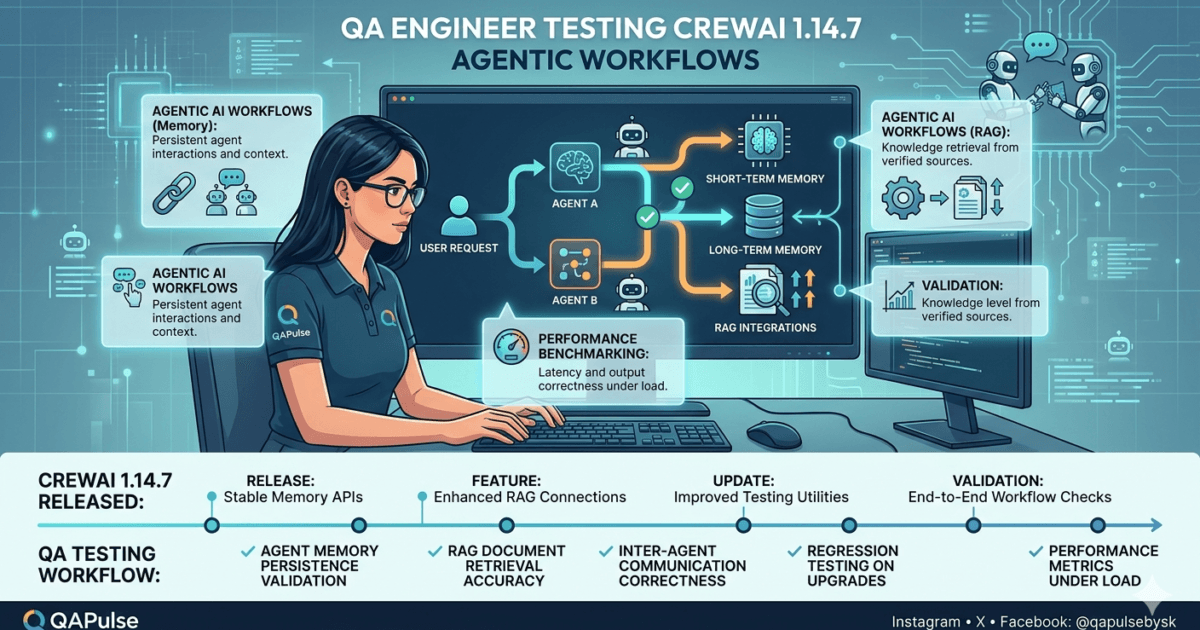
The CrewAI team has officially released CrewAI 1.14.7, bringing major enhancements for agent orchestration, conversational AI, memory management, RAG systems, observability, Snowflake integrations, and runtime reliability.
While version 1.14.7 appears to be a maintenance release, the scope of changes makes it one of the most impactful CrewAI updates for organizations building Agentic AI solutions in 2026.
For QA Engineers, SDETs, AI Test Engineers, Automation Architects, and teams building multi-agent systems, this release introduces several improvements that deserve immediate attention.
What is CrewAI 1.14.7?
CrewAI is one of the leading frameworks for building:
- AI Agents
- Multi-Agent Systems
- Agentic AI Applications
- RAG Workflows
- Enterprise AI Automation
- LLM Orchestration Platforms
CrewAI allows organizations to create collaborative AI agents capable of reasoning, planning, tool execution, memory management, and workflow automation.
Official Release Notes:
https://github.com/crewAIInc/crewAI/releases/tag/1.14.7
Official Documentation:
Official Repository:
https://github.com/crewAIInc/crewAI
Why CrewAI 1.14.7 Matters for QA Engineers
Many organizations are moving beyond simple chatbots and are now deploying:
- AI Agents
- Multi-Agent Architectures
- Autonomous Workflows
- AI Test Automation Systems
- MCP-Based Agent Frameworks
- Enterprise RAG Platforms
As these systems grow more complex, testing becomes significantly more challenging.
QA teams must validate:
- Agent behavior
- Memory consistency
- Tool execution
- Flow orchestration
- Agent communication
- Runtime reliability
CrewAI 1.14.7 introduces improvements across nearly all these areas.
Key Feature #1: Pluggable Memory, Knowledge, and RAG Backends
One of the most important additions is support for:
- Pluggable memory backends
- Pluggable knowledge backends
- Pluggable RAG backends
- Pluggable flow backends
Why This Matters
Previous AI systems often tightly coupled memory and retrieval mechanisms.
The new architecture allows organizations to swap implementations without redesigning workflows.
Examples include:
- Vector databases
- Knowledge graphs
- Enterprise search systems
- Internal document repositories
QA Testing Impact
Teams should validate:
- Memory persistence
- Context retrieval
- Knowledge accuracy
- RAG consistency
- Backend switching behavior
This feature significantly improves enterprise flexibility.
Key Feature #2: New Conversational Chat API
CrewAI now introduces a dedicated:
Chat API for conversational flows
Why This Matters
Many organizations build:
- Customer support agents
- AI assistants
- Internal copilots
- Agentic chat systems
A dedicated conversational API simplifies architecture and improves maintainability.
QA Validation Areas
Test:
- Multi-turn conversations
- Context retention
- Session persistence
- Conversation recovery
- Tool invocation
This is likely one of the most adopted features from this release.
Key Feature #3: Snowflake Cortex LLM Provider Support
CrewAI 1.14.7 adds native support for:
Snowflake Cortex
Enterprise Impact
Many enterprises already use Snowflake for:
- Data warehousing
- Analytics
- AI workloads
- Enterprise governance
Direct Cortex integration reduces operational complexity.
QA Recommendation
Validate:
- Authentication
- Prompt execution
- Token handling
- Response consistency
- Access controls
Organizations using Snowflake should prioritize testing this feature.
Key Feature #4: Better Observability and OpenTelemetry Data
CrewAI now surfaces:
- finish_reason
- sampling parameters
- response IDs
through LLM events.
Why This Is Important
Observability is becoming mandatory for AI systems.
Without detailed telemetry it becomes difficult to understand:
- Why agents stopped
- Why responses changed
- Why workflows failed
Benefits for AI Testing
This enhancement improves:
- Debugging
- Root cause analysis
- LLM evaluation
- Agent traceability
- Compliance reporting
For AI test engineers, this may be the most valuable addition in the release.
Key Feature #5: Flow DSL Improvements
CrewAI continues investing in workflow orchestration.
New enhancements include:
- Route-aware decorators
- Flow definitions from metadata
- Simplified flow evaluation
- Stateless event processing
Why QA Teams Should Care
Complex agent workflows often fail because of:
- State corruption
- Event ordering issues
- Routing errors
- Workflow drift
The new architecture improves maintainability and scalability.
Important Runtime Stability Fixes
Several bug fixes directly impact production reliability.
Runtime State Isolation
CrewAI now scopes runtime state per run.
Benefits include:
- Better concurrency handling
- Reduced memory growth
- Improved execution isolation
Restore Protection
The framework now prevents:
Live snapshots from replaying as resumes
This reduces unexpected workflow execution behavior.
Custom LLM Restore Fixes
Custom BaseLLM implementations now rebuild correctly after restore operations.
Enterprise users running custom AI models should test this immediately.
Security and Dependency Improvements
CrewAI 1.14.7 resolves vulnerabilities involving:
- aiohttp
- docling
- docling-core
Why This Matters
Security vulnerabilities in AI frameworks can affect:
- Data protection
- Enterprise compliance
- Internal governance
Organizations should include dependency scanning as part of upgrade validation.
Performance Improvements
Faster Imports
CrewAI now lazy-loads docling imports.
Benefits include:
- Faster startup times
- Lower memory consumption
- Improved developer experience
This may appear minor but can significantly improve large enterprise deployments.
Impact on AI Testing Teams
| Area | Impact |
|---|---|
| Agent Testing | High |
| Memory Validation | High |
| RAG Testing | High |
| Observability | High |
| Multi-Agent Systems | High |
| Snowflake Integrations | Medium |
| Runtime Stability | High |
Impact on QA Engineers
Teams testing AI agents should focus on:
Functional Testing
- Agent execution
- Tool invocation
- Memory retrieval
- Workflow routing
Reliability Testing
- Long-running agents
- Concurrent execution
- Recovery scenarios
AI Quality Testing
- Hallucination detection
- Context accuracy
- Response consistency
Migration Guide
Upgrade CrewAI
pip install --upgrade crewai
Verify Installation
crewai --version
Validate Critical Components
After upgrading verify:
- Agent workflows
- Memory systems
- RAG pipelines
- Flow execution
- Snowflake integrations
- Telemetry exports
Testing Checklist After Upgrading
Agent Testing
✅ Agent execution
✅ Tool usage
✅ Goal completion
Memory Testing
✅ Context persistence
✅ Retrieval accuracy
✅ Session continuity
RAG Testing
✅ Vector retrieval
✅ Citation accuracy
✅ Knowledge freshness
Observability Testing
✅ OpenTelemetry exports
✅ Event tracing
✅ Response metadata
Enterprise Testing
✅ Snowflake integrations
✅ User permissions
✅ Access controls
Upgrade Recommendation
Upgrade Immediately If
✅ You use RAG systems
✅ You rely on CrewAI memory
✅ You use OpenTelemetry
✅ You operate multi-agent workflows
Additional Validation Required If
⚠️ You use custom LLM providers
⚠️ You maintain enterprise AI systems
⚠️ You depend on production checkpoint recovery
My QA Assessment of CrewAI 1.14.7
Biggest Win
Pluggable memory, knowledge, and RAG backends.
Most Valuable Enterprise Feature
Native Snowflake Cortex support.
Most Important QA Enhancement
Enhanced LLM observability metadata.
Upgrade Risk
Low to Medium.
Enterprise Recommendation
Upgrade after validating memory, RAG, and workflow orchestration.
Overall Rating
9.1/10
CrewAI 1.14.7 significantly improves flexibility, observability, and enterprise readiness for Agentic AI platforms.
CrewAI 1.14.7 vs Previous Release
| Area | Previous Versions | CrewAI 1.14.7 |
|---|---|---|
| Memory Backends | Fixed | Pluggable |
| RAG Backends | Limited | Pluggable |
| Chat API | Basic | Native Support |
| Snowflake Cortex | Unsupported | Native Support |
| Observability | Basic | Enhanced |
| Runtime Isolation | Limited | Improved |
More Relevant Articles
- How I Reduced Flaky Tests by 40% Using Self-Healing Locators + AI
- The Architecture Mistake 90% of Playwright Projects Make And How the Top 1% Quietly Avoid it
Official Resources
- CrewAI Release Notes: https://github.com/crewAIInc/crewAI/releases/tag/1.14.7
- CrewAI Documentation: https://docs.crewai.com
- CrewAI GitHub Repository: https://github.com/crewAIInc/crewAI
- OpenTelemetry: https://opentelemetry.io
- Snowflake Cortex: https://docs.snowflake.com/en/user-guide/snowflake-cortex
Frequently Asked Questions
What is CrewAI 1.14.7?
CrewAI 1.14.7 is a major update focused on memory systems, RAG flexibility, conversational APIs, observability, runtime stability, and Snowflake AI integrations.
Does CrewAI 1.14.7 contain breaking changes?
No major breaking changes were announced, but organizations should validate custom workflows and integrations.
What is the most important feature?
Pluggable memory, knowledge, and RAG backends are the standout enhancements.
Why is the Chat API important?
It simplifies conversational AI architectures and improves support for multi-turn agent interactions.
Should enterprises upgrade immediately?
Most organizations can upgrade after standard validation testing.
What should AI testing teams validate first?
Memory retrieval, RAG accuracy, workflow execution, telemetry exports, and agent behavior.
Is Snowflake Cortex supported now?
Yes. CrewAI 1.14.7 introduces native Snowflake Cortex LLM provider support.
How does this release affect Agentic AI systems?
It improves flexibility, observability, scalability, and reliability for enterprise-grade AI agents.
Final Thoughts
CrewAI 1.14.7 is one of the most meaningful Agentic AI framework updates released in 2026. The combination of pluggable memory systems, native conversational APIs, Snowflake Cortex support, improved OpenTelemetry observability, and runtime stability enhancements makes this release highly relevant for organizations building AI agents at scale.
For QA Engineers, SDETs, AI Test Engineers, and Automation Architects, now is the time to validate your CrewAI workflows, memory systems, RAG pipelines, and observability tooling before moving the release into production.