 QA
QA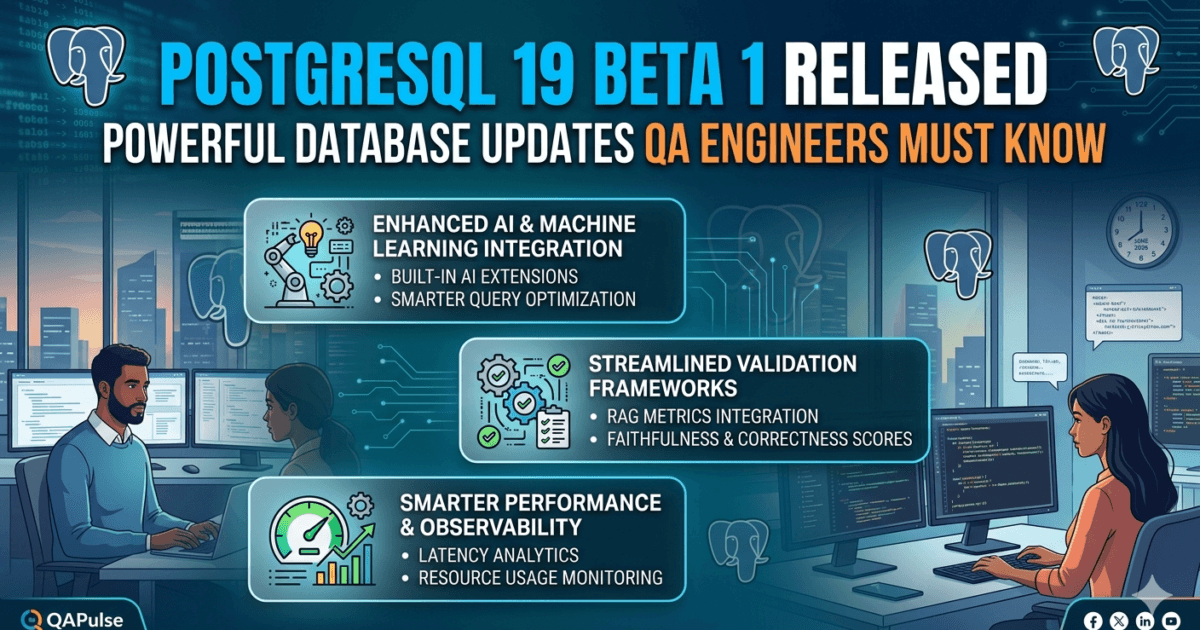
The PostgreSQL community has officially released PostgreSQL 19 Beta 1, marking an important milestone toward the next major version of one of the world’s most trusted open-source database platforms.
For developers, DBAs, DevOps teams, QA Engineers, and SDETs, beta releases provide an opportunity to evaluate upcoming changes before they reach production environments.
If your organization relies on PostgreSQL for APIs, microservices, enterprise applications, SaaS platforms, AI workloads, or automation frameworks, now is the ideal time to begin compatibility and regression testing.
In this article, we’ll explore what PostgreSQL 19 Beta 1 means for QA teams, migration planning, testing strategies, and whether organizations should begin preparing for adoption.
What Is PostgreSQL 19 Beta 1?
PostgreSQL 19 Beta 1 is the first public beta release of the upcoming PostgreSQL 19 database platform.
Beta releases are intended for:
- Compatibility testing
- Feature validation
- Performance benchmarking
- Extension verification
- Ecosystem feedback
Unlike stable releases, beta versions are not intended for production deployments.
However, they are extremely valuable for identifying migration issues before the final release becomes available.
Why PostgreSQL 19 Beta 1 Matters
PostgreSQL powers thousands of modern systems including:
- Enterprise applications
- Banking systems
- E-commerce platforms
- Cloud-native applications
- Microservices architectures
- AI platforms
- Data-intensive SaaS products
Even small database changes can affect:
- Application behavior
- Query performance
- Data integrity
- Automation frameworks
- Reporting systems
This is why QA teams should pay close attention to major PostgreSQL releases.
What Should QA Engineers Focus on First?
When evaluating PostgreSQL 19 Beta 1, the goal should not be feature exploration alone.
The primary objective should be risk identification.
Areas Worth Testing
- Database migrations
- Existing SQL queries
- Stored procedures
- ORM compatibility
- API integrations
- Data validation logic
- Reporting systems
- ETL processes
- Performance benchmarks
Organizations that begin testing early typically experience smoother upgrades later.
Impact on QA Engineers
Database Regression Testing
Every PostgreSQL upgrade should trigger a database regression cycle.
Recommended validations include:
- CRUD operations
- Transactions
- Data consistency
- Rollback scenarios
- Constraint validation
- Trigger execution
API Testing Impact
Many APIs rely heavily on PostgreSQL.
After upgrading, validate:
- API response times
- Data correctness
- Error handling
- Pagination behavior
- Search functionality
Teams using Playwright API testing, Postman, or automated API frameworks should include database-backed scenarios in regression suites.
Automation Framework Impact
Test automation environments often depend on PostgreSQL test databases.
Verify:
- Test data creation
- Cleanup routines
- Parallel execution
- CI/CD database provisioning
Database upgrades frequently expose hidden framework assumptions.
Impact on DevOps Teams
For DevOps engineers, PostgreSQL 19 Beta 1 should be evaluated in:
- Docker environments
- Kubernetes clusters
- CI/CD pipelines
- Infrastructure as Code deployments
Recommended validation areas include:
- Backup restoration
- Replication
- Failover procedures
- Monitoring integrations
- Container deployments
Impact on AI Testing Teams
Organizations using PostgreSQL for AI systems should pay particular attention.
Common use cases include:
- Vector storage
- Knowledge bases
- Retrieval-Augmented Generation (RAG)
- AI observability data
- Evaluation datasets
QA teams should verify:
- Retrieval accuracy
- Data ingestion pipelines
- AI workflow performance
- Indexing behavior
Migration Risks to Consider
Because PostgreSQL 19 Beta 1 is still a beta release, compatibility risks should be expected.
Common Risk Areas
| Area | Risk Level | Recommendation |
|---|---|---|
| Custom SQL Queries | High | Execute regression tests |
| Extensions | High | Verify compatibility |
| ORMs | Medium | Test supported versions |
| Reporting Systems | Medium | Validate outputs |
| CI/CD Pipelines | Medium | Run staging tests |
| Monitoring Tools | Low | Verify dashboards |
Testing Checklist for PostgreSQL 19 Beta 1
Before considering adoption, QA teams should complete the following checklist.
Functional Testing
✅ CRUD operations
✅ Data validation
✅ Transactions
✅ Stored procedures
✅ Triggers
Integration Testing
✅ API workflows
✅ Authentication services
✅ Microservices communication
✅ Reporting tools
Performance Testing
✅ Query response times
✅ Database throughput
✅ Resource utilization
✅ Connection pooling
Security Testing
✅ Role permissions
✅ Access control
✅ Audit logging
✅ Encryption validation
Upgrade Recommendation
Upgrade Immediately If
✅ You are evaluating future PostgreSQL adoption.
✅ You maintain staging environments.
✅ You develop PostgreSQL extensions.
✅ You support enterprise database platforms.
Do Not Upgrade Production If
❌ Mission-critical systems rely on current stable releases.
❌ Extension compatibility is unverified.
❌ Application testing has not been completed.
❌ Vendor support requirements mandate stable versions.
My QA Assessment of PostgreSQL 19 Beta 1
Biggest Opportunity
Early compatibility testing.
Biggest Risk
Undiscovered extension and application compatibility issues.
Enterprise Recommendation
Begin testing immediately in non-production environments.
Production Recommendation
Wait for the final PostgreSQL 19 release.
QA Readiness Score
8.5/10
This beta release provides excellent preparation time for organizations that want to avoid surprises when PostgreSQL 19 reaches general availability.
How to Start Testing PostgreSQL 19 Beta 1
Docker
docker pull postgres:19-beta1
Docker Compose
services:
  postgres:
    image: postgres:19-beta1
    ports:
      - "5432:5432"
Verify Version
SELECT version();
Official Resources
Official PostgreSQL Announcement:
https://www.postgresql.org/about/news/postgresql-19-beta-1-released-3102
PostgreSQL Official Website:
https://www.postgresql.org
PostgreSQL Documentation:
https://www.postgresql.org/docs
PostgreSQL Release Notes:
https://www.postgresql.org/docs/devel/release-19.html
Frequently Asked Questions
What is PostgreSQL 19 Beta 1?
PostgreSQL 19 Beta 1 is the first public beta release of PostgreSQL 19 and is intended for testing and feedback before the final stable release.
Should production systems upgrade to PostgreSQL 19 Beta 1?
No. Production systems should continue using stable PostgreSQL versions until PostgreSQL 19 reaches general availability.
Why should QA engineers test PostgreSQL 19 Beta 1?
Testing helps identify compatibility issues, performance regressions, and migration risks before the final release.
What should be tested first?
Database migrations, APIs, extensions, stored procedures, ORM integrations, and performance-critical queries.
Can PostgreSQL 19 Beta 1 be used in Docker?
Yes. PostgreSQL provides beta Docker images suitable for development and testing environments.
How long should organizations test before upgrading?
Organizations should begin testing immediately and continue validation through the beta and release candidate phases.
Will PostgreSQL 19 improve performance?
Potentially, but performance benefits should be validated through benchmarking against your own workloads.
What is the biggest risk when upgrading PostgreSQL?
Application compatibility issues, unsupported extensions, and untested database migration paths.
Recommended External Links
- Official PostgreSQL Announcement: https://www.postgresql.org/about/news/postgresql-19-beta-1-released-3102
- PostgreSQL Official Website: https://www.postgresql.org
- PostgreSQL Documentation: https://www.postgresql.org/docs
- PostgreSQL Release Notes: https://www.postgresql.org/docs/devel/release-19.html
More Related Blogs
- Playwright vs Cypress in 2026: Which Tool Actually Wins?
- Why QA Observability Will Become Bigger Than Automation Frameworks in 2026
- AI Agents vs Agentic AI — Stop Confusing These Concepts (90% of Developers Get It Wrong)
Final Thoughts
PostgreSQL 19 Beta 1 marks the beginning of the final testing phase for one of the most important database releases in the PostgreSQL ecosystem.
For QA Engineers, SDETs, DBAs, and DevOps teams, this is the perfect opportunity to begin evaluating compatibility, performance, and operational readiness.
Organizations that start testing today will be significantly better prepared when PostgreSQL 19 becomes generally available.