 QA
QA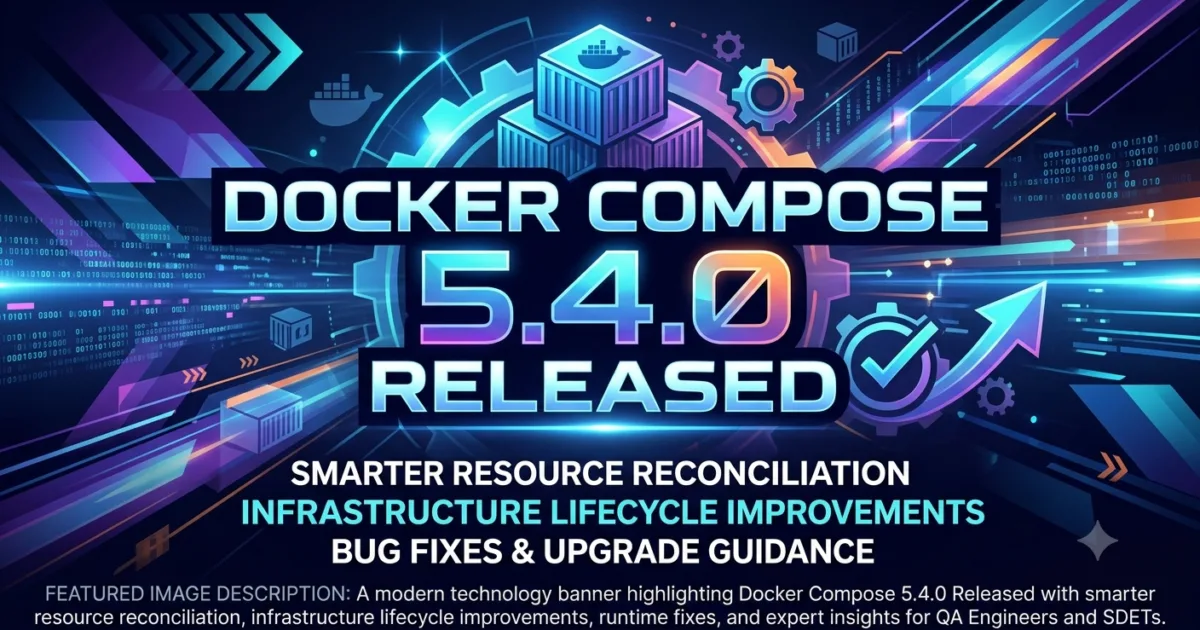
The Docker team has released Docker Compose 5.4.0, introducing an improved resource reconciliation model along with several fixes that enhance configuration handling, container lifecycle management, image resolution, and overall reliability. While this is not a major feature release, it contains meaningful improvements for teams that rely on Docker Compose to build, test, and deploy applications consistently across development and CI/CD environments.
For QA Engineers, SDETs, DevOps professionals, and Automation Engineers, Docker Compose plays a critical role in creating reproducible test environments. Whether you’re running API automation, browser automation with Playwright or Selenium Grid, database integration tests, or microservices validation, improvements in Compose directly affect the stability and predictability of your testing infrastructure.
What’s New in Docker Compose 5.4.0
The headline feature in Docker Compose 5.4.0 is a new resource reconciliation mechanism for managing infrastructure components such as volumes and networks.
Instead of simply applying configuration changes, Docker Compose now models the lifecycle of these resources as part of its execution plan. This enables more predictable infrastructure updates and provides a stronger foundation for future lifecycle management improvements.
Alongside the reconciliation enhancements, this release also includes numerous bug fixes covering:
- Configuration validation
- Build behavior
- Image resolution
- Runtime commands
- OCI registry handling
- Volume management
- Service selection
- Copy operations
- Environment file handling
Collectively, these changes improve the reliability of Docker Compose across both local development and automated deployment pipelines.
Why This Release Matters for QA Engineers
Modern software testing depends on reproducible environments. Test failures caused by inconsistent containers, outdated networks, or unexpected volume behavior can be just as damaging as application defects.
Docker Compose has become a standard tool for creating disposable testing environments that include application services, databases, message queues, cache servers, and supporting infrastructure.
The improvements in Docker Compose 5.4.0 help ensure that these environments remain consistent throughout the testing lifecycle.
For QA teams, this means:
- More predictable environment provisioning
- Improved consistency between local and CI environments
- Better lifecycle management for shared resources
- Reduced infrastructure-related test failures
- Greater confidence in automated regression testing
Key Improvement 1 — Smarter Resource Reconciliation
The most significant enhancement in this release is the new reconciliation model for Docker resources.
Volumes and networks are fundamental building blocks of containerized applications. Incorrect lifecycle management can lead to stale test data, networking inconsistencies, or environment drift that affects automated testing.
By modelling resource recreation and lifecycle changes within its execution plan, Docker Compose provides a more structured and predictable approach to infrastructure updates.
For QA Engineers, this improvement helps:
- Maintain consistent testing environments.
- Reduce unexpected infrastructure changes.
- Improve repeatability of automated tests.
- Minimize configuration drift.
- Simplify environment management across multiple developers and CI runners.
As automation pipelines continue to grow in complexity, predictable infrastructure becomes increasingly important.
Key Improvement 2 — Improved Configuration and Runtime Reliability
Docker Compose 5.4.0 also introduces multiple fixes that improve configuration handling and runtime behavior.
Examples include:
- Better handling of missing environment files.
- Improved configuration flag processing.
- More accurate service selection warnings.
- Better OCI registry support.
- Improved image resolution.
- More reliable copy operations.
While each fix may appear relatively small on its own, together they reduce the likelihood of unexpected behavior during development, testing, and deployment.
These refinements contribute to a smoother developer experience while improving confidence in automated workflows.
Are There Any Breaking Changes?
The official release notes do not identify any major breaking changes in Docker Compose 5.4.0.
Instead, the release focuses on improving the existing reconciliation engine and addressing multiple bugs affecting configuration management and runtime behavior.
Nevertheless, every infrastructure update should be validated before production deployment.
QA teams should verify:
- Existing Compose files
- Multi-container applications
- Volume mappings
- Network configurations
- Build pipelines
- Integration tests
- CI/CD workflows
A controlled rollout remains the recommended approach for enterprise environments.
Should QA Teams Upgrade Immediately?
For organizations already using the Docker Compose 5.x release series, Docker Compose 5.4.0 is a recommended maintenance upgrade.
The release improves infrastructure consistency without introducing disruptive architectural changes, making it a low-risk update for most projects.
Recommended For
- QA Engineers
- SDETs
- Automation Engineers
- DevOps Engineers
- Platform Engineers
- Cloud Engineers
- Container Platform Teams
- Enterprise Development Teams
Upgrade Recommendations
Before deploying Docker Compose 5.4.0 across production environments:
- Validate existing Compose configurations.
- Execute smoke tests.
- Run complete integration and regression suites.
- Verify database and network connectivity.
- Confirm volume persistence behavior.
- Validate CI/CD workflows.
- Monitor deployment logs after rollout.
Following these validation steps helps ensure a smooth upgrade while taking advantage of the latest platform improvements.
Key Takeaway
Docker Compose 5.4.0 is a valuable maintenance release that strengthens one of the most important components of modern containerized development. The introduction of a more sophisticated resource reconciliation model, combined with improvements to configuration handling, runtime behavior, and infrastructure management, helps create more reliable environments for software testing and deployment.
For QA Engineers and SDETs, these enhancements translate into more consistent test environments, fewer infrastructure-related failures, and improved confidence in CI/CD pipelines. Teams already using Docker Compose 5.x should evaluate this release, validate their existing workflows, and adopt the update as part of their regular maintenance strategy to keep their containerized testing environments stable, predictable, and future-ready.
Deep Dive into Docker Compose 5.4.0 for QA Engineers and Automation Teams
Docker Compose 5.4.0 is a maintenance release that focuses on improving how Docker Compose manages infrastructure resources while addressing several configuration, runtime, and build-related issues. Although the release doesn’t introduce major user-facing features, it delivers improvements that can make development, testing, and deployment environments more predictable.
For QA Engineers and SDETs, reliable infrastructure is just as important as reliable test scripts. Stable container orchestration helps eliminate environment-related failures, reduces flaky tests, and ensures automation pipelines behave consistently across local machines, staging environments, and CI/CD systems.
Why Docker Compose Is Essential for Test Automation
Modern software testing rarely involves a single application running in isolation. Most automation projects require multiple services working together, such as web applications, APIs, databases, message brokers, authentication servers, caching layers, and monitoring tools.
Docker Compose simplifies the management of these interconnected services by allowing teams to define complete environments in a single configuration.
Common testing scenarios include:
- Web application testing
- API automation
- Database integration testing
- Microservices validation
- Browser automation
- Performance testing
- End-to-end testing
- Security testing
Because so many QA workflows depend on Docker Compose, improvements to resource management directly enhance testing reliability.
Smarter Resource Reconciliation
The headline enhancement in Docker Compose 5.4.0 is the introduction of a new reconciliation approach for managing volumes and networks.
Instead of treating infrastructure resources independently, Docker Compose now models their lifecycle as part of its execution plan. This provides a more structured approach to determining when resources should be created, recreated, preserved, or updated.
For QA teams, this results in several advantages:
- More predictable environment provisioning
- Better consistency between test runs
- Reduced infrastructure drift
- Improved resource lifecycle management
- Greater confidence in automated deployments
As automation environments become increasingly complex, these improvements help maintain stable and repeatable testing conditions.
Better Volume and Network Management
Volumes and networks form the foundation of most containerized applications. Databases rely on persistent volumes, while application services communicate through Docker networks.
Incorrect handling of these resources can lead to stale data, connectivity issues, or inconsistent testing environments.
The reconciliation improvements introduced in this release help Docker Compose manage these resources more intelligently, reducing the likelihood of infrastructure-related issues during testing and deployment.
Organizations that frequently create and destroy temporary environments for automated testing are likely to benefit the most.
Improved Configuration Handling
Several fixes in Docker Compose 5.4.0 enhance how configuration files and runtime options are processed.
These improvements include:
- Better validation of configuration options
- Improved handling of service selection
- More consistent application of configuration flags
- Enhanced processing of runtime parameters
- Improved handling of environment files
These refinements reduce configuration-related surprises and make Compose behavior more predictable across different environments.
Runtime and Build Reliability
The release also includes fixes affecting build operations, image resolution, registry interactions, and runtime behavior.
These improvements contribute to:
- More reliable image builds
- Better compatibility with container registries
- Improved image selection
- More predictable deployment behavior
- Greater consistency across development and production environments
For QA Engineers maintaining automated deployment pipelines, these enhancements reduce the risk of infrastructure inconsistencies affecting test execution.
Why This Matters for CI/CD Pipelines
Continuous Integration systems frequently create fresh containerized environments for every build. Any inconsistency in infrastructure provisioning can result in failed deployments or unreliable automated tests.
Docker Compose 5.4.0 helps improve CI/CD reliability by strengthening the way resources are planned and managed during deployment.
Organizations can expect benefits such as:
- More consistent build environments
- Improved deployment stability
- Better infrastructure reproducibility
- Reduced pipeline failures
- Easier troubleshooting of environment-related issues
Reliable infrastructure contributes directly to faster and more dependable software delivery.
Recommended Validation After Upgrading
Before adopting Docker Compose 5.4.0 across production environments, QA teams should complete a structured validation process.
Recommended validation activities include:
- Verify Compose configuration files.
- Test multi-container application startup.
- Validate database connectivity.
- Confirm volume persistence.
- Test network communication between services.
- Execute integration tests.
- Run end-to-end automation suites.
- Validate CI/CD workflows.
- Review deployment logs.
- Monitor container lifecycle events.
Completing these checks helps ensure that existing environments continue to function correctly after the upgrade.
Validation Checklist
| Validation Area | Purpose |
|---|---|
| Compose Configuration | Verify syntax and configuration compatibility |
| Container Startup | Ensure all services initialize correctly |
| Network Communication | Validate inter-service connectivity |
| Volume Management | Confirm persistent data behaves as expected |
| Database Services | Verify database initialization and connections |
| API Services | Test service communication and endpoints |
| Integration Testing | Execute complete workflow validation |
| CI/CD Pipeline | Confirm automated deployments continue working |
| Registry Access | Validate image retrieval from registries |
| Runtime Logs | Monitor containers for unexpected behavior |
This checklist helps identify compatibility issues before production deployment.
Best Practices for Enterprise Teams
To maximize the benefits of Docker Compose 5.4.0, organizations should follow a disciplined upgrade strategy.
Recommended best practices include:
- Upgrade development environments first.
- Validate all Compose configurations.
- Execute regression and integration testing.
- Verify shared volumes and networks.
- Test deployment automation.
- Monitor production environments after rollout.
- Document environment-specific observations for future upgrades.
A phased deployment strategy minimizes operational risk while ensuring infrastructure remains stable.
Expert Recommendation
From a software quality and infrastructure perspective, Docker Compose 5.4.0 is a recommended maintenance upgrade for teams already using the Docker Compose 5.x release series. The enhanced reconciliation model, improved configuration handling, and numerous reliability fixes help create more predictable containerized environments for development, testing, and deployment.
Organizations should validate existing Compose projects, execute comprehensive integration testing, and confirm CI/CD compatibility before promoting the update to production. Adopting Docker Compose 5.4.0 as part of a regular maintenance cycle helps reduce infrastructure-related issues and provides a stronger foundation for scalable, container-based software testing.
Real-World Impact of Docker Compose 5.4.0 on QA and DevOps Teams
For many organizations, Docker Compose is the foundation of local development, automated testing, and Continuous Integration pipelines. Whether you’re validating a microservices application, testing REST APIs, running browser automation, or performing database integration tests, Docker Compose helps create consistent environments that closely resemble production.
The improvements introduced in Docker Compose 5.4.0 reinforce this foundation by making infrastructure management more predictable and reducing issues related to resource lifecycle management. Although the release focuses on maintenance rather than new functionality, these enhancements can improve the overall reliability of automated testing workflows.
More Consistent Test Environments
One of the biggest challenges in software testing is ensuring that every engineer and every CI/CD pipeline executes tests in the same environment. Differences in networks, volumes, or service configurations can lead to inconsistent results and difficult-to-reproduce defects.
The enhanced reconciliation model introduced in Docker Compose 5.4.0 helps manage infrastructure resources more consistently, reducing the chances of environment drift between development, staging, and production.
Benefits include:
- More predictable environment provisioning
- Improved consistency across test executions
- Reduced infrastructure-related failures
- Better alignment between local and CI environments
- Increased confidence in regression testing
These improvements help QA teams focus on identifying application defects rather than troubleshooting environment inconsistencies.
Better Resource Lifecycle Management
Applications rarely consist of containers alone. Persistent storage, internal networking, and shared resources are equally important components of a reliable testing environment.
The new reconciliation capabilities improve how Docker Compose manages the lifecycle of resources such as:
- Volumes
- Networks
- Service dependencies
- Runtime configuration
More intelligent resource planning helps ensure that infrastructure components are recreated or preserved appropriately during deployment and testing operations.
This is especially valuable for teams that frequently create temporary environments for feature validation, automated regression testing, or release verification.
Improved Stability for Automated Testing
Modern automation frameworks often rely on Docker Compose to orchestrate supporting services before test execution begins.
Typical examples include:
- Web applications
- API services
- Databases
- Redis
- Message brokers
- Authentication servers
- Mock services
When infrastructure behaves consistently, automated tests become more reliable and easier to maintain.
For QA Engineers, this translates into:
- Fewer flaky tests
- More stable regression suites
- Faster failure analysis
- Improved release confidence
- Better automation reliability
Reliable infrastructure remains one of the most important prerequisites for effective software testing.
Benefits for CI/CD Pipelines
Every CI/CD pipeline depends on predictable infrastructure. Containers must start correctly, services must communicate successfully, and shared resources must remain available throughout the testing process.
Docker Compose 5.4.0 contributes to stronger pipeline reliability by improving resource planning and addressing multiple runtime issues.
After upgrading, organizations should verify:
- Container startup
- Service communication
- Database initialization
- Network connectivity
- Volume persistence
- Image resolution
- Build execution
- Integration testing
Completing these validation activities helps ensure production pipelines continue operating without interruption.
Impact on Different Engineering Roles
The improvements in Docker Compose 5.4.0 benefit multiple roles across modern software engineering teams.
QA Engineers gain more stable testing environments, reducing failures caused by inconsistent infrastructure rather than application defects.
SDETs benefit from improved repeatability when executing automated regression suites across multiple environments.
Automation Engineers can rely on more predictable container orchestration when building large-scale automation frameworks.
DevOps Engineers benefit from improved infrastructure management, smoother deployments, and greater consistency across development and production systems.
Platform Engineers gain a stronger foundation for managing shared containerized environments used by multiple development teams.
Recommended Validation Before Production Deployment
Although Docker Compose 5.4.0 does not introduce significant breaking changes, organizations should still perform comprehensive validation before deploying the update into production.
Recommended validation includes:
- Verify Compose file compatibility.
- Execute smoke tests.
- Validate multi-container applications.
- Confirm volume persistence.
- Test service networking.
- Execute integration testing.
- Validate browser and API automation.
- Review deployment logs.
- Monitor CI/CD pipelines after rollout.
Following these practices minimizes upgrade risk while ensuring a smooth transition to the latest version.
Common Upgrade Mistakes
Maintenance releases are generally straightforward, but teams should avoid several common mistakes during the upgrade process.
These include:
- Updating production environments before testing.
- Ignoring configuration warnings.
- Skipping integration testing.
- Assuming resource behavior remains unchanged.
- Overlooking shared volume validation.
- Failing to monitor deployment logs after rollout.
A disciplined validation strategy helps prevent these issues from affecting production workloads.
Best Practices for QA Teams
To maximize the benefits of Docker Compose 5.4.0, QA teams should incorporate the following practices into their maintenance process:
- Keep Docker Compose updated within supported release versions.
- Review official release notes before upgrading.
- Validate infrastructure alongside application functionality.
- Execute complete regression testing after environment updates.
- Test container networking and persistent storage.
- Monitor CI/CD pipelines following deployment.
- Maintain version consistency across development, staging, and production environments.
These practices help create dependable testing environments and reduce operational risk.
Internal Links
- Docker Compose 5.3.1 Released: CI/CD & Container Improvements for QA Engineers
- Docker Compose 5.3.0 Released: Native Init Containers Are Finally Here for QA Engineers
- Docker Compose 5.2.0 Released: Critical Container Improvements Every QA Engineer Should Know
- Docker Compose 5.1.4 Released: Powerful Updates QA Engineers Must Know
Official Resources
- Official Release Notes: https://github.com/docker/compose/releases/tag/v5.4.0
- Docker Compose Documentation: https://docs.docker.com/compose
People Asked Questions
What is Docker Compose 5.4.0?
Docker Compose 5.4.0 is a maintenance release published on August 03, 2026. It introduces a new resource reconciliation model for volumes and networks while delivering multiple bug fixes related to configuration, runtime behavior, builds, and OCI registry support.
What are the major improvements in Docker Compose 5.4.0?
The key improvements include:
- New reconciliation model for volume recreation
- Improved network lifecycle planning
- Better configuration handling
- Enhanced OCI registry support
- Improved image resolution
- Better environment file handling
- Runtime reliability improvements
- Multiple bug fixes across Docker Compose
Why is the new reconciliation model important?
The new reconciliation model allows Docker Compose to better manage the lifecycle of infrastructure resources such as volumes and networks. This helps create more predictable environments, reduces configuration drift, and improves consistency across development, testing, and production.
Does Docker Compose 5.4.0 include breaking changes?
No major breaking changes are listed in the official release notes. The release primarily focuses on improving resource management and resolving existing issues, making it a low-risk upgrade for most users.
Why should QA Engineers care about this release?
QA Engineers rely on Docker Compose to build repeatable test environments for browser automation, API testing, database validation, and end-to-end testing. The improvements in Docker Compose 5.4.0 help create more stable and reliable testing environments.
Should organizations upgrade immediately?
Teams already using the Docker Compose 5.x release series should plan a controlled upgrade after validating their Compose configurations, container networking, persistent volumes, and CI/CD pipelines.
Which teams benefit most from Docker Compose 5.4.0?
This release is particularly valuable for:
- QA Engineers
- SDETs
- Automation Engineers
- DevOps Engineers
- Platform Engineers
- Cloud Engineers
- Infrastructure Teams
- Container Platform Administrators
What should be tested after upgrading?
Organizations should validate:
- Compose configuration files
- Multi-container applications
- Network communication
- Volume persistence
- Database connectivity
- API integrations
- Browser automation
- CI/CD workflows
- Container startup behavior
- Deployment pipelines
Key Takeaways
- Released on August 03, 2026
- Introduces a new resource reconciliation model
- Improves volume and network lifecycle management
- Includes multiple configuration and runtime fixes
- Enhances OCI registry support
- No reported breaking changes
- Recommended upgrade for Docker Compose 5.x users after validation
Final Verdict
Docker Compose 5.4.0 is a valuable maintenance release that strengthens the reliability of one of the most widely used container orchestration tools for development and testing. The new resource reconciliation approach, together with improvements to configuration handling, runtime behavior, and infrastructure management, provides meaningful benefits for organizations building modern containerized applications.
For QA Engineers, SDETs, Automation Engineers, and DevOps teams, the release offers improved environment consistency, better resource lifecycle management, and greater confidence in automated testing pipelines. Teams already using the Docker Compose 5.x release series should evaluate the update, validate their existing Compose projects, and include Docker Compose 5.4.0 in their regular maintenance cycle to maintain stable, predictable, and scalable testing environments.
Continue Learning
Explore more expert articles on n8n, LangChain, CrewAI, MCP Servers, AI Agents, LlamaIndex, Docker, FastAPI, Playwright, Cypress, Test Automation, DevOps, and Software Engineering at www.skakarh.com.
QAPulse by SK delivers expert release analysis, AI engineering insights, enterprise automation strategies, migration guidance, DevOps best practices, and practical testing knowledge to help software professionals build scalable, intelligent, and production-ready software systems.