 QA
QA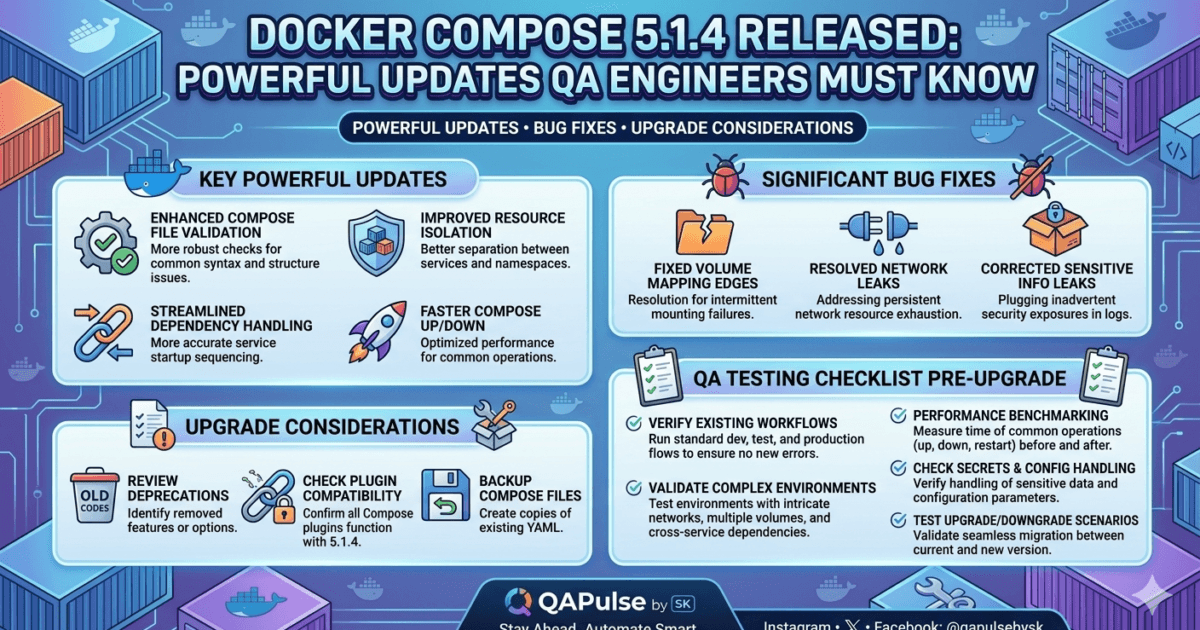
Containerised testing environments have become a standard part of modern software quality engineering.
Whether you are running Playwright tests, Selenium Grid, API automation suites, performance testing tools, or AI testing workloads, Docker Compose remains one of the most widely used tools for orchestrating services during development and testing.
On May 20, 2026, Docker released Docker Compose 5.1.4, introducing several improvements, bug fixes, dependency updates, and internal maintenance enhancements. While this is not a feature-heavy release, it contains updates that can directly impact QA automation pipelines and containerized testing environments.
In this article, we’ll examine what changed in Docker Compose 5.1.4, what QA engineers should pay attention to, and whether teams should upgrade immediately.
What is Docker Compose?
Docker Compose is a tool used to define and run multi-container applications.
Instead of manually starting databases, APIs, browsers, message queues, and supporting services, teams can define everything in a single YAML configuration file.
QA engineers commonly use Docker Compose for:
- Test automation environments
- CI/CD pipelines
- Selenium Grid deployments
- API testing environments
- Microservice integration testing
- Performance testing setups
- AI testing infrastructure
As software architectures become increasingly distributed, Docker Compose continues to play a critical role in test environment management.
What’s New in Docker Compose 5.1.4?
The Docker Compose 5.1.4 release focuses primarily on stability, lifecycle management improvements, proxy handling enhancements, and reliability fixes.
Major Improvement: Stop Lifecycle Hook for External Providers
One of the most notable updates is:
feat: add stop lifecycle hook for external providers
This enhancement improves how external providers can react when services stop.
Why This Matters for QA Teams
Many modern testing environments integrate with:
- External infrastructure
- Cloud resources
- Test environments
- Monitoring systems
- Service virtualization platforms
Improved lifecycle management can reduce cleanup issues and help prevent resource leaks after automated test execution.
For teams running large-scale automation suites, reliable service shutdown behavior is particularly important.
Proxy Handling Improvements
Docker Compose 5.1.4 introduces:
fix: route OCI artifact pulls through Docker Desktop HTTP proxy
Why QA Engineers Should Care
Many enterprise environments operate behind:
- Corporate proxies
- Secure gateways
- Network inspection tools
Previous proxy-related issues could cause:
- Failed image pulls
- Unstable builds
- Pipeline failures
This fix improves reliability when downloading OCI artifacts in secured enterprise networks.
Organizations running CI/CD pipelines in restricted environments should particularly benefit from this improvement.
Plugin Stop Hook Reliability Fixes
The release also restores:
stoppingEvent/stoppedEvent helpers for plugin stop hook
Testing Impact
This update improves reliability for plugin-based integrations that depend on service lifecycle events.
QA teams using:
- Monitoring integrations
- Reporting plugins
- Observability tooling
should validate these workflows after upgrading.
Lifecycle-related bugs can be difficult to diagnose because failures often occur during environment teardown rather than during test execution.
Environment Variable Publishing Fix
Docker Compose 5.1.4 also introduces:
fix(publish): flag literal inline environment values
Why This Matters
Environment variables are frequently used to manage:
- Test credentials
- API endpoints
- Feature flags
- Environment-specific configurations
Incorrect handling of environment values can lead to:
- Deployment mistakes
- Configuration drift
- Security concerns
Teams should verify environment variable handling after upgrading.
Internal Improvements Worth Noting
Although most internal changes are not directly visible to end users, they often improve overall platform stability.
The release includes:
- Code simplification
- Dependency updates
- Documentation improvements
- Workflow cleanup
- Reliability enhancements for end-to-end tests
These updates typically reduce maintenance overhead and improve long-term project health.
What QA Engineers Should Test After Upgrading
Whenever upgrading Docker Compose, a regression testing strategy should be followed.
1. Container Startup Validation
Verify:
- Services start successfully
- Dependencies initialize correctly
- Health checks pass
2. CI/CD Pipeline Execution
Validate:
- GitHub Actions
- Jenkins pipelines
- GitLab CI jobs
- Azure DevOps workflows
Container orchestration issues frequently appear first inside automated pipelines.
3. Environment Variable Handling
Confirm:
- Secrets load correctly
- Configuration values resolve properly
- Environment-specific settings behave as expected
4. Proxy-Based Deployments
Organizations behind corporate networks should verify:
- Artifact downloads
- Image pulls
- Registry authentication
- Network communication
5. Test Environment Cleanup
Validate:
- Container shutdown
- Volume cleanup
- Network cleanup
- Resource release
The new lifecycle-related improvements make this area especially important to test.
Potential Risks When Upgrading
No major breaking changes were announced for Docker Compose 5.1.4.
However, QA teams should remain cautious.
| Risk Area | Recommended Validation |
|---|---|
| Lifecycle Hooks | Verify cleanup behavior |
| Plugin Integrations | Execute integration tests |
| Proxy Configurations | Validate image downloads |
| Environment Variables | Run configuration tests |
| CI/CD Pipelines | Execute full regression suites |
A controlled rollout remains the safest deployment strategy.
Should QA Teams Upgrade Immediately?
For most organizations, the answer is:
Yes, but test first.
The release focuses primarily on:
- Stability
- Reliability
- Lifecycle management
- Enterprise networking improvements
These updates generally represent low-risk maintenance improvements.
However, teams heavily dependent on:
- Docker Desktop
- Plugin integrations
- Corporate proxy environments
- Complex CI/CD pipelines
should perform regression testing before production adoption.
Best Practices for Testing Docker Compose Upgrades
A Docker Compose upgrade should never be treated as a simple package update.
Before deployment:
- Run smoke tests
- Execute regression suites
- Validate infrastructure provisioning
- Test service dependencies
- Monitor resource cleanup behavior
Organizations that standardize upgrade validation processes often experience fewer production incidents and more stable automation pipelines.
Frequently Asked Questions
What is Docker Compose 5.1.4?
Docker Compose 5.1.4 is a maintenance release containing lifecycle improvements, bug fixes, proxy enhancements, dependency updates, and reliability improvements.
Does Docker Compose 5.1.4 contain breaking changes?
No significant breaking changes were announced, but regression testing is recommended before upgrading production environments.
Why should QA engineers care about Docker Compose updates?
Docker Compose is commonly used to manage automated testing environments, CI/CD pipelines, Selenium Grid deployments, and microservice testing infrastructure.
Should teams upgrade to Docker Compose 5.1.4?
Most teams can upgrade safely after validating CI/CD pipelines, proxy configurations, lifecycle hooks, and environment management workflows.
Relevant Articles
- What is Playwright and Why Everyone is Talking About It
- The Hidden Architecture Behind Scalable QA Platforms in 2026
- AI-Powered Test Automation Framework: Powerful Complete Guide for 2026
Official Resources
- Official Release Notes:
https://github.com/docker/compose/releases/tag/v5.1.4 - Docker Compose Documentation:
https://docs.docker.com/compose/ - Docker Compose GitHub Repository:
https://github.com/docker/compose
Final Thoughts
While Docker Compose 5.1.4 is not a major feature release, it delivers several valuable improvements for teams managing containerized testing environments.
The lifecycle hook enhancements, proxy handling fixes, plugin reliability improvements, and maintenance updates collectively contribute to a more stable testing ecosystem.
For QA Engineers, SDETs, and Test Automation Architects, the recommendation is straightforward:
- Upgrade in a non-production environment first
- Execute regression tests
- Validate infrastructure workflows
- Monitor container lifecycle behavior
Small infrastructure improvements often have a significant impact on long-term test automation reliability.