QA
QA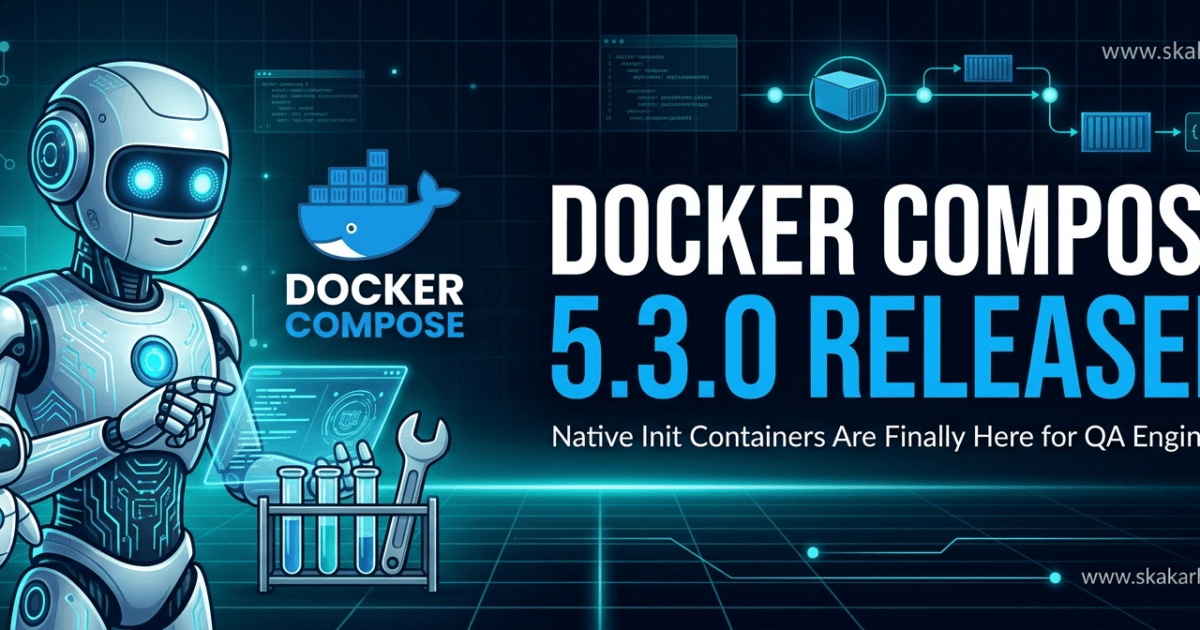
Docker Compose 5.3.0 Released: Bringing Kubernetes-Style Initialization to Local Development
Modern software testing rarely happens on a single machine with a single service. Today’s applications depend on multiple containers working together—databases, APIs, message brokers, caches, authentication servers, monitoring tools, and AI services all need to start in the correct order before testing can begin.
Docker Compose has long simplified multi-container environments, but one important capability remained missing: native init containers.
With Docker Compose 5.3.0, that gap finally closes.
Released on July 2, 2026, this version introduces native support for init containers, allowing developers to execute setup tasks before application services start. The release also includes several reliability improvements for OCI authentication, runtime events, CLI consistency, and dependency updates.
For QA engineers, SDETs, DevOps professionals, and platform teams, this is one of the most meaningful Docker Compose releases in recent months because it makes local testing environments behave much more like Kubernetes production environments.
If your automation depends on databases, migrations, seeded test data, or infrastructure preparation, this release deserves your attention.
What’s New in Docker Compose 5.3.0?
According to the official release notes, Docker Compose 5.3.0 introduces one major new capability together with several important stability improvements.
New Feature
- Native support for Init Containers.
Reliability Improvements
- Improved OCI authorization token handling.
- Better scoping for Running events.
- CLI flag normalization.
- Improved reconciliation logic.
- Better error reporting.
- Dependency updates.
Although many of the remaining changes are internal, together they improve Compose reliability and developer experience.
Release Highlights
| Component | Improvement | Why It Matters |
|---|---|---|
| Init Containers | Native initialization support | Enables Kubernetes-like startup workflows in Docker Compose |
| Container Startup | Pre-start initialization tasks | Improves environment consistency before tests begin |
| OCI Authentication | Improved token transport | More reliable private registry authentication |
| Runtime Events | Better event scoping | More accurate automation and monitoring |
| CLI Improvements | Consistent command behavior | Better scripting reliability |
| Compatibility | No major breaking changes reported | Safe upgrade for most development environments |
Native Init Containers Are the Biggest Feature
The headline capability in Docker Compose 5.3.0 is native support for init containers.
For teams already using Kubernetes, init containers are a familiar concept.
They execute before application containers start and perform one-time initialization tasks required for successful application startup.
Typical examples include:
- Database schema migrations
- Creating required directories
- Downloading configuration files
- Loading environment secrets
- Seeding test data
- Waiting for dependent services
- Running security checks
- Preparing shared storage
Until now, Docker Compose users often relied on shell scripts, custom entrypoints, startup delays, or complex depends_on configurations to accomplish similar goals.
These approaches worked, but they were difficult to maintain and frequently behaved differently from production Kubernetes deployments.
Native init container support brings Docker Compose much closer to production orchestration models.
For QA engineers, this means fewer environment inconsistencies between local testing, CI pipelines, and production clusters.
Why QA Engineers Should Care
Environment setup is one of the leading causes of flaky automated tests.
Many failures occur not because application code is broken, but because supporting infrastructure wasn’t fully initialized before test execution began.
Common examples include:
- Database migrations not completed.
- Seed data missing.
- Authentication services still starting.
- Cache servers unavailable.
- Message queues not yet ready.
- Configuration files generated too late.
With native init containers, these preparation tasks can execute in a controlled sequence before application services become available.
This creates a far more predictable testing environment.
For SDETs maintaining large automation frameworks, the result is:
- More stable CI/CD pipelines.
- Fewer intermittent test failures.
- Faster debugging.
- Cleaner infrastructure configuration.
- Better alignment between development and production deployments.
Instead of embedding setup logic inside application containers, teams can isolate initialization into dedicated init containers—making both infrastructure and automation easier to maintain.
Docker Compose Continues Closing the Kubernetes Gap
Over the past few years, Docker Compose has evolved beyond a simple developer convenience tool.
Many organizations now use Compose to support:
- Local microservice development
- Integration testing
- End-to-end automation
- API validation
- Performance testing
- AI development environments
- Containerized developer workstations
The addition of init containers further strengthens Compose as a realistic development platform.
Developers can now reproduce production startup behavior more accurately without requiring a full Kubernetes cluster for every testing scenario.
For QA teams, that translates into higher confidence that locally validated workflows will behave similarly when deployed to staging or production.
What Docker Compose 5.3.0 Means for QA Engineers
The introduction of native init containers is far more than a convenience feature—it fundamentally changes how QA engineers can prepare test environments before automation begins.
In many enterprise CI/CD pipelines, automated tests fail not because the application contains defects, but because supporting services are not fully initialized. Databases may still be running migrations, APIs may be waiting for secrets, or caches may not yet be populated.
Historically, engineering teams solved these problems using shell scripts, custom entrypoints, retry loops, or artificial startup delays. While functional, these workarounds often increased maintenance overhead and created differences between local development and Kubernetes production environments.
With Docker Compose 5.3.0, initialization becomes a first-class capability.
QA engineers can now define dedicated init containers responsible for preparing the environment before application containers start. This results in cleaner infrastructure, fewer flaky tests, and automation pipelines that more closely resemble production deployments.
Beyond init containers, this release also improves OCI authentication, runtime event handling, and CLI consistency—small improvements that collectively strengthen the reliability of container-based testing workflows.
Enterprise Impact
Organizations increasingly depend on Docker Compose for much more than local development.
Common enterprise use cases include:
- API integration testing
- End-to-end automation
- Performance testing environments
- AI application development
- Microservices orchestration
- Local Kubernetes simulation
- Test data preparation
- CI/CD infrastructure
Many of these environments require multiple services to start in a predictable sequence.
For example:
- PostgreSQL must complete initialization before APIs connect.
- Redis should be available before background workers start.
- Database migrations must finish before regression tests begin.
- Mock services should load predefined responses before API testing.
- AI inference servers may need model downloads before accepting requests.
Native init containers allow these preparation tasks to execute independently, creating more stable and reproducible environments across local machines, build servers, and cloud pipelines.
For QA teams, this reduces environmental inconsistencies while improving automation reliability.
Other Improvements Worth Noticing
Although init containers receive most of the attention, several additional fixes improve Docker Compose’s overall stability.
Improved OCI Authentication
Authentication requests now route correctly through the configured transport layer.
For organizations pulling images from private registries such as Docker Hub Enterprise, GitHub Container Registry, AWS ECR, Azure Container Registry, or Google Artifact Registry, this reduces authentication-related deployment issues.
Better Runtime Event Handling
Running events are now scoped more accurately to project services.
Teams relying on automation, monitoring, or custom orchestration scripts can expect more predictable runtime event behavior.
CLI Consistency
The normalization of the --no-TTY flag improves command-line consistency and reduces scripting issues across different environments.
These changes may not be immediately visible, but they contribute to a more dependable developer and automation experience.
Should You Upgrade?
Yes.
Docker Compose 5.3.0 is recommended for most teams, especially those working with:
- Multi-container applications
- Kubernetes deployments
- CI/CD pipelines
- Microservices
- API automation
- AI workloads
- Integration testing
- Enterprise development environments
Reasons to upgrade include:
- Native init container support.
- Improved startup reliability.
- Better Kubernetes workflow alignment.
- More consistent container orchestration.
- Improved registry authentication.
- No major breaking changes reported.
If your organization depends on Docker Compose for automated testing or deployment, this is one of the most valuable upgrades released this year.
Regression Testing Checklist
Before deploying Docker Compose 5.3.0, validate the following:
- Multi-container startup sequence.
- Database initialization.
- Init container execution.
- API availability after initialization.
- Docker networking.
- Volume mounting.
- Private registry authentication.
- CI/CD deployment pipelines.
- Existing compose.yml compatibility.
- Integration and end-to-end automation suites.
Completing these checks helps ensure a smooth upgrade with minimal operational risk.
How to Upgrade
Upgrade Docker Compose
docker compose version

docker compose pull

docker compose up -d
Or install the latest version manually from Docker’s official release packages if required by your operating system.
After upgrading, recreate your containers and execute representative automation suites to verify startup ordering and service initialization.
Internal Links
- Day 7: Master the 4 MCP Transport Layer Options: STDIO vs HTTP vs SSE vs WebSockets
- n8n 2.28.3 Released: Startup Reliability Improvements Every QA Engineer Should Know
- k6 2.1.0 Released: Why QA Engineers Should Upgrade for Better Performance Testing
- Day 5: Playwright Locators: Stop Writing Fragile Selectors Forever
Official Resources
Official Release Notes: https://github.com/docker/compose/releases/tag/v5.3.0
Docker Compose Documentation: https://docs.docker.com/compose
Final Verdict
Docker Compose 5.3.0 is one of the most impactful releases in recent memory because it introduces a capability that development and QA teams have requested for years: native init containers.
This feature significantly improves startup orchestration, allowing infrastructure preparation tasks to execute before application services begin. Combined with reliability improvements for OCI authentication, runtime events, and CLI behavior, the release strengthens Docker Compose as a production-grade development and testing platform.
For QA engineers and SDETs, the biggest benefit is improved test environment consistency. Stable infrastructure leads directly to fewer flaky tests, more reliable CI/CD pipelines, and faster debugging when failures occur.
Recommendation: Upgrade to Docker Compose 5.3.0 during your next maintenance window. The new init container functionality alone makes this release worthwhile for teams building modern containerized applications.
Frequently Asked Questions
Does Docker Compose 5.3.0 introduce breaking changes?
No major breaking changes have been reported. Existing Compose projects should continue working, although regression testing is always recommended before production deployment.
What is the biggest feature in Docker Compose 5.3.0?
Native support for init containers, allowing initialization tasks to execute before application services start.
Why are init containers important for QA?
They ensure databases, configuration, secrets, and supporting services are fully prepared before automated tests begin, reducing flaky test failures.
Should enterprise teams upgrade?
Yes. Teams using CI/CD pipelines, Kubernetes, microservices, or complex multi-container applications will benefit most from this release.
Docker Compose 5.3.0 Released: Key Takeaways
Docker Compose 5.3.0 Released delivers one of the platform’s most valuable capabilities to date by introducing native init containers. This enhancement brings Compose closer to Kubernetes behavior while making local development, integration testing, and CI/CD pipelines more predictable. Combined with reliability improvements across authentication, runtime events, and command-line behavior, the release represents a meaningful upgrade for organizations building modern cloud-native applications.
Continue Learning
Explore more expert articles on Docker, Kubernetes, FastAPI, Playwright, Selenium, MCP, CrewAI, LangChain, AI Agents, Test Automation, and Software Engineering at www.skakarh.com.
QAPulse by SK delivers expert release analysis, migration guidance, DevOps best practices, AI engineering insights, and enterprise testing strategies to help software professionals stay ahead of the rapidly evolving technology landscape.