 QA
QA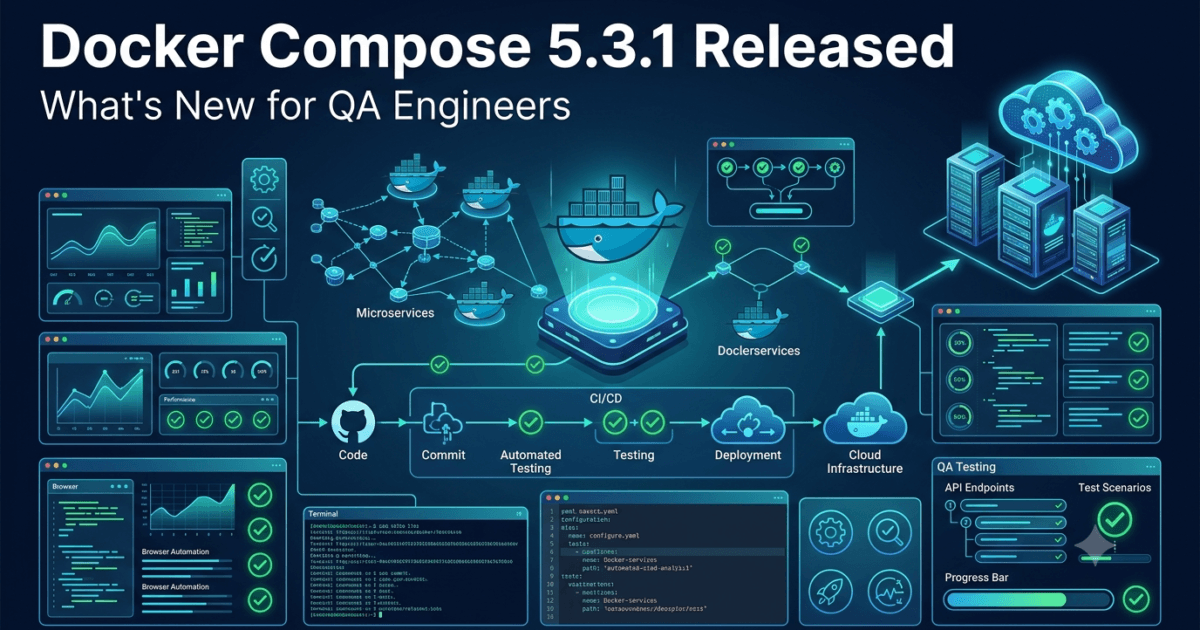
Containerisation has become the backbone of modern software development, making Docker Compose an indispensable tool for QA Engineers, SDETs, DevOps Engineers, Platform Engineers, and Software Developers. From spinning up local microservices to orchestrating complete end-to-end testing environments, Docker Compose enables engineering teams to create consistent, reproducible, and production-like environments with minimal effort.
Docker Compose 5.3.1, released on July 7, 2026, is a maintenance-focused update that prioritizes internal improvements, dependency updates, CI/CD workflow enhancements, and project governance rather than introducing new end-user features. While this may seem like a small release on the surface, maintenance releases like this play a vital role in keeping one of the industry’s most widely adopted container orchestration tools stable, secure, and enterprise-ready.
For organizations practicing Continuous Integration (CI), Continuous Delivery (CD), Infrastructure as Code (IaC), GitOps, Kubernetes development, and cloud-native application testing, these improvements contribute to a healthier ecosystem and a more reliable development pipeline.
Whether you’re executing automated UI tests with Playwright, running Cypress end-to-end suites, validating APIs, executing performance tests with k6 or Locust, or testing AI-powered applications, Docker Compose often serves as the foundation that brings every dependent service together.
Official Release Highlights
According to the official release notes, Docker Compose 5.3.1 primarily focuses on:
Internal Improvements
- Improved GitHub Actions workflow reliability.
- Added concurrency controls to prevent duplicate CI reviews.
- Hardened GitHub Actions security workflows.
- Improved documentation and project governance.
- Updated CODEOWNERS configuration.
- Removed obsolete CI workflows.
- Improved documentation quality and grammar.
Dependency Updates
Several core dependencies were updated, including:
- BuildKit
- Docker CLI
- YAML libraries
- System user packages
- Additional internal build components
These updates improve overall compatibility, security, maintainability, and long-term platform stability.
Although no major user-facing functionality has been introduced, the project continues strengthening its internal engineering practices—a positive indicator of a healthy open-source ecosystem.
Why This Release Matters
Engineering teams frequently underestimate maintenance releases because they often contain few visible changes.
However, mature software platforms evolve through continuous refinement rather than constant feature expansion.
Docker Compose powers countless enterprise workflows, including:
- Local development environments
- Integration testing
- API automation
- UI automation
- Performance testing
- AI application deployment
- Database testing
- Message queue validation
- Distributed system simulation
- Microservices orchestration
A small improvement within Docker Compose can positively influence thousands of engineering pipelines worldwide.
By strengthening internal automation, modernizing dependencies, and improving CI workflows, Docker Compose 5.3.1 contributes to a more stable and maintainable ecosystem that benefits every engineering team relying on containerized development and testing environments.
What This Means for QA Engineers
For QA Engineers and SDETs, Docker Compose is much more than a developer convenience tool—it is often the foundation of reliable test automation. A typical automated testing pipeline may require multiple interconnected services such as application containers, databases, Redis caches, message brokers, mock APIs, authentication services, Selenium Grid nodes, or browser automation containers. Docker Compose simplifies this orchestration by ensuring every dependency starts consistently and predictably.
Although Docker Compose 5.3.1 does not introduce new Compose commands or orchestration features, its focus on dependency updates, CI workflow hardening, and infrastructure improvements helps improve the long-term reliability of the platform that countless QA pipelines depend on. Stable tooling reduces unexpected build failures, minimizes compatibility issues with newer Docker Engine releases, and improves confidence when executing automated regression suites.
Organizations practicing Continuous Testing, Shift-Left Testing, DevSecOps, and GitOps will particularly benefit from these ongoing improvements because infrastructure stability directly influences test stability. Even small internal refinements can reduce pipeline interruptions and make automated deployments more predictable.
Key Improvements for Enterprise Teams
Improved CI/CD Reliability
Several updates focus on improving GitHub Actions workflows by preventing duplicate reviews, cleaning obsolete workflows, and strengthening automation. While invisible to most end users, these improvements reflect a more mature and reliable release engineering process.
For enterprises running hundreds of automated builds every day, stronger CI infrastructure contributes to more consistent releases and improved software quality.
Updated Dependencies Improve Long-Term Stability
Docker Compose 5.3.1 updates important dependencies including BuildKit, Docker CLI, YAML libraries, and supporting system packages.
Dependency maintenance helps organizations:
- Reduce compatibility issues.
- Improve build performance.
- Receive upstream security improvements.
- Stay aligned with modern Docker tooling.
- Minimize future upgrade risks.
Keeping dependencies current is particularly important for engineering teams managing large containerized environments.
Better Project Governance
Updates to CODEOWNERS, documentation, GitHub workflows, and contributor management indicate continued investment in the long-term health of the Docker Compose project.
Healthy governance often translates into:
- Faster bug resolution.
- Better release quality.
- Improved community collaboration.
- More reliable maintenance.
- Sustainable long-term development.
For organizations standardizing on Docker Compose as part of their development platform, these improvements are valuable indicators of project maturity.
Are There Any Breaking Changes?
The official release notes do not report any breaking changes in Docker Compose 5.3.1.
There are:
- No Compose file syntax changes.
- No removed commands.
- No deprecated features.
- No migration requirements.
- No changes to existing workflows.
This makes Docker Compose 5.3.1 a straightforward maintenance upgrade for most organizations.
Teams can generally upgrade without modifying existing docker-compose.yml files or CI/CD automation pipelines.
Migration Recommendations
Migration risk for this release is extremely low.
Before upgrading, QA teams should:
- Verify automated regression pipelines.
- Execute container startup validation.
- Test service networking.
- Validate mounted volumes.
- Confirm database initialization.
- Verify browser automation containers.
- Validate API testing environments.
- Execute smoke tests.
- Compare existing Docker Engine compatibility.
- Validate CI/CD deployment workflows.
These checks help ensure consistent behavior across development, staging, and production-like environments.
How to Upgrade
Upgrade Docker Compose
docker compose version
Install the latest version using your platform’s recommended installation method.
If using Docker Desktop, simply update Docker Desktop to receive the latest Docker Compose release.
Verify the installation afterward:
docker compose version
Should QA Teams Upgrade?
Yes.
Although Docker Compose 5.3.1 is primarily a maintenance release, it strengthens the ecosystem through improved dependency management, hardened CI workflows, updated project governance, and ongoing platform maintenance.
Recommended for teams using:
- Docker Desktop
- Docker Engine
- Kubernetes development
- GitHub Actions
- Jenkins
- GitLab CI
- Azure DevOps
- Playwright
- Cypress
- Selenium Grid
- API automation
- AI application development
- Microservices testing
- Performance testing
- Enterprise DevOps pipelines
Because there are no reported breaking changes and migration effort is minimal, most organizations can safely adopt this release as part of their regular maintenance schedule.
Final Verdict
Docker Compose 5.3.1 demonstrates why mature engineering tools continue to earn enterprise trust. Instead of focusing solely on new features, this release invests in the foundation of the project through dependency modernization, CI/CD workflow improvements, governance updates, and infrastructure hardening. These behind-the-scenes enhancements improve the overall quality, maintainability, and reliability of one of the most widely used container orchestration tools in modern software engineering.
For QA Engineers, SDETs, DevOps Engineers, Cloud Architects, Platform Engineers, and Software Developers, Docker Compose remains an essential component of automated testing and cloud-native development. Keeping it updated helps ensure stable local environments, reliable CI/CD pipelines, and smoother collaboration across development teams.
Recommendation: Upgrade to Docker Compose 5.3.1 during your next maintenance window. It is a low-risk, production-ready maintenance release that reinforces the stability and long-term health of the Docker Compose ecosystem.
Docker Compose 5.3.1 Released: Key Takeaways
Docker Compose 5.3.1 is a maintenance-focused release that reinforces the reliability of one of the most widely used container orchestration tools in modern software development. While this version does not introduce new user-facing features, it improves the project’s internal infrastructure through CI/CD workflow enhancements, dependency upgrades, governance improvements, and security hardening. For QA Engineers, SDETs, DevOps Engineers, Platform Engineers, and Cloud Architects, these behind-the-scenes improvements contribute to more dependable development environments, more stable automated testing pipelines, and smoother long-term upgrades. Organizations already using Docker Compose across local development, integration testing, API testing, browser automation, and microservices should confidently adopt this release as part of their routine maintenance strategy.
Interview Question Answers
Is Docker Compose 5.3.1 a major feature release?
No. Docker Compose 5.3.1 is a maintenance release focused on internal improvements rather than introducing new Compose commands or user-facing functionality. The emphasis is on dependency updates, CI workflow improvements, project governance, and overall platform stability.
Are there any breaking changes in Docker Compose 5.3.1?
No. According to the official release notes, Docker Compose 5.3.1 introduces no breaking changes, no Compose file syntax modifications, and no migration requirements. Existing Docker Compose projects should continue working without modification.
Should QA Engineers upgrade immediately?
Yes. Since this is a low-risk maintenance release with no reported breaking changes, QA teams should include Docker Compose 5.3.1 in their regular upgrade cycle. Updating ensures improved compatibility with the latest Docker ecosystem while maintaining a stable foundation for automated testing pipelines.
Does this release improve CI/CD environments?
Indirectly, yes. Docker Compose 5.3.1 enhances GitHub Actions workflows, improves CI pipeline management, removes obsolete workflows, and strengthens project automation. These updates help improve release quality and long-term maintainability, which benefits organizations relying on automated CI/CD pipelines.
Does Docker Compose 5.3.1 improve container security?
While no new runtime security features have been introduced, dependency upgrades, hardened GitHub Actions workflows, and ongoing infrastructure maintenance contribute to a healthier and more secure development ecosystem.
Is Docker Compose still recommended for microservices testing?
Absolutely. Docker Compose remains one of the best tools for creating reproducible local environments for:
- Microservices
- REST APIs
- GraphQL services
- Databases
- Redis
- Kafka
- RabbitMQ
- Selenium Grid
- Playwright
- Cypress
- AI applications
- Integration testing
- End-to-end testing
Its simplicity and strong ecosystem support continue to make it a preferred solution for modern QA and DevOps teams.
Best Practices After Upgrading
After installing Docker Compose 5.3.1, QA and DevOps teams should perform a quick validation of their containerized environments to ensure existing workflows continue operating as expected.
Recommended verification checklist:
- Confirm Docker Compose version.
- Validate
docker-compose.ymlconfiguration files. - Start all application services successfully.
- Verify inter-container networking.
- Test persistent volumes and bind mounts.
- Validate database initialization scripts.
- Run API smoke tests.
- Execute Playwright or Cypress automation suites.
- Verify Selenium Grid containers.
- Confirm CI/CD pipeline execution.
- Test Docker BuildKit compatibility.
- Monitor application logs for unexpected warnings.
- Validate environment variables and secrets.
- Compare startup times against previous versions.
- Execute integration and regression testing before production rollout.
These validation steps help ensure that infrastructure changes have no unintended impact on automated quality assurance workflows.
Why Maintenance Releases Matter
Many engineering teams focus primarily on feature releases, but maintenance releases are equally important for keeping development platforms healthy and reliable.
Internal improvements such as:
- Dependency upgrades
- CI/CD optimization
- Security hardening
- Documentation improvements
- Governance updates
- Workflow refinements
reduce technical debt and improve long-term software quality.
For tools like Docker Compose—which serve as the foundation for countless automated testing environments—even minor maintenance improvements can increase reliability across thousands of enterprise pipelines.
Keeping foundational tools updated minimizes compatibility issues, reduces operational risks, and helps organizations maintain modern, secure, and efficient engineering workflows.
Internal Links
- Docker Compose 5.3.0 Released: Native Init Containers Are Finally Here for QA Engineers
- Docker Compose 5.2.0 Released: Critical Container Improvements Every QA Engineer Should Know
- Docker Compose 5.1.4 Released: Powerful Updates QA Engineers Must Know
Official Resources
- Official Release Notes: https://github.com/docker/compose/releases/tag/v5.3.0
- Docker Compose Documentation: https://docs.docker.com/compose
Conclusion
The latest release of Docker Compose 5.3.1 focuses on stronger CI/CD workflows, dependency upgrades, improved project maintenance, and enhanced platform stability. While there are no major new features, these behind-the-scenes improvements help QA Engineers, SDETs, DevOps teams, and Platform Engineers build more reliable containerised testing and deployment pipelines.
Continue Learning
Explore more expert articles on n8n, LangChain, CrewAI, MCP Servers, AI Agents, LlamaIndex, Docker, FastAPI, Playwright, Cypress, Test Automation, DevOps, and Software Engineering at www.skakarh.com.
QAPulse by SK delivers expert release analysis, AI engineering insights, enterprise automation strategies, migration guidance, DevOps best practices, and practical testing knowledge to help software professionals build scalable, intelligent, and production-ready software systems.