QA
QA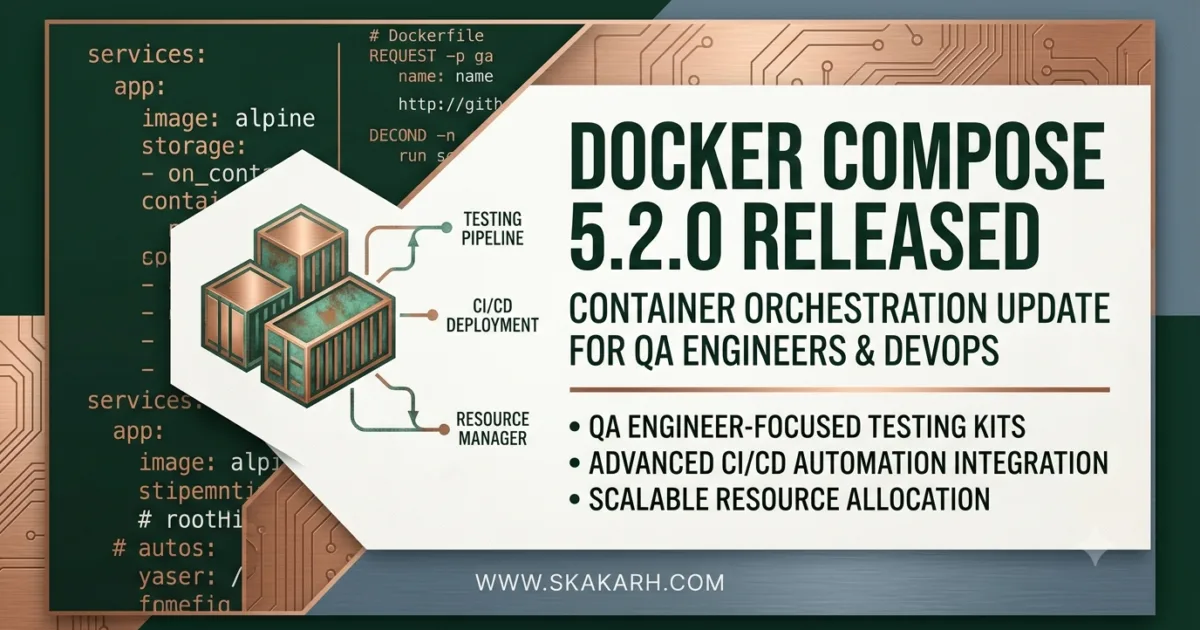
The Docker Compose 5.2.0 Released update introduces one of the most technically significant improvements to Docker Compose in recent months. While the release contains several bug fixes and internal optimizations, the headline feature is an entirely new reconciliation algorithm that changes how Docker Compose determines the difference between the desired application state and the actual running containers.
For developers, this change promises smarter orchestration and improved deployment consistency. For QA engineers, SDETs, DevOps teams, and platform engineers, however, it represents something even more important: a core behavioral change that deserves careful validation before being introduced into production CI/CD pipelines.
Unlike cosmetic updates or documentation improvements, reconciliation logic directly affects container lifecycle management. It determines when containers are recreated, restarted, updated, or left untouched. Any modification to this process has the potential to influence automated testing environments, integration pipelines, ephemeral test environments, and local developer workflows.
The Docker Compose team has explicitly advised users to report workloads that behave differently after upgrading—an indication that this release modifies fundamental orchestration behavior rather than simply fixing isolated defects.
If your organization relies on Docker Compose for application testing or deployment automation, Docker Compose 5.2.0 should be treated as an operational upgrade that requires structured regression testing.
What’s New in Docker Compose 5.2.0?
Docker Compose 5.2.0 focuses on improving deployment intelligence, provider integrations, configuration handling, and runtime reliability.
Highlights from the release include:
- A brand-new reconciliation planning algorithm
- Better provider plugin communication
- Improved handling of environment files
- Smarter configuration variable extraction
- Enhanced build behavior
- Better terminal detection for progress output
- Internal performance optimizations
- Documentation improvements
While many of these updates appear small individually, together they improve the consistency of container orchestration across development, testing, and production environments.
The reconciliation engine is unquestionably the centerpiece of this release.
The New Reconciliation Algorithm Explained
The biggest architectural change in Docker Compose 5.2.0 is the introduction of a new reconciliation plan.
Whenever you execute commands such as:
docker compose up
Docker Compose must answer a critical question:
“What is currently running, and what should be running?”
The reconciliation engine compares:
- Existing containers
- Service definitions
- Images
- Networks
- Volumes
- Environment variables
- Dependency relationships
It then calculates the minimum number of operations required to bring the running environment into the desired state.
Previous versions already performed this comparison, but Docker Compose 5.2.0 introduces an updated algorithm designed to make these decisions more intelligently.
The expected benefits include:
- fewer unnecessary container recreations
- improved deployment consistency
- cleaner infrastructure synchronization
- more predictable updates
- better scalability for larger Compose projects
For organizations managing dozens or even hundreds of services, these improvements can significantly reduce deployment overhead.
Why This Release Matters for QA Engineers
Many QA professionals think of Docker Compose as a developer convenience tool.
In reality, it has become a critical part of modern testing infrastructure.
Today, Docker Compose commonly powers:
- Local integration testing
- API automation environments
- Playwright test infrastructure
- Selenium Grid deployments
- Cypress execution containers
- Database provisioning
- Message queues
- Mock services
- Contract testing environments
- CI/CD integration pipelines
Every automated test depends on the environment being provisioned correctly before execution begins.
If Docker Compose changes how services are synchronized, automation reliability can change as well.
That is precisely why this release deserves attention.
The Docker team’s recommendation to report previously working workloads indicates that the reconciliation engine may expose assumptions hidden within existing Compose configurations.
This is not necessarily a negative outcome.
Instead, it is an opportunity for QA teams to identify configuration inconsistencies before they affect production deployments.
Smarter Environment Handling Improves Automation Stability
Another useful enhancement improves how Docker Compose handles environment configuration.
Among the fixes included are improvements to:
- missing optional environment files
- configuration variable extraction
- provider plugin communication
For enterprise automation, environment configuration is often one of the most fragile aspects of deployment.
Consider a typical automation stack:
- PostgreSQL
- Redis
- RabbitMQ
- Playwright
- Selenium Grid
- API services
- Authentication server
- Reporting service
Each component frequently depends on dozens of environment variables.
Incorrect handling of configuration files can produce:
- startup failures
- inconsistent test execution
- environment drift
- hidden deployment bugs
Docker Compose 5.2.0 improves several of these configuration workflows, helping teams build more predictable automation environments.
Better Support for Provider Plugins
Another noteworthy enhancement introduces a new rawsetenv message type for provider plugins.
Although this may seem like an internal implementation detail, it represents continued investment in Docker Compose’s extensibility.
Modern infrastructure increasingly integrates with external providers responsible for:
- cloud credentials
- secret management
- deployment orchestration
- infrastructure provisioning
- enterprise authentication
Improving communication between Docker Compose and provider plugins enables cleaner integrations while reducing the likelihood of configuration inconsistencies across distributed environments.
Organizations building internal platform engineering solutions may particularly benefit from this enhancement.
Bug Fixes That Matter in Enterprise CI/CD
Several bug fixes in Docker Compose 5.2.0 may appear minor in the changelog but have practical implications for QA and DevOps teams.
For example, the release improves:
- Build context handling for remote URLs
- Validation behavior during configuration extraction
- Terminal detection for progress output
- Publishing behavior when optional environment files are absent
These changes help reduce friction in automated pipelines where builds often execute inside headless Linux containers rather than interactive developer terminals.
Reliable behavior across CI platforms such as GitHub Actions, GitLab CI, Azure DevOps, Jenkins, and CircleCI is essential for maintaining predictable release pipelines.
Small fixes in these areas frequently eliminate intermittent build failures that consume significant engineering time to diagnose.
QA Impact Analysis: What Should Teams Test Before Upgrading?
Although Docker Compose 5.2.0 does not introduce breaking CLI syntax changes, the new reconciliation algorithm means QA teams should validate container lifecycle behaviour rather than assuming identical execution.
Before promoting the upgrade into production CI/CD pipelines, verify the following scenarios:
Validate Container Recreation Logic
Run repeated deployments using:
docker compose up -d
Observe whether services are unnecessarily recreated after configuration changes. Unexpected recreation can:
- reset databases
- invalidate test data
- restart dependent services
- increase pipeline execution time
A healthy upgrade should only recreate containers when configuration actually changes.
Verify Multi-Service Dependency Ordering
Many enterprise automation environments depend on startup sequencing.
Typical examples include:
- API waiting for PostgreSQL
- Worker waiting for RabbitMQ
- UI waiting for backend services
- Test runner waiting for Selenium Grid
Confirm that dependency resolution still behaves exactly as expected after upgrading.
Regression Test Environment Variables
Because several fixes target configuration parsing and optional environment files, verify:
.envfilesenv_file- optional environment files
- secrets injection
- CI/CD variables
- Docker Desktop environments
A small configuration parsing difference can silently alter application behaviour.
Validate Existing Compose Files
Large organisations often maintain Compose files that have evolved over several years.
Test older projects for:
- deprecated syntax
- legacy overrides
- custom plugins
- provider integrations
- complex networking
- volume mappings
The Docker team specifically requested users report workloads that behave differently after this release, making regression testing especially important.
Should QA Teams Upgrade Immediately?
Recommendation: Yes—but validate first.
Unlike releases introducing experimental features, Docker Compose 5.2.0 primarily improves orchestration behaviour while fixing several reliability issues.
For most teams, the benefits outweigh the risks.
However, because reconciliation logic has changed internally, production environments should follow a staged rollout:
| Environment | Recommendation |
|---|---|
| Developer machines | ✅ Upgrade immediately |
| Local automation | ✅ Recommended |
| Feature branch CI | ✅ Validate first |
| Shared QA environment | ✅ Short regression cycle |
| Production CI/CD | ⚠ Roll out gradually |
This approach allows teams to identify behavioural differences before they affect critical delivery pipelines.
Upgrade Instructions
Docker Compose Plugin
docker compose version

docker compose pull

docker compose up -d
Or update Docker Desktop to receive the latest bundled Compose version.
Migration Checklist for QA Engineers
Use this checklist before adopting Docker Compose 5.2.0 across enterprise environments.
✅ Verify all Compose projects start successfully
✅ Compare container recreation behaviour with previous version
✅ Validate environment variables and .env handling
✅ Test service dependency ordering
✅ Run complete API automation suites
✅ Execute UI automation using Selenium or Playwright
✅ Validate integration tests
✅ Verify Docker volumes remain intact
✅ Confirm provider plugins still function correctly
✅ Monitor CI/CD execution time for unexpected regressions
Expert Verdict
Docker Compose 5.2.0 is more significant than its changelog initially suggests.
The new reconciliation engine changes one of the most fundamental parts of Compose—how it determines the difference between desired and actual infrastructure state. While end users may notice little difference during routine development, QA engineers responsible for reliable automation environments should pay close attention.
The accompanying fixes for configuration extraction, environment file handling, build behaviour, and provider integrations further improve the stability of modern container-based testing workflows.
For organisations embracing DevOps, Infrastructure as Code, and container-first testing strategies, this release is worth adopting after a structured regression cycle.
Overall recommendation: Upgrade to Docker Compose 5.2.0 after validating your Compose workloads in a staging environment.
Frequently Asked Questions
Is Docker Compose 5.2.0 a major release?
No. It is a feature release that introduces a new reconciliation algorithm together with several bug fixes and internal improvements.
Are there any breaking changes?
No explicit breaking changes have been announced. However, Docker has advised users to test existing Compose workloads because reconciliation behaviour has changed internally.
Should QA engineers upgrade immediately?
For local development environments, yes. Production CI/CD systems should first complete regression testing to ensure container orchestration behaves as expected.
Does this release improve automated testing?
Indirectly, yes. More reliable reconciliation, improved environment handling, and better provider integrations contribute to more stable automation environments.
More Relevant Articles
- Playwright 1.61.1 Released: 5 Critical Bug Fixes QA Engineers Must Know in 2026
- TypeScript 6.0.3 vs TypeScript 5.x: 7 Powerful Changes QA Engineers Should Know
- n8n 2.26.7 Released: Critical Compression Node Fix Every QA Engineer Should Know
External Resources
- Docker Compose Release Notes: https://github.com/docker/compose/releases/tag/v5.2.0
- Docker Compose Documentation: https://docs.docker.com/compose/
- Docker Engine Documentation: https://docs.docker.com/engine/
- Docker Desktop Documentation: https://docs.docker.com/desktop/
- Twelve-Factor App Methodology: https://12factor.net/
Final Thoughts
Container orchestration has become the foundation of modern software testing. Even seemingly small infrastructure updates can influence deployment consistency, test reproducibility, and pipeline stability.
Docker Compose 5.2.0 demonstrates that infrastructure tooling continues to evolve toward smarter state management and improved operational reliability. QA engineers who proactively validate these changes before production rollout will minimise deployment risks while benefiting from a more predictable automation ecosystem.
If you’re building modern testing frameworks with Docker, Playwright, Selenium, Cypress, FastAPI, or Kubernetes, keep following QAPulse by SK at www.skakarh.com for expert release analysis, practical migration guidance, and real-world QA engineering insights beyond the official release notes.