QA
QA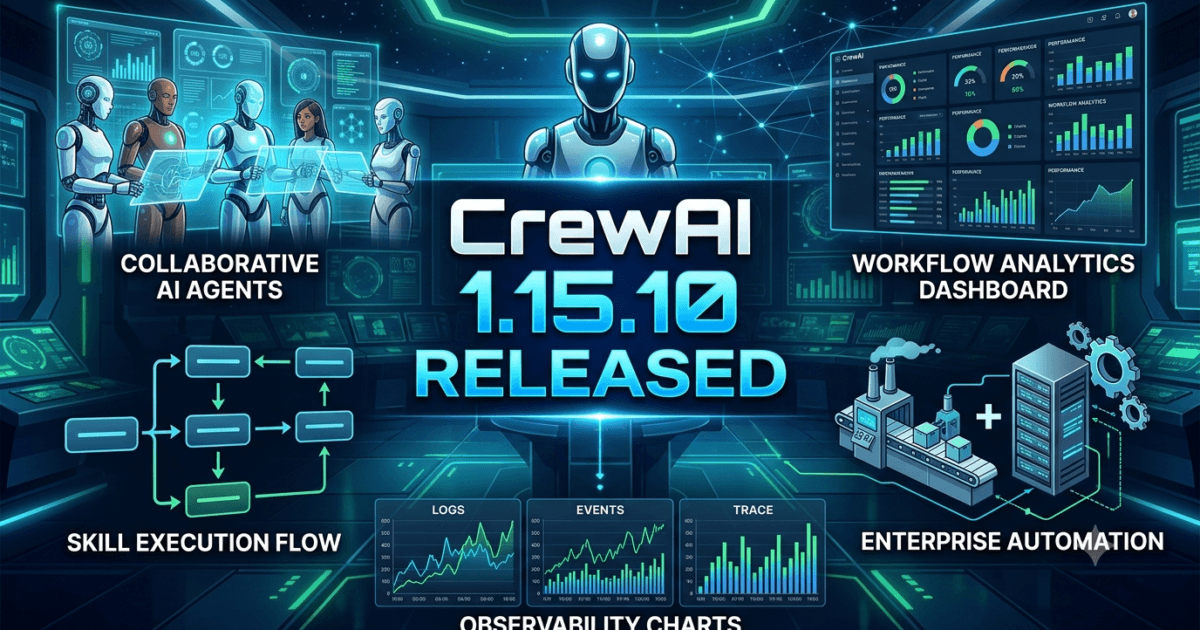
Introduction
CrewAI 1.15.10 was officially released on July 31, 2026, delivering another incremental but meaningful update to one of the fastest-growing frameworks for building AI agents, multi-agent systems, and Agentic AI applications. While this release doesn’t introduce groundbreaking new capabilities, it focuses on improving observability, developer experience, and project maintenance, making it especially valuable for organizations deploying AI agents in production environments.
CrewAI has rapidly become a preferred framework for developers building collaborative AI systems where multiple autonomous agents work together to accomplish complex tasks. From customer support automation and software development assistants to research agents and enterprise workflow automation, CrewAI enables organizations to create intelligent agent ecosystems capable of planning, reasoning, delegating, and executing tasks with minimal human intervention.
As AI systems become increasingly sophisticated, engineering teams require more than just intelligent agents—they also need complete visibility into how those agents operate. Understanding which skills are being executed, how frequently they are used, and where they contribute within an AI workflow is becoming essential for performance optimization, debugging, compliance, cost analysis, and quality assurance.
CrewAI 1.15.10 addresses this growing need by introducing Skill Usage Event Collection, providing developers with deeper insight into skill execution across AI agent workflows. Alongside this feature, the release also includes several documentation improvements, cleanup of migrated documentation, updated security reporting guidance, and refreshed project snapshots.
Although this release appears modest compared to major feature updates, experienced QA Engineers, SDETs, AI Test Engineers, Platform Engineers, and MLOps teams recognize that observability improvements often have a greater long-term impact than entirely new functionality. Better visibility into AI execution enables more reliable testing, faster debugging, improved monitoring, and more confident production deployments.
Official Release Highlights
According to the official CrewAI release notes, CrewAI 1.15.10 includes the following updates.
New Feature
- Collect Skill Usage Events
Documentation Improvements
- Remove migrated AMP documentation
- Update security reporting guidelines
- Update snapshots and changelog for version 1.15.9
Contributors
This release includes contributions from:
- @gvieira
- @joaomdmoura
- @theCyberTech
While the changelog is relatively concise, the new skill usage event collection capability lays the foundation for significantly improved monitoring and analytics across enterprise AI applications.
Understanding Skill Usage Event Collection
One of the most important additions in CrewAI 1.15.10 is the ability to collect skill usage events during AI workflow execution.
Skills in CrewAI represent reusable capabilities that agents invoke while solving problems. These skills may include:
- Database queries
- API integrations
- Web searches
- Document retrieval
- File manipulation
- Code generation
- Mathematical calculations
- External service integrations
- Business workflow execution
As AI agents collaborate, they continuously invoke these skills to complete assigned tasks.
Prior to this release, developers could observe overall workflow execution but had limited built-in visibility into how individual skills were utilized throughout complex multi-agent processes.
CrewAI 1.15.10 improves this by introducing structured event collection for skill execution, enabling engineering teams to better understand how agents interact with available capabilities.
Why This Matters for Modern AI Development
Enterprise AI systems rarely consist of a single prompt sent to a language model.
Instead, production AI applications typically involve:
- Multiple specialized agents
- Shared skills
- External APIs
- Business rules
- Memory systems
- Vector databases
- Human approval workflows
- Long-running orchestration pipelines
As these systems grow, identifying which skills contribute to successful outcomes becomes increasingly important.
Skill usage telemetry enables teams to answer critical operational questions such as:
- Which skills are executed most frequently?
- Which tools are rarely used?
- Which agent depends heavily on specific capabilities?
- Where do workflow bottlenecks occur?
- Which skills increase execution cost?
- Which integrations experience failures?
Having access to this information dramatically improves the ability to optimize AI systems over time.
Why QA Engineers Should Care
Although “Skill Usage Events” may initially sound like a feature intended only for developers, it delivers substantial benefits for software quality assurance and AI testing.
Modern QA Engineers are increasingly responsible for validating not only application functionality but also AI decision-making processes, agent orchestration, tool execution, and workflow reliability.
Observability plays a central role in that validation.
With better insight into skill execution, QA teams can verify that AI agents:
- Invoke the correct tools.
- Avoid unnecessary operations.
- Follow expected execution paths.
- Produce repeatable outcomes.
- Interact correctly with external services.
Instead of treating AI agents as opaque “black boxes,” testers gain greater transparency into how intelligent workflows behave internally.
This significantly improves confidence during functional testing, integration testing, regression testing, and production monitoring.
Better Debugging for Multi-Agent Systems
Debugging traditional software is already challenging.
Debugging autonomous AI agents introduces an entirely new level of complexity because failures may originate from:
- Prompt interpretation
- Agent reasoning
- Tool invocation
- API responses
- Memory retrieval
- External dependencies
- Decision-making logic
Without execution visibility, identifying the root cause of an issue becomes difficult.
Skill usage event collection provides additional diagnostic information that helps engineering teams trace exactly which capabilities were executed during an AI workflow.
For QA Engineers investigating failed test cases, this greatly reduces debugging time while improving overall issue reproducibility.
Improved Observability Supports Production AI
As organizations move AI agents from experimentation into production, observability becomes just as important as model accuracy.
Enterprise AI platforms increasingly require:
- Audit trails
- Usage analytics
- Performance monitoring
- Cost optimization
- Compliance reporting
- Operational dashboards
Skill usage events represent another valuable telemetry source that supports these objectives.
Rather than simply knowing that an AI workflow completed successfully, organizations can understand how it completed successfully—an important distinction for highly regulated industries and mission-critical applications.
Upgrade Recommendation
CrewAI 1.15.10 is recommended for:
- QA Engineers
- AI Test Engineers
- SDETs
- Platform Engineers
- MLOps Teams
- AI Developers
- Enterprise AI teams
- Organizations deploying CrewAI agents in production
Although the release introduces only one functional enhancement, improved observability makes it a worthwhile upgrade for teams building scalable, maintainable, and production-ready AI systems.
There are no announced breaking changes, making this a low-risk maintenance update that enhances visibility while preserving compatibility with existing CrewAI workflows.
CrewAI 1.15.10: How Skill Usage Events Improve AI Testing, Debugging, and Enterprise Observability
Why Observability is Becoming Essential for Agentic AI
As the software industry rapidly shifts from traditional automation toward Agentic AI, engineering teams are discovering that building intelligent agents is only half the challenge. The other half is understanding how those agents behave in production. Unlike conventional software, AI agents make dynamic decisions, choose different execution paths, invoke multiple tools, collaborate with other agents, and adapt their reasoning based on changing inputs. This flexibility is powerful, but it also introduces significant complexity for developers, QA Engineers, and platform teams.
CrewAI has become one of the leading frameworks for building collaborative AI systems because it enables multiple specialized agents to work together on complex business workflows. Whether the objective is software testing, document analysis, customer support, DevOps automation, or enterprise knowledge management, CrewAI allows organizations to orchestrate autonomous agents that communicate, delegate work, and execute specialized skills.
However, as these AI ecosystems continue growing, engineering teams need deeper visibility into agent execution. Questions such as Which skills were executed?, Which tools were used most frequently?, Why did an agent choose one workflow over another?, and Where did execution slow down? become increasingly important. CrewAI 1.15.10 addresses this challenge by introducing Skill Usage Event Collection, giving teams valuable telemetry that improves monitoring, debugging, testing, and operational decision-making.
Understanding Skills in CrewAI
Before exploring the new feature, it’s important to understand what Skills represent inside CrewAI.
A skill is a reusable capability that an AI agent can invoke while completing a task. Instead of forcing every agent to contain all functionality internally, CrewAI allows agents to call specialized skills whenever they require external information, perform calculations, retrieve documents, interact with APIs, or execute business logic.
Examples of commonly used skills include:
- Searching the web for current information
- Querying SQL or NoSQL databases
- Calling REST or GraphQL APIs
- Reading and writing files
- Executing Python code
- Summarizing large documents
- Retrieving information from vector databases
- Performing mathematical calculations
- Integrating with CRM or ERP platforms
- Triggering enterprise workflows
These modular capabilities make CrewAI highly extensible and allow organizations to build scalable AI solutions without duplicating logic across multiple agents.
What Are Skill Usage Events?
Every time an AI agent invokes one of these reusable capabilities, CrewAI can now generate a Skill Usage Event.
Rather than simply recording that a workflow completed successfully, the framework captures valuable execution metadata showing how the workflow reached its final outcome.
Although the release notes do not specify the complete event schema, skill usage events generally provide insight into:
- Which skill was executed
- Which agent initiated the request
- When the skill was called
- How frequently a skill is used
- Which workflows depend on specific skills
- Overall execution patterns within AI systems
This additional telemetry gives engineering teams a much clearer understanding of agent behavior than was previously available.
Why This Matters for QA Engineers
Traditional software testing focuses on verifying expected outputs. AI testing, however, must also validate the decision-making process that produces those outputs.
Two AI workflows might generate identical answers while taking completely different execution paths.
For QA Engineers, understanding those internal execution paths is becoming increasingly important.
With Skill Usage Event Collection, testers can verify whether AI agents are:
Calling the Correct Skills
A travel-planning agent should invoke mapping APIs rather than financial calculators.
A customer support agent should retrieve product documentation before generating responses.
A software engineering assistant should execute code analysis tools instead of irrelevant knowledge sources.
Skill telemetry helps verify that the correct capabilities are selected during execution.
Avoiding Unnecessary Tool Calls
One common issue in Agentic AI systems is excessive tool invocation.
Repeated API requests can increase:
- Execution latency
- Infrastructure costs
- Token consumption
- Network traffic
- Overall operational expenses
By monitoring skill usage frequency, QA teams can identify inefficient workflows before they reach production.
Detecting Workflow Regression
Regression testing traditionally compares application outputs between software versions.
For AI systems, regression testing increasingly includes validating execution behavior.
If a newly updated AI agent suddenly begins invoking completely different skills than previous versions, testers can investigate whether this represents an intended improvement or an unexpected regression.
Skill usage events provide another valuable regression metric beyond simple output comparison.
Benefits for AI Debugging
Debugging AI applications differs significantly from debugging traditional software.
Failures can originate from multiple layers, including:
- Prompt engineering
- LLM reasoning
- Memory retrieval
- Tool invocation
- External APIs
- Workflow orchestration
- Agent collaboration
- Human approval processes
Without execution visibility, developers often spend hours reproducing issues before identifying the true source of failure.
Skill usage telemetry shortens this investigation process by revealing exactly which capabilities were invoked during execution.
Instead of asking, “Why did the AI produce this answer?”, engineering teams can analyze the sequence of skill invocations that led to the result.
This dramatically improves root cause analysis and reduces troubleshooting time.
Operational Advantages for Enterprise AI Teams
The value of Skill Usage Event Collection extends beyond debugging.
Enterprise organizations increasingly require detailed operational visibility for governance, compliance, and performance optimization.
With richer execution telemetry, engineering teams can answer questions such as:
- Which skills generate the highest operational costs?
- Which integrations experience the most failures?
- Which AI agents rely heavily on external APIs?
- Which workflows consume the greatest execution time?
- Which tools should be optimized or retired?
These insights support better architectural decisions while helping organizations continuously improve AI efficiency.
Documentation Improvements Also Matter
In addition to the new feature, CrewAI 1.15.10 includes several documentation updates that contribute to long-term project health.
These include:
- Removal of migrated AMP documentation
- Updated security reporting guidelines
- Refreshed project snapshots and changelog
Although documentation updates rarely receive significant attention, they play an important role in enterprise software development.
Accurate documentation enables:
- Faster onboarding
- Improved developer productivity
- Better security practices
- Easier maintenance
- Reduced implementation errors
For organizations with large engineering teams, maintaining clear documentation is an essential aspect of software quality.
Upgrade Recommendations for QA Teams
Organizations currently using CrewAI should include several additional validation activities after upgrading to version 1.15.10.
Recommended verification includes:
Functional Validation
- Confirm agents execute expected skills.
- Verify workflows complete successfully.
- Test external tool integrations.
Observability Validation
- Monitor generated skill usage events.
- Verify telemetry collection accuracy.
- Confirm event logging consistency.
Regression Testing
- Compare execution behavior before and after upgrading.
- Validate workflow stability.
- Ensure no existing automation scenarios are affected.
Performance Monitoring
- Measure execution overhead.
- Verify event collection does not negatively impact workflow performance.
- Monitor API response times and overall agent efficiency.
Summary
CrewAI 1.15.10 Released introduces Skill Usage Event Collection, allowing developers to monitor how AI agents utilize reusable skills during workflow execution. The update enhances observability, debugging, workflow analytics, and AI testing while also improving project documentation and security reporting. It is a recommended maintenance release for QA Engineers, AI developers, SDETs, and enterprise teams building production-ready multi-agent AI applications.
People Also Ask
What is CrewAI 1.15.10?
CrewAI 1.15.10 is a maintenance release introducing Skill Usage Event Collection to improve AI agent observability and workflow monitoring.
What are Skill Usage Events in CrewAI?
Skill Usage Events track when AI agents execute reusable skills, providing visibility into workflow behavior, debugging, and analytics.
Why is CrewAI 1.15.10 important?
The release improves AI system transparency, making enterprise AI workflows easier to monitor, optimize, and validate.
Does CrewAI 1.15.10 contain breaking changes?
No. The release contains no announced breaking changes and is considered a safe maintenance update.
Should QA Engineers upgrade to CrewAI 1.15.10?
Yes. QA Engineers benefit from improved observability, easier debugging, and better validation of AI agent execution paths.
Does this release improve AI testing?
Yes. Skill Usage Event Collection gives testers deeper visibility into how agents execute workflows and invoke reusable skills.
Is CrewAI suitable for enterprise AI?
Yes. CrewAI is widely used for building scalable multi-agent AI systems and enterprise workflow automation.
Does this release affect existing workflows?
Existing workflows remain compatible while gaining improved telemetry and execution visibility.
Internal Links
- CrewAI 1.15.9 Released: Better Failure Visibility and Smarter AI Agent Workflows for QA Engineers
- CrewAI 1.15.8 Released: Smarter AI Agent Workflows and Reliability Improvements Every QA Engineer Should Know
- CrewAI 1.15.5 Strengthens Enterprise AI Security with Authenticated Skill Registry Downloads
- CrewAI 1.15.4 Elevates Skills Repository to Production Ready for Enterprise AI Agent Development
- CrewAI 1.15.2 Released: AI Flow & Agent Updates for QA Engineers
- CrewAI 1.15.1 Released: What QA Engineers Need to Know About the Latest AI Agent Update
- CrewAI 1.15.0 Released: Agentic AI Workflow Improvements Every QA Engineer Should Know
- CrewAI 1.14.7 Released: Powerful Agentic AI Improvements QA Engineers Must Know
- CrewAI 1.14.6 Released: Powerful Agent Reliability Improvements QA Engineers Should Know
Official Resources
- Official Release Notes: https://docs.crewai.com/v1.15.10/en/changelog
- Official Documentation: https://docs.crewai.com
Key Takeaways
- CrewAI updated to version 1.15.10
- Introduces Skill Usage Event Collection
- Improves AI workflow observability
- Better debugging for multi-agent systems
- Enhanced QA validation capabilities
- Updated security reporting guidelines
- Documentation cleanup completed
- No announced breaking changes
- Recommended production upgrade
Final Thoughts
CrewAI 1.15.10 may not introduce major AI capabilities, but it significantly strengthens one of the most important aspects of enterprise Agentic AI systems—observability. By introducing Skill Usage Event Collection, the framework provides developers, QA Engineers, and AI platform teams with greater transparency into how autonomous agents interact with reusable capabilities throughout complex workflows.
For organizations building production-ready multi-agent systems, this additional visibility supports more effective debugging, richer analytics, improved regression testing, and better long-term optimization. Combined with updated documentation and refined security guidance, the release represents another step toward making CrewAI a mature, enterprise-grade platform for scalable AI orchestration.
If your team is actively developing AI agents, automating business processes, or deploying collaborative agent workflows, CrewAI 1.15.10 is a recommended maintenance upgrade that enhances operational insight without introducing breaking changes or requiring significant migration effort.