 QA
QA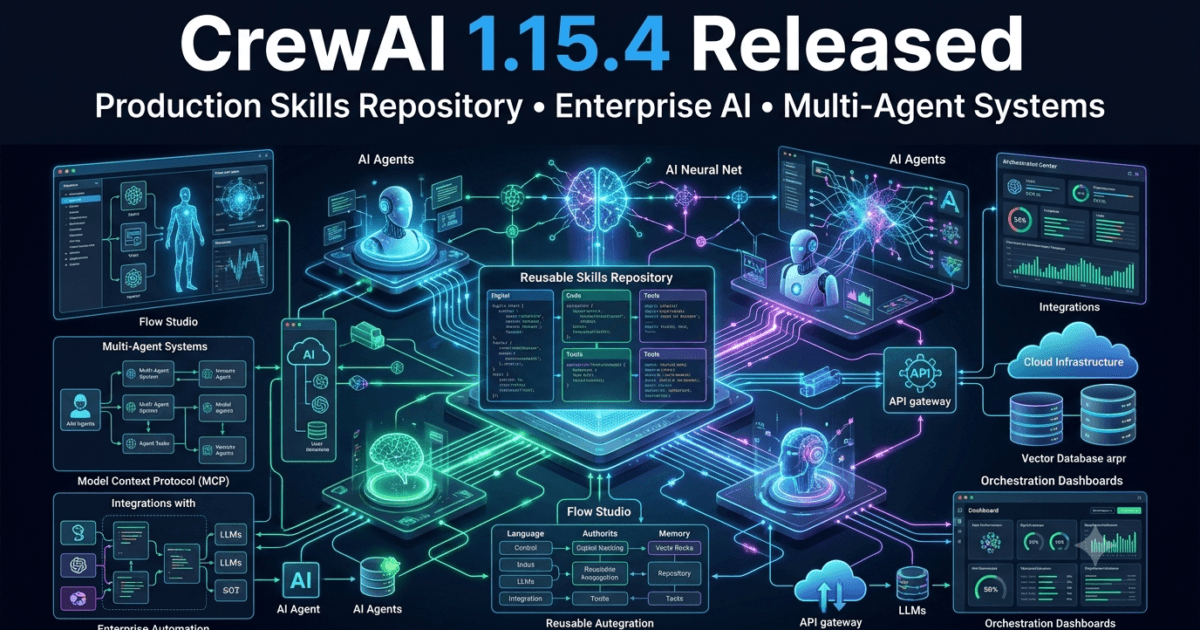
CrewAI 1.15.4, released on July 17, 2026, marks another important milestone in the evolution of enterprise AI agent orchestration. While this release contains only a small number of changes, its headline feature is highly significant: the Skills Repository has officially graduated from experimental to production-ready status. Alongside this, the CrewAI team has expanded its documentation by introducing Flows in Studio, making it easier for developers to build, visualize, and manage complex AI workflows.
Although this may appear to be a lightweight maintenance release, it represents a major step toward greater platform maturity. As organizations increasingly adopt multi-agent AI systems, Agentic AI architectures, Model Context Protocol (MCP), and autonomous workflow automation, having stable, reusable, and production-supported skills becomes essential for scaling AI applications.
For QA Engineers, SDETs, AI Engineers, Prompt Engineers, Software Architects, DevOps Engineers, Backend Developers, and Enterprise Automation Teams, CrewAI 1.15.4 provides greater confidence when building reusable AI capabilities that can be shared across multiple crews, agents, and enterprise workflows.
Instead of introducing experimental innovation, this release focuses on platform stability, developer productivity, code reuse, and long-term maintainability—all of which are critical characteristics for organizations moving AI systems into production.
Official Release Highlights
According to the official CrewAI release notes, CrewAI 1.15.4 introduces one major feature enhancement and one documentation improvement.
Features
- Promote Skills Repository out of experimental status, making reusable AI skills officially production-ready.
Documentation
- Added comprehensive Flows in Studio documentation to improve workflow design and development.
No breaking changes have been reported in this release.
CrewAI 1.15.4 Release Overview
| Category | Details |
|---|---|
| Version | CrewAI 1.15.4 |
| Release Date | July 17, 2026 |
| Release Type | Feature & Stability Release |
| Breaking Changes | None Reported |
| Skills Repository | Production Ready |
| Flow Studio Documentation | Expanded |
| Enterprise Readiness | Improved |
| Upgrade Recommendation | Highly Recommended |
Why This Release Matters
As AI applications grow beyond simple prompt engineering into sophisticated multi-agent ecosystems, organizations require standardized ways to reuse intelligence across projects.
Rather than rewriting prompts, tools, workflows, and business logic repeatedly, development teams increasingly build reusable AI skills that can be shared across:
- Customer support agents
- Software engineering assistants
- QA automation agents
- DevOps assistants
- Data analysis workflows
- Knowledge retrieval systems
- Enterprise copilots
- Business automation pipelines
- Research assistants
- MCP-powered AI applications
By officially promoting the Skills Repository to production status, CrewAI signals that this capability is now mature enough for enterprise adoption.
For organizations investing in long-term AI infrastructure, this is considerably more valuable than simply introducing another experimental feature.
Skills Repository Becomes Production Ready
The most important enhancement in CrewAI 1.15.4 is the promotion of the Skills Repository from experimental to stable.
Skills represent reusable capabilities that AI agents can execute repeatedly without redefining behavior for every workflow.
Examples include:
- API integrations
- Database access
- File processing
- Knowledge retrieval
- Email automation
- Report generation
- Document summarization
- Code analysis
- Test case generation
- Deployment automation
With production-ready Skills Repository support, engineering teams can now standardize these capabilities across multiple AI agents while improving consistency, maintainability, and governance.
For enterprise organizations, this delivers several benefits:
- Better code reuse
- Reduced maintenance costs
- Consistent AI behavior
- Simplified agent development
- Easier collaboration across teams
- Improved scalability
- Stronger governance
- Faster onboarding for new AI projects
This release therefore strengthens CrewAI’s position as an enterprise-grade framework for building intelligent agent ecosystems.
Better Workflow Development with Flow Studio Documentation
The second enhancement focuses on developer experience.
CrewAI has expanded documentation around Flows in Studio, making it easier for developers to understand how to design, visualize, and orchestrate complex AI workflows.
Flow-based development continues to gain popularity because it enables engineers to represent sophisticated multi-agent systems using structured workflow logic rather than isolated prompts.
Improved documentation benefits teams by:
- Accelerating onboarding
- Reducing implementation mistakes
- Improving architectural consistency
- Simplifying debugging
- Encouraging reusable workflow patterns
- Supporting enterprise collaboration
While documentation updates may seem minor, they significantly improve developer productivity over the lifecycle of large AI projects.
What This Means for QA Engineers
For QA Engineers and SDETs, CrewAI 1.15.4 represents an opportunity to build more modular and maintainable AI testing frameworks.
Reusable skills can now power automated workflows for:
- Test case generation
- Test data creation
- API validation
- Bug report generation
- Requirement analysis
- Regression planning
- Documentation generation
- Performance analysis
- Security validation
- Code review assistance
Instead of embedding prompts directly inside every AI workflow, QA teams can create standardized skills that deliver consistent behavior across multiple automation pipelines.
This approach improves maintainability while reducing duplicated prompt engineering efforts.
Comparison with CrewAI 1.15.2
| Capability | CrewAI 1.15.2 | CrewAI 1.15.4 |
|---|---|---|
| Flow Definitions | Enhanced | Maintained |
| Inline Skills | Supported | Production Ready |
| Skills Repository | Experimental | Stable |
| Flow Studio Documentation | Basic | Expanded |
| Enterprise Adoption | Strong | Stronger |
| Breaking Changes | None | None |
Upgrade Commands
Python
pip install --upgrade crewai
Verify Installed Version
pip show crewai
Upgrade Inside a Virtual Environment
python -m pip install --upgrade crewai
After upgrading, validate AI agent execution, reusable skills, Flow Studio projects, LLM integrations, MCP connectivity, API tools, memory handling, multi-agent orchestration, knowledge retrieval, and end-to-end workflow execution.
Upgrade Recommendation
CrewAI 1.15.4 is a highly recommended upgrade for organizations already using the 1.15.x release series.
Although the release introduces relatively few visible changes, the graduation of the Skills Repository from experimental to production-ready status is an important signal that the framework is becoming increasingly enterprise-focused.
Teams that will benefit the most include:
- AI Engineers
- QA Engineers
- SDETs
- Agentic AI Developers
- Platform Engineers
- DevOps Teams
- Prompt Engineers
- Enterprise Automation Architects
- MCP Developers
- Software Engineering Teams
Since no breaking changes have been reported, upgrading carries minimal risk after standard regression testing.
For organizations building production-grade AI assistants, multi-agent workflows, or intelligent automation platforms, CrewAI 1.15.4 strengthens the foundation for creating reusable, scalable, and maintainable AI systems.
Enterprise Upgrade Strategy for CrewAI 1.15.4
Although CrewAI 1.15.4 is not a feature-heavy release, it represents an important milestone for organizations adopting enterprise AI agent development. The official promotion of the Skills Repository from experimental to production-ready status signals that CrewAI is maturing into a stable platform capable of supporting large-scale, mission-critical AI applications.
Many organizations are no longer experimenting with isolated AI assistants. Instead, they are building enterprise AI ecosystems consisting of autonomous agents, reusable skills, shared knowledge bases, Model Context Protocol (MCP) servers, Retrieval-Augmented Generation (RAG) pipelines, workflow orchestration, and cloud-native automation platforms. In these environments, stability and reusability are often more valuable than introducing entirely new features.
Before deploying CrewAI 1.15.4 into production, organizations should follow a structured enterprise rollout strategy to ensure that existing AI agents, reusable skills, integrations, and workflow definitions continue functioning correctly.
A recommended deployment strategy includes:
- Upgrade a development environment to CrewAI 1.15.4.
- Validate all existing crews and agent workflows.
- Test reusable Skills Repository components.
- Verify Flow Studio projects and orchestration logic.
- Execute AI regression testing across LLM providers.
- Validate MCP Server integrations.
- Test external tool integrations and API connectivity.
- Deploy to staging and complete User Acceptance Testing (UAT).
- Execute production smoke tests after deployment.
- Monitor execution logs, token usage, latency, workflow completion rates, and agent decision quality during the first 48 hours.
Following a phased deployment strategy reduces operational risk while ensuring that enterprise AI systems remain stable, scalable, and maintainable.
QA Regression Testing Checklist
Following the upgrade, QA Engineers, SDETs, and AI Automation Engineers should execute comprehensive regression testing covering both functional behavior and reusable AI components.
| Test Area | Validation Required |
|---|---|
| Crew Execution | Verify all crews complete successfully |
| Skills Repository | Validate reusable skills execute correctly |
| Agent Collaboration | Confirm multi-agent communication |
| Flow Studio Projects | Verify flow orchestration logic |
| LLM Integrations | Test OpenAI, Claude, Gemini, Azure OpenAI, Ollama, and other providers |
| MCP Servers | Validate Model Context Protocol connectivity |
| Knowledge Retrieval | Test RAG pipelines and vector database queries |
| Tool Calling | Verify API tools and external integrations |
| Memory Management | Validate short-term and long-term memory behavior |
| Prompt Consistency | Ensure reusable skills return expected outputs |
| Error Handling | Confirm retries, fallbacks, and exception handling |
| Security | Verify credential handling and secret management |
| Performance | Compare execution time and latency before and after upgrade |
| CI/CD Pipelines | Validate automated AI workflow deployment |
| Logging & Monitoring | Confirm execution logs and telemetry are generated correctly |
Executing these regression tests helps ensure AI workflows remain reliable while benefiting from the platform improvements introduced in CrewAI 1.15.4.
Real-World Impact for Enterprise AI Development
The production-ready Skills Repository significantly improves how organizations design and maintain AI-powered systems.
Common enterprise use cases include:
- AI Software Engineering Assistants
- QA Automation Agents
- Customer Support AI
- Code Review Agents
- Documentation Generation
- DevOps Automation
- Security Analysis
- API Testing Automation
- Research Assistants
- Business Intelligence Agents
- Compliance Validation
- Workflow Automation
- Multi-Agent Collaboration
- Enterprise Knowledge Assistants
- Intelligent Report Generation
Instead of redefining prompts and business logic for every new AI project, development teams can now build standardized, reusable skills that become organizational assets.
This improves:
- Development speed
- Code quality
- AI consistency
- Governance
- Long-term maintainability
- Team collaboration
- Enterprise scalability
As organizations deploy dozens or even hundreds of AI agents, centralized reusable skills become increasingly valuable.
Best Practices After Upgrading
Standardize Your Skills Repository
One of the biggest opportunities introduced by CrewAI 1.15.4 is the ability to treat reusable skills as enterprise building blocks.
Rather than creating duplicate implementations across multiple projects, organizations should establish a centralized Skills Repository containing standardized capabilities such as:
- API communication
- Database access
- Email automation
- Report generation
- Document summarization
- Code generation
- Test case creation
- File management
- Knowledge retrieval
- Data validation
This approach improves consistency while reducing long-term maintenance costs.
Expand AI Regression Testing
Traditional software regression testing is no longer sufficient for AI-powered systems.
Modern AI regression testing should include:
- Prompt consistency validation
- Deterministic output verification
- Tool invocation testing
- Memory behavior validation
- Hallucination detection
- Multi-agent communication testing
- Context retention
- Error recovery
- Workflow orchestration
- Human approval checkpoints
These additional validations ensure enterprise AI systems continue producing reliable and predictable outcomes after every framework upgrade.
Validate Flow Studio Projects
Since this release expands Flow Studio documentation, organizations should review existing workflow definitions and verify:
- Sequential execution
- Conditional routing
- Parallel branches
- Tool chaining
- Agent hand-offs
- Retry mechanisms
- State management
- Error handling
Maintaining clean and well-documented flows improves long-term maintainability.
Monitor Production AI Metrics
Following deployment, engineering teams should monitor:
- Workflow success rate
- Agent completion rate
- Token consumption
- API latency
- Tool execution time
- Memory utilization
- Cost per workflow
- Failure rate
- Retry frequency
- User feedback
Monitoring these KPIs helps optimize AI systems while quickly identifying unexpected regressions.
Migration Considerations
One of the strengths of CrewAI 1.15.4 is its strong backward compatibility.
Existing Projects
Projects built with previous 1.15.x releases should upgrade without requiring major architectural changes.
Skills Repository
Organizations currently experimenting with reusable skills can now confidently adopt the Skills Repository in production environments.
Flow Studio
Existing Flow Studio projects remain compatible while benefiting from expanded documentation and improved implementation guidance.
AI Infrastructure
Integrations with OpenAI, Anthropic Claude, Google Gemini, Ollama, Azure OpenAI, AWS Bedrock, MCP Servers, Vector Databases, and RAG frameworks continue functioning without additional migration work.
Should You Upgrade?
Absolutely.
Organizations already running the CrewAI 1.15.x release series should consider CrewAI 1.15.4 a recommended upgrade.
While this release introduces only a few visible changes, they have long-term architectural significance:
- Production-ready Skills Repository
- Improved developer experience through enhanced Flow Studio documentation
- Stronger enterprise readiness
- Better support for reusable AI capabilities
- Continued platform maturity
Because no breaking changes have been reported, upgrade risk remains very low after standard validation.
Teams that will benefit the most include:
- AI Engineers
- Agentic AI Developers
- QA Engineers
- SDETs
- Platform Engineers
- DevOps Engineers
- Backend Developers
- Enterprise Architects
- Prompt Engineers
- Software Engineering Teams
Internal Links
- CrewAI 1.15.2 Released: AI Flow & Agent Updates for QA Engineers
- CrewAI 1.15.1 Released: What QA Engineers Need to Know About the Latest AI Agent Update
- CrewAI 1.15.0 Released: Agentic AI Workflow Improvements Every QA Engineer Should Know
- CrewAI 1.14.7 Released: Powerful Agentic AI Improvements QA Engineers Must Know
- CrewAI 1.14.6 Released: Powerful Agent Reliability Improvements QA Engineers Should Know
Official Resources
- Official Release Notes: https://docs.crewai.com/v1.15.4/en/changelog
- Official Documentation: https://docs.crewai.com
Frequently Asked Questions
Is CrewAI 1.15.4 a major release?
No. It is a stability-focused release that promotes the Skills Repository to production-ready status and expands Flow Studio documentation.
Are there any breaking changes?
No. According to the official release notes, CrewAI 1.15.4 introduces no breaking changes, making it a safe upgrade for existing projects.
Why is the Skills Repository important?
The Skills Repository enables developers to create reusable AI capabilities that can be shared across multiple crews, agents, and enterprise workflows. This improves maintainability, consistency, governance, and development speed.
Who benefits the most from this release?
Organizations building multi-agent AI systems, Agentic AI platforms, enterprise automation solutions, MCP-powered applications, and large-scale AI workflows will gain the greatest value.
Should enterprise teams upgrade immediately?
Yes. After completing standard regression testing, CrewAI 1.15.4 is recommended because it strengthens platform maturity while maintaining full backward compatibility.
Continue Learning with QAPulse by SK
At QAPulse by SK, we help software engineers, QA professionals, AI developers, and enterprise teams stay ahead of the rapidly evolving AI ecosystem. Our in-depth release analyses, migration guides, framework comparisons, and technical tutorials cover CrewAI, LangChain, Model Context Protocol (MCP), FastAPI, n8n, Playwright, Selenium, Docker, Node.js, Locust, k6, and other modern engineering technologies.
Whether you’re building AI agents, implementing enterprise workflow automation, designing RAG architectures, orchestrating multi-agent systems, or modernizing your QA automation strategy, QAPulse by SK delivers practical insights and production-focused guidance to help you build scalable, reliable, and future-ready AI solutions.