 QA
QA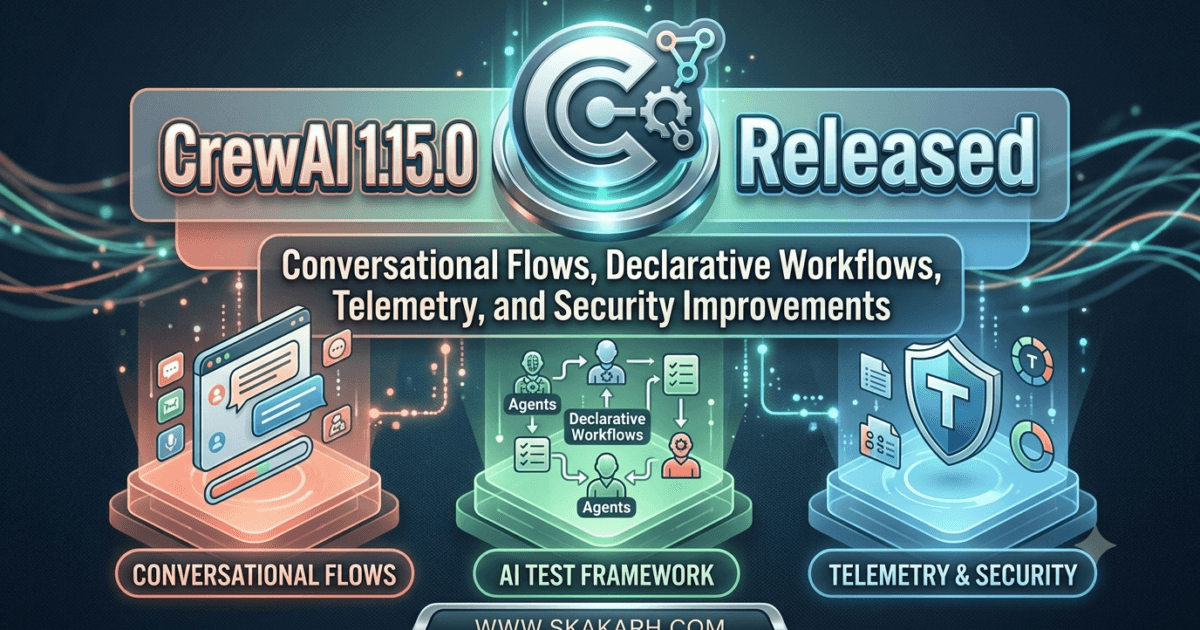
Agentic AI is rapidly moving from experimentation into enterprise production, and CrewAI continues to position itself as one of the leading orchestration frameworks for autonomous AI agents. Instead of focusing on a single language model interaction, CrewAI enables developers to build collaborative AI systems where multiple agents communicate, make decisions, execute tools, and complete complex workflows.
The release of CrewAI 1.15.0 represents another significant step toward making those workflows easier to build, easier to monitor, and more reliable in production environments.
While this version introduces no headline-grabbing AI model integration, it delivers something arguably more valuable for engineering teams: better workflow orchestration, improved observability, stronger security, and a more developer-friendly Flow architecture.
For QA engineers, SDETs, automation architects, and AI platform teams, these improvements directly affect how agentic systems are tested, validated, monitored, and deployed.
What’s New in CrewAI 1.15.0?
CrewAI 1.15.0 focuses on six major engineering areas:
- Conversational Flow improvements
- Declarative Flow architecture
- Enhanced telemetry
- Better Flow execution capabilities
- Multiple security fixes
- Developer experience improvements
Instead of simply adding new AI features, this release strengthens the platform’s foundations, making enterprise agent orchestration more maintainable.
Major Highlights at a Glance
| Area | What’s New | QA Impact |
|---|---|---|
| Conversational Flows | CLI TUI support and turn tracking | Easier testing of multi-turn AI conversations |
| Flow Definitions | Declarative Flow loading and CLI support | Simplifies workflow validation and automation |
| Agent Actions | Single agent actions, crew actions and composite actions | More modular AI workflow testing |
| Telemetry | Token aggregation and conversation tracking | Better performance monitoring |
| Security | Credential permission fixes and archive validation | Safer enterprise deployments |
| Runtime | Improved Flow execution and startup | Faster CI/CD automation |
Deep Dive into the Most Important Changes
Conversational Flows Become More Production Ready
One of the biggest improvements in CrewAI 1.15.0 is the continued investment in Conversational Flows.
Previous releases introduced the concept, but this version significantly improves how conversations are created, executed, and monitored.
New capabilities include:
- CLI support for conversational flows
- Conversation telemetry
- Turn usage tracking
- Better runtime visibility
For QA engineers, this matters because conversational agents are notoriously difficult to validate.
Traditional automation focuses on predictable request-response patterns.
Conversational AI introduces:
- Context retention
- Memory updates
- Multi-turn reasoning
- Dynamic tool usage
- Stateful execution
Having telemetry available for every conversational turn makes regression testing much more practical.
Instead of simply checking the final response, teams can inspect how every interaction evolved throughout the conversation.
That dramatically improves debugging.
Declarative Flow Architecture Makes Automation Easier
Perhaps the most impactful engineering improvement is the move toward a declarative Flow architecture.
CrewAI now introduces:
- Declarative Flow loading
- Declarative CLI support
- Inline Flow definitions
- FlowDefinition enhancements
- Unified runtime loading
This represents a shift away from heavily imperative workflow construction.
Instead of writing increasingly complex Python orchestration logic, teams can define workflows using structured configurations that are easier to version, review, and validate.
For enterprise QA teams, declarative workflows offer several advantages:
- simpler code reviews
- predictable execution
- easier regression testing
- reusable automation assets
- improved CI/CD integration
- reduced maintenance effort
When workflow logic is expressed declaratively, automated validation also becomes considerably easier because configurations can be linted, compared, and version-controlled alongside test assets.
Better Building Blocks for Multi-Agent Systems
CrewAI continues expanding its Flow ecosystem by introducing several new workflow primitives.
Version 1.15.0 adds support for:
- Single Agent Actions
- Crew Actions
- Composite Each Actions
- Optional conditional expressions for iteration steps
These additions allow developers to build richer orchestration pipelines without writing large amounts of custom runtime logic.
From a testing perspective, modular actions create smaller validation units.
Instead of testing one enormous AI workflow, QA teams can independently verify:
- individual agents
- reusable crews
- conditional execution paths
- loop behaviour
- branching decisions
- action sequencing
Smaller testable units generally produce more reliable automation suites and make root-cause analysis significantly faster when failures occur.
Security, Telemetry, and Production Reliability Improvements
While the new Flow capabilities will attract most attention, some of the most important changes for enterprise teams are actually found in the security and observability updates.
As AI systems move from experimentation into production, organizations increasingly need answers to questions such as:
- Which agent consumed the most tokens?
- Which workflow caused excessive API costs?
- Which credential was accessed during execution?
- Why did a multi-agent workflow fail?
- How can we audit agent decisions?
CrewAI 1.15.0 addresses several of these concerns.
Token Usage Aggregation Across LLM Calls
One particularly useful improvement is the ability to aggregate token usage across all LLM calls.
Previously, understanding the total cost of a complex multi-agent workflow could require manually correlating multiple requests.
Now telemetry provides a more complete picture.
For QA engineers validating AI systems, this enables:
- Cost regression testing
- Performance benchmarking
- Resource consumption monitoring
- Agent efficiency analysis
- Capacity planning
Organizations running GPT, Claude, Gemini, or local LLMs can now establish clearer performance baselines before releasing AI applications into production.
Credential Security Improvements
Security remains one of the biggest challenges in enterprise AI adoption.
CrewAI 1.15.0 introduces fixes related to:
- Credential file permissions
- JSON crew handling
- Skill archive extraction
- Symlink traversal vulnerabilities
These updates may sound minor, but they address areas frequently targeted during security reviews.
For regulated industries such as:
- Banking
- Healthcare
- Government
- Insurance
- Telecommunications
credential management and file handling often become major approval blockers.
The fixes included in CrewAI 1.15.0 help reduce risk while improving enterprise readiness.
What QA Engineers Should Test After Upgrading
Before promoting CrewAI 1.15.0 into production, teams should execute focused validation across key areas.
Conversational Flow Testing
Validate:
- Multi-turn conversations
- Context retention
- Memory persistence
- Tool invocation
- Conversation branching
- Human approval workflows
Because conversational flow capabilities were expanded, these areas deserve additional regression coverage.
Flow Definition Validation
Test all declarative workflow definitions.
Verify:
- Conditional logic
- Flow branching
- Agent execution order
- Crew orchestration
- Runtime loading
- CLI execution
Organizations moving from imperative workflows to declarative definitions should perform side-by-side execution comparisons.
Telemetry and Monitoring Validation
Confirm:
- Token tracking accuracy
- Agent telemetry visibility
- Runtime metrics
- Cost reporting
- OpenTelemetry integrations
- Monitoring dashboards
Observability issues are often discovered only after production deployment, making pre-release validation essential.
Security Regression Testing
Run security-focused tests covering:
- Credential access
- File uploads
- Archive extraction
- Path traversal attempts
- User permissions
- Agent authorization boundaries
The security fixes included in this release make this an ideal time to strengthen AI platform validation suites.
CrewAI 1.15.0 vs CrewAI 1.14.7
| Area | CrewAI 1.14.7 | CrewAI 1.15.0 |
|---|---|---|
| Conversational Flows | Initial improvements | Major expansion |
| Declarative Workflows | Limited support | Full CLI integration |
| Telemetry | Improved LLM events | Conversation tracking |
| Agent Actions | Basic flow actions | Expanded action ecosystem |
| Security | General fixes | Credential and archive protections |
| Enterprise Readiness | Strong | Significantly improved |
Should QA Teams Upgrade?
Short answer: Yes.
Unlike many AI framework releases that focus on adding new model providers, CrewAI 1.15.0 focuses on operational maturity.
This release is particularly valuable for organizations that:
- Build multi-agent systems
- Run agent workflows in production
- Require observability
- Need enterprise governance
- Operate AI automation platforms
- Use CrewAI in CI/CD pipelines
The combination of conversational flow improvements, declarative workflow support, telemetry enhancements, and security fixes makes this one of the more important CrewAI releases in recent months.
How to Upgrade
Python
pip install --upgrade crewai
Verify Installed Version
pip show crewai
Using Virtual Environments
python -m venv venv
source venv/bin/activate

pip install --upgrade crewai
Migration Checklist for QA Engineers
Before releasing CrewAI 1.15.0 into production:
✅ Validate conversational workflows
✅ Test declarative Flow definitions
✅ Verify CLI-based Flow execution
✅ Review token usage reporting
✅ Validate telemetry integrations
✅ Execute security regression tests
✅ Verify credential management
✅ Test memory persistence behavior
✅ Compare execution costs against previous versions
✅ Run end-to-end agent orchestration suites
Expert Verdict
CrewAI 1.15.0 is less about adding flashy AI features and more about making agentic systems production-ready.
The introduction of declarative workflow capabilities significantly improves maintainability. Conversational Flow enhancements make AI interactions easier to test and monitor. Telemetry improvements strengthen observability, while security fixes address concerns that frequently emerge during enterprise adoption.
For QA engineers, automation architects, and AI platform teams, this release delivers tangible improvements that reduce operational complexity and improve confidence in production deployments.
If your organization is actively building agentic AI solutions, CrewAI 1.15.0 should be considered a recommended upgrade after completing standard regression testing.
Frequently Asked Questions
Is CrewAI 1.15.0 a major release?
While not a framework rewrite, it introduces substantial improvements to Flow architecture, conversational workflows, telemetry, and security.
Are there any breaking changes?
No major breaking changes were announced. However, teams should thoroughly test custom Flow implementations and agent orchestration logic.
What is the most important feature for QA teams?
The combination of declarative Flow definitions and conversational telemetry provides the biggest testing and debugging benefits.
Should production teams upgrade immediately?
Development and staging environments can upgrade immediately. Production deployments should follow normal validation and regression testing procedures.
Internal Links
- Grafana K6 1.7.1 Released — What’s New for QA Engineers
- langchain core 1.3.2 Released — What’s New for QA Engineers
- Playwright 1.59.1 Released — What’s New for QA Engineers
- Selenium 4.43.0 Released — What’s New for QA Engineers
- Cypress 15.14.1 Released — What’s New for QA Engineers
- n8n version stable Released — What’s New for QA Engineers
External Links
- CrewAI Release Notes: https://github.com/crewAIInc/crewAI/releases/tag/1.15.0
- CrewAI Documentation: https://docs.crewai.com
- OpenTelemetry: https://opentelemetry.io
- Datadog AI Monitoring: https://www.datadoghq.com
- Model Context Protocol: https://modelcontextprotocol.io
Final Thoughts
The future of AI engineering is not simply about more powerful models. It is about building reliable, observable, secure, and testable systems around those models.
CrewAI 1.15.0 moves the framework closer to that future. By improving workflow architecture, strengthening telemetry, expanding conversational capabilities, and addressing security concerns, this release provides meaningful value for organizations building serious AI products.
For QA professionals, the release reinforces a growing reality: testing AI systems increasingly means testing workflows, decisions, conversations, costs, and governance—not just software functionality.
For more QA, AI testing, Agentic AI, and automation engineering insights, visit www.skakarh.com and explore QAPulse by SK.
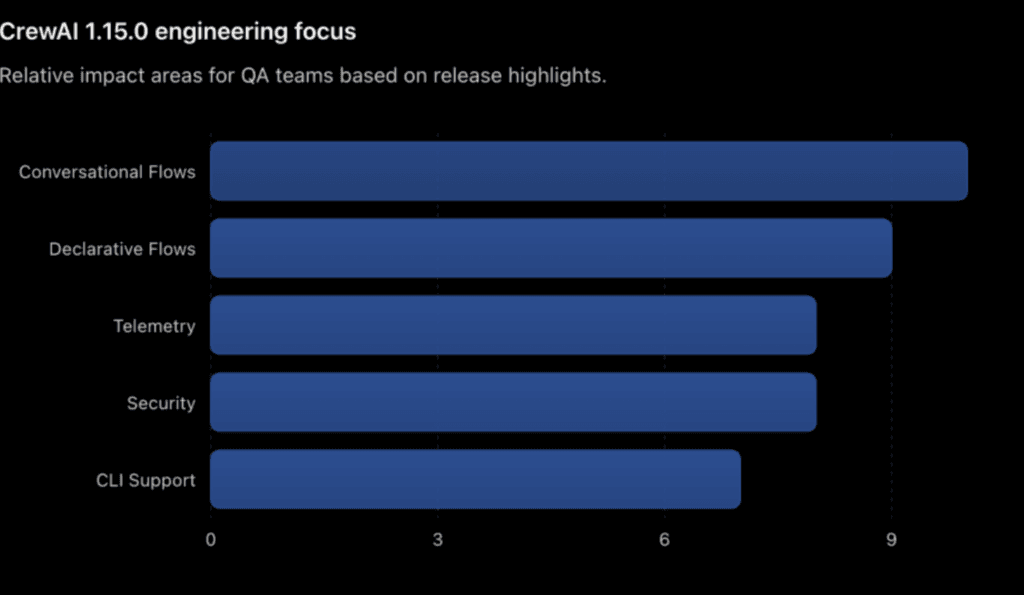
CrewAI 1.15.0 engineering focus
Relative impact areas for QA teams based on release highlights.
| area | impact |
|---|---|
| Conversational Flows | 10 |
| Declarative Flows | 9 |
| Telemetry | 8 |
| Security | 8 |
| CLI Support | 7 |