 QA
QA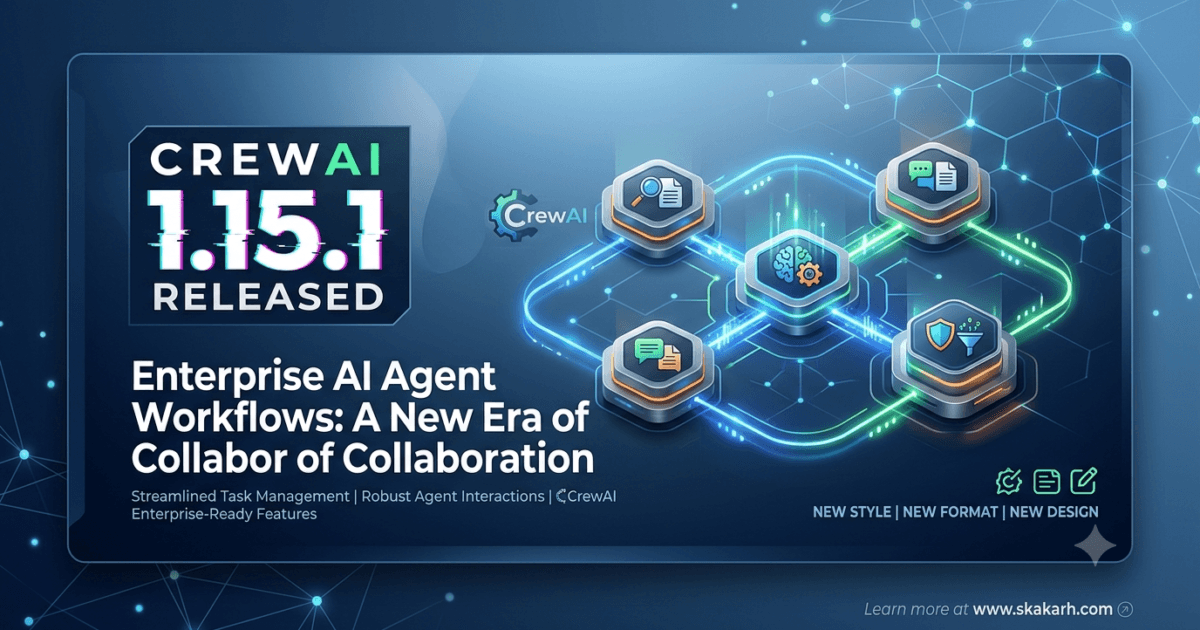
CrewAI 1.15.1 Released: Why This Update Deserves Your Attention
The AI agent ecosystem is evolving at an incredible pace, and CrewAI continues to position itself as one of the leading frameworks for building production-ready multi-agent applications. Every release is gradually transforming CrewAI from a simple orchestration library into a complete engineering platform capable of supporting enterprise AI systems.
While CrewAI 1.15.1 is not a major feature release, it delivers several practical improvements that directly impact developers, DevOps engineers, QA professionals, and teams building AI-powered applications.
Instead of introducing another experimental capability, this release focuses on strengthening project generation, deployment workflows, configuration consistency, template reliability, and security. These improvements may appear small individually, but together they reduce friction throughout the AI development lifecycle.
For organizations building AI assistants, autonomous workflows, MCP-enabled agents, or enterprise automation platforms, these improvements translate into smoother onboarding, safer deployments, and more predictable project maintenance.
What’s New in CrewAI 1.15.1?
CrewAI 1.15.1 introduces enhancements across four important areas:
- Better project initialization
- Improved deployment workflow
- Stronger project configuration
- Security and template reliability fixes
Although most release notes fit on a single page, each change targets a stage of the development lifecycle that engineering teams encounter every day.
Rather than adding another AI model integration, CrewAI is investing in improving the developer experience around building and shipping agentic applications.
Key Highlights at a Glance
| Area | Update | QA Impact |
|---|---|---|
| Project Initialization | Automatically initializes Git repositories | Improves project consistency and version control |
| Project Configuration | Requires explicit CrewAI project definitions | Reduces configuration ambiguity and deployment errors |
| CLI Deployment | Automatically opens deployment page | Faster deployment verification for engineering teams |
| Security | Fixes SSRF redirect bypass vulnerability | Strengthens security testing requirements |
| JSON Templates | Resolves rendering and version pinning issues | More reliable project generation |
| Documentation | Improved onboarding guidance | Easier adoption for new engineering teams |
Git Repository Initialization Simplifies Project Creation
One of the most practical additions in CrewAI 1.15.1 is the automatic initialization of Git repositories when new projects are generated.
At first glance, this may seem like a small convenience feature. In reality, it encourages engineering best practices from the very beginning of a project.
Version control plays a critical role in AI application development because prompt engineering, agent definitions, workflow configurations, memory settings, and orchestration logic evolve rapidly during experimentation. Automatically creating a Git repository ensures developers begin with a version-controlled project instead of remembering to initialize one later.
For QA engineers, this also improves traceability. Test failures can be linked to specific commits, making regression analysis and rollback decisions significantly easier.
Explicit Project Definitions Reduce Configuration Errors
Another notable improvement is the requirement for explicit CrewAI project definitions.
Earlier versions allowed greater flexibility, but implicit configurations can become problematic as AI projects grow in size and complexity.
Enterprise agentic systems often contain:
- Multiple crews
- Shared tools
- Memory backends
- Knowledge bases
- MCP integrations
- Environment-specific configurations
- CI/CD deployment pipelines
Requiring explicit project definitions reduces ambiguity by ensuring every project clearly declares its structure.
For QA teams, this means fewer environment-specific failures caused by hidden assumptions or inconsistent project layouts. Automated testing frameworks also become easier to configure because project metadata is standardized.
Deployment Workflow Becomes More Developer Friendly
CrewAI continues improving its command-line experience by automatically opening the deployment page after a successful CLI deployment.
Although this feature targets developer productivity, it also benefits QA engineers responsible for deployment verification.
Instead of manually locating deployment dashboards after each release, engineers are immediately taken to the deployment interface where they can validate:
- Deployment status
- Runtime configuration
- Environment variables
- Build success
- Service availability
This small workflow improvement reduces repetitive manual steps and shortens the feedback loop during release validation.
Security Fixes Matter More Than New Features
Among all the improvements in this release, the most significant from a QA perspective is the fix for an SSRF (Server-Side Request Forgery) redirect bypass during scraping operations.
Security vulnerabilities inside AI frameworks deserve special attention because modern AI agents frequently interact with:
- External APIs
- Internal enterprise systems
- Cloud services
- MCP servers
- Web scraping tools
- Third-party integrations
An SSRF vulnerability could potentially allow malicious requests to reach unintended internal resources.
Although the vulnerability has now been addressed, this release serves as an important reminder that AI applications require the same rigorous security testing as traditional software systems.
For security-focused QA engineers, SSRF validation should remain part of every AI application regression suite, particularly when agents can access external URLs or enterprise resources.
What CrewAI 1.15.1 Means for QA Engineers
CrewAI 1.15.1 is another example of how mature AI frameworks are shifting their priorities. Instead of adding flashy capabilities every release, the focus is increasingly on developer experience, deployment reliability, project consistency, and platform security.
For QA engineers, these improvements often provide more long-term value than new features.
A framework that generates consistent project structures, enforces explicit configuration, fixes template generation bugs, and closes security vulnerabilities is easier to test, easier to automate, and far less likely to introduce unexpected production failures.
If your organization is building AI agents for customer support, software delivery, enterprise automation, or internal knowledge systems, this release contributes to a healthier engineering workflow rather than changing how agents behave.
Regression Testing Checklist Before Upgrading
Although CrewAI 1.15.1 is primarily a maintenance release, every production upgrade should be validated through a structured regression testing strategy.
Before promoting the new version, verify the following areas:
- Existing Crew definitions load correctly.
- Flow definitions execute successfully.
- JSON-based projects generate without template errors.
- Memory and knowledge integrations continue working as expected.
- MCP server integrations remain compatible.
- Agent-to-agent communication behaves consistently.
- Deployment pipelines complete successfully.
- Authentication and credential handling remain secure.
- Existing automated AI workflows execute without regression.
Teams using CrewAI Studio or custom deployment pipelines should also verify deployment metadata and runtime configurations after upgrading.
Security Considerations for Enterprise AI Applications
One of the most important fixes in CrewAI 1.15.1 addresses an SSRF (Server-Side Request Forgery) redirect bypass in scraping fetches.
While this issue may not affect every project, it reinforces an important lesson for AI engineering teams: AI agents frequently interact with external systems, making security validation an essential part of quality assurance.
If your agents perform web scraping, API calls, document retrieval, or interact with external services, your regression suite should include security-focused scenarios such as:
- Preventing unauthorized internal network access.
- Validating URL allowlists and blocklists.
- Testing malformed or redirected URLs.
- Verifying credential protection.
- Confirming sensitive environment variables are never exposed.
As agentic AI systems become increasingly autonomous, security testing should become a standard component of every AI release cycle.
Should You Upgrade to CrewAI 1.15.1?
For most organizations, the recommendation is yes.
This release delivers meaningful improvements without introducing significant architectural changes. The combination of better project initialization, improved deployment workflows, stronger configuration validation, template fixes, and security enhancements makes it a worthwhile upgrade for both new and existing CrewAI projects.
Organizations running production AI agents should still follow a staged deployment strategy:
- Upgrade in a development environment.
- Execute automated regression tests.
- Validate agent workflows and memory operations.
- Test deployment pipelines.
- Roll out gradually through staging before production.
This approach minimizes operational risk while ensuring compatibility with your broader AI ecosystem.
How to Upgrade
Python
pip install --upgrade crewai
After upgrading, regenerate any new project templates if applicable, verify existing Crew definitions, and rerun your end-to-end AI automation suite before deploying to production.
Internal Links
- Grafana K6 1.7.1 Released — What’s New for QA Engineers
- langchain core 1.3.2 Released — What’s New for QA Engineers
- Playwright 1.59.1 Released — What’s New for QA Engineers
- Selenium 4.43.0 Released — What’s New for QA Engineers
- Cypress 15.14.1 Released — What’s New for QA Engineers
- n8n version stable Released — What’s New for QA Engineers
Official Resources
Official Release Notes: https://github.com/crewAIInc/crewAI/releases/tag/1.15.1
Official Documentation: https://docs.crewai.com
Final Verdict
CrewAI 1.15.1 may not introduce revolutionary AI capabilities, but it significantly improves the engineering experience around building, deploying, and maintaining production-grade AI agents.
The emphasis on explicit project definitions, Git repository initialization, deployment workflow enhancements, and security improvements demonstrates the framework’s continued evolution toward enterprise readiness.
For QA engineers and SDETs, this is the type of release that deserves attention. Stable project structures, secure integrations, and predictable deployment behaviour reduce operational risk and simplify automated testing across the software development lifecycle.
If your organization relies on CrewAI for multi-agent orchestration, autonomous workflows, or enterprise AI platforms, upgrading to version 1.15.1 is a sensible step after completing your normal regression testing process.
Frequently Asked Questions
Is CrewAI 1.15.1 a major feature release?
No. It is a maintenance-focused release that improves project generation, deployment workflows, template reliability, and security.
Does CrewAI 1.15.1 introduce breaking changes?
No major breaking changes have been announced. However, teams should validate existing Crew definitions and deployment pipelines before upgrading.
Why is the SSRF fix important?
AI agents frequently communicate with external systems. Fixing SSRF vulnerabilities strengthens the security of applications that perform web requests, document retrieval, or external integrations.
Should enterprise teams upgrade immediately?
Most organizations should plan the upgrade during their regular maintenance window after completing regression testing in a staging environment.
Continue Learning
Explore more expert content on Agentic AI, CrewAI, LangChain, LlamaIndex, MCP, Playwright, Selenium, AI Testing, Test Automation, and Software Engineering at www.skakarh.com.
QAPulse by SK delivers practical release analysis, migration guidance, testing strategies, and engineering insights that help QA professionals stay ahead of the rapidly evolving AI ecosystem.