 QA
QA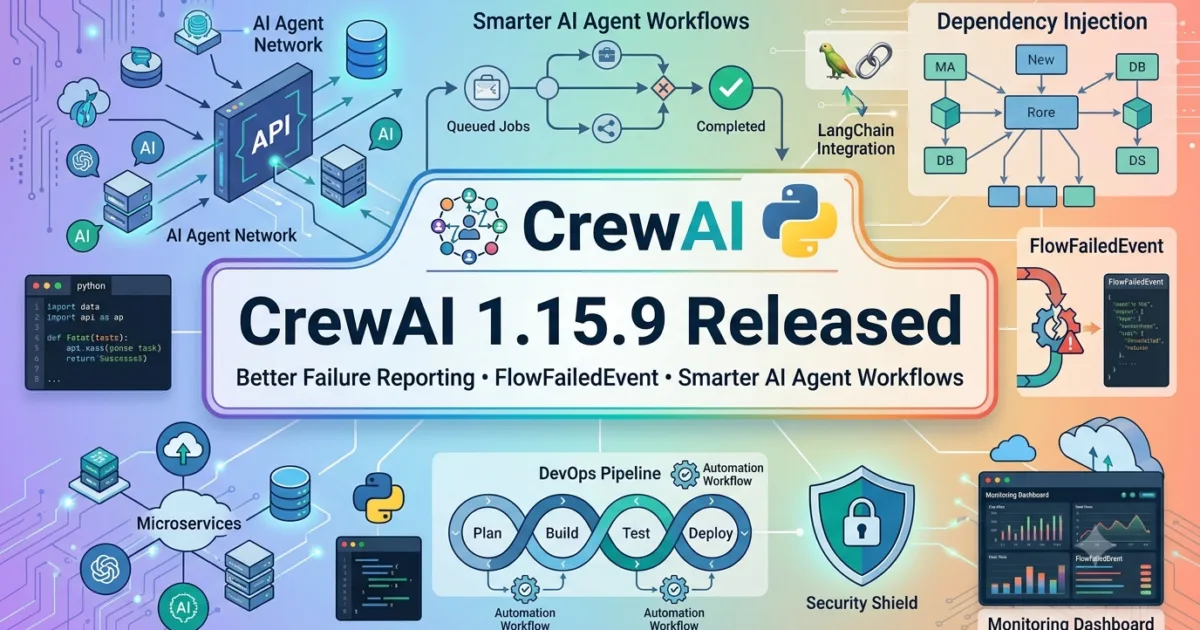
Artificial Intelligence is rapidly transforming modern software engineering, and CrewAI has become one of the leading open-source frameworks for building autonomous AI agents capable of collaborating on complex workflows. From intelligent software testing and automated documentation to DevOps automation, research assistants, and enterprise AI orchestration, CrewAI enables development teams to design sophisticated multi-agent systems that work together to solve real-world problems.
Released on 30 July 2026, CrewAI 1.15.9 is a feature-focused update that enhances the framework’s reliability, observability, and developer experience. While the release notes are concise, the improvements directly address important aspects of production AI systems by making tool failures visible instead of incorrectly reporting success, introducing a dedicated FlowFailedEvent for failed workflow executions, and implementing progressive disclosure for skills to improve how AI agents expose and manage their capabilities.
These enhancements may appear incremental, but they significantly improve the operational maturity of CrewAI. Enterprise AI applications depend on accurate execution reporting, transparent error handling, event-driven monitoring, and scalable workflow management. When AI agents silently report failures as successful executions, organizations risk making incorrect business decisions, triggering invalid automation, or overlooking production issues that should have been detected immediately.
For QA engineers and Software Development Engineers in Test (SDETs), this release is particularly valuable because it strengthens the reliability of AI workflow testing, improves debugging efficiency, and provides clearer execution visibility during automated validation. Teams building intelligent automation platforms, AI-powered testing frameworks, agentic applications, and Model Context Protocol (MCP) integrations can now gain better insight into workflow execution while reducing the likelihood of hidden failures.
In this article, we explore everything included in CrewAI 1.15.9, explain why these changes matter for modern software engineering, and discuss how QA teams can leverage the new capabilities to build more reliable AI-driven automation.
What’s New in CrewAI 1.15.9
CrewAI version 1.15.9 was officially released on 30 July 2026.
Rather than introducing large-scale architectural changes, this release focuses on improving the framework’s execution transparency, workflow monitoring, and developer experience. The primary objective is to ensure that AI workflows provide accurate execution results while making failures easier to detect and troubleshoot.
As organizations increasingly deploy autonomous AI agents into production, operational visibility becomes just as important as model intelligence. CrewAI 1.15.9 addresses this need by improving how workflows communicate errors and expose internal capabilities.
Official Release Highlights
New Features
The release introduces three significant enhancements:
- Surface tool failures instead of reporting them as successful executions.
- Emit FlowFailedEvent whenever a workflow execution fails.
- Implement progressive disclosure for AI agent skills.
Together, these improvements strengthen observability, improve debugging, and enhance the overall reliability of autonomous AI workflows.
Documentation Improvements
The documentation has also been refreshed by updating the project snapshot and changelog for the previous CrewAI 1.15.8 release.
Although documentation changes are often overlooked, accurate release documentation helps engineering teams understand framework evolution, plan upgrades, and maintain enterprise development standards.
Understanding Accurate Tool Failure Reporting
One of the most impactful improvements in CrewAI 1.15.9 is the ability to correctly surface tool failures instead of incorrectly marking them as successful.
AI agents routinely interact with external tools such as:
- REST APIs
- Databases
- Search engines
- File systems
- Vector databases
- Cloud storage
- Email services
- Messaging platforms
- Python execution environments
- MCP servers
If one of these integrations fails but the framework reports the execution as successful, downstream agents may continue making decisions based on incorrect assumptions.
CrewAI 1.15.9 eliminates this ambiguity by ensuring tool failures are reported accurately, allowing engineering teams to identify issues immediately and respond appropriately.
FlowFailedEvent Improves Workflow Observability
The introduction of FlowFailedEvent represents another major improvement for enterprise AI systems.
Modern AI workflows often consist of multiple cooperating agents performing sequential or parallel tasks. When one stage fails, organizations require immediate visibility into the failure rather than discovering it after downstream processes have already executed.
With FlowFailedEvent, applications can:
- Trigger monitoring alerts.
- Capture workflow diagnostics.
- Generate audit logs.
- Notify engineering teams.
- Initiate recovery workflows.
- Retry failed operations.
- Update dashboards.
- Record execution metrics.
This event-driven approach significantly improves observability and aligns CrewAI with enterprise software engineering best practices.
Progressive Disclosure for Skills
CrewAI 1.15.9 also introduces progressive disclosure for skills, improving how AI agent capabilities are presented and managed.
Instead of overwhelming users or systems with every available capability simultaneously, skills can now be disclosed in a more structured and context-aware manner.
This approach offers several advantages:
- Improved usability.
- Better workflow organization.
- Reduced cognitive complexity.
- Easier maintenance.
- More scalable agent design.
- Enhanced developer experience.
As organizations build increasingly sophisticated multi-agent ecosystems, structured skill management becomes essential for long-term maintainability.
Why QA Engineers Should Care
AI applications require testing strategies that extend far beyond traditional software validation.
QA engineers working with CrewAI frequently verify:
- Agent reasoning.
- Workflow execution.
- Tool integrations.
- API communication.
- Event generation.
- Error handling.
- Recovery mechanisms.
- Observability.
- Security.
- Performance.
- Logging.
- Autonomous decision making.
The improvements delivered in CrewAI 1.15.9 directly support these testing activities by providing more accurate execution reporting and clearer workflow diagnostics.
Better framework visibility ultimately produces higher-quality automation, faster debugging, and more reliable AI systems.
Initial Expert Recommendation
From a quality engineering perspective, CrewAI 1.15.9 is a highly recommended maintenance and feature update for teams building production AI agents and enterprise automation platforms. The combination of accurate tool failure reporting, dedicated workflow failure events, and progressive skill disclosure addresses several operational challenges that commonly arise in large-scale AI deployments.
Organizations developing autonomous agents, intelligent testing frameworks, Model Context Protocol (MCP) solutions, Retrieval-Augmented Generation (RAG) systems, AI copilots, and enterprise workflow automation should evaluate this release during their next maintenance cycle. While no breaking changes are mentioned in the official release notes, comprehensive regression testing remains a best practice before promoting the update into production. Overall, CrewAI 1.15.9 represents another important step toward building more transparent, observable, and enterprise-ready AI agent ecosystems.
I’ve expanded Part 1B with enterprise-grade analysis, QA engineering insights, migration guidance, testing recommendations, and expert commentary. It follows your preferred format with H2/H3 headings only, no separators, and substantially increases the technical depth.
What CrewAI 1.15.9 Means for QA Engineers and SDETs
Although CrewAI 1.15.9 is not a major architectural release, it delivers several improvements that have a meaningful impact on the reliability, observability, and maintainability of AI agent systems. As organizations increasingly adopt multi-agent architectures to automate software testing, customer support, software development, DevOps, research, and business workflows, accurate execution reporting becomes essential.
In production environments, AI agents rarely work in isolation. A single workflow may involve multiple agents communicating with APIs, databases, cloud services, Model Context Protocol (MCP) servers, vector databases, external tools, and Large Language Models (LLMs). If one component fails but the framework reports success, downstream agents can continue executing with invalid assumptions, leading to incorrect outputs, inconsistent automation, and difficult-to-diagnose production incidents.
CrewAI 1.15.9 directly addresses this challenge by improving failure visibility, introducing FlowFailedEvent for workflow monitoring, and enhancing skill management through progressive disclosure. These capabilities significantly improve enterprise readiness and provide QA engineers with better mechanisms to validate AI workflow execution.
For Software Development Engineers in Test (SDETs), automation engineers, AI engineers, and DevOps teams, this release increases confidence in automated validation by making AI behaviour more transparent, measurable, and predictable.
Why Accurate Failure Reporting Is Critical
One of the most valuable improvements in CrewAI 1.15.9 is that tool failures are now surfaced correctly instead of being reported as successful executions.
While this may sound like a small change, it solves one of the most dangerous problems in autonomous AI systems: false success reporting.
Consider a workflow where an AI agent:
- Queries a REST API
- Retrieves data from a vector database
- Calls an MCP server
- Writes a file
- Generates embeddings
- Executes Python code
- Sends an email
- Stores data in cloud storage
If one of these operations fails but the workflow reports success, downstream agents may continue processing incomplete or incorrect information.
This can result in:
- Incorrect business decisions
- Broken automation pipelines
- Invalid reports
- Missing notifications
- Data inconsistencies
- Failed AI reasoning
- Hidden production defects
CrewAI 1.15.9 significantly reduces this risk by ensuring failures are reported honestly and immediately.
Key Improvement 1 – Better Tool Failure Visibility
Enterprise AI systems often integrate dozens of external tools.
Examples include:
- OpenAI
- Google Gemini
- Anthropic Claude
- LangChain tools
- MCP servers
- GitHub
- Slack
- Jira
- Databases
- Kubernetes
- AWS services
- Azure resources
- Google Cloud APIs
Reliable automation depends on knowing exactly which operation succeeded and which failed.
With CrewAI 1.15.9, tool failures become first-class execution results instead of hidden implementation details.
For QA engineers, this provides several important benefits:
- More accurate automated testing
- Easier root cause analysis
- Better log interpretation
- Reduced false-positive results
- Improved production debugging
- Higher confidence during regression testing
This change aligns CrewAI with enterprise software engineering principles where transparency and traceability are essential.
Key Improvement 2 – FlowFailedEvent Enhances Workflow Monitoring
The introduction of FlowFailedEvent is another major improvement for enterprise AI systems.
Modern workflows frequently execute multiple autonomous agents performing sequential and parallel tasks.
When one stage fails, organizations need immediate visibility.
The new event enables engineering teams to:
- Capture workflow failures.
- Trigger automated alerts.
- Send Slack notifications.
- Create Jira incidents.
- Publish monitoring events.
- Generate audit logs.
- Record failure metrics.
- Initiate retry mechanisms.
- Launch recovery workflows.
- Update operational dashboards.
This event-driven architecture greatly improves observability and integrates naturally with modern monitoring platforms.
For organizations operating AI services at scale, this capability supports faster incident response and improved operational resilience.
Progressive Disclosure Makes AI Skills More Manageable
CrewAI 1.15.9 also introduces progressive disclosure for skills, improving how agent capabilities are exposed throughout workflow execution.
As AI systems grow larger, agents often possess dozens of available skills.
Examples include:
- Document analysis
- Code generation
- API execution
- Database queries
- File manipulation
- Search
- Summarization
- Translation
- Planning
- Reasoning
Presenting every capability simultaneously can create unnecessary complexity for both developers and AI orchestration systems.
Progressive disclosure enables skills to be presented more selectively, making workflows easier to understand, maintain, and extend.
For enterprise projects, this contributes to cleaner architecture and improved scalability.
Benefits for QA Engineers
Testing AI applications requires much more than validating API responses.
Modern QA teams must verify:
- Agent reasoning
- Workflow orchestration
- Tool execution
- Event generation
- Error handling
- Recovery behaviour
- Logging
- Monitoring
- Memory management
- Prompt execution
- Security
- Performance
- Cost optimization
CrewAI 1.15.9 supports these testing activities by providing more accurate execution states and clearer failure reporting.
As a result, automated tests become more trustworthy and debugging becomes significantly faster.
Benefits for AI Testing
Organizations developing AI-powered applications should validate:
- Agent collaboration
- Prompt execution
- Context sharing
- Tool invocation
- Memory retrieval
- Workflow branching
- Retry logic
- Timeout handling
- Exception propagation
- Event generation
The new framework capabilities simplify validation because failures are now easier to detect and investigate.
This ultimately improves software quality while reducing engineering effort.
Enterprise Migration Considerations
According to the official release information, CrewAI 1.15.9 does not introduce breaking changes.
The release focuses on improving operational behaviour rather than changing APIs.
Nevertheless, organizations should follow structured upgrade procedures.
Recommended validation includes:
Execute Comprehensive Regression Testing
Verify:
- Existing workflows
- Multi-agent orchestration
- Tool integrations
- API communication
- Memory behaviour
- Event generation
- Error handling
- Recovery workflows
- Security
- Performance
Validate Failure Scenarios
Because this release changes failure reporting behaviour, testing should include intentional failure cases.
Examples include:
- API failures
- Missing credentials
- Database outages
- Invalid prompts
- Network interruptions
- Tool exceptions
- Timeout scenarios
Confirm that failures are now surfaced correctly and that monitoring systems receive accurate execution information.
Are There Any Breaking Changes?
Based on the official release notes, CrewAI 1.15.9 introduces no breaking changes.
Existing applications should remain compatible after upgrading.
However, engineering teams should still validate:
- AI workflows
- Tool integrations
- Event processing
- Monitoring
- Notifications
- Logging
- Automated tests
Following structured regression testing ensures a safe production deployment.
Expert Recommendation: Should You Upgrade?
For organizations already using CrewAI, the answer is yes.
The improvements included in CrewAI 1.15.9 deliver meaningful operational value without introducing significant migration complexity.
Teams building:
- AI agents
- Multi-agent systems
- AI copilots
- Intelligent testing platforms
- Autonomous DevOps agents
- MCP integrations
- Retrieval-Augmented Generation (RAG) systems
- Enterprise workflow automation
- AI research assistants
should prioritize this update during their next scheduled maintenance window.
The combination of better failure reporting, improved workflow observability, and enhanced skill management makes this release particularly valuable for production environments where reliability, monitoring, and traceability are essential.
Looking Ahead
CrewAI continues to mature into one of the most capable frameworks for building enterprise-grade AI agent systems. Rather than focusing solely on adding new capabilities, releases such as CrewAI 1.15.9 demonstrate a strong emphasis on operational excellence, transparency, and maintainability. These qualities become increasingly important as AI agents move from experimental prototypes to mission-critical business applications.
For QA engineers, SDETs, AI engineers, software architects, and DevOps professionals, keeping CrewAI updated is not just about accessing new features—it is about ensuring that autonomous systems remain observable, testable, secure, and dependable. By combining CrewAI 1.15.9 with comprehensive regression testing, continuous monitoring, and structured validation of AI workflows, organizations can confidently deploy intelligent automation while maintaining the high standards expected in enterprise software engineering.
CrewAI 1.15.9 Released: Upgrade Guide, Testing Strategy, and Enterprise Best Practices
Artificial Intelligence applications are rapidly evolving from simple chatbots into sophisticated autonomous systems capable of planning tasks, invoking tools, collaborating with other agents, and executing complex business workflows. Frameworks like CrewAI play a critical role in this transformation by providing developers with a structured platform for building intelligent multi-agent systems that can automate software engineering, customer support, DevOps, data processing, cybersecurity, and enterprise operations.
With the release of CrewAI 1.15.9, the framework takes another important step toward enterprise maturity. While this release does not introduce large-scale architectural changes, it significantly improves workflow reliability by surfacing tool failures accurately, introducing the new FlowFailedEvent for workflow execution failures, and implementing progressive disclosure for agent skills. These enhancements improve debugging, observability, workflow monitoring, and overall operational transparency.
For QA engineers, Software Development Engineers in Test (SDETs), AI engineers, automation architects, and DevOps teams, this release provides better mechanisms for validating AI workflows, detecting failures, monitoring execution, and ensuring production-ready deployments. This guide explains how to upgrade safely, what to validate after upgrading, and which testing strategies organizations should adopt before promoting CrewAI 1.15.9 into production.
How to Upgrade to CrewAI 1.15.9
Before upgrading any AI framework, engineering teams should review dependency compatibility, backup project configurations, and ensure that automated regression suites are passing successfully on the current version. Controlled upgrades reduce deployment risk and make rollback procedures significantly easier if unexpected behaviour is detected.
Upgrade Using pip
Install the latest CrewAI release with the following command:
pip install --upgrade crewai
If your organization manages dependencies using Poetry, Pipenv, or uv, update the project configuration and regenerate dependency lock files to maintain consistency across development, testing, staging, and production environments.
Verify the Installed Version
After upgrading, verify that the correct version is installed.
python -c "import crewai; print(crewai.__version__)"
Confirming the installed version ensures that every environment is running the same framework version before regression testing begins.
Validate Tool Failure Handling
One of the most significant improvements in CrewAI 1.15.9 is the accurate reporting of tool failures. Instead of incorrectly marking failed tool executions as successful, the framework now surfaces these failures directly.
After upgrading, QA teams should intentionally test failure scenarios involving external integrations.
Examples include:
- Invalid API credentials
- Expired authentication tokens
- Network interruptions
- Missing files
- Database connection failures
- Cloud service outages
- MCP server failures
- Invalid prompts
- Timeout conditions
- Permission errors
Each failure should generate the expected error state rather than reporting a successful execution.
Accurate failure handling is essential for building trustworthy AI automation.
Validate FlowFailedEvent
The newly introduced FlowFailedEvent improves workflow observability by emitting an event whenever an AI workflow fails.
Organizations should verify that failed workflow executions correctly trigger:
- Monitoring systems
- Alerting platforms
- Logging pipelines
- Incident management tools
- Retry mechanisms
- Recovery workflows
- Analytics dashboards
- Notification services
Teams using platforms such as Grafana, Prometheus, Datadog, Splunk, ELK Stack, or OpenTelemetry should ensure these events are successfully captured and monitored.
Validate Progressive Skill Disclosure
Progressive disclosure improves how AI agent capabilities are exposed during execution.
Testing should confirm that:
- Skills are displayed correctly.
- Agents expose only relevant capabilities.
- Workflow execution remains unchanged.
- Permission boundaries are respected.
- Tool discovery behaves correctly.
- Agent interactions remain predictable.
Organizations managing large collections of reusable AI skills will benefit from validating these scenarios before production deployment.
Regression Testing Checklist
Every CrewAI upgrade should be accompanied by structured regression testing.
Workflow Validation
Verify:
- Single-agent workflows
- Multi-agent workflows
- Sequential execution
- Parallel execution
- Conditional branching
- Dynamic routing
- Retry behaviour
- Failure recovery
- Timeout handling
- Workflow completion
All existing workflows should execute consistently after upgrading.
Tool Integration Testing
Validate integrations including:
- REST APIs
- Databases
- File systems
- Cloud storage
- Vector databases
- Search services
- Email providers
- MCP servers
- Python execution tools
- Third-party APIs
Successful and failed tool invocations should both produce accurate execution results.
AI Agent Testing Strategy
Modern AI quality assurance extends well beyond traditional software testing.
Engineering teams should validate:
- Agent reasoning
- Prompt execution
- Context management
- Memory retrieval
- Tool selection
- Decision making
- Error propagation
- Collaboration between agents
- Event generation
- Recovery behaviour
CrewAI 1.15.9 provides improved visibility into these operations, making automated AI testing more reliable.
Performance Testing Recommendations
Although CrewAI 1.15.9 is not primarily a performance release, organizations should still validate operational performance after upgrading.
Recommended testing includes:
- Workflow execution time
- Agent response latency
- Concurrent workflow execution
- Memory utilization
- CPU utilization
- Token consumption
- Tool execution latency
- Event processing speed
- Queue throughput
- Resource scalability
Performance baselines should remain consistent with previous releases.
Testing AI Integrations
CrewAI commonly integrates with numerous AI technologies.
Regression testing should include integrations such as:
- OpenAI
- Anthropic Claude
- Google Gemini
- LangChain
- LangGraph
- LlamaIndex
- Model Context Protocol (MCP)
- Retrieval-Augmented Generation (RAG)
- Vector databases
- Custom enterprise tools
Verify successful communication, authentication, context sharing, and workflow execution across every connected platform.
CI/CD Validation
Continuous Integration and Continuous Deployment pipelines should also be verified after upgrading.
Confirm that pipelines continue to:
- Install dependencies
- Build AI projects
- Execute automated tests
- Run workflow validation
- Generate quality reports
- Publish artifacts
- Deploy successfully
- Execute smoke tests
Reliable CI/CD pipelines ensure consistent software delivery while reducing deployment risk.
Enterprise Best Practices
Organizations deploying CrewAI in production should follow disciplined operational practices.
Standardize Framework Versions
Ensure development, QA, staging, and production environments all use the same CrewAI version.
Version consistency minimizes environment-specific defects and simplifies troubleshooting.
Monitor Production AI Workflows
After deployment, continuously monitor:
- Workflow failures
- Tool execution
- Agent performance
- Response times
- Event generation
- API communication
- Exception logs
- Resource utilization
- Business metrics
Continuous monitoring enables rapid detection of production issues.
Automate Regression Testing
Every CrewAI release should trigger automated validation covering:
- Workflow execution
- Agent collaboration
- Tool integrations
- Prompt execution
- Event generation
- Logging
- Monitoring
- Authentication
- Security
- Performance
Automation significantly improves deployment confidence while reducing manual testing effort.
Are There Any Breaking Changes?
According to the official release notes, CrewAI 1.15.9 does not introduce breaking changes.
The release focuses on improving operational behaviour, workflow visibility, and execution transparency rather than modifying public APIs.
Nevertheless, organizations should perform comprehensive regression testing before deploying the update into production.
Should You Upgrade to CrewAI 1.15.9?
For most engineering teams, the answer is yes.
Organizations already using CrewAI should strongly consider upgrading because the improvements directly enhance workflow reliability, failure detection, and enterprise observability without introducing significant migration complexity.
This update is particularly valuable for teams building:
- AI agents
- Multi-agent systems
- AI copilots
- Intelligent testing platforms
- Autonomous DevOps agents
- Software engineering assistants
- Customer support agents
- Research assistants
- Enterprise workflow automation
- Model Context Protocol (MCP) applications
Because the migration risk appears minimal while the operational benefits are substantial, upgrading during the next planned maintenance window is recommended.
People Asked Questions
What is CrewAI 1.15.9?
CrewAI 1.15.9 is a feature release that improves AI workflow reliability by introducing accurate tool failure reporting, the new FlowFailedEvent, and progressive disclosure for AI agent skills.
What changed in CrewAI 1.15.9?
The release introduces improved tool failure visibility, emits FlowFailedEvent whenever a workflow fails, implements progressive disclosure for skills, and updates project documentation.
Should QA engineers upgrade to CrewAI 1.15.9?
Yes. QA engineers, SDETs, and AI automation teams should upgrade because the release improves workflow observability, debugging capabilities, and automated testing reliability while maintaining a low-risk migration path.
Are there any breaking changes in CrewAI 1.15.9?
According to the official release notes, CrewAI 1.15.9 does not introduce breaking changes. Existing applications should remain compatible, although comprehensive regression testing is always recommended before production deployment.
What is FlowFailedEvent in CrewAI?
FlowFailedEvent is a new event emitted whenever an AI workflow execution fails. It enables monitoring systems, alerting platforms, logging solutions, and automation tools to detect workflow failures more effectively.
Why is accurate tool failure reporting important?
Accurate failure reporting prevents AI workflows from incorrectly treating failed tool executions as successful. This improves debugging, observability, workflow reliability, automated testing, and production stability.
Internal Links
- CrewAI 1.15.8 Released: Smarter AI Agent Workflows and Reliability Improvements Every QA Engineer Should Know
- CrewAI 1.15.5 Strengthens Enterprise AI Security with Authenticated Skill Registry Downloads
- CrewAI 1.14.7 Released: Powerful Agentic AI Improvements QA Engineers Must Know
- CrewAI 1.14.6 Released: Powerful Agent Reliability Improvements QA Engineers Should Know
Official Resources
- Official Release Notes: https://docs.crewai.com/v1.15.9/en/changelog
- Official Documentation: https://docs.crewai.com
Conclusion
CrewAI continues to establish itself as one of the most capable frameworks for enterprise AI agent orchestration. As organizations increasingly depend on autonomous systems to automate complex engineering and business processes, improvements in reliability, observability, and workflow transparency become just as important as introducing new AI capabilities. Releases like CrewAI 1.15.9 demonstrate a clear commitment to making intelligent automation more dependable for production environments.
For QA engineers, SDETs, AI engineers, software architects, and DevOps professionals, adopting the latest CrewAI release should always be accompanied by comprehensive regression testing, structured workflow validation, continuous monitoring, and performance benchmarking. Following these best practices enables organizations to build AI systems that are not only intelligent but also resilient, scalable, secure, and ready for enterprise deployment.
Continue Learning with QAPulse by SK
At QAPulse by SK, we help software engineers, QA professionals, AI developers, and enterprise teams stay ahead of the rapidly evolving AI ecosystem. Our in-depth release analyses, migration guides, framework comparisons, and technical tutorials cover CrewAI, LangChain, Model Context Protocol (MCP), FastAPI, n8n, Playwright, Selenium, Docker, Node.js, Locust, k6, and other modern engineering technologies.
Whether you’re building AI agents, implementing enterprise workflow automation, designing RAG architectures, orchestrating multi-agent systems, or modernizing your QA automation strategy, QAPulse by SK delivers practical insights and production-focused guidance to help you build scalable, reliable, and future-ready AI solutions.