 QA
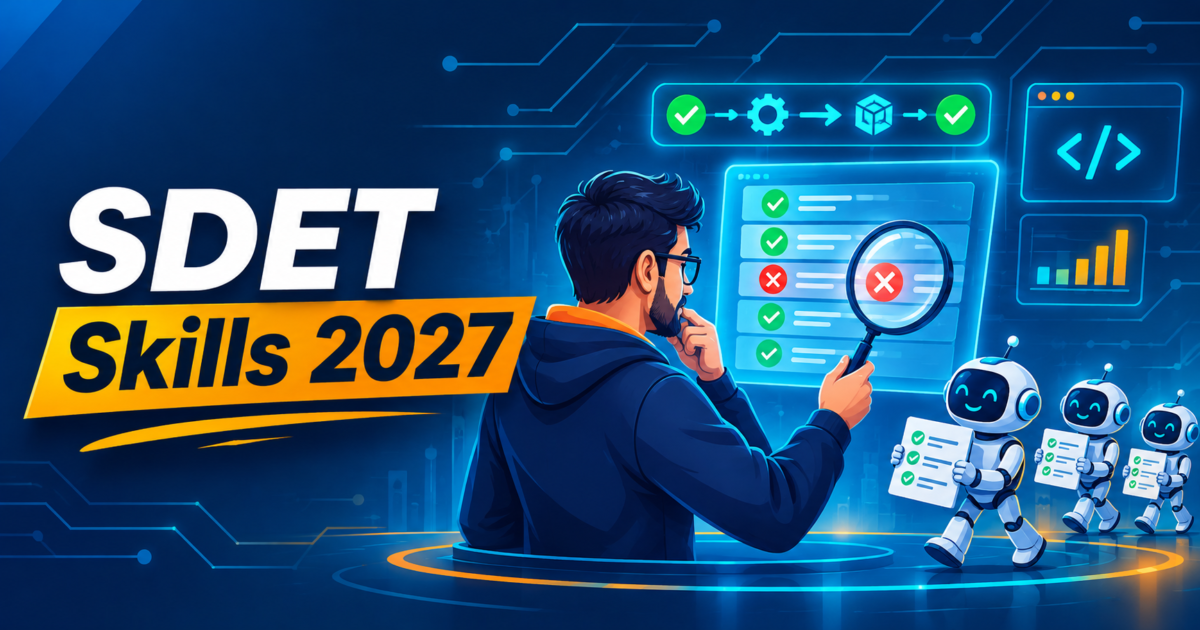
The rewards for SDETs in 2027 are no longer about collecting a long list of tool names on a CV. Instead, value is placed on solid programming, test architecture, CI/CD ownership, API and contract testing, and the critical judgment required to review AI-generated tests. With artificial intelligence now writing a significant portion of test code, the SDET who thrives—and gets hired—is the one who can effectively design, verify, and debug what the machine produces.
Who this is for: QA engineers moving into automation, working SDETs planning their next year, and leads hiring for test roles. Last updated: November 17, 2026.
The SDET skills 2027 will demand look very different from a few years ago. AI agents now plan, write and repair browser tests. Surveys show nearly every quality team experimenting with generative AI, and fewer developers trusting what it produces.
That gap is where the modern SDET earns their salary. Someone has to decide what’s worth testing, design a suite that stays fast and stable, and catch the plausible-looking test that checks nothing.
After 11+ years in SDET and SQA roles, I’ve watched tools come and go; the skills that last have barely changed, but how we apply them has. This guide covers which skills matter most going into 2027, which matter less, and a 90-day plan to close the gap.
What Does an SDET Actually Do in 2027?
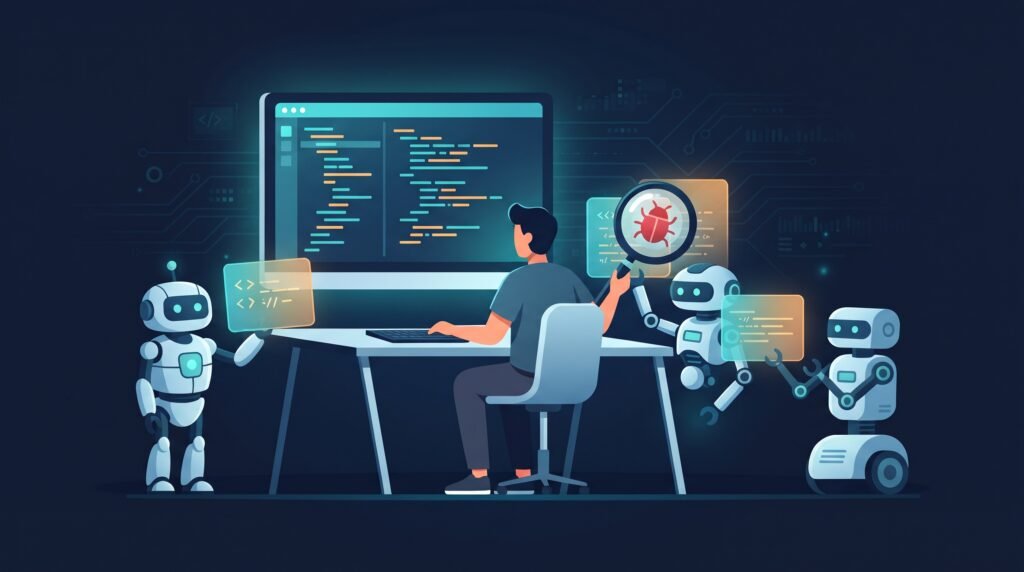
A Software Development Engineer in Test (SDET) is a software engineer whose product is the team’s ability to ship safely: the test code, the frameworks, the pipelines and the quality signals.
The title hasn’t changed, but the daily work has moved up a level. Less time goes into typing locators and step definitions. More goes into four jobs:
- Designing what to test and at which layer: unit, API, contract, UI or production checks.
- Building and owning the framework, fixtures, test data and CI pipeline the whole team uses.
- Reviewing tests written by developers and AI agents, the same way a senior engineer reviews production code.
- Diagnosing failures fast, from a flaky locator to a real race condition in the product.
In short, a 2027 SDET is closer to a platform engineer for quality than a script writer. If you’re mapping the full path into the role, the SDET learning track breaks it into stages.
Why SDET Skills Are Changing: 4 Forces Behind 2027
Four shifts explain why a 2023 skill list no longer fits. Each one moves value away from typing tests and toward judging them.
1. AI agents now write and repair tests
Playwright 1.56 shipped three built-in test agents: a planner that explores the app and writes a test plan, a generator that turns the plan into test files, and a healer that fixes failing tests (Playwright docs: Test agents). The same pattern is spreading across the tooling, so writing a first-draft test is no longer the scarce skill.
2. Adoption is high; trust is not
The World Quality Report 2025-26 found about 89% of organisations piloting or deploying generative AI in quality engineering, but only 37% in production; the rest are still piloting (Capgemini). Developers feel the same tension: 84% use or plan to use AI tools, yet 46% distrust the accuracy of the output (Stack Overflow Developer Survey 2025). Someone has to verify what AI produces, and that’s squarely an SDET job.
3. Pipelines got faster, so feedback must too
Teams that deploy several times a day can’t wait an hour for an end-to-end suite. That pushes SDETs toward fast API and contract tests, parallel and sharded runs, and quality gates wired into every pull request.
4. Products now ship AI features
Chatbots, search ranking and summarisation give different outputs for the same input. Testing them needs evaluation datasets, scoring rubrics and statistical thresholds, not just expect(x).toBe(y).
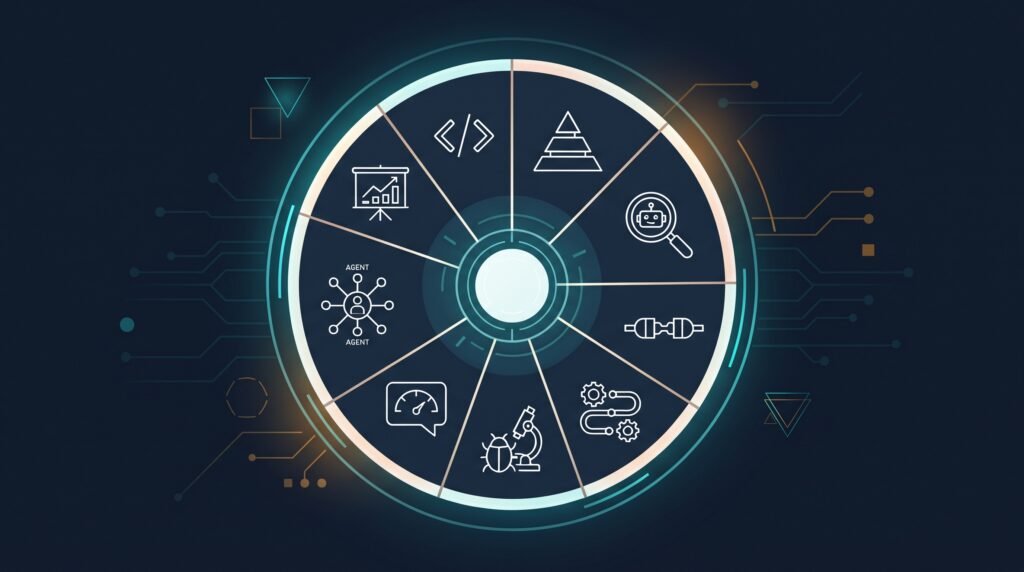
The 9 SDET Skills 2027 Hiring Managers Actually Test For
The skills below are ranked by how much they separate strong candidates from average ones in interviews and on the job. Each one ends with a way to prove it, because a portfolio beats a list of keywords.
1. Real programming depth in one language
Pick TypeScript or Python and go deep: async code, data structures, error handling, refactoring and debugging without a framework holding your hand. AI tools amplify engineers who can read code critically; they don’t replace that ability.
Prove it: a public test framework repo with linting, typed fixtures and its own unit tests.
2. Test design and strategy
Knowing what to test, and at which layer, is now worth more than knowing how to automate a click. That means risk-based prioritisation, boundary values, equivalence classes, and pushing checks down to the API or unit layer when the UI adds nothing.
Prove it: a one-page test strategy for a real feature, showing what you tested at each layer and why.
3. Reviewing AI-generated tests
This is the new core skill. AI-written tests often pass while checking almost nothing. Here’s a typical first draft:
// AI-generated: passes, but proves almost nothing
test('user can update profile', async ({ page }) => {
  await page.goto('/profile');
  await page.getByLabel('Name').fill('Ayesha Khan');
  await page.getByRole('button', { name: 'Save' }).click();
  await expect(page.getByRole('button', { name: 'Save' })).toBeVisible();
});
The assertion only proves the button still exists. A reviewed version checks the outcome and that it persisted:
// Reviewed: asserts the behaviour the user cares about
test('user can update profile name', async ({ page }) => {
  await page.goto('/profile');
  await page.getByLabel('Name').fill('Ayesha Khan');
  await page.getByRole('button', { name: 'Save' }).click();

  await expect(page.getByRole('status')).toHaveText('Profile updated');
  await page.reload();
  await expect(page.getByLabel('Name')).toHaveValue('Ayesha Khan');
});
Prove it: a pull request where you review and harden a batch of AI-generated tests, with the review comments visible.
4. API and contract testing
Most business logic lives behind APIs, and API tests run in milliseconds rather than seconds. Add schema validation and consumer-driven contract tests so services can deploy independently without breaking each other (Pact docs).
Prove it: an API suite with schema checks and one consumer–provider contract running in CI.
5. CI/CD and test infrastructure
An SDET who can’t change the pipeline depends on someone who can. Learn GitHub Actions or GitLab CI, Docker, parallel and sharded runs, and disposable test environments. For databases, Testcontainers in Python shows how to spin up a clean one per run.
Prove it: a pipeline that runs your suite sharded across machines and publishes a report on every pull request.
6. Debugging and observability
Fast diagnosis is what teams remember. Read traces, network logs and server logs together, and tell a flaky test from a real race condition. My guide to Playwright flaky tests covers the workflow end to end.
Prove it: a short write-up of one hard failure you traced to its root cause.
7. Testing AI and LLM features
Non-deterministic features need a different toolkit: golden evaluation datasets, scoring rubrics, pass-rate thresholds instead of exact matches, and checks for safety and hallucination. An LLM-as-judge can score outputs at scale, but calibrate it against human ratings before you trust it.
Prove it: an eval suite for a small chatbot or summariser, with a pass-rate threshold enforced in CI.
8. Agentic tooling and MCP
Know how to drive test agents well: write the project rules and seed tests they learn from, give them safe sandboxes, and gate every agent-made change behind human review. The MCP Zero to Hero series covers the protocol these tools run on.
Prove it: a repo where agents generate tests from your seed spec and a reviewer approves each diff.
9. Communicating quality
The best SDETs translate test results into risk: what’s covered, what isn’t, and what could break in production. Track a few metrics people act on, such as escaped defects, change failure rate, suite duration and flaky rate.
Prove it: a one-page release-readiness report a non-technical manager could act on.
What Matters Less, and What Replaces It
None of these old skills are worthless. Their market value has dropped because tools now do them, or because a higher-level skill covers them.
| Area | Valued less in 2027 | Valued more in 2027 |
|---|---|---|
| Writing tests | Hand-writing every locator and step | Reviewing and hardening AI-drafted tests |
| Tools | Knowing many tools on the surface (Selenium, Cypress, Playwright, Appium, all at once) | Mastering one stack deeply and learning others on demand |
| Frameworks | Building custom keyword-driven or record-and-playback frameworks | Lean code-first frameworks with typed fixtures |
| Test layer | Large end-to-end UI suites for every rule | API, contract and component tests, with a thin UI layer |
| Maintenance | Fixing broken selectors by hand | Designing stable locators and gating agent “heals” behind review |
| Pipelines | Handing CI changes to DevOps | Owning sharding, caching and quality gates yourself |
| Assertions | Exact-match checks only | Statistical thresholds and evals for AI features |
| Reporting | Pass/fail counts | Risk-based release readiness and flake-rate trends |
If you’re deciding which stack to go deep on, the Playwright Zero to Hero series is a structured place to start.
A 90-Day Plan to Build SDET Skills for 2027
This plan assumes about 6–8 hours a week alongside a full-time job. Each phase ends with something public you can show in an interview.
| Weeks | Focus | Deliverable |
|---|---|---|
| 1–2 | Language depth: async, types, error handling, debugging | A small typed utility library with its own unit tests |
| 3–4 | Test design: risk analysis, layering, boundary values | A one-page test strategy for a real open-source app |
| 5–6 | API and contract testing | An API suite with schema checks and one Pact contract |
| 7–8 | CI/CD: Docker, GitHub Actions, sharding | A pipeline that runs the suite sharded on every pull request |
| 9–10 | AI-assisted testing: agents, MCP, review discipline | Agent-generated tests plus your review PR hardening them |
| 11–12 | Testing AI features: evals and thresholds | An eval suite for a small LLM feature, gated in CI |
| 13 | Communication | A release-readiness report and a short write-up of the whole project |
Keep everything in one repository with a clear README. By day 90 you have a portfolio that shows every skill above, not just claims it.
Career Pitfalls That Stall SDETs
Most SDETs who plateau don’t lack effort. They put it into the wrong things. These are the patterns I see most often.
- Collecting tools instead of depth. Five frameworks at beginner level lose to one at expert level, plus the ability to learn the next one in a week.
- Trusting green AI-generated tests. A passing test that asserts nothing is worse than no test, because it creates false confidence. Review every assertion.
- Letting healers merge on their own. An auto-healed locator can quietly point at the wrong element. Keep agent changes behind pull-request review.
- Living only in the UI layer. If every check runs through a browser, the suite gets slow, flaky and expensive. Push logic checks down to the API.
- Avoiding the pipeline. “DevOps owns CI” makes you dependent on someone else’s priorities. Learn enough to change it yourself.
- Reporting numbers nobody acts on. “1,200 tests passed” says little. “Checkout and refunds are covered; tax rules are not” helps someone decide.
- Skipping fundamentals for AI hype. Agents amplify good test design and good code. Without both, they just produce bad tests faster.
SDET Skills 2027:
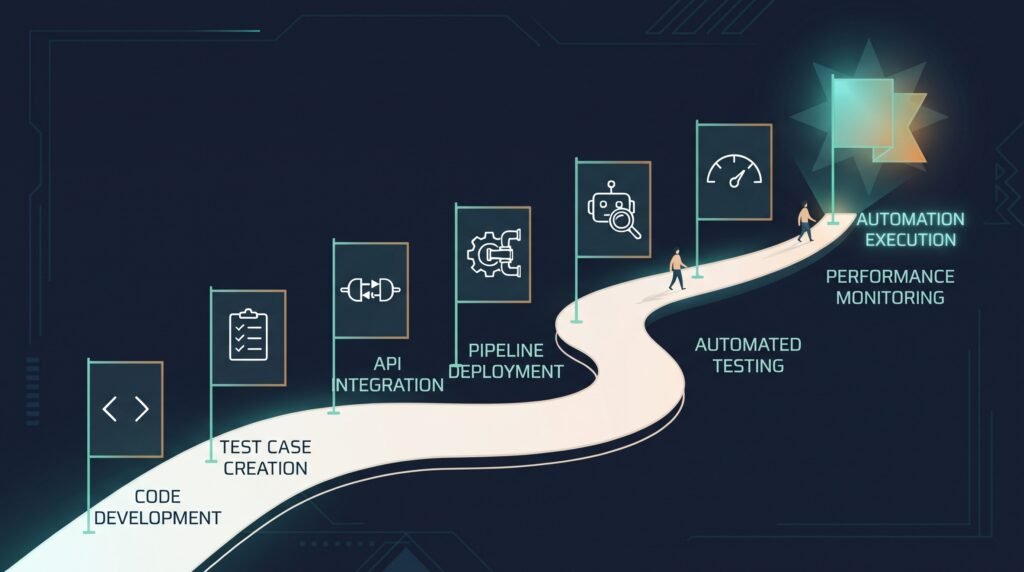
In an era where AI agents can flood CI pipelines with thousands of passing tests in seconds, true quality assurance comes down to human judgment. Discover the 9 essential skills modern SDETs need to master from advanced test design and AI code review to agentic workflows to stay indispensable in 2027.
SDET Skills 2027 Self-Assessment Checklist
Score yourself honestly. Each “no” is a gap for your next 90 days.
- I can write, debug and refactor non-trivial code in one language without AI help.
- I can explain, for any feature, which checks belong at the unit, API, contract and UI layers.
- I review AI-generated tests line by line and can name what each assertion proves.
- I have built an API suite with schema validation, and at least one contract test.
- I can edit our CI pipeline: add a job, shard a suite, cache dependencies.
- I can tell a flaky test from a product race condition using traces and logs.
- I have tested at least one non-deterministic feature with an evaluation dataset and a threshold.
- I have used a test agent or MCP server, with human review on every change.
- I can write a release-readiness summary a non-technical manager can act on.
- My work is visible: a public repo, a write-up or a talk that proves the skills above.
Internal Blog Links
- How to Build a Reliable Test Automation Architecture: 7 Powerful Pillars for SDETs
- Claude Code for SDETs: 10 Best High-Velocity Workflows
- QA Engineer vs SDET vs Quality Engineer: What’s the Difference?
- 7 Powerful AI Agent Workflows Every Modern SDET Should Learn
- Test Automation Framework vs Test Suite: 7 Powerful Truths
Internal Series Links
- Learn Python – Zero to Hero
- Playwright Forge — Modern Web Automation
- Agentic QA & LLMs — AI Driven Quality Engineering
- API & Performance Testing
- Enterprise SDET Architect — Frameworks, CI/CD & Leadership
- LangGraph: Complete Zero to Hero
- Claude Code Tutorial: Complete Zero to Hero
- Learn MCP – Zero to Hero
- Cursor AI: Complete Zero to Hero
- OpenAI Codex: Complete Zero to Hero
- AutoGen: Complete Zero to Hero Guide
- AI Agents for QA: Zero to Hero
- Python for Data Science: Complete Zero to Hero
- Learn Playwright – Zero to Hero
- Learn Cypress Testing – Zero to Hero
- Learn Selenium WebDriver – Zero to Hero
- Postman AI: Complete Zero to Hero
- XCUITest iOS Testing: Complete Zero to Hero
- Appium: Complete Zero to Hero
- Detox React Native Testing: Complete Zero to Hero
- EarlGrey: Complete Zero to Hero
- Espresso Android Testing: Complete Zero to Hero
- Flutter Integration Testing: Complete Zero to Hero
- Maestro Mobile Testing: Complete Zero to Hero
- Robot Framework Appium: Complete Zero to Hero
- UI Automator: Complete Zero to Hero
- WebdriverIO Mobile: Complete Zero to Hero
- SQL Mastery: From Basics to Advanced
- TencentDB Agent Memory: Complete Zero to Hero
- DataRobot: Complete Zero to Hero
- Deepnote AI: Complete Zero to Hero
- Jupyter AI: Complete Zero to Hero
- AWS Q Developer: Complete Zero to Hero
- Azure AI DevOps: Complete Zero to Hero
- Docker AI: Complete Zero to Hero
- GitHub Actions AI: Complete Zero to Hero
- Google Cloud AI: Complete Zero to Hero
- Kubernetes AI: Complete Zero to Hero
- Terraform AI: Complete Zero to Hero
- Free QA Resources Built From Real Experience
- QA Glossary: Test Automation Terms Every Engineer Should Know
People Asked Questions
Will AI replace SDETs by 2027?
AI is replacing parts of the job, mainly first-draft test writing and simple locator fixes. It isn’t replacing the judgement around them: deciding what to test, designing stable suites, verifying AI output and diagnosing real failures. SDETs who lean into those skills become more valuable, not less.
Which programming language should an SDET learn for 2027?
TypeScript if your team builds web products, since Playwright and most front-end stacks use it. Python if you work in data, ML or backend-heavy teams, or plan to test AI features. Go deep in one before adding a second; the concepts transfer quickly.
Is manual testing still needed in 2027?
Yes, as exploratory testing. Automation and agents check what you already know to ask. Exploratory sessions find what nobody thought of: confusing flows, odd edge cases and accessibility gaps. Strong SDETs schedule both and feed what they find back into automated checks.
What is the difference between an SDET and a QA engineer?
A QA engineer focuses on finding defects through test design, exploration and verification. An SDET does that and also builds the engineering around it: frameworks, test data, CI pipelines and tooling the whole team uses. In 2027 the line is blurring, and most QA roles now expect some SDET skills.
What SDET skills should a beginner learn first?
Start with one programming language, test design basics and API testing. Then add a UI framework such as Playwright, Git and a basic CI pipeline. Leave AI agents until you can tell a good test from a bad one, because that judgement is what makes the agents useful.
Conclusion
The SDET skills 2027 rewards are the ones AI can’t fake: real programming depth, sharp test design, ownership of the pipeline, and the judgement to tell a meaningful test from a green one. Tools will keep changing every few months. Those skills compound.
Pick the two weakest items from the checklist above and start the 90-day plan this week. Ship each phase publicly, and by spring you’ll have proof, not promises, for your next interview or promotion.
Want a structured path? Follow the SDET learning track, or browse the QA glossary for any term above. If your team needs help modernising its test strategy, see agentic QA services or book a call.