 QA
QA
FastAPI iter_route_contexts() is a small API addition with a much bigger lesson for engineers maintaining FastAPI tooling: route introspection should follow FastAPI’s effective routing structure rather than assuming router.routes is a simple flat list.
FastAPI 0.137.2 introduced iter_route_contexts() specifically for advanced use cases that previously relied on inspecting router.routes. The change followed the routing refactor in FastAPI 0.137.0, where included routers could no longer be treated as the same simple route structure that older tooling expected. (GitHub)
If you maintain API documentation generators, authorization checks, observability integrations, test tooling, route analyzers, or custom FastAPI plugins, this change deserves your attention.
The important question isn’t simply:
“What does
iter_route_contexts()do?”
The better question is:
“Why did FastAPI need it, and what should engineers change in code that currently walks
router.routes?”
Why Route Introspection Suddenly Matters
For ordinary FastAPI applications, you normally define routes and let FastAPI handle routing:
from fastapi import FastAPI

app = FastAPI()


@app.get("/users")
async def get_users():
    return {"users": []}
You don’t normally need to inspect the application’s routing internals.
But infrastructure and tooling often does.
For example, imagine you are building a security checker that needs to identify every API endpoint:
for route in app.routes:
    print(route.path)
Or perhaps you maintain a test generator:
for route in app.routes:
    generate_test_case(route)
Or an observability integration:
for route in router.routes:
    register_route(route)
These patterns can look perfectly reasonable.
The problem appears when routing becomes more complex.
The Router Tree Is More Complicated Than It Looks
Consider a modular application:
from fastapi import APIRouter, FastAPI

users = APIRouter(prefix="/users")


@users.get("/{user_id}")
async def get_user(user_id: int):
    return {"user_id": user_id}


admin = APIRouter(prefix="/admin")


@admin.get("/users")
async def admin_users():
    return {"users": []}


app = FastAPI()

app.include_router(users)
app.include_router(admin)
The effective endpoints are:
/users/{user_id}
/admin/users
But applications can have deeper nesting:
Application
   │
   ├── API Router
   │      │
   │      ├── Users Router
   │      │       └── /users/{id}
   │      │
   │      └── Orders Router
   │              └── /orders/{id}
   │
   └── Admin Router
          └── /admin/users
Once routers can be included dynamically and nested, simply assuming that every object in router.routes represents a final endpoint becomes dangerous.
FastAPI 0.137.0 changed its router inclusion internals so that included routers could remain part of a routing structure rather than being handled as the old flat representation. This was important for capabilities such as routes being added after include_router(). (Change8)
That created a natural need for a supported way to obtain effective route contexts.
What iter_route_contexts() Actually Solves
FastAPI 0.137.2 added iter_route_contexts() for advanced use cases that previously inspected router.routes. (FastAPI)
The basic usage is straightforward:
from fastapi.routing import iter_route_contexts

for route_context in iter_route_contexts(router.routes):
    print(route_context.path)
FastAPI’s own maintainer demonstrated this pattern in a discussion about route introspection after the routing changes. (GitHub)
The important part is not the loop.
It’s the abstraction.
Instead of writing your own logic to understand FastAPI’s internal route tree, you ask FastAPI to provide the effective route contexts.
Conceptually:
Old assumption

router.routes
     ↓
flat route objects
     ↓
inspect them


New approach

router.routes
     ↓
iter_route_contexts()
     ↓
effective route contexts
     ↓
inspect them
That difference matters enormously for framework integrations.
router.routes vs iter_route_contexts()
| Capability | Direct router.routes Inspection | iter_route_contexts() |
|---|---|---|
| Simple applications | Works in many cases | Works |
| Nested routers | Requires care | Designed for effective contexts |
| Included routers | Can expose implementation details | Handles route contexts |
| Framework internals | Your code must understand them | FastAPI provides abstraction |
| Future compatibility | More fragile | Better supported approach |
| Advanced introspection | Manual logic | Dedicated helper |
| Tooling integrations | More maintenance | Cleaner integration |
The lesson is not:
“
router.routesis always bad.”
The lesson is:
Framework internals should not become your application’s long-term API contract when the framework provides a supported abstraction for the same job.
A Real-World Problem: Route Discovery
Imagine you are writing a route inventory tool.
You want this:
GET     /users
GET     /users/{user_id}
POST    /users
DELETE  /users/{user_id}
GET     /admin/users
A naive implementation might be:
def list_routes(router):
    for route in router.routes:
        print(route.path)
That assumes every route object exposes the information you need.
A more robust approach is:
from fastapi.routing import iter_route_contexts


def list_routes(router):
    for context in iter_route_contexts(router.routes):
        print(context.path)
Now your application isn’t responsible for reproducing FastAPI’s route-flattening logic.
That is the real value of the helper.
Why This Is Particularly Important for Testing Tools
QA engineers frequently build tooling that discovers endpoints automatically.
For example:
def discover_api_routes(app):
    routes = []

    for route in app.routes:
        if hasattr(route, "path"):
            routes.append(route.path)

    return routes
This might work until framework internals change.
A test generator might then silently stop discovering endpoints.
That’s worse than an obvious failure.
You could have:
Application:
100 routes

Test generator discovers:
72 routes

Result:
28 routes never tested
Your test suite may remain green while coverage quietly deteriorates.
Using the framework’s supported route-context mechanism reduces that risk.
Route Introspection Is an Infrastructure Concern
This is an important architectural distinction.
Your application code usually shouldn’t care about route internals.
Infrastructure code often does.
Examples include:
- OpenAPI customization
- authorization analysis
- API documentation generators
- route metrics
- tracing instrumentation
- automatic test generation
- endpoint inventory
- security scanning
- dependency analysis
- API governance
- plugin systems
This is why the addition of iter_route_contexts() is more significant than its small API surface suggests.
FastAPI’s own release notes explicitly describe it as being intended for advanced use cases. (FastAPI)
A Better Test for Route Introspection
Don’t only test:
assert "/users" in routes
Test nested routing too.
For example:
def test_nested_routes(app):
    paths = {
        context.path
        for context in iter_route_contexts(app.router.routes)
    }

    assert "/users/{user_id}" in paths
    assert "/admin/users" in paths
Then test different router structures:
Simple route
Nested router
Router with prefix
Nested router with prefix
Router included before routes are added
This is much closer to the actual risk introduced by routing changes.
The Hidden Issue: Effective Paths
One of the most important concepts here is the difference between a route’s local definition and its effective application path.
Suppose you define:
users = APIRouter(prefix="/users")


@users.get("/{user_id}")
async def get_user(user_id: int):
    ...
The route declaration contains:
/{user_id}
But the application sees:
/users/{user_id}
Now imagine another router:
api = APIRouter(prefix="/api")
api.include_router(users)
The effective route becomes:
/api/users/{user_id}
And if the application does:
app.include_router(api, prefix="/v1")
the final route becomes:
/v1/api/users/{user_id}
This is exactly why route introspection becomes more complicated than:
route.path
The routing hierarchy matters.
Think in Terms of Route Context
Instead of asking:
“What route object is this?”
think:
“What is the effective routing context for this endpoint?”
That context can carry information required to understand how the endpoint participates in the application’s routing structure.
This mental model is useful when building:
Authorization
     ↓
Route matching
     ↓
Endpoint
     ↓
Policy
or:
Route
 ↓
Test generator
 ↓
Test case
The effective context is more useful than simply inspecting an internal object.
Why Framework Abstractions Matter
There is a recurring pattern in software engineering:
Framework implementation
        ↓
Public abstraction
        ↓
Your application
Problems begin when developers do this:
Framework implementation
        ↓
Your application
The application becomes coupled to implementation details.
Then a framework upgrade changes those details.
Your code breaks.
A supported helper such as iter_route_contexts() provides a boundary:
FastAPI internals
       ↓
iter_route_contexts()
       ↓
Your tooling
FastAPI can change the internal representation while preserving the behavior promised by the public helper.
That is exactly what framework abstractions are supposed to accomplish.
Compare FastAPI With Manual Route Walking
A custom implementation might recursively inspect route structures:
def walk_routes(routes):
    for route in routes:
        if hasattr(route, "routes"):
            yield from walk_routes(route.routes)
        else:
            yield route
At first glance, this seems flexible.
But now your code needs to understand:
- nested routers
- included routers
- route prefixes
- effective paths
- framework-specific route types
- future internal changes
You’re effectively maintaining a mini routing implementation.
That’s expensive.
A framework-provided abstraction is usually preferable when it expresses exactly the behavior your integration requires.
When Manual Inspection Still Makes Sense
There are legitimate cases for lower-level inspection.
For example, debugging framework behavior:
for route in router.routes:
    print(type(route))
    print(vars(route))
This can be useful during development.
But distinguish between:
diagnostic inspection
and:
production dependency
That’s a critical engineering distinction.
Debugging internals is normal.
Building your production integration around undocumented internals is much riskier.
Migration Strategy for Existing Projects
If your code currently contains:
for route in router.routes:
    ...
don’t blindly replace every occurrence.
First determine why the code is inspecting routes.
Search your project:
grep -R "router.routes" .
Or:
grep -R "\.routes" src/ tests/
Then categorize each use.
Category 1 — Application debugging
Probably no migration required.
Category 2 — Test tooling
Review carefully.
Category 3 — Security tooling
Review carefully and add regression tests.
Category 4 — OpenAPI customization
Validate nested routers and prefixes.
Category 5 — Observability integration
Verify effective route matching.
Category 6 — Third-party integration
Check whether the dependency already supports FastAPI 0.137+.
This is a much safer upgrade strategy than performing a blind search-and-replace.
Build a Regression Test Before Migrating
Before changing route introspection code, create a test that describes the expected behavior.
def test_all_effective_routes_are_discovered(app):
    paths = {
        context.path
        for context in iter_route_contexts(app.router.routes)
    }

    expected = {
        "/users",
        "/users/{user_id}",
        "/admin/users",
    }

    assert expected <= paths
Then add nested prefixes.
def test_nested_prefix_is_preserved(app):
    paths = {
        context.path
        for context in iter_route_contexts(app.router.routes)
    }

    assert "/api/v1/users/{user_id}" in paths
Now you have a safety net.
Why FastAPI 0.137 Made This More Urgent
FastAPI 0.137.0 introduced routing changes that affected code relying on the previous structure of router.routes. The issue became visible in projects performing advanced route introspection, including Jupyverse. The FastAPI discussion around this change specifically proposed iter_route_contexts() as a way to support those use cases, and the helper became available in FastAPI 0.137.2. (GitHub)
This creates a useful upgrade lesson:
Framework upgrades can break infrastructure code even when ordinary endpoint declarations continue to work.
Your API might still respond perfectly:
GET /users → 200
POST /users → 201
while your route discovery tool is broken.
That means application-level smoke tests alone aren’t enough.
Test the Tooling Layer Separately
A mature FastAPI test strategy should distinguish:
Application tests
        ↓
API behavior

Infrastructure tests
        ↓
Route discovery
OpenAPI generation
Authorization mapping
Observability
For example:
def test_route_inventory():
    paths = get_application_routes(app)

    assert len(paths) >= 10
And:
def test_security_policy_covers_all_routes():
    routes = get_application_routes(app)

    for route in routes:
        assert policy_exists(route)
These tests can catch a class of failures that endpoint tests won’t.
The QA Perspective: Route Discovery Is Test Coverage
Here’s a strategic way to think about it.
Suppose your automated test generator discovers:
120 endpoints
After a framework upgrade it discovers:
83 endpoints
But nobody notices because the generator still executes successfully.
That’s a coverage regression.
You should therefore measure:
discovered = len(discover_routes(app))

assert discovered >= EXPECTED_ROUTE_COUNT
Even better, maintain a known route inventory:
expected_routes = {
    ("GET", "/users"),
    ("POST", "/users"),
    ("GET", "/users/{user_id}"),
}
Then compare:
actual_routes = discover_routes(app)

missing = expected_routes - actual_routes

assert not missing
Now route introspection becomes measurable.
That’s exactly how QA thinking improves infrastructure reliability.
A Practical Compatibility Pattern
If your library supports multiple FastAPI versions, you may need compatibility handling.
A simplified pattern could look like:
try:
    from fastapi.routing import iter_route_contexts
except ImportError:
    iter_route_contexts = None
Then:
def get_route_contexts(routes):
    if iter_route_contexts is not None:
        yield from iter_route_contexts(routes)
        return

    # Compatibility behavior for older versions
    for route in routes:
        if hasattr(route, "effective_route_contexts"):
            yield from route.effective_route_contexts()
        else:
            yield route
The OpenTelemetry FastAPI instrumentation code provides a real example of handling this transition: newer FastAPI versions use the public helper, while compatibility paths handle older versions differently. (OpenTelemetry Python Contrib)
The exact fallback strategy should depend on the versions your package supports.
The important design principle is:
Keep framework compatibility logic in one place.
Don’t scatter version checks throughout your codebase.
Version Compatibility Should Be Tested
If your package supports:
FastAPI 0.136
FastAPI 0.137
FastAPI 0.137.2+
test each supported range.
A CI matrix might look like:
strategy:
  matrix:
    fastapi:
      - "0.136.*"
      - "0.137.*"
      - "latest"
Then run:
pytest tests/route_introspection
This gives you early warning when framework internals change again.
Don’t Test Only the Happy Path
Your route introspection tests should cover:
✓ Direct routes
✓ Nested routers
✓ Prefixes
✓ Multiple router levels
✓ Routes added after inclusion
✓ Empty routers
✓ Different HTTP methods
✓ Parameterized paths
✓ WebSocket routes if relevant
✓ Compatibility versions
This creates much stronger confidence than a single:
assert "/users" in routes
A Better Route Inventory Tool
You can turn the concept into a reusable utility:
from fastapi.routing import iter_route_contexts


def get_route_inventory(router):
    inventory = []

    for context in iter_route_contexts(router.routes):
        inventory.append({
            "path": context.path,
        })

    return inventory
Then:
routes = get_route_inventory(app.router)

for route in routes:
    print(route)
You can extend it with whatever information your context exposes and your integration legitimately needs.
For example:
Path
HTTP method
Endpoint
Tags
Dependencies
Security metadata
The exact fields should be verified against the FastAPI version you’re targeting rather than assumed.
Don’t Build Your Own iter_route_contexts()
This sounds obvious, but framework migrations often lead developers down this path:
def my_iter_route_contexts(...):
    ...
If you are trying to reproduce FastAPI’s own routing semantics, stop and ask:
“Am I rebuilding a framework abstraction that FastAPI now provides?”
If yes, use the framework abstraction when your supported version allows it.
Your code should focus on what your application needs to do with route contexts, not on reproducing how FastAPI constructs them.
What This Means for FastAPI Plugin Authors
If you’re developing a FastAPI integration, this change is particularly relevant.
Plugin authors commonly need to inspect:
Routes
Dependencies
Endpoints
Request handling
Middleware
OpenAPI metadata
The safest strategy is to minimize coupling to internal structures.
Instead of:
# Fragile assumption
for route in router.routes:
    ...
prefer:
from fastapi.routing import iter_route_contexts

for context in iter_route_contexts(router.routes):
    ...
when your minimum supported FastAPI version includes the helper.
This makes your integration easier to maintain.
A Useful Architecture for Route-Aware Tooling
Think about route-aware tooling like this:
              FastAPI
                 │
          Routing Structure
                 │
      iter_route_contexts()
                 │
          Route Contexts
          /      |      \
         ↓       ↓       ↓
      Tests   Security  Metrics
         │       │       │
         └───────┼───────┘
                 ↓
            Route Inventory
The framework owns route interpretation.
Your tooling consumes the resulting contexts.
That’s a clean separation of responsibilities.
What Developers Should Learn From This Change
iter_route_contexts() isn’t just another FastAPI utility.
It demonstrates a broader software-engineering principle:
Don’t make internal data structures part of your architecture unless you have no better option.
Frameworks evolve.
Internal representations change.
Abstractions exist to protect application code from those changes.
FastAPI’s routing evolution is a good example.
The API developer who writes:
@app.get("/users")
doesn’t need to know how router inclusion is implemented.
The infrastructure developer who builds route introspection tooling does.
But even that developer should ideally consume the framework’s supported abstraction rather than recreate the internal behavior.
Final Takeaway
FastAPI iter_route_contexts() matters most to engineers building tooling around FastAPI rather than simply declaring endpoints.
If you’re developing:
- route scanners
- security tooling
- test generators
- observability integrations
- OpenAPI customization
- API governance systems
- FastAPI plugins
then route introspection is part of your application’s infrastructure contract.
FastAPI 0.137.2 introduced iter_route_contexts() specifically to provide a supported mechanism for advanced route inspection following the routing changes introduced around FastAPI 0.137. (FastAPI)
The practical strategy is simple:
Don't ask:

"What is inside router.routes?"

Ask:

"What effective routes does FastAPI expose?"

Then use the supported abstraction to obtain them.
That shift—from inspecting framework internals to consuming framework-level abstractions—is what makes FastAPI integrations more resilient to future changes.
Designing Reliable FastAPI Route Introspection With iter_route_contexts()
When route introspection becomes part of testing, security, observability, or API governance, the implementation needs to do more than simply enumerate objects.
The real requirement is to discover the effective API surface represented by the FastAPI routing hierarchy.
That distinction becomes especially important when applications use nested APIRouter instances, prefixes, dynamically included routers, and infrastructure tooling.
A useful architecture looks like this:
FastAPI Application
       │
       ▼
Routing Hierarchy
       │
       ▼
iter_route_contexts()
       │
       ▼
Effective Route Contexts
   ┌────┼─────┬─────┐
   ▼    ▼     ▼     ▼
 Tests Security Metrics Docs
Instead of teaching every consumer how FastAPI internally represents routes, centralize route discovery behind one utility.
from fastapi.routing import iter_route_contexts


def get_route_contexts(app):
    return list(
        iter_route_contexts(app.router.routes)
    )
Now the rest of your system can work with the result without repeatedly depending on the routing implementation.
Build a Route Inventory Layer
A route inventory is useful because many engineering systems need to answer the same question:
What API endpoints actually exist?
For example:
from fastapi.routing import iter_route_contexts


def discover_routes(app):
    routes = []

    for context in iter_route_contexts(app.router.routes):
        routes.append({
            "path": context.path,
        })

    return routes
You could then expose the inventory to your test tooling:
routes = discover_routes(app)

for route in routes:
    print(route["path"])
The output might resemble:
/users
/users/{user_id}
/orders
/orders/{order_id}
/admin/users
The advantage is architectural separation.
Your test generator does not need to know how FastAPI builds its route hierarchy.
Your security scanner does not need to know either.
Both consume the same inventory abstraction.
FastAPI routing
       ↓
Route discovery utility
       ↓
┌──────────────┬──────────────┐
│              │              │
Test Engine    Security       Metrics
This becomes increasingly valuable as your project grows.
Don’t Make Every Tool Walk the Router
A common anti-pattern looks like this:
# test_generator.py
for route in app.router.routes:
    ...


# security_scanner.py
for route in app.router.routes:
    ...


# metrics.py
for route in app.router.routes:
    ...


# documentation.py
for route in app.router.routes:
    ...
Now four systems depend directly on FastAPI’s routing representation.
That creates unnecessary coupling.
A better approach is:
# route_inventory.py

from fastapi.routing import iter_route_contexts


def discover_routes(app):
    return list(
        iter_route_contexts(app.router.routes)
    )
Then:
# test_generator.py

routes = discover_routes(app)
# security_scanner.py

routes = discover_routes(app)
# metrics.py

routes = discover_routes(app)
The framework-specific logic has one home.
That is much easier to maintain.
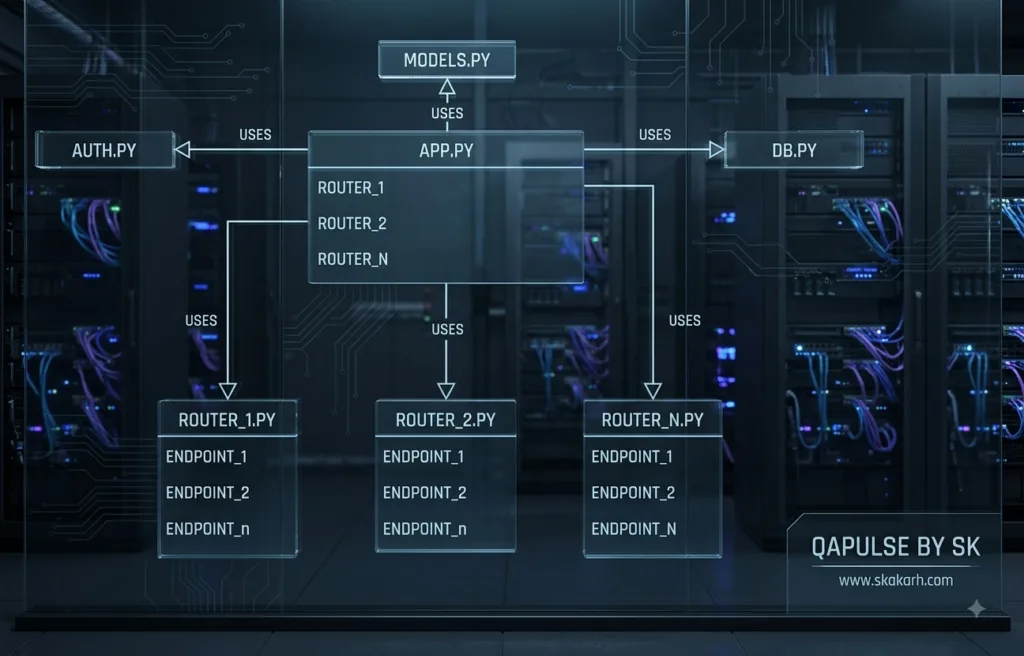
Nested Routers Are Where the Architecture Gets Interesting
Consider a realistic application:
from fastapi import APIRouter, FastAPI

users_router = APIRouter(
    prefix="/users"
)


@users_router.get("/{user_id}")
async def get_user(user_id: int):
    return {"user_id": user_id}
Now put that router inside another router:
api_router = APIRouter(
    prefix="/api"
)

api_router.include_router(users_router)
Finally:
app = FastAPI()

app.include_router(
    api_router,
    prefix="/v1"
)
The endpoint is effectively:
/v1/api/users/{user_id}
There are multiple layers involved:
Application
   │
   └── /v1
        │
        └── /api
             │
             └── /users
                  │
                  └── /{user_id}
This is precisely the kind of situation where simplistic route walking becomes fragile.
A route-aware integration should care about the effective routing context rather than merely assuming that the local route definition tells the complete story.
Test Nested Routing Explicitly
If you’re maintaining route tooling, create nested-router tests deliberately.
def test_nested_router_path(app):
    paths = {
        context.path
        for context in iter_route_contexts(
            app.router.routes
        )
    }

    assert "/v1/api/users/{user_id}" in paths
This test has greater value than simply testing a direct route.
Why?
Because nested routing is where assumptions about route representation are most likely to become visible.
A strong route-introspection test suite should contain:
Direct route
    ↓
Router prefix
    ↓
Nested router
    ↓
Multiple prefixes
    ↓
Routes added dynamically
The goal isn’t just to prove that route discovery works.
It’s to prove that your discovery logic understands the routing structures your application actually uses.
Route Discovery vs OpenAPI Discovery
There is another important distinction.
Many developers assume:
app.openapi()
is equivalent to discovering every route.
It isn’t necessarily the same abstraction.
OpenAPI describes API operations intended for the generated API specification.
Route introspection is concerned with the application’s routing structure.
You may therefore have tooling requirements such as:
Route inventory
      +
OpenAPI inventory
      +
Security policy inventory
A mature API governance system can compare them.
For example:
FastAPI Routes
      │
      ├──────────► OpenAPI
      │
      ├──────────► Security Rules
      │
      └──────────► Automated Tests
Now discrepancies become detectable.
Suppose your application contains:
120 routes
but OpenAPI contains:
116 operations
That difference deserves investigation.
It may be legitimate.
It may also reveal an undocumented or unsupported endpoint.
Build an API Surface Consistency Test
You could establish a simple inventory check:
def test_route_inventory_is_not_empty(app):
    routes = list(
        iter_route_contexts(
            app.router.routes
        )
    )

    assert routes
For a larger application, maintain expected critical endpoints:
EXPECTED_ENDPOINTS = {
    "/users",
    "/users/{user_id}",
    "/orders",
}
Then:
def test_critical_endpoints_are_discoverable(app):
    discovered = {
        context.path
        for context in iter_route_contexts(
            app.router.routes
        )
    }

    assert EXPECTED_ENDPOINTS <= discovered
This converts route introspection from an implementation detail into a measurable quality signal.
Why This Matters to SDETs
For an SDET, this creates an interesting possibility.
Instead of manually maintaining every endpoint in an API test configuration, your framework can discover the API surface automatically.
For example:
FastAPI
   ↓
Route Discovery
   ↓
Endpoint Metadata
   ↓
Test Generator
   ↓
API Tests
The generator could then create baseline tests:
def test_endpoint_exists(client):
    response = client.get("/users")

    assert response.status_code != 404
Of course, generated tests need more sophisticated assertions for real applications.
But route discovery provides the starting point.
This can become particularly powerful when combined with OpenAPI schemas.
Route Context
     +
OpenAPI Schema
     +
Authentication Metadata
     ↓
Test Scenario
Now your automation framework can reason about the API rather than relying entirely on manually maintained lists.
Route Introspection and Security
Security tooling has an even stronger reason to maintain an accurate route inventory.
Imagine an application with:
/admin/users
/admin/reports
/admin/settings
Your security middleware is supposed to protect all three.
A route inventory can become a verification source:
protected_prefix = "/admin"

routes = {
    context.path
    for context in iter_route_contexts(
        app.router.routes
    )
}

admin_routes = {
    path for path in routes
    if path.startswith(protected_prefix)
}
You can then test that every administrative endpoint is covered by the intended policy.
The architecture becomes:
Route Discovery
      ↓
Security Classification
      ↓
Policy Verification
      ↓
Automated Test
That is considerably stronger than relying on developers remembering to update a security configuration manually.
Use Route Contexts as Input, Not as Your Entire Architecture
There is an important boundary here.
iter_route_contexts() should help you discover routing information.
It should not become the center of every application decision.
Avoid creating a giant function like:
def analyze_everything(app):
    ...
Instead, separate responsibilities:
route_inventory.py
security_analysis.py
test_generation.py
metrics.py
documentation.py
Each component can consume the route inventory.
This follows a simple principle:
Discover once, consume many times.
A More Useful Route Model
For production tooling, you may want to normalize route information into your own model.
For example:
from dataclasses import dataclass


@dataclass
class Endpoint:
    path: str
    methods: set[str]
Then your discovery layer can produce:
def build_endpoint_inventory(app):
    endpoints = []

    for context in iter_route_contexts(
        app.router.routes
    ):
        endpoints.append(
            Endpoint(
                path=context.path,
                methods=set(),
            )
        )

    return endpoints
The exact metadata you populate should depend on the FastAPI version and context object you’re targeting.
The important architecture is:
FastAPI
   ↓
Framework-specific discovery
   ↓
Your normalized Endpoint model
   ↓
Your tooling
Now your test generator doesn’t need to understand FastAPI internals at all.
Why Normalization Helps
Imagine you eventually support:
FastAPI
Flask
Django
Starlette
If your test generator directly consumes FastAPI routing objects, you’ve created a FastAPI-specific test engine.
Instead:
FastAPI ───────┐
               │
Flask ─────────┼──► Endpoint Model ──► Test Engine
               │
Django ────────┤
               │
Starlette ─────┘
This makes your system extensible.
Your framework adapters understand framework-specific routing.
The core test engine understands your normalized model.
That’s a much cleaner design.
FastAPI iter_route_contexts() vs Custom Recursion
A useful engineering comparison looks like this:
| Approach | Simplicity | Framework Coupling | Nested Routing | Maintenance |
|---|---|---|---|---|
Direct router.routes | High | High | Riskier | Medium |
| Custom recursive walker | Medium | Very High | Custom-managed | High |
iter_route_contexts() | High | Lower | Framework-aware | Lower |
| OpenAPI-only discovery | High | Low | Different purpose | Low |
This isn’t an argument that direct inspection is always incorrect.
It’s about choosing the abstraction that matches the problem.
If you need effective route contexts, the dedicated helper is a better starting point than rebuilding route traversal yourself.
What About Older FastAPI Versions?
Compatibility becomes important if you maintain a package rather than a single application.
Suppose your package supports both older and newer FastAPI releases.
You should isolate version-specific behavior.
For example:
def discover_routes(app):
    return _discover_routes(app)
Then keep compatibility logic inside:
def _discover_routes(app):
    ...
Your application shouldn’t contain version checks everywhere:
if fastapi_version >= ...:
    ...
That quickly becomes technical debt.
Instead:
Application
     ↓
Route discovery API
     ↓
Compatibility adapter
     ↓
FastAPI version
This architecture makes future upgrades easier.
Add FastAPI Version Testing to CI
If you’re publishing a reusable package, don’t assume one FastAPI version is enough.
Your CI matrix can test multiple versions:
strategy:
  matrix:
    fastapi:
      - "supported-old"
      - "supported-current"
      - "latest"
Then:
pytest tests/route_introspection/
The exact versions should match your package’s declared compatibility range.
The principle is what matters:
Framework integrations should be tested against the framework versions they claim to support.
Regression Test the Routing Refactor Scenario
The most valuable tests are those that represent why route introspection changed.
For example:
def test_router_routes_added_after_include(
    app,
):
    ...
Your test should model the application behavior that previously caused your tooling to make incorrect assumptions.
This is a broader lesson in regression testing.
Don’t test the implementation change.
Test the behavior that was previously vulnerable.
Avoid Silent Route Loss
One of the worst failures in route-discovery tooling is not an exception.
It’s missing data.
Consider:
Application:
150 endpoints

Discovery:
149 endpoints

Tests:
149 endpoints

CI:
PASS
Nothing crashes.
But one endpoint is effectively invisible to your automation.
This is why route-count monitoring can be useful:
def test_route_count(app):
    routes = list(
        iter_route_contexts(
            app.router.routes
        )
    )

    assert len(routes) >= 150
For mature systems, explicit endpoint inventories are even better than counts.
A count can remain the same while one route disappears and another appears.
Compare identities:
expected = {
    ("GET", "/users"),
    ("POST", "/users"),
}

actual = discover_endpoint_signatures(app)

assert expected <= actual
Now the test tells you which contract disappeared.
Interactive Engineering Exercise
Before continuing with your own route tooling, try this experiment.
Create:
Router A
 └── /users

Router B
 └── /orders
Include both in:
/api
Then include that router in the application under:
/v1
Your expected routes should become:
/v1/api/users
/v1/api/orders
Now write a discovery function using iter_route_contexts().
Then intentionally add another nested router.
Ask yourself:
Does my tooling still discover every effective endpoint?
This is a better learning exercise than simply reading the API documentation because you’re testing the abstraction against a realistic routing structure.
Add Route Discovery to Your Test Architecture
A modern API automation stack can look like this:
                 FastAPI
                    │
                    ▼
          iter_route_contexts()
                    │
                    ▼
             Route Inventory
             /      |       \
            /       |        \
           ▼        ▼         ▼
       API Tests  Security  Monitoring
           │        │         │
           └────────┼─────────┘
                    ▼
             Quality Signals
This architecture provides a common source of truth.
When routes change, the downstream systems can react.
For example:
Developer adds endpoint
        ↓
Route inventory changes
        ↓
Test generator detects change
        ↓
Security policy evaluated
        ↓
Monitoring registration updated
That is much closer to an engineering platform than a collection of disconnected scripts.
The Bigger Lesson About Framework Upgrades
The iter_route_contexts() story illustrates something broader than FastAPI.
Frameworks evolve their internal architecture.
Your application should not need to understand every internal change.
Whenever a framework introduces a supported abstraction for a previously internal behavior, ask:
Do we currently depend on the old implementation?
        │
        ├── No → Continue
        │
        └── Yes
             ↓
       Can we migrate to
       the supported abstraction?
             │
             ├── Yes → Migrate + test
             │
             └── No → Isolate dependency
This is a repeatable upgrade strategy.
It works beyond FastAPI.
The same principle applies to:
- database frameworks
- browser automation tools
- CI systems
- cloud SDKs
- ORM internals
- observability libraries
- AI frameworks
What Good Infrastructure Code Looks Like
Weak infrastructure code says:
“I know how this framework currently stores its routes.”
Stronger infrastructure code says:
“I know how to ask the framework for the routing information my integration needs.”
That difference may look small in code.
Architecturally, it is significant.
The first approach depends on implementation.
The second depends on behavior.
And behavior is generally the more stable contract.
Practical Migration Checklist
If your project currently inspects router.routes, use this checklist:
□ Find every direct route inspection
□ Identify why each inspection exists
□ Check whether nested routers are involved
□ Check whether routers are included dynamically
□ Identify FastAPI versions supported
□ Add route-discovery regression tests
□ Evaluate iter_route_contexts()
□ Centralize compatibility logic
□ Normalize route data if multiple tools consume it
□ Test security coverage
□ Test API test-generation coverage
□ Run the complete CI suite
Don’t treat the change as a mechanical API replacement.
Treat it as an opportunity to improve your infrastructure boundary.
A Strategic Rule for SDETs
For QA and SDET teams, there’s an especially useful principle here:
If your automation depends on discovering application structure automatically, framework upgrades must be tested at the discovery layer—not only at the endpoint layer.
Your API tests can all pass while your test generator becomes incomplete.
Your security tests can all pass while a new endpoint is never included.
Your monitoring can appear healthy while a route isn’t registered.
The discovery layer is therefore part of your test architecture.
And iter_route_contexts() gives you a cleaner foundation for that layer.
Testing iter_route_contexts() in Real FastAPI Projects
FastAPI iter_route_contexts() becomes especially valuable when route discovery is part of an automated engineering workflow. A production application rarely has a handful of directly declared endpoints. It usually has routers, prefixes, nested modules, authentication layers, administrative APIs, and sometimes routes that are assembled dynamically.
That means route discovery should be tested like any other infrastructure component.
A useful starting point is a small discovery utility:
from fastapi.routing import iter_route_contexts


def discover_routes(app):
    return list(
        iter_route_contexts(app.router.routes)
    )
You can then keep your tests independent from the details of how FastAPI represents its routing internals.
def test_routes_are_discoverable(app):
    routes = discover_routes(app)

    assert routes
But this test alone isn’t enough.
A route-discovery system can return something while still missing important endpoints.
The real objective is:
FastAPI application
        ↓
Routing hierarchy
        ↓
iter_route_contexts()
        ↓
Complete route inventory
        ↓
Tests / Security / Observability
Start With a Realistic Router Structure
Consider a small application organized into modules:
from fastapi import APIRouter

users_router = APIRouter(
    prefix="/users",
    tags=["users"],
)


@users_router.get("/")
async def list_users():
    return {"users": []}


@users_router.get("/{user_id}")
async def get_user(user_id: int):
    return {"user_id": user_id}
An orders module could look like:
orders_router = APIRouter(
    prefix="/orders",
    tags=["orders"],
)


@orders_router.get("/")
async def list_orders():
    return {"orders": []}
Then combine them:
from fastapi import FastAPI

api_router = APIRouter(
    prefix="/api",
)

api_router.include_router(users_router)
api_router.include_router(orders_router)

app = FastAPI()

app.include_router(
    api_router,
    prefix="/v1",
)
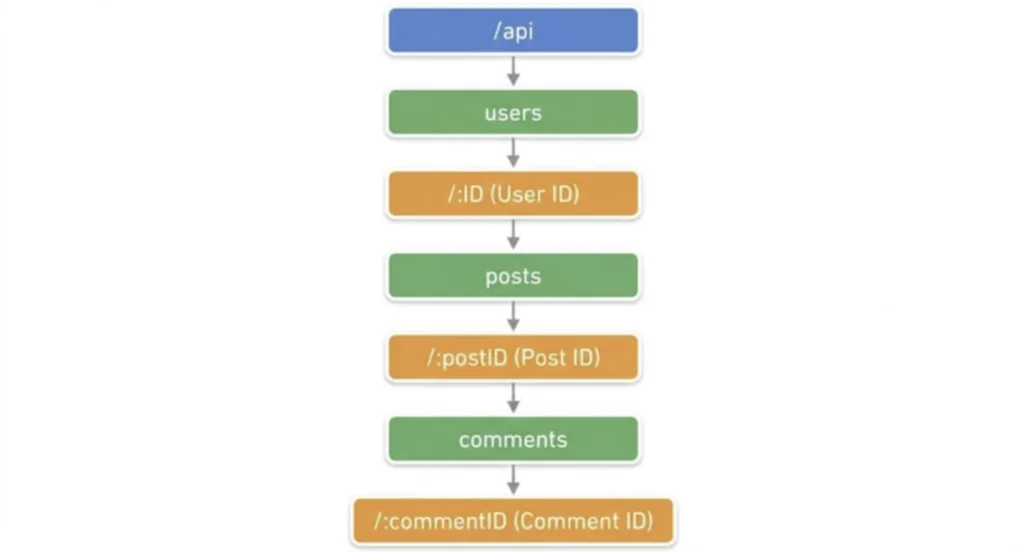
The resulting API structure is conceptually:
/v1
 └── /api
      ├── /users
      │    ├── /
      │    └── /{user_id}
      │
      └── /orders
           └── /
This is where route introspection becomes much more interesting than simply reading a list.
Test the Effective Route Paths
Your first meaningful assertion should verify the effective paths.
from fastapi.routing import iter_route_contexts


def discovered_paths(app):
    return {
        context.path
        for context in iter_route_contexts(
            app.router.routes
        )
    }
Then:
def test_effective_paths(app):
    paths = discovered_paths(app)

    assert "/v1/api/users/" in paths
    assert "/v1/api/users/{user_id}" in paths
    assert "/v1/api/orders/" in paths
This is considerably stronger than:
assert len(paths) > 0
Why?
Because the latter only proves that some route exists.
The former verifies that the routing hierarchy produced the paths your application expects.
Test the Difference Between Local and Effective Paths
This is an important exercise for engineers learning FastAPI routing.
You might define:
users_router = APIRouter(
    prefix="/users"
)


@users_router.get("/{user_id}")
async def get_user(user_id: int):
    ...
Locally, the endpoint looks like:
/{user_id}
But once included through:
api_router.include_router(users_router)
and:
app.include_router(
    api_router,
    prefix="/v1"
)
the application-level route becomes:
/v1/api/users/{user_id}
This distinction matters for:
- API test generation
- authorization mapping
- monitoring
- documentation
- endpoint inventories
- security scanning
Your tooling should reason about the application’s effective routing structure, not merely the local declaration.
Test Nested Routers Instead of Only Direct Routes
A weak test might be:
def test_user_endpoint():
    assert "/users" in discovered_paths(app)
A stronger test deliberately creates nesting:
def test_nested_user_endpoint():
    paths = discovered_paths(app)

    assert "/v1/api/users/{user_id}" in paths
Then add another layer:
internal_router = APIRouter(
    prefix="/internal"
)

internal_router.include_router(users_router)
api_router.include_router(internal_router)
Now the expected route becomes:
/v1/api/internal/users/{user_id}
Test it:
def test_deeply_nested_route():
    paths = discovered_paths(app)

    assert (
        "/v1/api/internal/users/{user_id}"
        in paths
    )
This type of test is valuable because it challenges the exact assumption that often causes route-discovery tools to fail.
Build a Route Signature Instead of Only Comparing Paths
A path isn’t always enough.
Consider:
GET  /users
POST /users
Both operations have the same path.
A test generator therefore needs something closer to:
HTTP method + path
You can create a normalized representation:
def route_signature(context):
    return context.path
Then extend it according to the metadata exposed by the FastAPI version you’re targeting.
Conceptually:
{
    "method": "GET",
    "path": "/v1/api/users/"
}
and:
{
    "method": "POST",
    "path": "/v1/api/users/"
}
become two separate API operations.
This is a critical distinction when building automated API testing.
Route Discovery Can Drive Test Generation
Imagine your API test framework receives:
GET  /v1/api/users/
GET  /v1/api/users/{user_id}
GET  /v1/api/orders/
POST /v1/api/orders/
Instead of manually creating an inventory, your framework can use the discovered route information.
Conceptually:
for route in discover_routes(app):
    generate_api_test(route)
A simple generator might create:
def generate_smoke_test(path):
    return f"""
def test_{normalize(path)}(client):
    response = client.get("{path}")
    assert response.status_code != 404
"""
This isn’t a complete API-testing strategy, but it demonstrates the architecture.
The route layer becomes the input to the testing layer.
Route discovery
      ↓
Endpoint metadata
      ↓
Test generation
      ↓
Smoke tests
      ↓
Contract validation
Don’t Confuse Route Discovery With API Testing
There is an important boundary here.
Discovering an endpoint does not mean the endpoint is tested correctly.
Suppose your tool finds:
POST /users
That doesn’t tell you:
- which fields are required
- which values are valid
- what authentication is required
- what response schema is expected
- what business rules apply
So a mature architecture should combine route discovery with schema information.
Route Context
      +
OpenAPI Schema
      +
Authentication Rules
      +
Test Data
      ↓
Meaningful API Test
This prevents a common mistake:
generating hundreds of shallow tests simply because hundreds of routes exist.
Automation should improve coverage, not create noise.
Use OpenAPI as a Complement
FastAPI already generates OpenAPI documentation.
You can inspect:
schema = app.openapi()
Then:
paths = schema.get("paths", {})
This gives you a specification-oriented representation.
The two approaches solve related but different problems.
| Approach | Primary Purpose | Best Use |
|---|---|---|
iter_route_contexts() | Routing introspection | Framework-aware tooling |
| OpenAPI | API contract description | Client generation, contract testing |
app.routes | Low-level route inspection | Debugging and specialized cases |
| Custom recursion | Manual traversal | Legacy compatibility or unusual tooling |
The strategic approach is often to use route contexts for routing awareness and OpenAPI for contract information.
Detect Route and OpenAPI Mismatches
This can become an interesting QA check.
Suppose route discovery produces:
/v1/users
/v1/users/{id}
/v1/admin/reports
while OpenAPI contains:
/v1/users
/v1/users/{id}
You have discovered a discrepancy.
It doesn’t automatically mean something is wrong.
But it should trigger investigation.
A QA pipeline could report:
Route inventory:
3 endpoints

OpenAPI:
2 operations

Potential discrepancy:
1 route is not represented in OpenAPI
This is a much more useful quality signal than simply checking whether /docs loads successfully.
Test Route Discovery as Infrastructure
This deserves its own test module:
tests/
├── api/
├── integration/
├── security/
└── infrastructure/
     └── test_route_discovery.py
Then:
def test_route_inventory(app):
    routes = list(
        iter_route_contexts(
            app.router.routes
        )
    )

    assert routes
And:
def test_required_routes_exist(app):
    paths = {
        context.path
        for context in iter_route_contexts(
            app.router.routes
        )
    }

    required = {
        "/v1/api/users/",
        "/v1/api/users/{user_id}",
    }

    missing = required - paths

    assert not missing
This is infrastructure testing.
You’re not testing whether /users returns 200.
You’re testing whether the system responsible for understanding your API can still see /users.
That distinction is easy to miss.
Protect Against Silent Coverage Regression
Imagine this situation:
Before upgrade
---------------
Routes discovered: 87


After upgrade
-------------
Routes discovered: 64

Application:
Healthy

CI:
Green
That is dangerous.
Why might CI remain green?
Because your existing tests may only exercise the routes they explicitly know about.
The missing 23 routes could be invisible to the automated discovery layer.
A simple route-count assertion can catch some regressions:
EXPECTED_MINIMUM_ROUTES = 87


def test_route_count(app):
    routes = list(
        iter_route_contexts(
            app.router.routes
        )
    )

    assert len(routes) >= EXPECTED_MINIMUM_ROUTES
But route identity is better.
EXPECTED_ROUTES = {
    "/v1/api/users/",
    "/v1/api/users/{user_id}",
    "/v1/api/orders/",
}


def test_route_inventory(app):
    actual = {
        context.path
        for context in iter_route_contexts(
            app.router.routes
        )
    }

    missing = EXPECTED_ROUTES - actual

    assert not missing
Now the failure tells you what disappeared.
Build a Route Inventory Report
For larger systems, don’t limit discovery to assertions.
Generate a report.
def route_inventory(app):
    inventory = []

    for context in iter_route_contexts(
        app.router.routes
    ):
        inventory.append({
            "path": context.path,
        })

    return inventory
You could serialize it:
import json


with open("route-inventory.json", "w") as file:
    json.dump(
        route_inventory(app),
        file,
        indent=2,
    )
A CI pipeline could then compare inventories between builds.
Build #101
---------
Routes: 142


Build #102
---------
Routes: 145

Added:
+ /v1/reports
+ /v1/reports/{id}
+ /v1/exports
This turns routing into an observable engineering artifact.
Route Inventory as a Change-Detection Mechanism
This idea becomes particularly powerful in CI.
Imagine a pull request changes:
@router.post("/reports")
async def create_report():
    ...
The route inventory changes.
Your CI system can detect:
API surface changed
        ↓
Security review required?
        ↓
New tests required?
        ↓
Documentation changed?
        ↓
Monitoring required?
This is much closer to API governance than traditional endpoint testing.
A route-aware CI system can treat API changes as first-class events.
Use It for Security Regression Testing
Suppose every /admin endpoint must have an authorization dependency.
Your discovery layer can identify the administrative routes:
def admin_routes(app):
    return [
        context
        for context in iter_route_contexts(
            app.router.routes
        )
        if context.path.startswith("/admin")
    ]
Then your security tests can verify policy coverage.
The exact dependency inspection should be implemented according to the FastAPI version and application architecture, but the route discovery layer remains independent.
The architecture is:
Routes
  ↓
Classification
  ↓
Security expectations
  ↓
Verification
This is particularly useful when new endpoints are added by different teams.
Route Discovery and Observability
Observability systems also need accurate route information.
Suppose your monitoring dashboard expects:
GET /users
GET /orders
GET /reports
If route registration depends on a manually maintained list, new endpoints may be forgotten.
Instead:
FastAPI
  ↓
Route discovery
  ↓
Observability registration
  ↓
Metrics
Your monitoring integration can use the discovered route inventory as its source.
This does not mean blindly creating a metric for every route.
High-cardinality concerns still matter.
For example, avoid metric labels containing raw IDs:
/users/123
/users/124
/users/125
Prefer the route template:
/users/{user_id}
That is another reason effective route metadata is valuable.
Route Templates Are Better Than Runtime URLs
A monitoring system should ideally aggregate:
/users/{user_id}
rather than:
/users/123
/users/456
/users/789
Otherwise, every identifier becomes a separate dimension.
That can create unnecessary cardinality.
The conceptual pipeline becomes:
Request:
GET /users/123

Route template:
GET /users/{user_id}

Metrics:
request_count{route="/users/{user_id}"}
Route-aware tooling therefore has value beyond test generation.
It can support production observability.
Compare Framework-Level and Application-Level Knowledge
There are two kinds of information your tooling can consume.
Framework-level information
Routes
Prefixes
Endpoint mappings
Routing hierarchy
Application-level information
Business meaning
Authorization policy
Expected behavior
Test data
Risk classification
A strong platform combines them.
FastAPI routing
      +
Application metadata
      ↓
Engineering intelligence
Don’t expect iter_route_contexts() to solve business-level testing.
It provides infrastructure information.
Your system must add the application semantics.
A Better Test Generator Architecture
A production-oriented API test generator could be structured as:
              FastAPI
                 │
                 ▼
       iter_route_contexts()
                 │
                 ▼
        Route Adapter
                 │
                 ▼
       Endpoint Model
          /     |     \
         ▼      ▼      ▼
     OpenAPI  Policy  Test Data
         \      |      /
          \     |     /
           ▼    ▼    ▼
          Test Scenario
                 │
                 ▼
            API Test
The important design decision is the adapter.
Your test engine should not depend directly on FastAPI route objects.
Instead:
@dataclass
class Endpoint:
    path: str
    methods: set[str]
Then:
FastAPI adapter
      ↓
Endpoint
      ↓
Generic test engine
This gives you a much stronger architecture.
Supporting Multiple Frameworks
Suppose your organization later introduces Flask.
You don’t want to rewrite your entire test generator.
Instead:
FastAPI Adapter ──┐
                  │
Flask Adapter ────┼──► Endpoint Model
                  │
Django Adapter ───┘
                         ↓
                   Test Generator
FastAPI-specific routing remains isolated.
The rest of the system remains framework-independent.
This is one of the strongest arguments for creating a route adapter rather than spreading FastAPI introspection across your codebase.
A Practical Adapter
A simplified adapter could look like:
from fastapi.routing import iter_route_contexts


def fastapi_endpoints(app):
    endpoints = []

    for context in iter_route_contexts(
        app.router.routes
    ):
        endpoints.append({
            "path": context.path,
        })

    return endpoints
Then your generic tooling receives:
endpoints = fastapi_endpoints(app)
The test engine doesn’t need to know where those endpoints came from.
What Should You Actually Test?
For a route-introspection utility, prioritize these cases:
1. Direct routes
2. Router prefixes
3. Nested routers
4. Multiple nesting levels
5. Parameterized paths
6. Multiple HTTP operations
7. Dynamically assembled routers
8. Expected endpoint inventory
9. Framework-version compatibility
10. Security-sensitive routes
This gives you significantly more confidence than testing only one direct endpoint.
An SDET Challenge: Break Your Own Discovery Tool
Try deliberately creating a difficult routing structure.
root = APIRouter(prefix="/api")
v1 = APIRouter(prefix="/v1")
users = APIRouter(prefix="/users")

@users.get("/{user_id}")
async def user(user_id: int):
    return {"id": user_id}

v1.include_router(users)
root.include_router(v1)
app.include_router(root)
Now predict the effective path before running your code.
What should the route inventory contain?
/api/v1/users/{user_id}
Then verify it.
paths = {
    context.path
    for context in iter_route_contexts(
        app.router.routes
    )
}

assert "/api/v1/users/{user_id}" in paths
Now add another router.
Then another prefix.
Then a route after router inclusion.
Your goal is not merely to make the test pass.
Your goal is to discover where your assumptions about routing become wrong.
That is how infrastructure testing becomes engineering rather than checklist execution.
The Upgrade Question
When upgrading FastAPI, don’t ask only:
“Do my API tests still pass?”
Ask five questions:
1. Can I still discover every expected route?
2. Are nested routers represented correctly?
3. Does my OpenAPI inventory still match expectations?
4. Does security tooling still see protected endpoints?
5. Does observability still identify route templates correctly?
This creates a much stronger upgrade validation strategy.
A framework upgrade is not only an application-code event.
For organizations with custom tooling, it’s also an infrastructure compatibility event.
When Direct app.routes Inspection Is Still Appropriate
There is no need to treat every direct inspection as a defect.
For quick diagnostics, you might reasonably do:
for route in app.routes:
    print(type(route), getattr(route, "path", None))
This can be excellent for debugging.
The problem arises when this becomes a permanent dependency for critical infrastructure without understanding the framework’s supported abstractions.
A useful rule is:
Debugging:
direct inspection can be useful

Production integration:
prefer supported framework abstractions
That distinction keeps engineering decisions practical rather than dogmatic.
The Strategic QA Lesson
The most interesting lesson isn’t really about one FastAPI helper.
It is about testable infrastructure.
When an automation framework discovers application structure automatically, the discovery mechanism itself becomes part of the quality chain.
Application
     ↓
Framework
     ↓
Discovery
     ↓
Automation
     ↓
Quality signal
If discovery fails silently, everything downstream can become misleading.
That means route discovery deserves:
- unit tests
- regression tests
- compatibility tests
- CI validation
- change detection
- coverage monitoring
And this is exactly where iter_route_contexts() becomes strategically useful.
Build the Smallest Useful Abstraction
Don’t over-engineer your first implementation.
Start with:
def discover_routes(app):
    return list(
        iter_route_contexts(
            app.router.routes
        )
    )
Then add normalization:
def route_paths(app):
    return {
        context.path
        for context in discover_routes(app)
    }
Then add validation:
def assert_routes_exist(app, expected):
    actual = route_paths(app)
    missing = expected - actual

    assert not missing, (
        f"Missing routes: {missing}"
    )
Now you have a reusable foundation.
From there, you can add:
Security analysis
OpenAPI comparison
Test generation
Observability
API governance
without putting all responsibilities into one function.
A Production-Oriented Mental Model
Think about your API as a continuously changing surface.
Developer change
       ↓
FastAPI route structure
       ↓
Route discovery
       ↓
API inventory
       ↓
Automated analysis
       ├── Testing
       ├── Security
       ├── Documentation
       └── Observability
A route addition should therefore become visible to the systems that depend on API structure.
That is the real opportunity behind framework-aware route introspection.
The strongest implementation is not the one with the most clever recursion.
It is the one that establishes a clean boundary between FastAPI’s routing model and your engineering tooling.
Build a Production-Ready FastAPI Route Discovery Strategy
FastAPI iter_route_contexts() becomes much more valuable when route discovery moves beyond experimentation and becomes part of a production QA, security, observability, or API-governance workflow.
The goal is not simply to prove that the helper can return routes.
The goal is to build a reliable route inventory that remains trustworthy when the application grows, routers become nested, endpoints change, and the FastAPI dependency is upgraded.
A production architecture can look like this:
                    FastAPI Application
                           │
                           ▼
                  iter_route_contexts()
                           │
                           ▼
                    Route Inventory
                           │
             ┌─────────────┼─────────────┐
             ▼             ▼             ▼
        API Testing     Security     Observability
             │             │             │
             └─────────────┼─────────────┘
                           ▼
                    Quality Signals
This approach changes the question from:
“Can I list the routes?”
to:
“Can my engineering platform reliably understand the API surface?”
That is a much more useful question for SDETs.
Create a Stable Route Inventory Contract
A common mistake is allowing every consumer to work directly with FastAPI’s routing objects.
For example:
# test_generator.py

for context in iter_route_contexts(app.router.routes):
    ...
Then:
# security_scanner.py

for context in iter_route_contexts(app.router.routes):
    ...
And again:
# metrics.py

for context in iter_route_contexts(app.router.routes):
    ...
This creates framework coupling everywhere.
Instead, centralize discovery:
from fastapi.routing import iter_route_contexts


def discover_route_contexts(app):
    return list(
        iter_route_contexts(
            app.router.routes
        )
    )
Now your consumers use:
routes = discover_route_contexts(app)
The architectural improvement is small but important:
Before

FastAPI ──► Tests
FastAPI ──► Security
FastAPI ──► Metrics
FastAPI ──► Documentation


After

             FastAPI
                │
                ▼
        Route Discovery
                │
                ▼
        Normalized Inventory
          /       |       \
         ▼        ▼        ▼
      Tests    Security  Metrics
When the framework changes, you have one integration boundary to review instead of dozens.
Normalize the Data
The next step is to create your own representation.
For example:
from dataclasses import dataclass


@dataclass(frozen=True)
class Endpoint:
    path: str
    methods: frozenset[str]
Your discovery layer can then translate framework-specific information into your model.
A simplified version might begin with:
def discover_endpoints(app):
    endpoints = []

    for context in discover_route_contexts(app):
        endpoints.append(
            Endpoint(
                path=context.path,
                methods=frozenset(),
            )
        )

    return endpoints
The exact method extraction should follow the FastAPI version and route-context metadata available in your application.
The important design principle is:
FastAPI-specific knowledge belongs in the adapter, not throughout the test platform.
This becomes extremely useful if your organization eventually supports multiple API frameworks.
FastAPI Adapter ───┐
                   │
Flask Adapter ─────┼──► Endpoint Model
                   │
Django Adapter ────┘
                           │
                           ▼
                     Test Platform
Your generic testing engine now doesn’t care whether the endpoint came from FastAPI, Flask, or another framework.
Add an API Surface Snapshot
Once you have normalized endpoints, create an inventory snapshot.
For example:
def route_snapshot(app):
    return sorted(
        endpoint.path
        for endpoint in discover_endpoints(app)
    )
You could save the result:
import json


snapshot = route_snapshot(app)

with open(
    "api-routes.json",
    "w",
    encoding="utf-8",
) as file:
    json.dump(snapshot, file, indent=2)
A CI job can compare the current snapshot against the previous version.
Imagine a pull request changes the API from:
/users
/users/{user_id}
/orders
to:
/users
/users/{user_id}
/orders
/reports
Your pipeline can report:
API SURFACE CHANGED

Added:
  /reports

Removed:
  none
This is more useful than discovering the change after production deployment.


Turn Route Changes Into QA Signals
A route change should potentially trigger different actions.
For example:
New endpoint
     │
     ├──► API test required?
     │
     ├──► Authentication review?
     │
     ├──► Security policy required?
     │
     ├──► Documentation update?
     │
     └──► Monitoring required?
This is where route discovery becomes strategic.
Suppose a developer introduces:
@router.post("/payments")
async def create_payment():
    ...
The route itself may look harmless.
But from a QA perspective, you may need:
- authentication validation
- authorization testing
- negative input testing
- idempotency testing
- schema validation
- audit logging validation
- performance testing
The route inventory provides the trigger for asking those questions.
Risk-Based Route Classification
Not every endpoint deserves the same testing strategy.
Consider:
GET /health
GET /products
POST /users
POST /payments
DELETE /users/{user_id}
POST /admin/permissions
A simple route inventory can become a risk classification input.
def classify_route(path: str) -> str:
    if path.startswith("/admin"):
        return "critical"

    if "payment" in path:
        return "critical"

    if path.startswith("/users"):
        return "high"

    return "normal"
Then:
for endpoint in discover_endpoints(app):
    risk = classify_route(endpoint.path)

    print(
        endpoint.path,
        risk,
    )
This is intentionally simple.
A real enterprise implementation could use:
- HTTP method
- authentication requirement
- data classification
- business domain
- endpoint ownership
- historical failures
- transaction impact
The result could be:
Route                     Risk
------------------------------------------------
/health                   Low
/products                 Normal
/users                    High
/payments                 Critical
/admin/permissions        Critical
Now your automation platform can prioritize testing intelligently.
Combine Route Discovery With OpenAPI
Route discovery and OpenAPI should not be treated as competitors.
They provide different information.
A useful architecture is:
              FastAPI
              /     \
             /       \
            ▼         ▼
Route Discovery      OpenAPI
     │                  │
     ▼                  ▼
Routing context      API contract
     │                  │
     └────────┬─────────┘
              ▼
        Endpoint Model
              │
              ▼
         Test Scenarios
Route information can tell you what the application routing layer exposes.
OpenAPI can provide contract-level information such as schemas and documented operations.
Together they can produce stronger automation.
Detect Documentation Drift
Imagine route discovery reports:
/v1/users
/v1/orders
/v1/reports
but OpenAPI contains:
/v1/users
/v1/orders
Your system should flag:
Potential documentation drift:

Route:
  /v1/reports

OpenAPI:
  missing
Don’t immediately classify this as a defect.
There may be intentional exclusions.
But the discrepancy deserves an explicit decision.
This is a powerful QA pattern:
Turn silent differences between system representations into visible quality signals.
Build a Route Contract Test
You can maintain a list of important endpoints:
EXPECTED_ENDPOINTS = {
    "/v1/users",
    "/v1/users/{user_id}",
    "/v1/orders",
}
Then:
def test_required_routes(app):
    actual = {
        endpoint.path
        for endpoint in discover_endpoints(app)
    }

    missing = EXPECTED_ENDPOINTS - actual

    assert not missing, (
        f"Missing API routes: {missing}"
    )
This protects against accidental removal.
But there is another useful check.
Detect unexpected routes:
def test_unexpected_routes(app):
    actual = {
        endpoint.path
        for endpoint in discover_endpoints(app)
    }

    unexpected = actual - EXPECTED_ENDPOINTS

    assert not unexpected, (
        f"Unexpected API routes: {unexpected}"
    )
This can be particularly valuable for tightly controlled APIs.
Use an Allowlist Carefully
An endpoint allowlist provides control but can become expensive to maintain.
Consider:
EXPECTED_ENDPOINTS = {
    "/users",
    "/orders",
    "/reports",
}
If your application grows to 1,000 endpoints, manually maintaining every endpoint may become unrealistic.
A better enterprise strategy can combine:
Automatic discovery
        +
Critical endpoint allowlist
        +
Change detection
        +
Risk classification
That means you don’t need to manually describe every route.
You only explicitly govern what is business-critical.
Test Route Discovery During FastAPI Upgrades
Framework upgrades deserve special attention.
Suppose your application uses a particular FastAPI release today and upgrades tomorrow.
Your normal API tests might still pass.
But your custom tooling could behave differently.
Therefore, add discovery checks to your upgrade suite:
def test_route_inventory_after_upgrade(app):
    routes = discover_route_contexts(app)

    assert len(routes) >= EXPECTED_MINIMUM
And verify critical paths:
CRITICAL_ROUTES = {
    "/v1/payments",
    "/v1/admin/users",
}


def test_critical_routes_after_upgrade(app):
    actual = {
        context.path
        for context in discover_route_contexts(app)
    }

    assert CRITICAL_ROUTES <= actual
This gives you an early warning if a framework change affects your integration.
Build a Compatibility Layer
If your project supports several FastAPI versions, isolate compatibility decisions.
Instead of:
if version_a:
    ...
elif version_b:
    ...
throughout your project, keep them in one module:
route_discovery/
├── __init__.py
├── fastapi_adapter.py
├── models.py
└── compatibility.py
Then:
def discover_endpoints(app):
    return fastapi_adapter.discover(app)
The rest of your application simply consumes:
endpoints = discover_endpoints(app)
This is much easier to maintain.
Test the Failure Modes, Not Just the Happy Path
Good infrastructure testing asks:
“How can this discovery system lie to me?”
That’s a better question than:
“Does this function return a list?”
Build tests around failure scenarios.
Missing nested router
def test_nested_router_is_discovered(app):
    routes = route_paths(app)

    assert "/api/v1/users/{user_id}" in routes
Missing critical route
def test_payment_route_exists(app):
    assert "/api/v1/payments" in route_paths(app)
Unexpected API exposure
def test_no_unapproved_admin_route(app):
routes = route_paths(app)
unexpected = {
path
for path in routes
if path.startswith("/admin/")
and path not in APPROVED_ADMIN_ROUTES
}
assert not unexpected
These tests turn route discovery into an active control rather than a passive utility.
Don’t Use Route Count as Your Only Metric
Route count is useful but insufficient.
Consider:
Build A:
100 routes
Build B:
100 routes
Looks healthy.
But perhaps:
Build A:
100 expected routes
Build B:
98 old routes
+ 2 accidental routes
The count remains exactly the same.
Therefore, use multiple signals:
Route count
+
Route identity
+
Critical route checks
+
Risk classification
+
OpenAPI comparison
This is much harder for a regression to escape.
Build an Endpoint Fingerprint
A useful technique is creating a deterministic fingerprint.
For example:
import hashlib
def endpoint_fingerprint(paths):
normalized = "\n".join(sorted(paths))
return hashlib.sha256(
normalized.encode("utf-8")
).hexdigest()
Then:
paths = route_paths(app)
fingerprint = endpoint_fingerprint(paths)
print(fingerprint)
A change in the API surface changes the fingerprint.
CI can store the previous value and report:
API fingerprint changed.
Previous:
a91...
Current:
e32...
This doesn’t replace detailed comparison, but it provides a fast signal.
Compare Route Discovery With Manual Registration
Some teams maintain a separate registry:
REGISTERED_ENDPOINTS = {
"/users",
"/orders",
}
Meanwhile FastAPI knows:
/users
/orders
/reports
Now your QA tooling can compare:
registered = REGISTERED_ENDPOINTS
discovered = route_paths(app)
missing_registration = discovered - registered
Result:
Missing manual registration:
/reports
This helps identify systems that depend on manually synchronized metadata.
A better long-term strategy is often to reduce duplicated configuration where automatic discovery is reliable.
Route Discovery for Contract Testing
Contract testing can benefit from route inventories.
Imagine:
Consumer:
Mobile App
Provider:
FastAPI API
The provider exposes:
/users
/orders
/payments
Your contract test platform can verify that expected endpoints still exist.
EXPECTED_PROVIDER_ROUTES = {
"/users",
"/orders",
"/payments",
}
Then:
def test_provider_routes(app):
actual = route_paths(app)
assert EXPECTED_PROVIDER_ROUTES <= actual
This doesn’t validate the entire contract.
But it establishes a structural compatibility check before deeper schema assertions execute.
Combine Structural and Behavioral Testing
This produces a useful testing hierarchy:
Level 1
Route exists
↓
Level 2
Correct method exists
↓
Level 3
OpenAPI contract exists
↓
Level 4
Authentication works
↓
Level 5
Validation works
↓
Level 6
Business behavior works
↓
Level 7
Performance/security requirements pass
Route discovery primarily supports the earliest layers.
But those layers are important because they provide the foundation for the rest.
If the endpoint isn’t even discovered, downstream automated coverage may never reach it.
A Practical SDET Route Audit
Run this exercise against one of your real FastAPI applications.
Start with:
routes = list(
iter_route_contexts(
app.router.routes
)
)
Count them:
print("Routes:", len(routes))
Then inspect paths:
for context in routes:
print(context.path)
Now classify them:
for context in routes:
print(
classify_route(context.path),
context.path,
)
Finally compare them with your documented API:
openapi_paths = set(
app.openapi()["paths"]
)
discovered_paths = {
context.path
for context in routes
}
Then:
print(
"Undocumented:",
discovered_paths - openapi_paths,
)
You have now turned a simple framework utility into a practical API-quality audit.
What Should Your CI Pipeline Check?
A mature pipeline could implement:
Pull Request
│
▼
Build FastAPI App
│
▼
Discover Route Set
│
┌───────────┼───────────┐
▼ ▼ ▼
Compare Security OpenAPI
Snapshot Rules Contract
│ │ │
└───────────┼───────────┘
▼
Quality Gate
For example:
✓ All critical routes present
✓ No unexpected admin routes
✓ OpenAPI differences reviewed
✓ API fingerprint change reviewed
✓ Route-based smoke tests generated
✓ Security coverage validated
Now route changes become part of engineering governance.
When to Prefer a Framework Helper Over Custom Traversal
There is a recurring temptation to write your own recursive traversal.
It might begin with:
def walk_routes(routes):
for route in routes:
yield route
if hasattr(route, "routes"):
yield from walk_routes(
route.routes
)
It looks simple.
But now your code owns assumptions about:
- nested route structures
- route object types
- internal attributes
- framework evolution
- edge cases
- compatibility behavior
If the framework provides an appropriate abstraction, use it where it matches your requirement.
Your custom logic should add application-specific behavior rather than recreate framework internals unnecessarily.
The Difference Between Convenience and Architecture
There is an important distinction.
This:
list(
iter_route_contexts(
app.router.routes
)
)
is merely a convenience call.
This:
FastAPI
↓
iter_route_contexts()
↓
Endpoint Model
↓
Security
Testing
Observability
Governance
is architecture.
The value doesn’t come from the helper alone.
The value comes from where you place the helper in your engineering system.
Production Checklist
Before adopting route discovery as a foundation for tooling, validate:
□ Direct routes discovered
□ Nested routers discovered
□ Multiple prefixes handled
□ Parameterized paths preserved
□ Critical endpoints monitored
□ Route identities compared
□ OpenAPI differences detected
□ Security-sensitive endpoints classified
□ Route changes visible in CI
□ FastAPI upgrade tests added
□ Framework-specific code isolated
□ Generic endpoint model created
□ Route inventory can be reproduced
□ Silent route loss causes a failure
Don’t check every box just because a checklist exists.
Choose the controls that correspond to your application’s risk.
A small internal API may need only route regression tests.
A financial platform may need route inventory, security classification, API governance, contract comparison, and CI approval gates.
Internal Links
- FastAPI 0.141.1 Released: Background Task Fixes That Strengthen Modern API Development
- FastAPI 0.141.0 Released: New Frontend Development Enhancement Every QA Engineer and Python Developer Know
- FastAPI 0.140.13 Released: Critical Streaming API Fixes Every QA Engineer and Backend Developer Should Know
- FastAPI 0.139.2 Improves Thread Safety for Parallel Testing and Enterprise API Reliability
- FastAPI 0.139.0 Released: Powerful Frontend Authentication Improvements for QA Engineers
- FastAPI 0.138.1 Released: Important Quality Improvements Every QA Engineer Should Know
- FastAPI 0.138.0 Released: 9 Powerful Improvements QA Engineers Must Know in 2026
- FastAPI 0.137.2 Release: 5 Important Updates for QA Engineers
- FastAPI 0.137.1 Released: Important API Routing Fixes QA Engineers Should Upgrade For
- FastAPI 0.136.3 Released: 7 Critical Security Improvements QA Engineers Must Know in 2026
Official Resources
- Official Release Notes: https://github.com/fastapi/fastapi/releases/tag/0.141.1
- Official Documentation: https://fastapi.tiangolo.com
AI Overview Optimization
FastAPI
iter_route_contexts()is a route-discovery utility that can be used to inspect the routing structure of a FastAPI application. It is particularly useful for building API inventories, automated test generation, security checks, OpenAPI comparisons, observability integrations, and CI regression checks.
What is iter_route_contexts() in FastAPI?
iter_route_contexts() can be used to iterate through route contexts associated with a FastAPI application’s routing structure. It is useful when tooling needs structured awareness of registered endpoints.
How can I discover FastAPI routes?
A route-discovery workflow can use:
from fastapi.routing import iter_route_contexts
routes = list(
iter_route_contexts(
app.router.routes
)
)Why use route discovery in API testing?
Route discovery allows QA tooling to build an endpoint inventory automatically instead of maintaining every endpoint manually. That inventory can support smoke tests, regression checks, security validation, contract testing, and API change detection.
Should FastAPI routes be compared with OpenAPI?
Yes. Route discovery and OpenAPI provide complementary information. Comparing them can help identify potential documentation drift or unexpected API-surface changes.
Can route discovery help with CI?
Yes. A CI pipeline can compare discovered routes against an approved inventory, detect missing critical endpoints, identify newly exposed routes, and trigger additional testing or security review.
People Asked Questions
1. What is iter_route_contexts() in FastAPI?iter_route_contexts() is a route-discovery mechanism that allows tooling to inspect route contexts associated with a FastAPI application’s routing structure.
2. How do I use iter_route_contexts() with FastAPI?
A basic approach is to import it from FastAPI’s routing module and pass the application’s registered routes:
from fastapi.routing import iter_route_contexts
routes = list(
iter_route_contexts(
app.router.routes
)
)3. Why is FastAPI route discovery useful for QA engineers?
It allows QA and SDET tooling to automatically build an API route inventory that can support regression testing, security checks, API contract validation, and CI monitoring.
4. Can iter_route_contexts() discover nested FastAPI routes?
It can be used as part of route-context discovery across an application’s routing structure, including applications that use router composition and prefixes.
5. Can I use FastAPI route discovery to generate API tests?
Yes. Discovered route information can become an input to a test-generation system. However, route discovery alone does not provide business rules, valid test data, or complete API contracts.
6. Is route discovery the same as OpenAPI?
No. Route discovery focuses on the application’s routing structure, while OpenAPI describes the API contract and can include schemas, parameters, responses, and documented operations.
7. Should I use app.routes or iter_route_contexts()?
For simple debugging, directly inspecting app.routes can be useful. For framework-aware tooling, use the appropriate supported route-context abstraction for the FastAPI version your project targets.
8. Can route discovery detect API changes?
Yes. Teams can compare route inventories between builds to detect added, removed, or changed API endpoints.
9. Can route discovery improve API security testing?
Yes. Discovered routes can be classified by risk and compared against authentication, authorization, and security expectations.
10. Should route discovery itself be tested?
Yes. If automated testing, security, documentation, or observability depends on route discovery, the discovery layer becomes an important piece of test infrastructure and should have regression coverage.
Conclusion
FastAPI iter_route_contexts() is most useful when treated as part of a broader route-discovery architecture rather than as a replacement for manually iterating through route objects.
The strongest implementation has a clear boundary:
FastAPI routing
↓
iter_route_contexts()
↓
Route adapter
↓
Normalized endpoint model
↓
Engineering systems
That separation gives QA and SDET teams a reliable foundation for automated API discovery.
It also creates opportunities that are easy to overlook.
A route inventory can become a source for:
- API smoke-test generation
- contract validation
- security regression testing
- documentation-drift detection
- observability registration
- API change detection
- risk-based testing
- framework upgrade validation
Most importantly, it changes how you think about API automation.
Instead of maintaining every endpoint manually, you can build systems that understand the application’s API surface dynamically.
And that leads to a broader engineering principle:
Automation becomes more reliable when it discovers application structure through stable framework abstractions instead of depending on framework internals.
Final Key Takeaways
- Use
iter_route_contexts()when your tooling needs framework-aware route discovery. - Centralize FastAPI-specific discovery instead of calling the helper throughout your codebase.
- Normalize discovered information into your own endpoint model when building reusable tooling.
- Test nested routers, prefixes, parameterized paths, and critical endpoints—not only direct routes.
- Don’t rely on route count alone. Compare route identities and critical endpoint sets.
- Combine routing information with OpenAPI, security metadata, and test data for meaningful automation.
- Treat API surface changes as CI signals rather than discovering them after deployment.
- Include route-discovery checks in FastAPI upgrade validation.
- Use route inventories as inputs to security, testing, observability, and governance systems.
- Most importantly, test the discovery layer itself. If your automation cannot reliably see the API, the rest of your automation may provide false confidence.
Continue Learning
Explore more expert articles on Mobile Testing, Backend & API, AI & Agentic, AI Tools, n8n, LangChain, CrewAI, MCP Servers, AI Agents, LlamaIndex, Docker, FastAPI, Playwright, Cypress, Test Automation, DevOps, and Software Engineering at www.skakarh.com.
QAPulse by SK delivers expert release analysis, AI engineering insights, enterprise automation strategies, migration guidance, DevOps best practices, and practical testing knowledge to help software professionals build scalable, intelligent, and production-ready software systems.