 QA
QA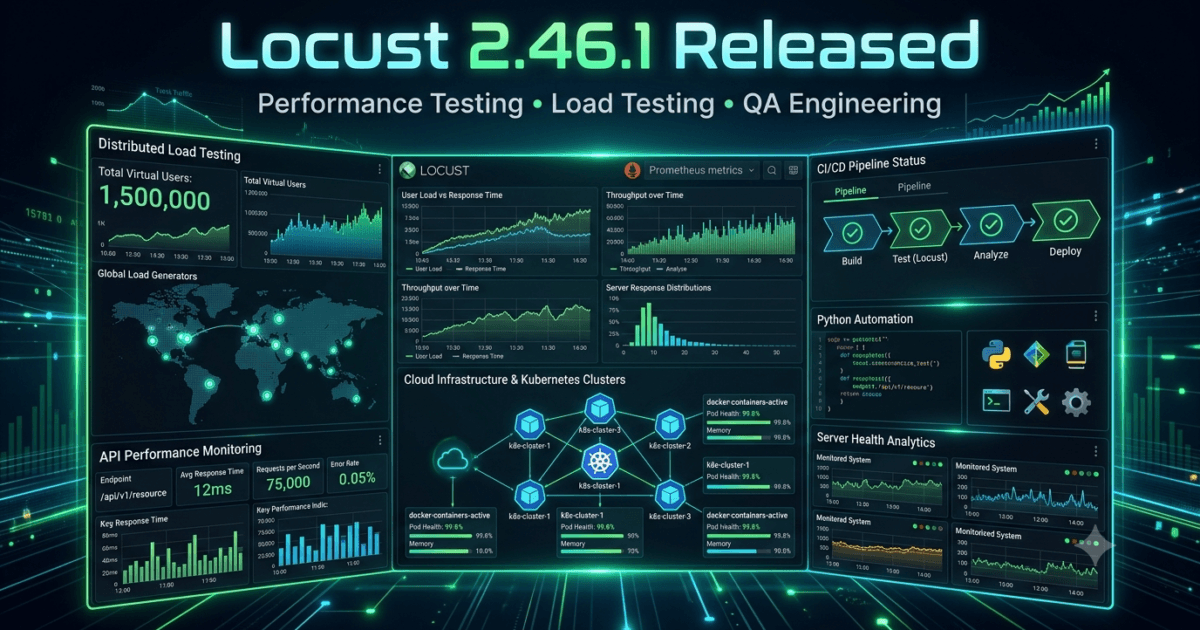
Performance testing has become a mission-critical activity for modern software teams as applications continue to scale across cloud-native platforms, microservices, APIs, AI-powered systems, and globally distributed infrastructures. To keep pace with these evolving architectures, performance testing frameworks must continuously improve compatibility, stability, and ecosystem support. Locust 2.46.1, released on July 21, 2026, is another important maintenance release that focuses on modernizing the framework while improving compatibility with the latest Python ecosystem.
Although this release does not introduce major user-facing performance testing features, it delivers several meaningful improvements that benefit QA Engineers, SDETs, Performance Test Engineers, Site Reliability Engineers (SREs), DevOps Engineers, and Software Architects. The highlights include removing support for the end-of-life Python 3.10, enabling compatibility with newer gevent versions, and enhancing swarm state management through improved handling of extraOptions.
For organizations running enterprise-scale performance testing, these changes help ensure that Locust remains compatible with current Python releases, asynchronous networking libraries, containerized execution environments, and modern CI/CD pipelines. Maintaining compatibility with actively supported dependencies is essential for reducing technical debt, minimizing security risks, and ensuring long-term maintainability of performance testing infrastructure.
Locust continues to be one of the most widely adopted open-source load testing frameworks because of its Python-first approach, distributed execution capabilities, lightweight architecture, and seamless integration with DevOps workflows. Whether teams are testing REST APIs, GraphQL services, microservices, Kubernetes applications, cloud-native platforms, or AI-powered systems, Locust remains a preferred choice for scalable performance engineering.
This release reinforces the project’s commitment to keeping the framework aligned with the latest Python ecosystem while improving stability for enterprise users.
Official Release Highlights
According to the official Locust 2.46.1 release notes, this version includes the following updates:
Key Changes
- Removed support for Python 3.10
- Added compatibility with newer gevent releases
- Updated swarm state management with extraOptions
- Welcomed a new contributor to the project
- Continued framework maintenance and ecosystem modernization
While these changes appear relatively small, they have significant implications for organizations maintaining long-lived automation and performance testing environments.
Locust 2.46.1 Release Overview
| Category | Details |
|---|---|
| Version | Locust 2.46.1 |
| Release Date | July 21, 2026 |
| Release Type | Maintenance Release |
| Primary Focus | Compatibility & Framework Stability |
| Python Support | Python 3.11+ |
| Distributed Testing | Improved |
| Breaking Changes | Python 3.10 Removed |
| Upgrade Recommendation | Recommended after validation |
Python 3.10 Support Has Been Removed
One of the most important updates in Locust 2.46.1 is the removal of Python 3.10 support.
While this may initially appear as a breaking change, it reflects the normal lifecycle of Python releases. Once a Python version reaches the end of its supported lifecycle, maintaining compatibility becomes increasingly difficult and may expose projects to unresolved security issues, dependency conflicts, and maintenance overhead.
For enterprise QA teams, this change signals that performance testing environments should migrate to newer Python versions such as:
- Python 3.11
- Python 3.12
- Python 3.13
- Future Python 3.15 support
Moving to supported Python versions provides several advantages:
- Better runtime performance
- Improved memory efficiency
- Faster asynchronous execution
- Enhanced security updates
- Better compatibility with modern packages
- Long-term ecosystem support
Organizations still running Python 3.10 should prioritize migration before adopting Locust 2.46.1.
Improved Compatibility with New gevent Versions
Another valuable enhancement is expanded compatibility with newer gevent releases.
Since Locust relies heavily on gevent for asynchronous concurrency and efficient virtual user simulation, maintaining compatibility with the latest gevent versions is critical for achieving optimal performance.
Benefits include:
- Better asynchronous scheduling
- Improved coroutine management
- Enhanced network performance
- Reduced compatibility issues
- Better integration with modern Python releases
- Simplified dependency management
For performance engineers executing thousands of concurrent virtual users, even small improvements in asynchronous execution can contribute to more stable and predictable load testing environments.
Enhanced Swarm State Management
Locust 2.46.1 also improves swarm state handling by supporting additional extraOptions.
Although this enhancement primarily affects advanced distributed testing scenarios, it provides greater flexibility when managing large-scale performance test executions.
Enterprise teams operating distributed Locust clusters can benefit from:
- Improved worker coordination
- Better execution consistency
- More flexible runtime configuration
- Enhanced swarm management
- Better support for customized deployment environments
These refinements help organizations running performance tests across Kubernetes clusters, Docker Swarm, cloud infrastructure, or distributed CI/CD pipelines.
Why This Release Matters
Maintenance releases often deliver the highest long-term value despite lacking flashy new features.
Locust 2.46.1 helps organizations:
- Stay aligned with supported Python versions
- Reduce dependency-related technical debt
- Improve framework compatibility
- Maintain secure testing environments
- Simplify future framework upgrades
- Strengthen distributed performance testing infrastructure
As enterprise software systems continue adopting cloud-native architectures, serverless platforms, AI applications, and event-driven services, maintaining an up-to-date performance testing framework becomes increasingly important.
Organizations that postpone maintenance upgrades often accumulate compatibility issues that make future migrations significantly more complex.
Performance Testing Ecosystem Impact
Modern performance engineering extends well beyond generating virtual users.
Today’s QA teams integrate Locust with:
- Docker
- Kubernetes
- Jenkins
- GitHub Actions
- Azure DevOps
- GitLab CI/CD
- Prometheus
- Grafana
- OpenTelemetry
- AWS
- Azure
- Google Cloud
- Python automation frameworks
- API testing platforms
Keeping Locust compatible with the latest versions of Python and gevent ensures smoother integration across this rapidly evolving ecosystem.
Upgrade Commands
Upgrade Using pip
pip install --upgrade locust
Install Specific Version
pip install locust==2.46.1
Verify Installed Version
locust --version
Upgrade Project Dependencies
pip install --upgrade -r requirements.txt
Initial Upgrade Recommendation
For organizations already running supported Python versions, Locust 2.46.1 is a recommended maintenance upgrade that improves compatibility and keeps performance testing infrastructure aligned with the latest ecosystem developments.
Teams still using Python 3.10 should first migrate to a supported Python release before upgrading Locust. Once migration is complete, QA Engineers should execute smoke tests, load tests, distributed execution validation, CI/CD pipelines, Docker-based environments, and monitoring integrations to confirm that the upgraded framework behaves consistently across production testing workflows. By staying current with maintenance releases such as Locust 2.46.1, organizations can reduce technical debt, improve long-term framework stability, and ensure their performance engineering practices remain reliable, scalable, and future-ready.
Enterprise Migration Guide for Locust 2.46.1
Upgrading to Locust 2.46.1 should be treated as more than a routine dependency update, especially for organizations that rely on continuous performance testing to validate mission-critical applications. Enterprise QA teams often execute thousands—or even millions—of virtual users across distributed environments, cloud infrastructure, Kubernetes clusters, and CI/CD pipelines. Even though Locust 2.46.1 is classified as a maintenance release, the removal of Python 3.10 support makes it an important upgrade that deserves careful planning.
Rather than upgrading directly in production, organizations should adopt a phased migration strategy that validates every aspect of the performance testing ecosystem. This approach minimizes operational risk while ensuring compatibility with the latest Python runtime, gevent versions, monitoring tools, and automation infrastructure.
A recommended enterprise migration workflow includes:
- Audit the current Python version across all Locust environments.
- Upgrade Python to a supported version (3.11 or newer) if necessary.
- Update Locust in a staging environment.
- Upgrade dependent Python packages.
- Validate distributed worker communication.
- Execute smoke load tests.
- Run full-scale performance and stress tests.
- Verify dashboards and monitoring integrations.
- Validate CI/CD automation pipelines.
- Roll out gradually to production performance testing environments.
Following this structured migration strategy reduces downtime, avoids compatibility surprises, and keeps performance testing infrastructure aligned with modern software engineering standards.
What This Means for QA Engineers
For QA Engineers, Performance Test Engineers, SDETs, DevOps Engineers, and Site Reliability Engineers (SREs), Locust 2.46.1 highlights the importance of maintaining not only test scripts but also the underlying testing framework and runtime environment.
The removal of Python 3.10 support serves as a reminder that automation infrastructure should evolve alongside the broader software ecosystem. Teams that regularly update frameworks, dependencies, and runtime versions are better positioned to avoid security vulnerabilities, dependency conflicts, and future migration challenges.
This release also emphasizes compatibility with newer gevent versions, which directly impacts asynchronous task scheduling and virtual user execution. For organizations running distributed load tests against APIs, microservices, cloud-native applications, and AI-powered systems, maintaining compatibility with modern concurrency libraries improves overall test reliability and execution efficiency.
QA teams should use this upgrade as an opportunity to review their complete performance testing workflow, including:
- Load testing scenarios
- Stress testing scripts
- Spike testing configurations
- Endurance testing
- API performance validation
- Database performance tests
- Distributed worker execution
- Kubernetes deployments
- Docker containers
- CI/CD pipelines
- Performance dashboards
- Monitoring integrations
- Custom Python libraries
- Third-party Locust plugins
Regular framework maintenance ensures that performance testing remains accurate, scalable, and capable of supporting modern software delivery pipelines.
Locust 2.46.1 Enterprise Upgrade Checklist
Before promoting Locust 2.46.1 into production, organizations should complete a comprehensive validation process.
| Validation Area | Recommended Action |
|---|---|
| Python Runtime | Confirm Python 3.11+ is installed |
| Framework Installation | Verify successful Locust upgrade |
| gevent Compatibility | Test latest supported version |
| Distributed Workers | Validate worker-master communication |
| Swarm Configuration | Test extraOptions behavior |
| Load Scripts | Execute smoke tests |
| Stress Testing | Run high-concurrency scenarios |
| API Performance | Validate response metrics |
| Monitoring | Confirm Grafana and Prometheus dashboards |
| Docker | Test containerized execution |
| Kubernetes | Validate distributed deployments |
| GitHub Actions | Verify automation workflows |
| Jenkins | Execute scheduled performance jobs |
| Azure DevOps | Confirm pipeline compatibility |
| Reports | Validate HTML and CSV reporting |
Completing this checklist significantly reduces deployment risks while improving confidence in enterprise performance testing environments.
Best Practices Before Upgrading Locust
Maintenance releases provide an ideal opportunity to modernize the entire testing ecosystem rather than upgrading a single package.
Upgrade the Python Runtime First
Since Locust 2.46.1 removes support for Python 3.10, migrating to Python 3.11 or newer should be completed before upgrading the framework. This ensures compatibility with future Locust releases and the broader Python ecosystem.
Update Dependencies Together
Review related packages such as gevent, requests, urllib3, monitoring libraries, reporting tools, and internal utilities. Keeping dependencies synchronized minimizes compatibility issues.
Validate Distributed Execution
Organizations using master-worker architectures should verify worker registration, synchronization, and execution consistency after upgrading.
Monitor Resource Consumption
Compare CPU usage, memory consumption, response times, and virtual user throughput before and after the upgrade. Maintenance releases may improve runtime efficiency even when no visible features are added.
Execute Realistic Load Scenarios
Avoid relying solely on smoke tests. Validate production-like workloads that simulate realistic traffic patterns, concurrent users, and peak demand conditions.
Locust 2.46.0 vs Locust 2.46.1
| Feature | Locust 2.46.0 | Locust 2.46.1 |
|---|---|---|
| Python Support | Included Python 3.10 | Python 3.10 Removed |
| gevent Compatibility | Previous Support | Expanded Support |
| Swarm Management | Standard | Improved extraOptions Handling |
| Framework Stability | Excellent | Enhanced |
| Dependency Management | Stable | Improved |
| Enterprise Readiness | High | Higher |
| Upgrade Recommendation | Recommended | Strongly Recommended |
This comparison illustrates that Locust 2.46.1 primarily focuses on ecosystem modernization and long-term maintainability rather than introducing new end-user functionality.
Breaking Changes
The most significant breaking change in Locust 2.46.1 is the removal of Python 3.10 support.
Organizations still running Python 3.10 will need to upgrade their runtime environment before adopting this release. Fortunately, teams already using Python 3.11, Python 3.12, or newer versions should experience a smooth migration with minimal framework changes.
Other than the Python version requirement, no major API-breaking changes have been highlighted in the official release notes.
Should You Upgrade to Locust 2.46.1?
Upgrade Immediately If You:
- Already use Python 3.11 or newer
- Run enterprise load testing
- Maintain distributed Locust clusters
- Integrate Locust into CI/CD pipelines
- Use Docker or Kubernetes
- Need compatibility with newer gevent releases
Plan Migration First If You:
- Still rely on Python 3.10
- Maintain legacy performance testing infrastructure
- Use custom Locust extensions requiring compatibility validation
- Operate highly regulated production environments
Final Recommendation
Locust 2.46.1 is a highly recommended maintenance release for organizations running supported Python versions. Although the update appears relatively small, it modernizes the framework by removing outdated runtime support, improving compatibility with newer gevent releases, and enhancing distributed swarm configuration handling. These changes contribute to a more stable, secure, and future-ready performance testing platform. Enterprise QA Engineers, Performance Test Engineers, SDETs, DevOps teams, and Site Reliability Engineers should include Locust 2.46.1 in their regular maintenance cycle after completing comprehensive regression testing, distributed execution validation, monitoring verification, and CI/CD pipeline checks. Keeping Locust current ensures scalable performance testing, reduced technical debt, and continued compatibility with modern cloud-native software development practices.
External Resources
- Official Locust Release Notes: https://github.com/locustio/locust/releases/tag/2.46.1
- Locust Documentation: https://docs.locust.io
- Locust GitHub Repository: https://github.com/locustio/locust
More Relevant Articles
- Locust 2.46.0 Enhances Python 3.15 Readiness and Improves Enterprise Load Testing Reliability
- Locust 2.45.0 Released: Smarter Load Testing, Better Metrics Accuracy, and Improved Performance for QA Engineers
- Locust 2.44.4 Release: Important Parsing Fix Every Performance Tester Should Know
- Locust 2.44.3 Released: Important Build Stability Fix Performance Testers Should Know
- Locust 2.44.1 Released: Valuable Observability Improvements Performance Test Engineers Will Love
- Locust 2.44.0 Released: Why Performance Engineers Should Care
Featured Snippet Optimized Answer
What is Locust 2.46.1?
Locust 2.46.1 is a maintenance release of the popular open-source Python performance testing framework. It removes support for Python 3.10, improves compatibility with newer gevent versions, enhances swarm configuration handling, and helps enterprise QA teams maintain modern, secure, and scalable load testing environments.
People Also Ask (PAA)
What is new in Locust 2.46.1?
Locust 2.46.1 removes Python 3.10 support, adds compatibility with newer gevent releases, improves swarm state handling through extraOptions, and modernizes the framework for supported Python environments.
Should I upgrade to Locust 2.46.1?
Yes. Teams already using Python 3.11 or newer should upgrade after validating their load testing scripts, distributed execution, CI/CD pipelines, and monitoring integrations.
Does Locust 2.46.1 introduce breaking changes?
The primary breaking change is the removal of Python 3.10 support. Organizations must migrate to a supported Python version before upgrading.
Why did Locust remove Python 3.10 support?
Python 3.10 has reached the end of its supported lifecycle for many projects. Removing support reduces maintenance overhead while improving compatibility with newer Python releases.
Is Locust 2.46.1 suitable for enterprise performance testing?
Yes. The release improves long-term maintainability, dependency compatibility, distributed execution, and performance testing reliability for enterprise environments.
What should QA Engineers validate after upgrading?
Teams should validate distributed workers, CI/CD pipelines, Docker environments, Kubernetes deployments, API load tests, monitoring dashboards, reporting, and regression performance tests.
Frequently Asked Questions
Is Locust 2.46.1 a major release?
No. It is a maintenance release focused on framework modernization, dependency compatibility, and long-term stability.
Can I continue using Python 3.10?
No. Locust 2.46.1 officially removes support for Python 3.10. Upgrade to Python 3.11 or newer before installing this release.
Does Locust 2.46.1 improve performance?
While it does not introduce benchmark-focused optimizations, improved compatibility with newer gevent versions contributes to a more stable and efficient execution environment.
Do I need to modify existing Locust scripts?
Most performance test scripts should continue working without changes. However, organizations should validate custom extensions and dependencies after upgrading.
Should DevOps teams update CI/CD pipelines?
Yes. CI/CD environments should be reviewed to ensure they use supported Python versions and compatible dependencies before upgrading Locust.
Is gevent compatibility important?
Absolutely. Since Locust relies heavily on gevent for asynchronous concurrency, supporting newer versions helps maintain efficient virtual user execution and long-term framework compatibility.
Is this release recommended for enterprise testing?
Yes. Organizations running distributed load testing, cloud-native applications, APIs, and microservices should include Locust 2.46.1 in their regular maintenance cycle.
Continue Learning with QAPulse by SK
At QAPulse by SK, we continuously analyze the latest releases across Locust, k6, JMeter, Playwright, Selenium, FastAPI, Python, Docker, Node.js, CrewAI, LangChain, MCP Servers, and many other technologies powering modern software engineering.
Our mission is to help QA Engineers, Performance Test Engineers, SDETs, DevOps Engineers, Cloud Architects, and AI Engineers stay ahead through in-depth release analyses, migration guides, regression testing strategies, performance engineering best practices, benchmarking techniques, and enterprise-grade automation insights that enable teams to build scalable, reliable, and high-performing software systems.