QA
QA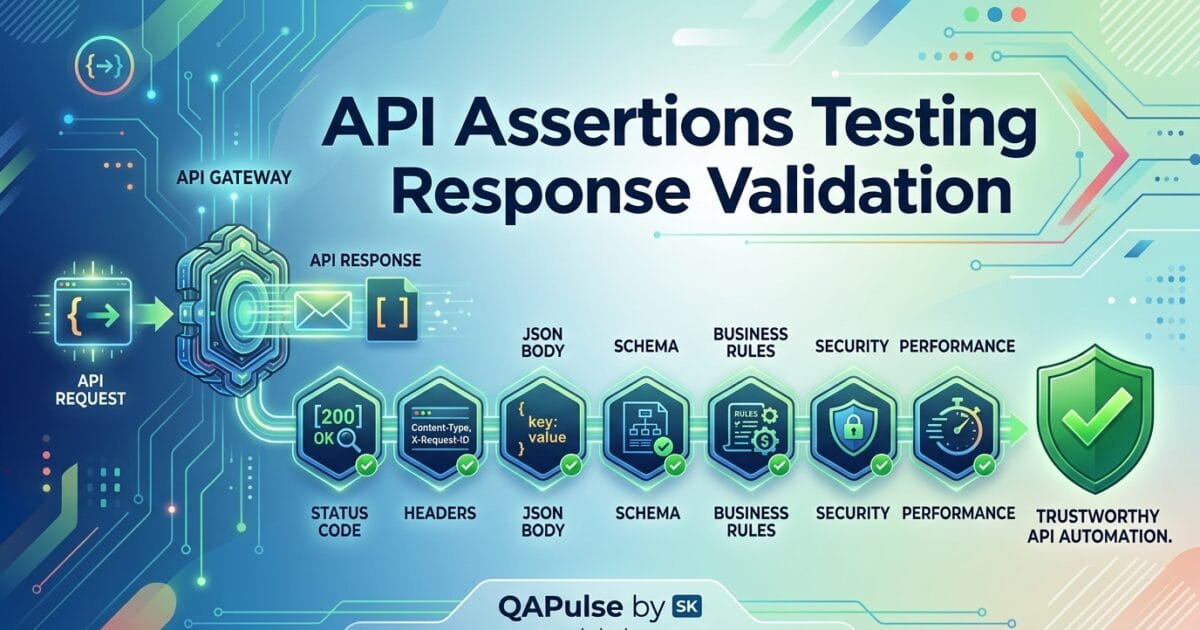
API Assertions Testing is where an API test stops being a request-and-response exercise and starts becoming a real quality check.
A request returning 200 OK does not automatically mean the API worked correctly. The server may have returned the wrong customer, an incomplete payload, an incorrect calculation, an invalid data type, missing security headers, or a response that took five seconds to complete. Without meaningful assertions, your automation may report green while the application is quietly broken.
That is the uncomfortable truth about API automation: sending requests is easy; proving that the response is correct is the real testing problem.
Current API-testing guidance consistently treats assertions as the mechanism that turns a response into a verifiable test. Assertions can target status codes, headers, response bodies, JSON properties, schemas, timing, and other response characteristics.
The strategic question is therefore not:
“Did my API request succeed?”
It is:
“What must be true about this response for me to trust that the API behaved correctly?”
That question changes how you design automated API tests.
What API Assertions Testing Actually Means
At its simplest, api assertions testing means defining conditions that a response must satisfy before an automated test is considered successful.
The basic flow looks like this:
Test Data
   ↓
HTTP Request
   ↓
API Endpoint
   ↓
Response
   ↓
Assertions
   ↓
Pass / Fail
Without the assertion layer, you essentially have an API monitoring script that confirms an endpoint responded.
With assertions, you are validating behavior.
For example:
const response = await request.get("/api/users/42");

expect(response.status()).toBe(200);

const body = await response.json();

expect(body.id).toBe(42);
expect(body.email).toContain("@");
expect(body.active).toBe(true);
The request tells you that the endpoint responded.
The assertions tell you whether the response satisfied the expected contract.
This distinction is fundamental to api assertions testing because an HTTP response is only raw evidence. Your assertions transform that evidence into a quality decision.
The Most Dangerous API Test Is the One That Always Passes
Imagine this test:
test("Get user", async ({ request }) => {
    const response = await request.get("/api/users/42");

    expect(response.status()).toBe(200);
});
It looks reasonable.
But what happens if the API returns:
{
  "id": 99,
  "name": "Wrong User",
  "email": null
}
The test still passes.
That is a false-positive test.
The endpoint returned 200, but the business behavior is wrong.
A stronger test would validate the important invariants:
expect(response.status()).toBe(200);

const body = await response.json();

expect(body.id).toBe(42);
expect(body.name).toBeTruthy();
expect(body.email).toMatch(/^[^@]+@[^@]+\.[^@]+$/);
This is one of the most important principles of api assertions testing:
Assert what must remain true, not merely what happened to be returned.
Recent practical guidance around JSON assertions makes the same distinction: robust tests should focus on meaningful invariants instead of blindly requiring the entire response representation to remain identical.
Status Code Assertions Are Only the First Layer
Status-code validation is important, but it should rarely be the entire test.
A typical happy-path assertion might be:
expect(response.status()).toBe(200);
For resource creation:
expect(response.status()).toBe(201);
For deletion:
expect(response.status()).toBe(204);
For validation failures:
expect(response.status()).toBe(400);
For authentication failures:
expect(response.status()).toBe(401);
For authorization failures:
expect(response.status()).toBe(403);
The important point is that the expected status should reflect the behavior being tested.
For example, a test for invalid credentials should not simply assert “not 200.” It should explicitly validate the expected failure contract:
expect(response.status()).toBe(401);
Then validate the error response:
const body = await response.json();

expect(body.error).toBe("invalid_credentials");
This makes the test much more diagnostic.
A 401 may be technically correct while the error body is still broken.
That is why mature api assertions testing combines multiple levels of validation rather than relying on status codes alone.
Response Body Assertions Catch the Bugs Status Codes Miss
The response body usually contains the information that represents actual business behavior.
Suppose your endpoint returns:
{
  "id": 101,
  "product": "Laptop",
  "quantity": 2,
  "unitPrice": 1000,
  "total": 2000
}
A weak test might only verify:
expect(response.status()).toBe(200);
A useful test verifies the important business values:
const body = await response.json();

expect(body.id).toBe(101);
expect(body.quantity).toBe(2);
expect(body.unitPrice).toBe(1000);
expect(body.total).toBe(2000);
Now the test can detect a calculation regression:
{
  "quantity": 2,
  "unitPrice": 1000,
  "total": 1500
}
The HTTP request succeeded.
The API did not.
This is exactly where api assertions testing delivers value: it validates the meaning of the response rather than merely its existence.
Exact Matching vs Meaningful Matching
One of the most important design decisions is deciding how strict an assertion should be.
Consider this response:
{
  "id": 101,
  "name": "Laptop",
  "price": 1000,
  "updatedAt": "2026-08-16T10:20:31Z"
}
A complete-body assertion might require every property and value to match exactly.
That sounds thorough, but it can become fragile.
The timestamp changes every time.
The backend might add a new optional field.
Property ordering may change depending on serialization.
A better approach is often to validate the invariants:
expect(body.id).toBe(101);
expect(body.name).toBe("Laptop");
expect(body.price).toBeGreaterThan(0);
expect(body.updatedAt).toMatch(
  /^\d{4}-\d{2}-\d{2}T/
);
The strategy is:
Be strict about behavior. Be flexible about irrelevant representation.
This principle makes api assertions testing more resistant to harmless API changes while still catching meaningful regressions.
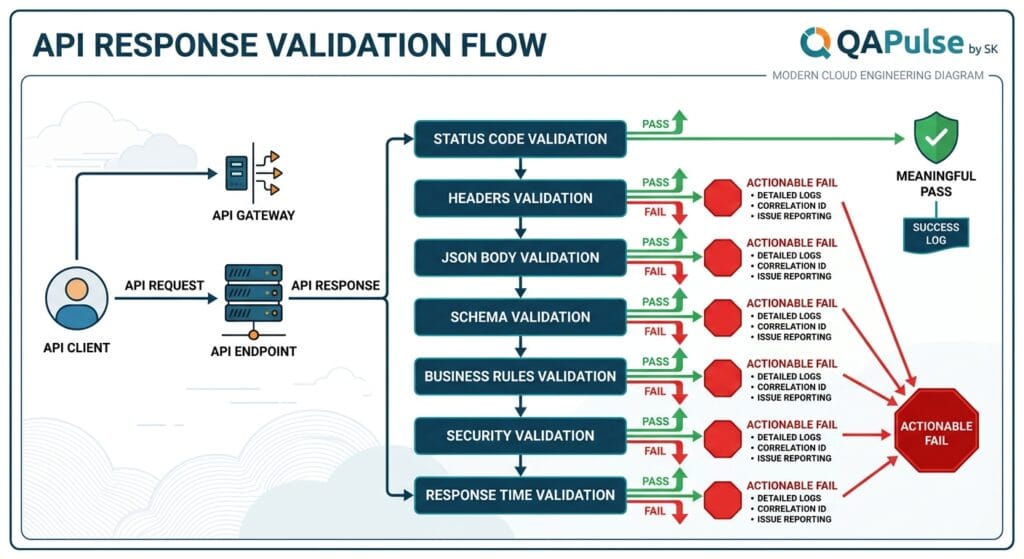
API Assertions Testing Across Different Validation Layers
A strong API test can validate several dimensions simultaneously.
| Validation layer | What it checks | Example |
|---|---|---|
| Status | HTTP outcome | 200 |
| Headers | Response metadata | Content-Type |
| Body | Returned values | user.id = 42 |
| Schema | Structure and types | id is integer |
| Business rules | Application behavior | total = quantity × price |
| Security | Access behavior | unauthorized request rejected |
| Performance | Response budget | < 800 ms |
| Error contract | Failure behavior | correct error code/message |
This layered approach is much stronger than creating hundreds of tests that only check HTTP status codes.
Schema Assertions Protect the API Contract
Imagine your API historically returns:
{
  "id": 101,
  "name": "Shahnawaz",
  "active": true
}
Then a backend change accidentally produces:
{
  "id": "101",
  "name": "Shahnawaz",
  "active": "true"
}
The endpoint might still return 200.
A status assertion will pass.
A schema assertion can detect the type regression.
For critical APIs, schema validation can therefore act as a contract-level safety net. Tools and API-testing platforms commonly support JSON-schema or structural validation for exactly this reason.
A simplified schema might look like:
{
  "type": "object",
  "required": ["id", "name", "active"],
  "properties": {
    "id": {
      "type": "integer"
    },
    "name": {
      "type": "string"
    },
    "active": {
      "type": "boolean"
    }
  }
}
Now your test validates the API contract rather than just individual examples.
Headers Are Test Data Too
Headers are often ignored because testers focus heavily on JSON.
That is a mistake.
Consider:
Content-Type: application/json
Cache-Control: no-store
X-Request-ID: 9a12...
You may want assertions such as:
expect(response.headers()["content-type"])
    .toContain("application/json");
Security-sensitive endpoints may also need checks for appropriate security headers.
Authentication and authorization behavior should be validated as well:
const response = await request.get("/api/admin/users");

expect(response.status()).toBe(403);
Then verify that the response does not accidentally expose administrative data.
The important idea is that api assertions testing should cover the complete HTTP contract when those details matter to the system.
Negative Assertions Are Where Mature API Testing Begins
Happy-path tests are necessary, but they are not enough.
Consider:
POST /api/orders
with:
{
  "quantity": -5
}
A mature test should prove that the API rejects invalid input:
expect(response.status()).toBe(400);

const body = await response.json();

expect(body.error).toBe("validation_error");
expect(body.field).toBe("quantity");
Now test:
- missing required fields
- invalid data types
- malformed identifiers
- expired tokens
- missing authorization
- unauthorized resources
- duplicate requests
- boundary values
- empty collections
- invalid pagination
- unsupported content types
This is where api assertions testing becomes a strategy rather than a collection of happy-path checks.
Compare Weak Assertions With Strong Assertions
| Weak approach | Strong approach |
|---|---|
Assert only 200 | Assert status + important response behavior |
| Compare entire response blindly | Validate meaningful invariants |
| Test only happy paths | Include negative and boundary scenarios |
| Ignore headers | Validate important HTTP metadata |
| Ignore schema | Validate structure and data types |
| Ignore response time | Enforce appropriate latency budgets |
| Use hardcoded values everywhere | Use controlled dynamic test data |
| Fail with vague messages | Produce precise assertion failures |
The goal is not to maximize the number of assertions.
The goal is to maximize the amount of useful information produced when the system is wrong.
That distinction should guide every api assertions testing decision.
The Same Strategy Works Across API Tools
The assertion concepts remain largely the same even when the technology changes.
| Tool | Typical assertion style | Strength |
|---|---|---|
| Postman | JavaScript tests | Fast exploratory and automated API validation |
| Playwright | expect() assertions | API + browser testing in one ecosystem |
| REST Assured | Java assertions | Strong Java ecosystem integration |
| Karate | Built-in matching | Readable API-focused validation |
| Cypress | Chai-style assertions | API checks alongside web tests |
| Apidog | Visual/scripted assertions | Accessible assertion authoring |
| Pact | Contract verification | Consumer-provider compatibility |
For example, Postman supports response assertions through its test scripts, while Playwright provides assertions around API responses and REST Assured is widely used for Java-based API automation.
The tool changes.
The engineering principle does not.
Request → response → meaningful validation → evidence.
A Practical Assertion Design Rule
Before writing an API test, ask five questions:
- What HTTP outcome should occur?
- What response data must be correct?
- What structure and types must remain stable?
- What business rule must hold?
- What must never happen?
For a payment API, that could become:
expect(response.status()).toBe(201);

const body = await response.json();

expect(body.paymentId).toBeTruthy();
expect(body.currency).toBe("USD");
expect(body.amount).toBe(100);
expect(body.status).toBe("authorized");
expect(body.paymentId).toMatch(/^pay_/);
Then add negative validation:
expect(body.cardNumber).toBeUndefined();
expect(body.cvv).toBeUndefined();
Now the test checks not only what the API returns, but also what it must not expose.
That is a far stronger definition of API quality.
Think Like an API Consumer, Not Just an API Tester
The best assertion is usually derived from the question:
“What would break my consumer if this response changed?”
If a frontend depends on:
{
  "customer": {
    "id": 42,
    "name": "Alex"
  }
}
then the test should protect those assumptions.
If a mobile application depends on:
{
  "expiresIn": 3600
}
then validate the contract that matters to the mobile client.
If a downstream service requires:
Content-Type: application/json
then validate it.
This consumer-oriented thinking makes api assertions testing much more strategic because assertions are connected directly to real system dependencies.
The Assertion Pyramid
You can think about API validation as layers:
                 Business Rules
                /              \
             Schema          Security
            /                    \
        Body Values          Headers
             \                /
               Status Code
                    |
                 Response
Status validation is the foundation.
But the higher layers provide increasingly meaningful behavioral confidence.
A test that validates all relevant layers is more valuable than ten tests that all repeat:
expect(response.status()).toBe(200);
The objective is risk coverage, not assertion count.
Your API Test Should Explain Its Failure
Compare these two failures:
Expected 200, received 500
versus:
Expected order.total to equal 250.00
Received 225.00
Order ID: 8127
Currency: USD
Quantity: 5
Unit price: 50.00
The second failure is dramatically more useful.
Good api assertions testing therefore includes meaningful assertion names and diagnostic context.
For example:
expect(
  body.total,
  "Order total should equal quantity × unit price"
).toBe(250);
A failure should help the engineer answer:
What failed? Why does it matter? Where should I investigate?
That is how assertions become engineering observability rather than simple pass/fail switches.
A Strategic Mental Model
Think of every API response as a claim made by the system.
The server is effectively saying:
“This is the result of your request.”
Your assertions respond:
“I will believe that result only if these conditions are true.”
That mindset produces better tests.
Instead of writing:
expect(status).toBe(200);
you begin asking:
Is the status correct?
Is the payload correct?
Is the structure correct?
Are the types correct?
Are business rules correct?
Are security expectations correct?
Is the response within an acceptable latency budget?
Is the error contract correct when the request is invalid?
That is the foundation of high-value api assertions testing.
And once your assertions are designed around those questions, your API automation becomes much more than a collection of HTTP requests. It becomes an executable definition of what your API is expected to guarantee.
From Basic Assertions to Contract-Level Confidence
The real value of api assertions testing appears when assertions move beyond individual fields and begin validating the behavior that consumers depend on.
A mature API test does not ask only whether a response contains a value. It asks whether the response satisfies the contract, business rules, security expectations, and operational boundaries of the application.
Consider an order API:
{
  "orderId": "ORD-1007",
  "quantity": 3,
  "unitPrice": 250,
  "discount": 50,
  "total": 700,
  "currency": "USD",
  "status": "confirmed"
}
A basic test might check:
expect(response.status()).toBe(200);
A stronger test validates the business relationship:
const body = await response.json();

expect(body.quantity).toBe(3);
expect(body.unitPrice).toBe(250);
expect(body.discount).toBe(50);
expect(body.total).toBe(700);
But an even better approach validates the invariant:
const expectedTotal =
  body.quantity * body.unitPrice - body.discount;

expect(body.total).toBe(expectedTotal);
That difference matters.
The first test checks a value.
The second test checks a rule.
The rule is generally more valuable because it continues protecting the system when the test data changes.
Validate Invariants Instead of Hardcoding Everything
One common mistake in api assertions testing is excessive hardcoding.
Suppose an endpoint returns a generated transaction ID:
{
  "transactionId": "txn_928374",
  "status": "completed"
}
This is fragile:
expect(body.transactionId).toBe("txn_928374");
The test is tied to one specific execution.
Instead:
expect(body.transactionId).toMatch(/^txn_[0-9]+$/);
expect(body.status).toBe("completed");
Now the test validates the contract without requiring an identical generated value.
This creates a useful distinction:
| Assertion style | What it validates | Typical reliability |
|---|---|---|
| Exact value | Specific known output | Useful for deterministic data |
| Pattern | Expected format | Useful for generated values |
| Type | Data contract | Useful for API compatibility |
| Range | Valid boundaries | Useful for numerical behavior |
| Relationship | Business rule | High-value validation |
| Schema | Overall structure | Contract-level protection |
The objective is not to make assertions less strict.
It is to make them strict about the right things.
Test Relationships Between Fields
Some of the most valuable API defects are not visible by checking individual fields.
Imagine:
{
  "subtotal": 100,
  "tax": 15,
  "shipping": 10,
  "total": 125
}
Every individual value might look reasonable.
But:
100 + 15 + 10 = 125
So the response is internally consistent.
Now imagine:
{
  "subtotal": 100,
  "tax": 15,
  "shipping": 10,
  "total": 115
}
Every field still contains a valid number.
A simple type assertion passes.
A business-rule assertion catches the defect:
const expectedTotal =
  body.subtotal +
  body.tax +
  body.shipping;

expect(body.total).toBe(expectedTotal);
This is where api assertions testing becomes particularly powerful.
The API contract is not merely a list of fields.
It is a collection of relationships.
Use Property-Based Thinking for Important APIs
For critical business logic, ask:
“What relationship should always remain true?”
Examples include:
total = subtotal + tax + shipping
balance = credits - debits
endDate >= startDate
quantity >= 0
discount <= subtotal
pageSize <= maximumPageSize
expiresAt > issuedAt
You can convert those rules into executable checks:
expect(body.quantity).toBeGreaterThanOrEqual(0);
expect(body.discount).toBeLessThanOrEqual(body.subtotal);
expect(
  new Date(body.expiresAt).getTime()
).toBeGreaterThan(
  new Date(body.issuedAt).getTime()
);
These assertions often provide more long-term protection than simply copying expected JSON from an API specification.
Do Not Confuse Schema Validation With Business Validation
Schema validation and business validation solve different problems.
Consider:
{
  "age": 15
}
The schema might correctly say:
{
  "type": "integer"
}
The value has the correct type.
But perhaps the business rule requires customers to be at least 18.
Schema validation passes.
Business validation should fail.
Therefore:
Schema validation
       ↓
Is the response structurally valid?

Business validation
       ↓
Does the response make sense for the domain?
A mature api assertions testing strategy uses both.
Schema validation
Checks:
- property existence
- data types
- arrays
- objects
- nullable values
- required fields
- structural compatibility
Business validation
Checks:
- calculations
- state transitions
- authorization rules
- domain constraints
- relationships
- workflow behavior
Neither replaces the other.
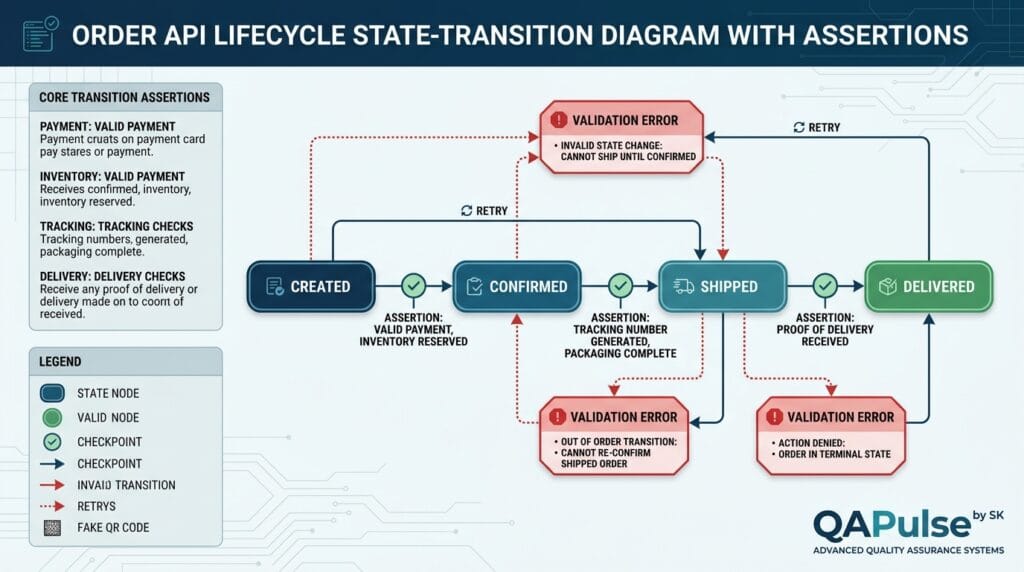
API State Transitions Need Assertions Too
Many APIs are state machines disguised as CRUD endpoints.
Consider an order:
CREATED
   ↓
CONFIRMED
   ↓
SHIPPED
   ↓
DELIVERED
A test should not merely verify that each endpoint returns 200.
It should validate legal transitions.
For example:
expect(createResponse.status()).toBe(201);

const order = await createResponse.json();

expect(order.status).toBe("CREATED");
Then:
expect(confirmResponse.status()).toBe(200);

const confirmed = await confirmResponse.json();

expect(confirmed.status).toBe("CONFIRMED");
Now test an invalid transition:
expect(cancelResponse.status()).toBe(409);
The response should explain why the transition is invalid.
This style of api assertions testing protects the application’s state model rather than isolated endpoints.
Authentication and Authorization Require Different Assertions
Authentication answers:
“Who are you?”
Authorization answers:
“What are you allowed to do?”
Those should be tested separately.
For authentication:
const response = await request.get("/api/profile");

expect(response.status()).toBe(401);
For authorization:
const response = await request.delete("/api/admin/users/42");

expect(response.status()).toBe(403);
Then verify the response body:
const body = await response.json();

expect(body.code).toBe("FORBIDDEN");
A particularly important security assertion is ensuring that unauthorized requests do not accidentally return sensitive information.
expect(body.password).toBeUndefined();
expect(body.accessToken).toBeUndefined();
This makes security part of the automated contract.
Test Error Responses as Carefully as Success Responses
Many teams spend most of their assertion effort on 200 responses.
That creates an incomplete test strategy.
A robust API needs predictable errors.
For invalid input:
expect(response.status()).toBe(400);

const body = await response.json();

expect(body.code).toBe("INVALID_REQUEST");
expect(body.message).toBeTruthy();
For a missing resource:
expect(response.status()).toBe(404);
expect(body.code).toBe("RESOURCE_NOT_FOUND");
For conflict:
expect(response.status()).toBe(409);
expect(body.code).toBe("RESOURCE_CONFLICT");
This matters because consumers often depend heavily on error contracts.
An API that returns inconsistent error structures can be difficult for frontend, mobile, and downstream-service developers to consume reliably.
Compare Happy-Path and Negative Assertions
| Scenario | Weak test | Better test |
|---|---|---|
| Valid request | 200 | Status + body + schema |
| Invalid input | Not 200 | Exact error status + error contract |
| Unauthorized request | Not 200 | 401 + safe error response |
| Forbidden request | Not 200 | 403 + authorization contract |
| Missing resource | Not 200 | 404 + resource error |
| Duplicate resource | Not 200 | 409 + conflict contract |
| Invalid state transition | Not 200 | Expected transition error |
| Server failure | Not 200 | Correct error handling and diagnostics |
This is a useful maturity model for api assertions testing.
Response-Time Assertions Need Context
Performance assertions can be useful:
const start = Date.now();

const response = await request.get("/api/products");

const duration = Date.now() - start;

expect(duration).toBeLessThan(1000);
But blindly adding timing thresholds to every functional test can create unstable automation.
A test running on a developer laptop may behave differently from the same test in CI.
Instead, define meaningful budgets based on the API’s requirements.
For example:
expect(duration).toBeLessThan(800);
could be appropriate for a latency-sensitive endpoint if 800 ms is an agreed service-level target.
The key is to distinguish:
Functional assertion
API must return the correct result.

Performance assertion
API must return the correct result within an agreed boundary.
This makes performance validation purposeful rather than arbitrary.
Avoid the “Everything Must Match” Trap
Full-response comparisons can be attractive because they appear comprehensive.
For example:
expect(body).toEqual({
    id: 42,
    name: "John",
    role: "admin"
});
But what happens when the backend adds:
"lastLogin": "2026-08-16T12:00:00Z"
The application may still be perfectly compatible.
The test fails because the test was checking representation rather than behavior.
A better approach is selective validation:
expect(body.id).toBe(42);
expect(body.name).toBe("John");
expect(body.role).toBe("admin");
Use exact snapshots or full-object comparisons when the complete representation is genuinely part of the contract.
Otherwise, api assertions testing should focus on meaningful guarantees.
Reusable Assertion Helpers Reduce Duplication
Large API suites often repeat the same validation logic.
For example:
expect(response.status()).toBe(200);
expect(response.headers()["content-type"])
    .toContain("application/json");
You can centralize common checks:
function assertJsonResponse(response, expectedStatus) {
    expect(response.status()).toBe(expectedStatus);

    expect(response.headers()["content-type"])
        .toContain("application/json");
}
Then:
assertJsonResponse(response, 200);
A more specialized helper could validate an error contract:
function assertApiError(body, code) {
    expect(body.code).toBe(code);
    expect(body.message).toBeTruthy();
}
Then:
assertApiError(body, "RESOURCE_NOT_FOUND");
The important rule is not to hide too much.
A helper should make tests more readable, not make assertions impossible to understand.
Assertion Helpers vs Generic Utilities
| Approach | Advantage | Risk |
|---|---|---|
| Inline assertions | Very explicit | Repetition |
| Small assertion helpers | Reusable and readable | Abstraction overhead |
| Large generic utility | Centralized | Hides test intent |
| Custom assertion library | Consistent at scale | Higher maintenance cost |
For most teams, small domain-specific helpers provide the best balance.
Data-Driven API Assertions
The same endpoint often needs multiple validation scenarios.
Instead of duplicating tests:
test("invalid email", async () => {
   // ...
});

test("missing email", async () => {
   // ...
});

test("malformed email", async () => {
   // ...
});
use test data:
const invalidCases = [
    {
        name: "missing email",
        payload: { name: "Alex" },
        code: "EMAIL_REQUIRED"
    },
    {
        name: "malformed email",
        payload: { email: "abc" },
        code: "EMAIL_INVALID"
    }
];

for (const scenario of invalidCases) {
    test(scenario.name, async ({ request }) => {
        const response = await request.post("/api/users", {
            data: scenario.payload
        });

        expect(response.status()).toBe(400);

        const body = await response.json();

        expect(body.code).toBe(scenario.code);
    });
}
This approach makes the test matrix visible.
It also makes adding a new scenario cheaper.
Contract Testing Adds Another Layer
Traditional API assertions validate a system against expected behavior.
Contract testing focuses on compatibility between consumers and providers.
For example:
Frontend
   ↓
Expected API Contract
   ↓
Provider API
A consumer might expect:
{
  "userId": 42,
  "displayName": "Alex"
}
If the provider changes:
{
  "id": 42,
  "name": "Alex"
}
the API may still be valid internally.
But the consumer contract has changed.
Contract-focused testing can identify this kind of compatibility problem earlier.
This makes contract testing a valuable complement to api assertions testing, especially in distributed systems and microservice architectures.
API Assertions Testing vs Contract Testing
| Area | API assertions | Contract testing |
|---|---|---|
| Primary concern | Response behavior | Consumer-provider compatibility |
| Scope | Individual API tests | Service interaction |
| Business rules | Strong | Possible |
| Response structure | Strong | Strong |
| Consumer expectations | Indirect | Central |
| Best use | Functional API validation | Distributed systems |
They are complementary rather than competing strategies.
Assertions Should Be Designed Around Risk
Not every field deserves the same testing effort.
Suppose an API returns:
{
  "id": 42,
  "name": "Alex",
  "theme": "dark",
  "createdAt": "2026-08-16T10:00:00Z"
}
If the application depends heavily on id, test it aggressively.
If theme is optional metadata, a lighter assertion may be enough.
A useful prioritization model is:
Business criticality
        ×
Change probability
        ×
Failure impact
        =
Assertion priority
High-risk fields deserve stronger validation.
This prevents teams from spending equal effort on every response property.
Build Assertions That Help Diagnose Failures
A good failure message can reduce debugging time dramatically.
Instead of:
expect(body.total).toBe(500);
consider:
expect(
    body.total,
    `Order ${body.orderId}: total should equal subtotal + tax`
).toBe(body.subtotal + body.tax);
Now the failure communicates intent.
For larger tests, include contextual information:
expect(
    body.status,
    `Unexpected status for order ${orderId}`
).toBe("CONFIRMED");
The goal of api assertions testing is not merely detecting failure.
It is reducing the distance between failure and diagnosis.
A Practical API Assertion Checklist
Before calling an API test complete, ask:
□ Is the HTTP status correct?
□ Are important headers correct?
□ Is the response body correct?
□ Are required properties present?
□ Are data types correct?
□ Are business relationships validated?
□ Are security expectations validated?
□ Are negative scenarios covered?
□ Are boundary values covered?
□ Are error responses validated?
□ Is response time validated where appropriate?
□ Are generated values asserted by rules rather than hardcoded?
□ Does the failure message explain the problem?
□ Does the test protect an actual consumer or business requirement?
If most answers are “no,” the test may be sending requests without providing enough confidence.
Build a Layered Assertion Strategy
A scalable approach looks like this:
                    Business Rules
                         ↑
                    Security Rules
                         ↑
                   Schema / Contract
                         ↑
                     Body Values
                         ↑
                       Headers
                         ↑
                    Status Code
                         ↑
                      Response
Not every endpoint needs every layer.
A health-check endpoint may only need status and a small body assertion.
A payment endpoint may need:
- status
- headers
- schema
- business calculations
- authorization
- sensitive-data checks
- error contracts
- latency expectations
- state transitions
This risk-based approach keeps api assertions testing efficient without turning every test into an enormous validation script.
The Real Goal Is Trustworthy Automation
The ultimate purpose of API automation is not to produce a large green dashboard.
It is to create trustworthy evidence.
A green test should mean:
“The behavior we care about was validated.”
A red test should mean:
“Something meaningful violated an expectation.”
That distinction is critical.
If your suite has hundreds of assertions that fail because of irrelevant timestamps, optional fields, unstable ordering, or environment noise, engineers will eventually stop trusting it.
If your suite validates meaningful contracts, business rules, security boundaries, and consumer expectations, the automation becomes an engineering asset.
Internal Blog Links
- 50 Playwright Commands Every QA Engineer Should Know
- How to Build a More Reliable Test Automation Architecture
- Test Automation Framework vs Test Suite: The Critical Difference Every Engineer Should Understand
- Test Automation Framework Health: 9 Signs Your Tests Are Lying to You
- RAG Powered Performance Testing: Make k6 Tests Smarter With Real API Behavior
Internal Series Links
- Learn MCP – Zero to Hero
- Learn AI Agents for QA – Zero to Hero
- Playwright Automation – Zero to Hero
- TencentDB Agent Memory: Complete Zero to Hero
- LangGraph: Complete Zero to Hero
- Learn Python – Zero to Hero
- OpenAI Codex: Complete Zero to Hero
- Cursor AI: Complete Zero to Hero
- Claude Code Tutorial: Complete Zero to Hero
- AutoGen: Complete Zero to Hero Guide
- Free QA Resources Built From Real Experience
- QA Glossary: Test Automation Terms Every Engineer Should Know
External Links
- Postman documentation: Postman Learning Center
- Playwright API testing documentation: Playwright API testing
- REST Assured documentation: REST Assured
- JSON Schema: JSON Schema
- OpenAPI Specification: OpenAPI Specification
- Pact contract testing: Pact documentation
- Cypress API testing: Cypress API testing
People Asked Questions
What is API assertions testing?
API assertions testing is the practice of validating API responses against expected conditions such as status codes, headers, response data, schemas, business rules, security requirements, errors, and performance limits.
Why are assertions important in API testing?
Assertions determine whether the API response is actually correct. A request returning 200 OK can still contain incorrect data, broken business logic, missing fields, or security problems.
What should you assert in API testing?
Important assertions can include HTTP status codes, response headers, JSON properties, data types, schemas, business rules, error contracts, authorization behavior, sensitive-data exposure, and response-time requirements.
What is the difference between API assertions and API validation?
API validation is the broader activity of determining whether an API behaves correctly. Assertions are the executable checks used to verify specific expectations during automated API tests.
How do I validate a JSON response in API testing?
You can validate required properties, values, data types, nested objects, arrays, patterns, and JSON Schema rules depending on the requirements of the API contract.
Should API tests assert the entire response body?
Not always. Full-response comparisons can become fragile when dynamic or optional fields change. Strong tests usually validate important business and contract invariants while avoiding unnecessary coupling to irrelevant representation details.
What is the difference between schema validation and API assertions?
Schema validation focuses primarily on the structure and types of an API response. API assertions can validate schema as well as status codes, values, business rules, security behavior, errors, and performance.
Can API assertions test business logic?
Yes. Assertions can verify calculations, state transitions, authorization rules, relationships between response fields, limits, and other domain-specific requirements.
Which tools support API assertions?
Popular API-testing tools and frameworks including Postman, Playwright, REST Assured, Cypress, Karate, and others provide mechanisms for validating API responses.
How many assertions should an API test have?
There is no universal number. Assertions should be based on risk and the behavior the test is intended to protect. Meaningful assertions are more valuable than maximizing assertion count.
AEO Optimization
What is API assertions testing?
API assertions testing validates whether an API response satisfies expected technical and business conditions, including status codes, headers, body values, schemas, business rules, security behavior, errors, and performance requirements.
What should API tests validate?
API tests should validate the response status, important headers, required data, structure, data types, business rules, error behavior, authorization, and performance requirements relevant to the endpoint.
Is a 200 status enough for API testing?
No. A
200status only confirms the HTTP request was successfully processed. The response can still contain incorrect data, invalid business logic, missing fields, or security problems.
What is the difference between API assertions and schema validation?
Schema validation checks response structure and data types, while API assertions can additionally verify values, business rules, status codes, security behavior, errors, and performance.
AI Overview Optimization
API assertions testing is the automated validation of API responses against expected status codes, data, structure, business rules, security requirements, and performance boundaries.
Conclusion
Effective api assertions testing is not about adding as many expect() statements as possible.
It is about deciding what the API must guarantee and turning those guarantees into executable checks.
Start with status codes, but do not stop there. Validate response bodies, headers, schemas, data types, business relationships, security behavior, error contracts, state transitions, and performance boundaries where they matter.
The strongest tests also avoid two extremes: assertions that are too weak to detect meaningful defects and assertions that are so rigid that harmless API evolution constantly breaks the suite.
The right strategy is to be strict about behavior and flexible about irrelevant representation.
Think like an API consumer. Identify the assumptions that downstream systems make. Protect those assumptions with focused assertions. Then add reusable helpers, data-driven scenarios, contract validation, and diagnostic failure messages as the suite grows.
When designed this way, api assertions testing becomes more than response checking. It becomes an executable quality contract between your API, its consumers, and the engineering team responsible for maintaining it.
Final Key Takeaways
- api assertions testing should validate behavior, not merely request execution.
- A
200 OKresponse does not prove that an API behaved correctly. - Combine status, headers, body, schema, business, security, and error assertions according to risk.
- Prefer meaningful invariants over unnecessary full-response comparisons.
- Validate relationships between fields when business rules depend on them.
- Treat negative scenarios as first-class API tests.
- Validate authentication and authorization separately.
- Use schema validation for structure and business assertions for domain behavior.
- Avoid hardcoding generated values when patterns or relationships provide stronger validation.
- Use reusable assertion helpers carefully without hiding test intent.
- Design failure messages to reduce debugging time.
- Contract testing complements functional API validation in distributed systems.
- The best assertion strategy is risk-based rather than assertion-count-based.
- A trustworthy API test should provide meaningful evidence when it passes and actionable information when it fails.
Continue Learning
Explore more expert articles on Mobile Testing, Backend & API, AI & Agentic, AI Tools, n8n, LangChain, CrewAI, MCP Servers, AI Agents, LlamaIndex, Docker, FastAPI, Playwright, Cypress, Test Automation, DevOps, and Software Engineering at www.skakarh.com.
QAPulse by SK delivers expert release analysis, AI engineering insights, enterprise automation strategies, migration guidance, DevOps best practices, and practical testing knowledge to help software professionals build scalable, intelligent, and production-ready software systems.