 QA
QA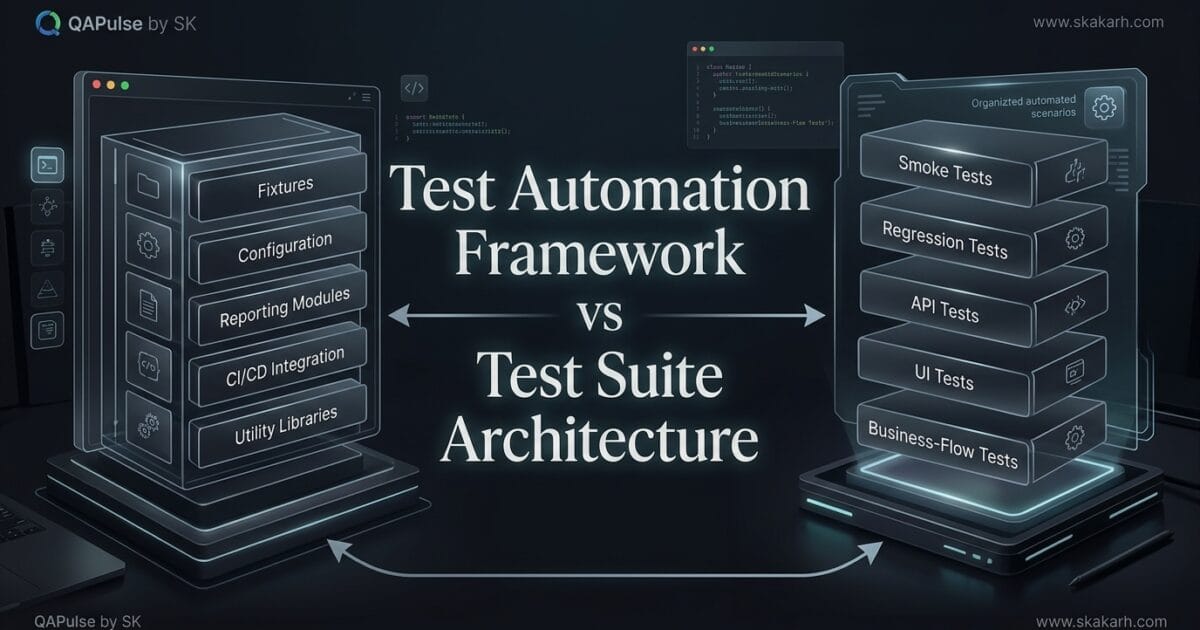
Test automation framework and test suite are often used as if they mean the same thing. They do not.
A test automation framework is the engineering foundation that determines how automated tests are designed, organized, executed, configured, diagnosed, reported, and maintained. A test suite, on the other hand, is primarily a collection of tests grouped around a particular purpose, feature, regression scope, release, or execution strategy.
That distinction sounds simple, but confusing these two concepts creates a surprisingly common architectural problem. Teams keep adding tests to a test suite and assume they are improving their automation system. The number of tests increases, dashboards become larger, CI pipelines become longer, and management sees thousands of automated checks. Yet the underlying test automation framework may become harder to maintain, slower to execute, more fragile, and less trustworthy.
The important question is therefore not:
“How many automated tests do we have?”
It is:
“Does our test automation framework make those tests reliable, maintainable, diagnosable, and scalable?”
That is the difference between having automation and engineering an automation system.
Test Automation Framework vs Test Suite at a Glance
The easiest way to understand the difference is to separate the system that runs and manages automation from the tests that the system executes.
| Area | Test Automation Framework | Test Suite |
|---|---|---|
| Primary purpose | Provides the engineering structure for automation | Groups related automated tests |
| Contains | Configuration, fixtures, utilities, abstractions, integrations, reporting, execution logic | Individual test cases |
| Main concern | How automation works | What scenarios are tested |
| Reusability | High | Usually scenario-specific |
| CI/CD integration | Usually part of the framework | Tests are executed through the framework/pipeline |
| Test data strategy | Framework may provide mechanisms | Suite consumes test data |
| Reporting | Framework can provide reporting infrastructure | Suite contributes test results |
| Browser/API/device management | Often handled by framework components | Tests use the provided capabilities |
| Failure diagnostics | Framework controls traces, logs, screenshots, artifacts | Individual tests generate failures |
| Scalability | Determines how the automation system grows | Determines how many scenarios are covered |
| Maintenance | Architectural responsibility | Test-level responsibility |
A useful mental model is this:
Framework = infrastructure + architecture + engineering rules
Suite = collection + organization + coverage
If you removed every test from your repository tomorrow, the test automation framework could still exist.
If you removed the framework while keeping the test files, you might still have test definitions, but you would lose much of the infrastructure required to execute and maintain them effectively.
A Simple Analogy
Think about a modern software application.
The application has:
- source code
- databases
- configuration
- authentication
- logging
- deployment infrastructure
- monitoring
- APIs
And it also has individual business features.
You would never say that a collection of five hundred business records is the application’s architecture.
The same principle applies to automation.
A test suite is closer to the content being executed.
A test automation framework is closer to the engineering platform that makes execution possible.
What Exactly Is a Test Automation Framework?
A test automation framework is not simply a folder containing test files.
It is the collection of architectural decisions, reusable components, execution mechanisms, conventions, and integrations that determine how automation is built and operated.
For example, a Playwright-based framework might contain:
automation/
├── tests/
│   ├── login/
│   ├── checkout/
│   └── search/
├── pages/
│   ├── LoginPage.ts
│   ├── CheckoutPage.ts
│   └── SearchPage.ts
├── fixtures/
│   └── testFixtures.ts
├── api/
│   └── ApiClient.ts
├── data/
│   └── testData.ts
├── utils/
│   └── dateUtils.ts
├── config/
│   └── environments.ts
├── reporters/
├── playwright.config.ts
└── package.json
The test files are only one part of this system.
The framework may define:
- how browsers are launched
- how environments are selected
- how authentication is established
- how test data is generated
- how APIs are called
- how pages are abstracted
- how retries are controlled
- how traces are collected
- how screenshots are captured
- how parallel execution works
- how failures are reported
- how tests execute in CI
- how secrets are handled
- how different environments are configured
That is why calling the entire system a “test suite” is misleading.
What Is a Test Suite?
A test suite is a logical grouping of tests.
For example:
tests/
├── smoke/
│   ├── login.spec.ts
│   ├── checkout.spec.ts
│   └── search.spec.ts
│
├── regression/
│   ├── login.spec.ts
│   ├── checkout.spec.ts
│   ├── payment.spec.ts
│   └── profile.spec.ts
│
└── api/
    ├── users.spec.ts
    ├── orders.spec.ts
    └── payments.spec.ts
Here, smoke, regression, and api can represent different test suites or suite groupings.
The individual tests answer questions such as:
- Can a user log in?
- Can a customer complete checkout?
- Can an order be created through the API?
- Can a payment be processed?
- Can a user update a profile?
The suite organizes those questions.
The framework determines how those questions are executed consistently.
That difference becomes especially important when the project grows.
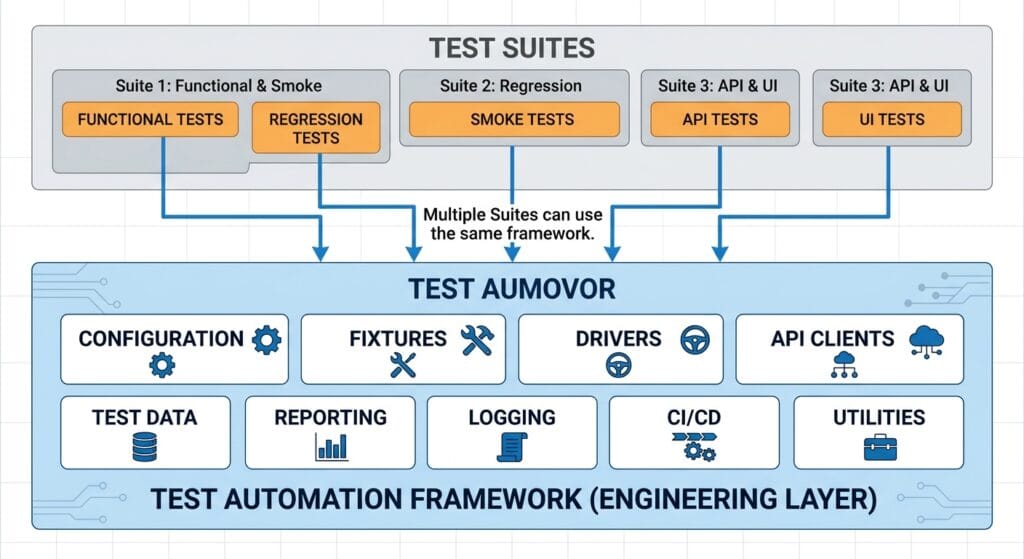
One Framework Can Power Multiple Test Suites
This is one of the most important architectural distinctions.
Imagine an organization has a single Playwright-based test automation framework.
It could support:
                    Test Automation Framework
                              │
          ┌───────────────────┼───────────────────┐
          │                   │                   │
      Smoke Suite        Regression Suite     E2E Suite
          │                   │                   │
       25 tests            600 tests           300 tests
The framework provides common capabilities.
The suites define different execution scopes.
The same framework could also support API testing:
Test Automation Framework
        │
        ├── UI Test Suite
        ├── API Test Suite
        ├── Smoke Suite
        ├── Regression Suite
        └── Critical Business Flow Suite
This is why increasing the number of suites does not automatically mean that the underlying framework is improving.
You can have:
1 excellent framework + 20 well-designed suites
or
1 terrible framework + 5,000 tests
The second system may look more impressive in a dashboard while being substantially less useful to engineers.
The Most Common Misunderstanding: “We Have 2,000 Automated Tests”
Imagine a team reports:
“We now have 2,000 automated tests.”
That sounds impressive.
But ask five additional questions:
- How many are flaky?
- How many are duplicated?
- How long does the entire suite take?
- How quickly can engineers diagnose a failure?
- How much effort does it take to add a new test?
Suddenly, the test count tells you very little about the quality of the test automation framework.
Consider two teams.
| Metric | Team A | Team B |
|---|---|---|
| Automated tests | 2,000 | 700 |
| Average execution | 5 hours | 45 minutes |
| Flaky tests | 18% | 1.5% |
| Mean failure diagnosis | 2 hours | 10 minutes |
| Test maintenance | High | Low |
| CI reliability | Poor | Strong |
| Test isolation | Weak | Strong |
Team A has almost three times as many tests.
Team B may have the better automation system.
This is where experienced SDETs stop treating test count as the primary measure of automation maturity.
Coverage Is Not the Same as Framework Quality
A large test suite can provide broad functional coverage while sitting on top of a weak test automation framework.
For example:
def test_checkout():
    login()
    search_product()
    add_product()
    checkout()
    verify_order()
The test might work.
But imagine that every one of 300 tests contains its own:
login()
implementation.
Now a login change can require updates across hundreds of tests.
The suite may have excellent coverage.
The framework has poor abstraction.
A stronger architecture centralizes reusable behavior:
class LoginPage:
    def login(self, username, password):
        self.username.fill(username)
        self.password.fill(password)
        self.submit.click()
Then tests focus on behavior:
def test_checkout(authenticated_user):
    checkout.open()
    checkout.add_product("Laptop")
    checkout.complete()
    checkout.verify_success()
The objective is not to hide every implementation detail behind abstractions.
The objective is to establish boundaries that reduce unnecessary duplication and make change cheaper.
Framework Architecture Determines the Cost of Change
This is where the distinction becomes strategically important.
Suppose an application changes its login mechanism.
In a poorly structured automation system:
Login change
   ↓
150 test files affected
   ↓
Manual updates
   ↓
New failures
   ↓
CI instability
   ↓
Long debugging cycle
In a well-designed test automation framework:
Login change
   ↓
Authentication abstraction updated
   ↓
Shared tests reuse implementation
   ↓
Focused validation
   ↓
Reduced maintenance
The second architecture does not eliminate all failures.
It reduces the blast radius of change.
That is one of the strongest indicators that an automation framework has been designed as an engineering system rather than merely accumulated over time.
Framework vs Suite: Think in Layers
A practical way to reason about automation is to divide it into layers.
┌─────────────────────────────────────┐
│             Test Suites             │
│ Smoke | Regression | API | E2E      │
├─────────────────────────────────────┤
│             Test Cases              │
│ Business scenarios and assertions   │
├─────────────────────────────────────┤
│       Reusable Test Components      │
│ Pages | API clients | Fixtures      │
├─────────────────────────────────────┤
│       Framework Infrastructure      │
│ Config | Data | Logging | Reporting │
├─────────────────────────────────────┤
│         Execution Platform          │
│ Browser | API | Device | CI/CD      │
└─────────────────────────────────────┘
The test suite sits toward the top.
The framework infrastructure sits underneath it.
This distinction matters because architectural problems usually appear underneath the tests while their symptoms appear inside the suites.
For example:
Symptom: 100 tests fail after a small UI change.
Possible underlying problem: excessive coupling between test cases and implementation details.
Symptom: tests pass locally but frequently fail in CI.
Possible underlying problem: environment assumptions, timing dependencies, shared state, or weak isolation.
Symptom: adding one test requires modifying five utilities.
Possible underlying problem: framework abstractions are too tightly coupled.
The suite exposes the symptoms.
The framework architecture often determines the cause.
A Practical Example: Playwright
Consider this test:
import { test, expect } from "@playwright/test";

test("user can log in", async ({ page }) => {
  await page.goto("/login");

  await page.getByLabel("Email").fill("user@example.com");
  await page.getByLabel("Password").fill("secret");
  await page.getByRole("button", { name: "Login" }).click();

  await expect(page.getByText("Dashboard")).toBeVisible();
});
This is a test.
It is not, by itself, a complete test automation framework.
The surrounding framework may determine:
export default defineConfig({
  testDir: "./tests",
  retries: process.env.CI ? 2 : 0,
  workers: process.env.CI ? 4 : undefined,
  reporter: [["html"], ["junit"]],
  use: {
    baseURL: process.env.BASE_URL,
    trace: "retain-on-failure",
    screenshot: "only-on-failure"
  }
});
Now the framework is responsible for execution behavior, diagnostics, configuration, and CI integration.
The test describes the scenario.
The framework establishes the environment in which the scenario becomes repeatable and observable.
Where Fixtures Fit
Fixtures are another example of something that belongs to framework architecture rather than merely test-suite organization.
For example:
import { test as base } from "@playwright/test";

type Fixtures = {
  authenticatedPage: Page;
};

export const test = base.extend<Fixtures>({
  authenticatedPage: async ({ page }, use) => {
    await page.goto("/login");
    await page.getByLabel("Email").fill(process.env.TEST_USER!);
    await page.getByLabel("Password").fill(process.env.TEST_PASSWORD!);
    await page.getByRole("button", { name: "Login" }).click();

    await use(page);
  }
});
Tests can then focus on business behavior:
test("customer can view orders", async ({ authenticatedPage }) => {
  await authenticatedPage.goto("/orders");

  await expect(
    authenticatedPage.getByRole("heading", { name: "Orders" })
  ).toBeVisible();
});
The suite contains the scenario.
The framework supplies the reusable execution capability.
That separation becomes increasingly valuable as automation grows.
The Same Principle Applies Beyond UI Testing
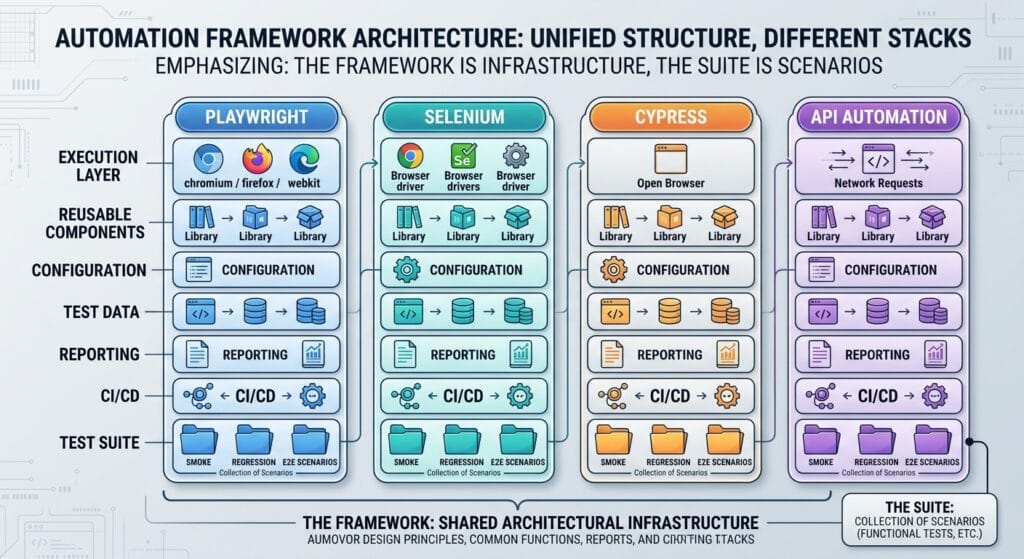
The distinction is not specific to Playwright.
A Selenium-based test automation framework may provide:
- WebDriver lifecycle management
- browser configuration
- waits
- page objects
- fixtures
- reporting
- screenshots
- logging
- environment configuration
- parallel execution
A Cypress framework setup may provide:
- custom commands
- fixtures
- configuration
- plugins
- environment handling
- reporting
- CI integration
An API automation framework may provide:
- HTTP clients
- authentication
- request builders
- schema validation
- test data generation
- response assertions
- reporting
- environment configuration
The test suite remains the collection of scenarios.
The technology may change.
The architectural distinction does not.
Framework Quality Is About Engineering Leverage
A mature test automation framework should make the next test cheaper to create than the previous one.
That is an important engineering principle.
Suppose the first test takes four hours.
If the second test also takes four hours because everything must be built from scratch, the framework is providing little leverage.
But imagine:
Test 1 → 4 hours
Test 2 → 2 hours
Test 3 → 60 minutes
Test 20 → 15 minutes
The framework is creating reusable engineering capability.
That is the point of abstraction.
A framework should gradually turn repeated implementation work into reusable infrastructure.
But there is an important warning.
More abstraction is not automatically better.
A framework containing 150 helper classes, 40 wrappers, six configuration layers, and three competing reporting systems can be harder to understand than a simpler architecture.
The goal is not maximum abstraction.
The goal is useful abstraction.
The Abstraction Trap
Consider this:
await framework.executeAction(
  framework.resolveComponent(
    framework.getPage(
      framework.getApplicationContext()
    )
  )
);
Technically, this might look sophisticated.
Practically, it may be terrible.
A test automation framework becomes counterproductive when engineers need to understand five abstraction layers just to discover what a test actually does.
Compare it with:
await checkoutPage.completeOrder();
The second approach communicates intent immediately.
Good framework design therefore balances:
- reuse
- readability
- flexibility
- simplicity
- maintainability
- observability
The best abstraction is not the most complicated one.
It is the one that removes repeated complexity without hiding important behavior.
How to Tell Whether You Have a Framework or Just a Collection of Tests
Ask your team these questions:
Question 1: Can a new engineer understand how tests are executed without reading hundreds of test files?
Question 2: Can the target environment be changed through configuration rather than source-code modifications?
Question 3: Can common authentication behavior be reused?
Question 4: Can failures automatically produce useful diagnostic artifacts?
Question 5: Can tests run independently?
Question 6: Can the suite execute reliably in CI?
Question 7: Can common application changes be handled centrally?
Question 8: Is test data intentionally managed?
Question 9: Can you add tests without repeatedly creating new infrastructure?
If most answers are “no,” you may have a large test suite without a sufficiently engineered test automation framework.
That distinction is critical.
A repository full of automated tests is not automatically a framework.
A framework is demonstrated by the engineering leverage surrounding those tests.
The Strategic Difference
The difference can ultimately be reduced to one sentence:
A test suite tells you what you test; a test automation framework determines how effectively, reliably, and sustainably you can test it.
That distinction changes how automation maturity should be measured.
Instead of celebrating only:
- number of tests
- number of assertions
- percentage of automated cases
- number of regression scenarios
also measure:
- stability
- execution time
- failure diagnosis time
- maintenance effort
- test isolation
- reuse
- CI reliability
- defect detection
- framework adoption
- cost of adding new coverage
A team with fewer tests and a strong test automation framework can often deliver more reliable engineering feedback than a team with thousands of brittle tests.
The objective of automation is therefore not to build the largest test suite possible.
The objective is to build an automation system that gives engineers fast, trustworthy, actionable feedback.
And that is why understanding the difference between a framework and a suite is not just terminology.
It is an architecture decision.
Why the Difference Matters More as Your Automation Grows
The difference between a test automation framework and a test suite becomes increasingly important as an engineering organization scales its automation.
With ten tests, almost any structure can appear to work.
With 500 tests, architectural weaknesses begin to surface.
With 5,000 tests, those weaknesses can become an organizational problem.
A small suite can survive duplicated setup, hard-coded credentials, repeated locators, shared state, and manual cleanup because engineers can still understand most of what is happening.
A large automation system cannot.
As the number of tests increases, the quality of the test automation framework increasingly determines whether additional automation creates value or additional maintenance.
Consider this progression:
10 tests
↓
Simple scripts may be enough

100 tests
↓
Reusable components become important

1,000 tests
↓
Architecture, isolation, data management and CI become critical

5,000+ tests
↓
Framework engineering becomes essential
This is why copying a successful ten-test project structure into a thousand-test organization rarely works.
The scale changes the engineering problem.
A Test Suite Measures Coverage; a Framework Enables Coverage
One of the easiest mistakes is to treat test coverage and framework quality as the same thing.
They are not.
A test suite can tell you that your application has automated scenarios for:
- login
- registration
- checkout
- payments
- search
- profile management
- notifications
- reporting
But it cannot, by itself, tell you whether those scenarios are:
- stable
- maintainable
- isolated
- fast
- diagnosable
- reusable
- CI-friendly
That responsibility belongs largely to the surrounding test automation framework.
For example, imagine two teams.
| Metric | Team A | Team B |
|---|---|---|
| Tests | 3,000 | 900 |
| Average runtime | 4 hours | 35 minutes |
| Flaky rate | 12% | 1% |
| Retry rate | 19% | 2% |
| Failure diagnosis | 90 minutes | 8 minutes |
| Maintenance effort | Very high | Moderate |
| CI confidence | Low | High |
Team A has greater test volume.
Team B may have greater engineering value.
This is an important lesson for engineering leaders:
Automation volume is not automation maturity.
What Happens When the Suite Becomes the Architecture
A dangerous pattern appears when teams allow test files themselves to become the architecture.
You might eventually see something like:
tests/
├── login_test.py
├── login_test_v2.py
├── login_test_final.py
├── checkout_test.py
├── checkout_test_new.py
├── checkout_test_fixed.py
├── checkout_test_final2.py
├── payment_test.py
└── payment_test_latest.py
The filenames are only the visible symptom.
The underlying problem is usually the absence of clear framework boundaries.
Instead of asking:
“Where should I put this test?”
engineers start asking:
“Which existing test can I copy?”
That is the beginning of automation duplication.
A stronger test automation framework gives engineers reusable places for common concerns.
tests/
pages/
components/
api/
fixtures/
data/
config/
utils/
reporting/
The exact folder structure is not important.
The architectural separation is.
Reuse Should Reduce Cost, Not Hide Complexity
Framework reuse is valuable when it removes repetitive engineering work.
For example, authentication is a common candidate.
Instead of repeating this everywhere:
await page.goto("/login");
await page.getByLabel("Email").fill(username);
await page.getByLabel("Password").fill(password);
await page.getByRole("button", { name: "Login" }).click();
the framework can provide a reusable capability:
await loginAs("standardUser");
The test becomes easier to read:
test("customer can view account details", async ({ page }) => {
  await loginAs("standardUser");

  await page.goto("/account");

  await expect(
    page.getByRole("heading", { name: "Account" })
  ).toBeVisible();
});
But there is a strategic question engineers should ask:
Does the abstraction make the test easier to understand?
If yes, keep it.
If the abstraction forces engineers to navigate multiple layers just to understand a simple operation, it may be doing more harm than good.
A good test automation framework hides unnecessary implementation detail while preserving useful test intent.
Test Data Exposes the Difference Quickly
Test data is another area where the distinction becomes obvious.
A weak automation project might contain:
def test_create_customer():
    email = "john@example.com"
    name = "John Smith"
    ...
Repeated across hundreds of tests.
Now imagine a requirement changes.
The application introduces stricter email validation.
Suddenly, hundreds of tests may contain incompatible data.
A better architecture separates test data from test behavior:
customer = create_customer(
    name="John Smith",
    email=unique_email()
)
The test expresses what it needs.
The framework provides the mechanism for generating valid data.
For example:
def unique_email():
    return f"user-{uuid.uuid4().hex[:8]}@example.com"
This approach improves:
- isolation
- uniqueness
- repeatability
- maintainability
- parallel execution
The test suite consumes the capability.
The test automation framework owns the reusable mechanism.
Environment Management Is Another Framework Responsibility
A mature automation system should not require engineers to edit test source code every time they move between environments.
Avoid:
BASE_URL = "https://staging.example.com"
inside individual tests.
Instead:
BASE_URL = os.getenv(
    "BASE_URL",
    "https://staging.example.com"
)
And configure the environment externally:
BASE_URL=https://qa.example.com pytest
This separation allows the same test suite to execute against:
Development
     ↓
QA
     ↓
Staging
     ↓
Production-like environment
without modifying test logic.
This is a classic example of framework infrastructure supporting the suite.
The suite says:
"Verify checkout."
The framework determines:
Where?
How?
With which credentials?
With which configuration?
Using which browser?
Using which data?
With which reporting?
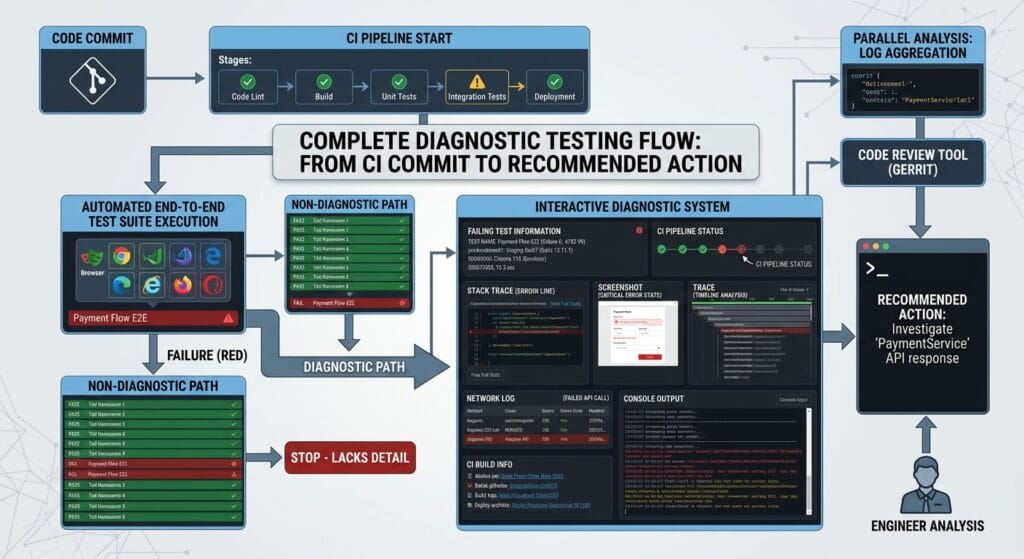
Reporting Is Not Just a Dashboard
Another common misunderstanding is that reporting belongs to the test suite because the suite generates the results.
In practice, reporting infrastructure is often a framework concern.
A weak report might say:
FAILED: checkout_test
That provides very little value.
A stronger framework can provide:
Test: checkout_test
Environment: staging
Browser: Chromium 141
Duration: 8.42s

Failure:
Expected: Order confirmation
Received: Payment declined

Artifacts:
✓ Screenshot
✓ Trace
✓ Console log
✓ Network log
✓ Video
✓ Request/response data
Now the failure becomes actionable.
The goal of automation reporting is not simply to count green and red tests.
It is to reduce the time between:
Failure
   ↓
Understanding
   ↓
Diagnosis
   ↓
Fix
This is one reason a mature test automation framework should treat observability as an architectural capability.
CI Is Where Weak Frameworks Get Exposed
A test that works perfectly on a developer’s laptop can still be unreliable.
Why?
Because CI changes the execution environment.
You may have:
- different CPU resources
- different network latency
- different browser versions
- different environment variables
- different filesystem behavior
- different parallelism
- different timing
- different service dependencies
This is why CI should not merely execute tests.
It should help expose weaknesses in the test automation framework.
A useful pipeline might look like:
name: Automated Tests

on:
  pull_request:

jobs:
  test:
    runs-on: ubuntu-latest

    steps:
      - uses: actions/checkout@v4

      - name: Install dependencies
        run: npm ci

      - name: Run tests
        run: npx playwright test

      - name: Upload report
        if: always()
        uses: actions/upload-artifact@v4
        with:
          name: test-results
          path: test-results/
The test suite supplies the scenarios.
The framework supplies the execution conventions.
The CI system supplies repeatable automation infrastructure.
These layers work together, but they are not the same thing.
Test Isolation Is a Framework-Level Design Decision
Consider two tests:
def test_create_order():
    create_user()
    create_order()
and:
def test_cancel_order():
    cancel_order()
What happens if test_cancel_order() requires the order created by test_create_order()?
You now have test dependency.
If the first test fails, the second may fail too.
That creates misleading results.
A better architecture establishes independent state:
def test_cancel_order():
    user = create_test_user()
    order = create_test_order(user)

    cancel_order(order)

    assert order_status(order) == "cancelled"
Now the test can execute independently.
This matters enormously when running tests in parallel.
A reliable test automation framework should make isolation easier rather than leaving every individual test author to solve state management independently.
Parallel Execution Changes Everything
Suppose you have 1,000 tests.
Sequential execution:
1000 tests
    ↓
4 hours
Parallel execution:
1000 tests
    ↓
20 workers
    ↓
~20–40 minutes
The exact improvement depends on the tests and infrastructure.
But parallelism exposes hidden assumptions.
Tests may unexpectedly:
- use the same account
- modify the same database record
- write to the same file
- use identical usernames
- depend on shared browser state
- consume the same external resource
Suddenly, tests that passed sequentially begin failing.
This is not necessarily a problem with the test scenarios.
It can reveal a weakness in framework architecture.
A strong test automation framework therefore considers parallel execution from the beginning.
Retries Can Make a Bad Suite Look Healthy
Retries are useful.
They can help diagnose intermittent infrastructure failures.
But there is a dangerous pattern:
Test fails
   ↓
Retry
   ↓
Pass
   ↓
Dashboard = Green
The dashboard says everything is fine.
The engineering system says otherwise.
Suppose:
10,000 executions
700 first-attempt failures
500 pass after retry
200 remain failed
A simple dashboard might emphasize:
95% Passed
An engineering-oriented system should also ask:
7% failed initially
5% required retries
2% remained failed
The retry rate becomes a reliability signal.
Do not use retries as a substitute for fixing:
- synchronization problems
- shared state
- unstable environments
- bad test data
- external dependencies
- race conditions
A healthy test automation framework makes flaky behavior visible.
It should not help hide it.
Test Suite Organization Still Matters
None of this means test suites are unimportant.
A well-organized suite is essential.
You might organize suites around:
Smoke
Regression
Critical Business Flows
API
UI
Integration
Security
Accessibility
Cross-browser
Or around business capabilities:
Authentication
Orders
Payments
Customers
Inventory
Reporting
The right organization depends on the product and delivery model.
The key is that suite organization should answer:
“Which tests should we execute for this purpose?”
Framework architecture answers:
“How should those tests be built and executed reliably?”
Those are different questions.
A Useful Decision Matrix
When deciding whether something belongs to the framework or suite, use this rule:
| Question | Framework | Test Suite |
|---|---|---|
| How do we launch browsers? | ✓ | |
| How do we authenticate? | ✓ | |
| How do we configure environments? | ✓ | |
| How do we collect traces? | ✓ | |
| How do we generate test data? | ✓ | |
| Which scenarios verify checkout? | ✓ | |
| Which tests run during smoke testing? | ✓ | |
| Which tests cover payment? | ✓ | |
| How should failures be reported? | ✓ | |
| Which tests run for regression? | ✓ | |
| How should tests run in parallel? | ✓ | |
| What business behavior should be verified? | ✓ |
There can be overlap, but this matrix provides a useful architectural starting point.
Three Common Anti-Patterns to Avoid
The Giant Test Folder
Everything lives under:
tests/
with little architectural separation.
The result is usually duplication, inconsistent patterns, and difficult onboarding.
The Utility Dump
A project develops:
utils/
├── helper1
├── helper2
├── helper3
├── helper4
├── common
├── common2
├── shared
└── genericHelper
This is not necessarily a framework.
A collection of utilities without clear ownership and architectural purpose can actually increase complexity.
The Framework-First Obsession
Some teams spend months building an enormous framework before writing meaningful tests.
That can also fail.
The framework should evolve from real testing needs.
A better approach is:
Real testing problem
        ↓
Simple reusable solution
        ↓
Repeated need
        ↓
Framework capability
        ↓
Standardized implementation
Build infrastructure because the product needs it, not because framework complexity looks impressive.
How to Audit Your Current Automation System
Try this practical exercise with your team.
Score each area from 1 to 5.
| Area | 1 | 3 | 5 |
|---|---|---|---|
| Test isolation | Highly dependent | Partially isolated | Fully independent |
| Maintainability | Frequent duplication | Some reuse | Strong reusable architecture |
| CI reliability | Frequently fails | Occasional instability | Consistently reliable |
| Diagnostics | Pass/fail only | Basic logs | Rich actionable evidence |
| Test data | Hard-coded | Partially managed | Controlled and isolated |
| Configuration | Embedded in tests | Partially externalized | Fully environment-driven |
| Parallel execution | Unsafe | Limited | Designed for parallelism |
| Reporting | Minimal | Useful | Diagnostic and traceable |
| Onboarding | Very difficult | Moderate | Clear and documented |
| Adding tests | Expensive | Moderate | Fast and predictable |
Calculate the total.
40–50 → Strong foundation
30–39 → Healthy but needs targeted improvements
20–29 → Significant architectural debt
10–19 → Automation system requires serious redesign
These numbers are not a universal industry standard.
They are a practical internal diagnostic.
The important part is identifying where your system is weakest.
The Best Framework Is Not the Biggest One
There is a temptation to compare automation systems by technical sophistication.
One team has:
- custom runners
- multiple reporting systems
- dozens of utility packages
- complex abstractions
- custom plugins
- extensive wrappers
Another has:
- a straightforward runner
- clean fixtures
- reusable components
- controlled test data
- useful reporting
- reliable CI
Which one is better?
The answer should not be based on complexity.
Ask:
Which system makes reliable feedback easier to produce?
That is the strategic test.
A test automation framework should reduce engineering friction.
If engineers need extensive documentation to understand the framework, if simple tests require complex abstractions, or if every new feature demands framework modifications, the framework may have become a product of its own rather than an enabler of testing.
The Relationship Between Framework, Suite, and CI
Think of the three as complementary layers:
                 Engineering Feedback
                         ↑
                         │
                    Test Results
                         ↑
              ┌──────────────────┐
              │    Test Suites   │
              └──────────────────┘
                         ↑
              ┌──────────────────┐
              │ Test Automation  │
              │    Framework     │
              └──────────────────┘
                         ↑
              ┌──────────────────┐
              │     CI/CD        │
              └──────────────────┘
The actual implementation may differ.
But the principle remains.
CI determines when and where execution happens.
The framework determines how automation operates.
The suite determines which scenarios are executed.
The resulting feedback helps engineers make decisions.
That final point is often forgotten.
Automation exists to create useful engineering feedback, not merely green dashboards.
A Simple Rule for Your Team
If your team is still debating whether a piece of code belongs to the framework or the suite, ask:
Will multiple tests, suites, environments, or execution contexts need this capability?
If yes, it is likely a framework concern.
If it represents a specific business scenario or collection of scenarios, it is likely suite/test territory.
For example:
LoginPage abstraction       → Framework
API client                   → Framework
Browser configuration        → Framework
Test-data factory            → Framework
Screenshot handling         → Framework

Checkout test                → Suite/Test
Payment regression group     → Suite
Smoke test collection        → Suite
Login validation scenario    → Suite/Test
This simple distinction can prevent a surprising amount of architectural confusion.
What Should You Optimize First?
If your automation system is struggling, do not immediately rewrite everything.
Start with evidence.
Measure:
Flaky test rate
Failure diagnosis time
Average execution time
Retry rate
Maintenance effort
CI failure rate
Test duplication
Test isolation
Then identify the largest source of engineering waste.
For example:
Problem:
30% of CI failures are flaky tests

↓
Investigate:

Timing?
Shared state?
Test data?
Environment?
External dependency?

↓
Fix root cause

↓
Measure again
This is much safer than declaring:
“Our framework is old. Let’s rewrite it.”
A framework rewrite can consume months while leaving the underlying testing strategy unchanged.
When a Framework Rewrite Actually Makes Sense
A complete rewrite may be justified when:
- the architecture prevents required testing capabilities
- the framework cannot support current CI requirements
- maintenance costs exceed realistic improvement costs
- core dependencies are obsolete
- test isolation cannot reasonably be achieved
- execution architecture prevents required scalability
- the framework has become impossible to understand or extend
But even then, migration should be incremental where possible.
A practical strategy is:
Existing Framework
       ↓
Identify highest-cost problem
       ↓
Build improved capability
       ↓
Migrate a small test group
       ↓
Measure
       ↓
Expand migration
       ↓
Retire old implementation
This reduces migration risk.
The Strategic Takeaway
The difference between a test automation framework and a test suite becomes much clearer when you stop looking at automation as a collection of scripts.
A suite is primarily about coverage and organization.
A framework is about engineering leverage and execution quality.
A mature automation strategy needs both.
You need tests that verify meaningful product behavior.
You also need infrastructure that makes those tests:
- reliable
- maintainable
- isolated
- observable
- scalable
- reusable
- CI-ready
Without the suite, the framework has little meaningful behavior to validate.
Without the framework, the suite can become a growing collection of expensive scripts.
The real objective is not choosing one over the other.
It is designing them so they work together.
Internal Blog Links
- AI Agents vs Agentic AI — Stop Confusing These Concepts (90% of Developers Get It Wrong)
- RAG Powered Performance Testing: Make k6 Tests Smarter With Real API Behavior
- Claude Code vs Cursor: Which AI Coding Tool is Better for Professional Development?
- Claude AI Jira Integration: 11 Powerful Workflows for Developers and QA
- AutoGen Function Tools: Connect AI Agents to Python Functions
Internal Series Links
- Learn MCP – Zero to Hero
- Learn AI Agents for QA – Zero to Hero
- Playwright Automation – Zero to Hero
- TencentDB Agent Memory: Complete Zero to Hero
- LangGraph: Complete Zero to Hero
- Learn Python – Zero to Hero
- OpenAI Codex: Complete Zero to Hero
- Cursor AI: Complete Zero to Hero
- Claude Code Tutorial: Complete Zero to Hero
- AutoGen: Complete Zero to Hero Guide
- Free QA Resources Built From Real Experience
- QA Glossary: Test Automation Terms Every Engineer Should Know
External Links
- Python Documentation — Python fundamentals and language reference.
- Playwright Documentation — Useful when discussing browser automation, fixtures, parallel execution, tracing, and test architecture.
- Cypress Documentation — Useful for comparing another modern automation architecture.
- Selenium Documentation — Useful for browser automation and framework ecosystem comparisons.
- pytest Documentation —Useful for fixtures, parametrization, test organization, and Python automation architecture.
- GitHub Actions Documentation — Useful for the CI/CD and automated test execution discussion.
People Asked Questions
What is a test automation framework?
A test automation framework is the reusable engineering foundation used to build and execute automated tests. It typically manages configuration, fixtures, test data, execution, reporting, integrations, and reusable automation components.
What is a test suite?
A test suite is an organized collection of automated tests grouped for a particular purpose, feature, risk area, or execution strategy.
Is a test automation framework the same as a test suite?
No. A framework provides the infrastructure and reusable capabilities for automation, while a test suite organizes the actual tests that verify application behavior.
Can one framework have multiple test suites?
Yes. A single framework can support multiple suites such as smoke, regression, API, UI, accessibility, and critical-business-flow suites.
Which is more important: framework or test suite?
Both serve different purposes. The suite provides meaningful coverage, while the framework determines how reliably and efficiently that coverage can be created and executed.
When should a team build a test automation framework?
A dedicated framework becomes valuable when automation requires reusable configuration, fixtures, data management, reporting, parallel execution, CI integration, and consistent engineering practices.
Can Playwright or Cypress be called a test automation framework?
They provide automation capabilities and testing infrastructure, but the exact meaning of “framework” depends on how the organization structures its own reusable architecture around the underlying tool.
Why do automated tests become flaky?
Common causes include timing problems, shared state, unstable environments, poor test data isolation, external dependencies, race conditions, and inadequate synchronization.
Should automated tests be retried?
Retries can help identify intermittent failures, but they should not be used to hide flaky tests. Retry rates should be measured and investigated.
Should a test automation framework contain business tests?
The framework should provide reusable capabilities, while business-specific scenarios generally belong in test suites or test modules built on top of the framework.
AEO Optimization
What is the difference between a test automation framework and a test suite?
A test automation framework is the reusable engineering foundation that provides configuration, fixtures, test data, execution, reporting, integrations, and CI/CD capabilities. A test suite is an organized collection of automated tests grouped around features, risks, business workflows, or testing objectives. One framework can support multiple test suites.
What belongs in a test automation framework?
A test automation framework should contain reusable capabilities rather than application-specific test scenarios. Typical components include configuration management, fixtures, reusable clients, test-data utilities, environment handling, logging, reporting, retries, parallel execution, and CI/CD integration.
AI Overview Optimization
| Concept | Primary responsibility | Typical contents |
|---|---|---|
| Test automation framework | Provides reusable automation infrastructure | Fixtures, configuration, utilities, clients, reporting, execution, CI/CD |
| Test suite | Organizes tests around a testing objective | Smoke, regression, API, UI, feature, business-flow tests |
| Test case | Verifies one specific behavior | Preconditions, actions, assertions, expected result |
Framework → enables execution → Test Suite → contains → Test Cases
Conclusion
A test suite tells you what you are testing.
A test automation framework determines how sustainably and reliably you can test it.
That distinction matters because automation maturity is not measured by how many test files exist in a repository. It is measured by how efficiently an engineering team can create trustworthy feedback as the product, team, and test estate grow.
If adding 100 more tests makes your system dramatically harder to maintain, the problem may not be the tests themselves. The deeper problem may be the architecture supporting them.
Start by measuring reliability, isolation, execution time, diagnostic quality, maintenance effort, and CI behavior. Then improve the framework around the most expensive problems instead of blindly adding more utilities or rewriting everything.
The strongest automation systems are not necessarily the largest.
They are the ones engineers can trust.
Final Key Takeaways
- A test automation framework is the engineering foundation; a test suite is a collection of automated scenarios.
- A framework manages concerns such as configuration, fixtures, execution, data, reporting, diagnostics, and CI integration.
- A test suite organizes scenarios around smoke, regression, API, UI, business flows, or other testing objectives.
- One framework can support multiple test suites.
- A large number of automated tests does not automatically indicate automation maturity.
- Framework quality should be evaluated through reliability, maintainability, isolation, scalability, diagnostics, and CI behavior.
- Reusable abstractions should reduce engineering effort without hiding important behavior.
- Test data and environment configuration should be deliberately separated from individual test scenarios.
- Parallel execution exposes hidden state and data dependencies, making isolation essential.
- Retries should provide diagnostic evidence rather than hide flaky tests.
- A framework should evolve from real testing problems instead of becoming a massive infrastructure project before meaningful automation exists.
- Before rewriting an automation system, measure the actual sources of engineering waste.
- The ultimate goal is not more automated tests; it is faster, more reliable, and more trustworthy engineering feedback.
Continue Learning
Explore more expert articles on Mobile Testing, Backend & API, AI & Agentic, AI Tools, n8n, LangChain, CrewAI, MCP Servers, AI Agents, LlamaIndex, Docker, FastAPI, Playwright, Cypress, Test Automation, DevOps, and Software Engineering at www.skakarh.com.
QAPulse by SK delivers expert release analysis, AI engineering insights, enterprise automation strategies, migration guidance, DevOps best practices, and practical testing knowledge to help software professionals build scalable, intelligent, and production-ready software systems.