 QA
QA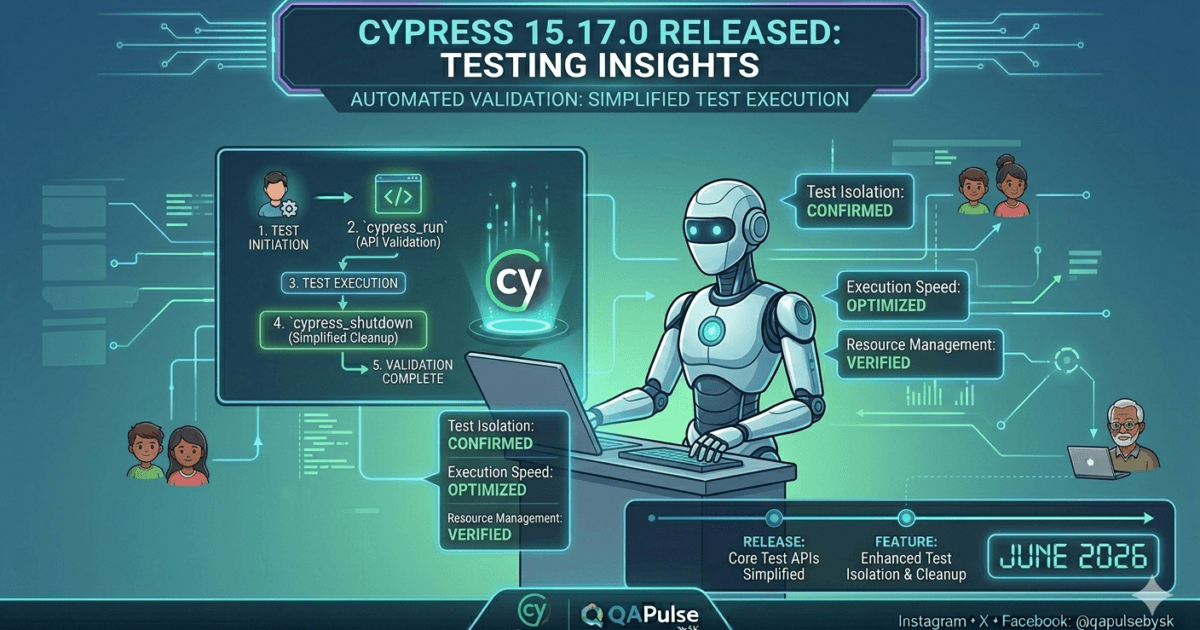
The Cypress team has released Cypress 15.17.0, continuing its focus on improving test reliability, developer experience, and framework stability for modern web application testing.
While Cypress 15.17.0 is not a major feature release, maintenance releases like this are often highly valuable because they resolve issues affecting test execution, CI/CD reliability, browser compatibility, and overall framework stability.
For QA Engineers, SDETs, Test Automation Architects, and DevOps teams, staying current with Cypress releases helps reduce flaky tests and improve confidence in automated regression suites.
What is Cypress?
Cypress is one of the most widely used end-to-end testing frameworks for modern web applications.
Organizations use Cypress for:
- End-to-End Testing
- Component Testing
- API Testing
- Regression Testing
- Cross-Browser Validation
- CI/CD Automation
- Frontend Quality Assurance
Official Resources:
- Cypress Documentation: https://docs.cypress.io
- Cypress Changelog: https://docs.cypress.io/app/references/changelog#15-17-0
- GitHub Repository: https://github.com/cypress-io/cypress
Why Cypress 15.17.0 Matters for QA Engineers
Many teams treat maintenance releases as optional upgrades.
However, history shows that Cypress maintenance releases frequently address:
- Browser compatibility issues
- Test runner stability
- Command execution reliability
- Component testing improvements
- CI/CD integration problems
Even minor fixes can significantly improve large-scale automation frameworks.
Potential Impact Areas for Automation Teams
When evaluating Cypress 15.17.0, QA teams should focus on:
Test Stability
Automation teams should verify:
- Command execution reliability
- Retry behavior
- Network interception
- Test synchronization
Browser Compatibility
Validate:
- Chrome
- Edge
- Electron
- Firefox
for any behavior changes.
CI/CD Pipelines
Confirm successful execution within:
- GitHub Actions
- Jenkins
- GitLab CI
- Azure DevOps
- CircleCI
What QA Engineers Should Test After Upgrading
Regression Testing
Run:
- Smoke suites
- Sanity suites
- Full regression suites
to identify any unexpected changes.
API Testing
Validate:
- cy.request()
- Authentication flows
- API mocking
- Response assertions
UI Testing
Verify:
- Form submissions
- File uploads
- Navigation flows
- Dynamic content loading
Network Interception
Confirm:
cy.intercept()
continues to behave as expected across critical workflows.
Cypress 15.17.0 for Enterprise Teams
Large organizations often run:
- Thousands of tests
- Parallel execution
- Distributed pipelines
- Cloud execution environments
Even small framework fixes can produce:
- Faster execution
- Fewer flaky tests
- More stable pipelines
- Lower maintenance costs
This is why enterprise QA teams should evaluate every Cypress release.
Cypress vs Playwright in 2026
Many teams continue comparing Cypress and Playwright.
| Feature | Cypress 15.17.0 | Playwright |
|---|---|---|
| Browser Automation | Excellent | Excellent |
| Multi-Tab Support | Limited | Strong |
| Network Control | Strong | Strong |
| Authentication Testing | Good | Excellent |
| Cross-Browser Testing | Good | Excellent |
| Modern Framework Support | Excellent | Excellent |
For organizations heavily invested in Cypress, 15.17.0 provides another step toward improved framework maturity.
Upgrade Guide
Upgrade Cypress
npm install cypress@latest
Verify installation:
npx cypress --versionTesting Checklist After Upgrading
Framework Validation
✅ Test execution
✅ Fixtures
✅ Custom commands
✅ Plugins
Browser Validation
✅ Chrome
✅ Firefox
✅ Edge
✅ Electron
CI/CD Validation
✅ GitHub Actions
✅ Jenkins
✅ Azure DevOps
✅ GitLab CI
Reporting Validation
✅ Mochawesome
✅ Allure
✅ JUnit Reports
Migration Risk Assessment
Upgrade Risk
Low
Breaking Changes
No major breaking changes have been highlighted for this maintenance release.
Recommended Upgrade Strategy
- Upgrade in staging.
- Run smoke tests.
- Execute regression suites.
- Validate CI/CD pipelines.
- Promote to production automation environments.
My QA Assessment of Cypress 15.17.0
Biggest Benefit
Improved framework stability.
Most Valuable Outcome
Reduced automation maintenance overhead.
Risk Level
Low.
Enterprise Recommendation
Recommended upgrade during the next sprint or maintenance window.
Overall Rating
8.8/10
While not a feature-heavy release, Cypress 15.17.0 helps teams maintain a stable and reliable automation platform.
More Relevant Articles
- The Most Dangerous QA Engineer in 2026 Is the Comfortable One
- Why Most Test Automation Frameworks Collapse at Scale
- Most QA Engineers Are Learning the Wrong Skills in 2026
- 9 Brutal Habits Destroying Software Testers in 2026
- Load Testing Microservices with AI Personas: k6 + LLM-Generated User Journeys
- How I Built a Postman Bot That Detects Breaking API Changes Before Deployment (Using LLM)
- From Pytest Scripts to Test Agents: Building Autonomous API Testing Systems with Autogen
External Resources
Cypress Documentation: https://docs.cypress.io
Cypress Changelog: https://docs.cypress.io/app/references/changelog#15-17-0
Cypress GitHub Repository: https://github.com/cypress-io/cypress
JavaScript Testing Best Practices: https://testingjavascript.com
Frequently Asked Questions
What is Cypress 15.17.0?
Cypress 15.17.0 is a maintenance release focused on framework reliability, bug fixes, and overall stability improvements.
Does Cypress 15.17.0 contain breaking changes?
No major breaking changes have been reported for this release.
Should QA teams upgrade immediately?
Most organizations can safely upgrade after running standard regression validation.
What should QA engineers test first?
Critical business workflows, network interception, browser compatibility, and CI/CD execution.
Does this release impact Playwright users?
No. This release only affects Cypress users.
Is Cypress still relevant in 2026?
Yes. Cypress remains one of the most popular web testing frameworks, especially for frontend-focused testing teams.
Final Thoughts
Cypress 15.17.0 continues the framework’s focus on reliability and stability. Although this release may not introduce major new capabilities, it provides important maintenance improvements that help QA teams maintain trustworthy automated test suites.
Organizations using Cypress for end-to-end testing, component testing, API validation, and regression automation should evaluate upgrading to benefit from ongoing platform improvements.