QA
QA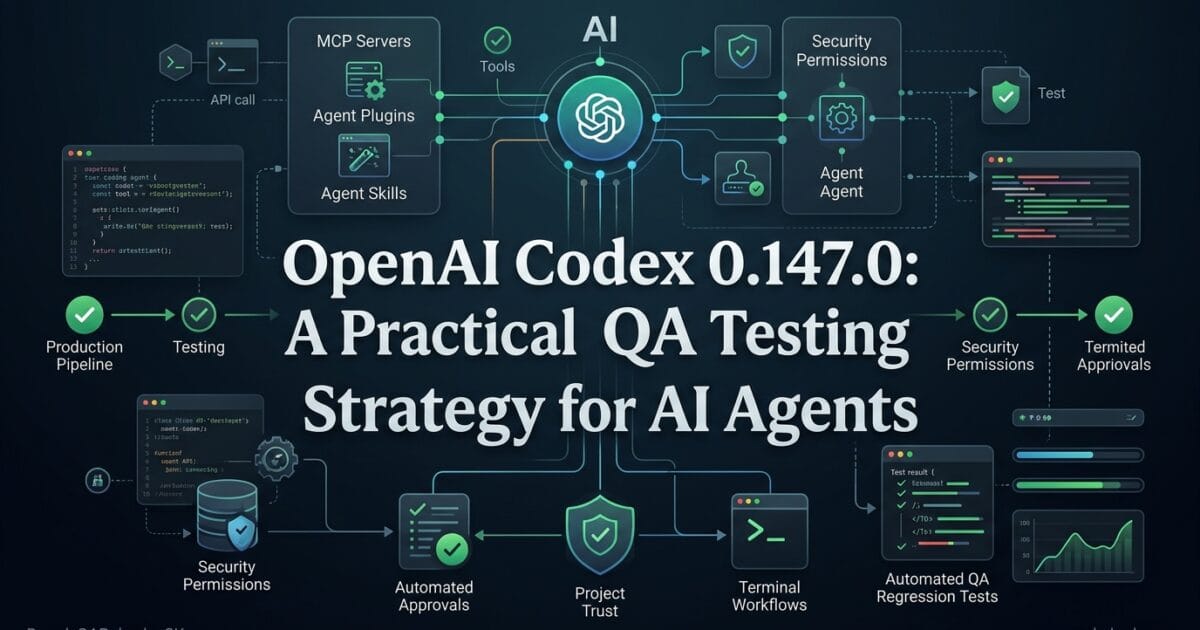
OpenAI Codex 0.147.0 is more than a routine version bump for QA engineers and SDETs. This release introduces changes across agent plugins, persistent conversations, approval workflows, MCP protocol support, skills interoperability, security, and terminal behavior.
That makes the right testing question very different from:
“Does Codex still start?”
The better question is:
Can your AI coding workflow still discover, approve, execute, secure, and complete the work you depend on after upgrading to OpenAI Codex 0.147.0?
That is the central QA challenge in this release.
When an AI coding agent gains new capabilities, the regression surface expands with it. A feature such as portable agent plugins sounds like a productivity improvement, but it also creates new surfaces for plugin discovery, installation, permissions, compatibility, and execution.
Likewise, MCP 2026-07-28 support is not merely a protocol-version change. Paginated discovery, multi-round requests, and non-blocking server startup can affect how an agent discovers and interacts with external tools.
For SDETs, this means OpenAI Codex 0.147.0 should be tested as an integrated AI workflow rather than as an isolated CLI binary.
What Changed in OpenAI Codex 0.147.0?
The release contains several changes that deserve attention from QA teams.
| Area | Change | QA Risk |
|---|---|---|
| Agent plugins | Portable plugins and multiple plugin catalogs | Installation and discovery compatibility |
| Conversations | Persistent manually ordered sections | State and UI regression |
| Approvals | --approve-for-me | Security and authorization risk |
| Skills | Cursor-managed skill import | Cross-tool compatibility |
| MCP | MCP 2026-07-28 support | Protocol compatibility |
| MCP discovery | Paginated discovery | Tool discovery regression |
| MCP requests | Multi-round requests | Workflow and state handling |
| MCP startup | Non-blocking server startup | Race-condition risk |
| Bedrock | Cached web search and remote compaction | Provider-specific behavior |
| Security | Secret and bearer-token redaction | High-priority security validation |
| Terminal | Input and process handling improvements | CLI regression |
| Rendering | Japanese, emoji, hyperlinks and viewport fixes | Terminal rendering regression |
| Windows | Process interruption and filesystem handling | Platform-specific regression |
| Trust | Explicit trust for unfamiliar projects | Security and authorization |
The important point is that these changes do not all have the same risk level.
A useful SDET approach is to classify them before writing tests.
HIGH RISK
├── Approval automation
├── Secret redaction
├── Project trust
├── Managed authentication
└── MCP protocol compatibility

MEDIUM RISK
├── Agent plugins
├── Skill import
├── Conversation persistence
└── MCP discovery

PLATFORM / UX RISK
├── Terminal input
├── Windows processes
├── Filesystem paths
└── Character rendering
This prevents a common mistake: spending equal testing effort on every release-note bullet.
The First Question: What Changed in Your Attack Surface?
Traditional software upgrades usually focus on functionality.
AI coding agents require another dimension:
What new authority does the agent receive?
Consider the new approval capability:
codex --approve-for-me
From a productivity perspective, this could reduce interruptions.
From a security-testing perspective, it immediately raises questions:
Who can approve?
      ↓
What can be approved?
      ↓
When is approval automatic?
      ↓
Can dangerous commands execute?
      ↓
Is the approval auditable?
That is exactly where QA and security testing intersect.
An automated approval mechanism should never be treated as simply another CLI option.
Build a Permission Test Matrix
| Scenario | Expected Behavior |
|---|---|
| Safe command | Allowed according to policy |
| Unknown command | Policy evaluated |
| Destructive command | Appropriate restriction |
| Untrusted project | Explicit trust required |
| Restricted credentials | Authentication policy enforced |
| Approval flag absent | Normal approval behavior |
| Approval flag enabled | Automated approval follows policy |
The goal is not to prove that automation works.
The goal is to prove that automation cannot silently bypass the security model.


Agent Plugins Change the Testing Model
Portable agent plugins are one of the more interesting additions.
The release introduces the ability to install portable Agent Plugins and search across:
- local catalogs
- personal catalogs
- workspace catalogs
- remote catalogs
That creates a new dependency chain.
Plugin Catalog
      ↓
Discovery
      ↓
Selection
      ↓
Installation
      ↓
Compatibility
      ↓
Activation
      ↓
Agent Execution
A basic test might be:
codex plugin search
But that is only a discovery test.
A stronger test validates the complete lifecycle:
Search plugin
      ↓
Find expected plugin
      ↓
Install plugin
      ↓
Load plugin
      ↓
Execute plugin capability
      ↓
Verify result
Test Plugin Catalog Precedence
Because plugins can come from different catalog scopes, QA should test whether the correct source is selected.
For example:
Local
Personal
Workspace
Remote
Questions worth testing include:
- What happens when two catalogs expose similarly named plugins?
- Does workspace configuration override personal configuration?
- Can a remote plugin be installed when policy prohibits it?
- What happens when a plugin disappears from a catalog?
- What happens when the plugin version is incompatible?
- Does an unavailable remote catalog cause the entire workflow to fail?
These are not theoretical questions.
They become production problems when AI agents depend on plugins to perform testing, coding, deployment, or analysis tasks.
Persistent Conversations Need State Testing
Persistent, manually ordered conversation sections introduce another type of regression risk: state integrity.
An AI coding agent does not merely process a request.
It maintains context.
If conversations can now be organized into persistent sections, test the persistence model.
def test_conversation_sections_persist():
    conversation = create_conversation()

    conversation.create_section("API Tests")
    conversation.create_section("UI Tests")

    restart_codex()

    sections = conversation.sections()

    assert "API Tests" in sections
    assert "UI Tests" in sections
Then test ordering.
def test_manual_section_order_is_preserved():
    sections = [
        "Planning",
        "Implementation",
        "Testing",
    ]

    save_section_order(sections)
    restart_codex()

    assert get_section_order() == sections
The important test isn’t merely whether sections appear.
It is whether the agent preserves the user’s intended organization after restart, synchronization, or long-session navigation.
Long Conversations Are a QA Problem
The release also improves browsing of long transcripts incrementally.
That deserves performance and state testing.
Imagine a conversation with thousands of messages:
Message 1
Message 2
...
Message 5000
A good test asks:
Can the user browse incrementally?
        ↓
Does the correct context load?
        ↓
Does scrolling preserve position?
        ↓
Are messages missing?
        ↓
Can the agent still reference relevant context?
This is particularly important for SDETs using Codex for large debugging or test-generation sessions.
A visual regression test alone cannot prove that the agent still has the right context.
You need a combination of:
- UI validation
- state validation
- context validation
- performance validation
MCP 2026-07-28 Support Is a Major Testing Surface
The MCP changes deserve special attention.
OpenAI Codex 0.147.0 adds opt-in support for the MCP 2026-07-28 protocol, including:
- paginated discovery
- multi-round requests
- non-blocking server startup
Each capability changes how an agent interacts with MCP servers.
Consider tool discovery.
A simplistic test assumes:
Request tools
     ↓
Receive all tools
Paginated discovery changes that model:
Request page 1
     ↓
Receive page 1
     ↓
Request page 2
     ↓
Receive page 2
     ↓
Continue
     ↓
Complete discovery
That creates new edge cases.
MCP Pagination Test Cases
| Scenario | Expected Result |
|---|---|
| One-page tool list | All tools discovered |
| Multiple pages | All pages processed |
| Empty page | Discovery handled correctly |
| Last page | Pagination terminates |
| Duplicate tool | No unexpected duplication |
| Server returns invalid cursor | Graceful failure |
| Server unavailable mid-pagination | Useful error/recovery |
This is where an SDET should think beyond happy-path testing.
Test MCP Discovery Like a Distributed System
The new MCP behavior creates opportunities for timing-related defects.
For example:
Codex
  │
  ├── Start MCP server
  │
  ├── Request discovery
  │
  └── Server still initializing
Because startup can now be non-blocking, your test suite should deliberately introduce timing variation.
def test_mcp_discovery_during_server_startup():
    start_mcp_server_async()

    result = codex.discover_tools()

    assert result.is_valid()
Then test delayed startup:
def test_mcp_server_delayed_startup():
    start_mcp_server(delay=3)

    result = codex.connect_to_mcp(timeout=10)

    assert result.connected
This is particularly valuable because race conditions often disappear when developers test manually.
Automated tests can expose them repeatedly.
Compare Traditional CLI Testing With AI Agent Testing
The testing model is fundamentally different.
| Traditional CLI | AI Coding Agent |
|---|---|
| Command execution | Agent decision + execution |
| Deterministic arguments | Context-dependent actions |
| Static configuration | Dynamic integrations |
| Simple process state | Persistent conversation state |
| API calls | MCP/tool interactions |
| Basic permissions | Agent approval and trust |
| Unit tests | Workflow-level validation |
This is why a conventional smoke test is insufficient.
A traditional CLI test might be:
codex --version
That proves almost nothing about the complete AI workflow.
A stronger AI-agent test might be:
Start Codex
   ↓
Load project
   ↓
Validate trust
   ↓
Load skills
   ↓
Connect MCP
   ↓
Discover tools
   ↓
Execute approved operation
   ↓
Verify output
That is much closer to what users actually depend on.
Security Testing Gets More Important
The release includes security-focused fixes around displayed commands and replayed conversation history.
Specifically, secrets and complete bearer tokens are being redacted.
That deserves a dedicated regression suite.
Create a controlled secret:
TEST_BEARER_TOKEN=qa-secret-12345
Then execute a workflow that causes the value to appear in command or conversation context.
Your assertion should be:
history = get_conversation_history()

assert "qa-secret-12345" not in history
Also test partial representations.
assert "qa-secret-12345" not in displayed_commands()
assert "qa-secret-12345" not in replayed_history()
Security testing should also verify that redaction doesn’t destroy legitimate diagnostic information.
The goal is:
Sensitive information
        ↓
REDACTED

Non-sensitive diagnostic context
        ↓
PRESERVED
Over-redaction can make debugging difficult.
Under-redaction can expose credentials.
The correct behavior is somewhere in between.
Test Trust Boundaries Explicitly
The release also strengthens explicit trust requirements for unfamiliar local projects and managed authentication restrictions.
This should trigger security-oriented test cases.
Unknown project
      ↓
Codex detects unfamiliar location
      ↓
Explicit trust required
      ↓
User/policy decision
      ↓
Execution allowed or blocked
Test both paths.
def test_untrusted_project_requires_confirmation():
    result = open_untrusted_project()

    assert result.requires_trust
And:
def test_trusted_project_can_execute():
    trust_project()

    result = open_project()

    assert result.ready
The important thing is to ensure that trust is not accidentally remembered beyond the intended scope.
Cross-Tool Skills Compatibility
Importing Cursor-managed skills and synchronizing imported Claude and Cursor conversations introduces interoperability testing.
This is an excellent example of a feature where QA should test round-trip integrity.
Cursor Skill
     ↓
Import
     ↓
Codex
     ↓
Modify
     ↓
Synchronize
     ↓
Original ecosystem
Potential test cases include:
| Test | Expected |
|---|---|
| Import valid skill | Success |
| Import duplicate skill | No unintended duplicate |
| Modify imported skill | Change preserved |
| Sync Claude conversation | No duplicate |
| Sync Cursor conversation | No duplicate |
| Invalid skill metadata | Graceful failure |
| Missing source | Useful error |
Cross-tool compatibility is rarely solved by a single happy-path test.
The test should verify what happens to state before, during, and after synchronization.
The Upgrade Question for QA Teams
Should every QA team immediately upgrade?
Not necessarily.
The correct decision depends on which capabilities your environment uses.
| Environment | Priority |
|---|---|
| Basic Codex CLI usage | Moderate |
| Agent plugins | High |
| MCP integrations | High |
| MCP 2026-07-28 testing | High |
| Automated approvals | Very High |
| Production credentials | Very High |
| Cursor/Claude skill interoperability | High |
| Bedrock workflows | High |
| Windows automation | High |
| Security-sensitive projects | Very High |
This produces a more rational upgrade strategy.
Don’t ask:
“Is the latest version available?”
Ask:
“Does this release affect capabilities that are business-critical in our environment?”
That is the question an SDET should answer before approving production rollout.
Building a Production-Ready QA Strategy for OpenAI Codex 0.147.0
OpenAI Codex 0.147.0 becomes much more interesting from a QA perspective when the release is treated as an ecosystem change rather than a simple CLI upgrade.
The strongest validation strategy is not to verify that Codex launches. It is to verify that the complete AI-assisted engineering workflow remains safe, compatible, observable, and useful.
The practical model is:
OpenAI Codex 0.147.0
        ↓
Project Trust
        ↓
Skills / Plugins
        ↓
MCP Connection
        ↓
Tool Discovery
        ↓
Approval / Permissions
        ↓
Agent Execution
        ↓
Conversation State
        ↓
QA Result
If any critical link breaks, the upgrade is not production-ready.
Create an OpenAI Codex 0.147.0 Upgrade Regression Suite
Instead of creating unrelated tests for every release-note item, build a risk-based regression suite.
tests/
├── test_version.py
├── test_trust.py
├── test_plugins.py
├── test_skills.py
├── test_mcp.py
├── test_approvals.py
├── test_security.py
├── test_conversations.py
├── test_terminal.py
└── test_e2e_workflows.py
A simple smoke test can establish the installed version:
codex --version
Then automate the important capabilities:
pytest tests/test_trust.py
pytest tests/test_plugins.py
pytest tests/test_skills.py
pytest tests/test_mcp.py
pytest tests/test_approvals.py
pytest tests/test_security.py
pytest tests/test_e2e_workflows.py
This is considerably more valuable than relying on:
codex --version
alone.
A version command proves installation.
A regression suite proves usability.
Test Agent Plugin Installation From Every Catalog Scope
Because the release adds plugin discovery across local, personal, workspace, and remote catalogs, catalog scope should become part of your regression matrix.
                 Plugin Discovery
                       │
       ┌───────────────┼────────────────┐
       ↓               ↓                ↓
     Local          Personal         Workspace
                                        │
                                        ↓
                                     Remote
A useful test matrix is:
| Catalog | Discovery | Installation | Execution | Expected |
|---|---|---|---|---|
| Local | ✓ | ✓ | ✓ | PASS |
| Personal | ✓ | ✓ | ✓ | PASS |
| Workspace | ✓ | ✓ | ✓ | PASS |
| Remote | ✓ | ✓ | ✓ | PASS |
| Unavailable | ✓ | ✗ | ✗ | Graceful failure |
The important test isn’t simply:
“Can Codex find a plugin?”
It is:
“Can Codex find the correct plugin, install it safely, load it consistently, and execute its expected capability?”
Test Duplicate Plugin Names
Suppose two catalogs expose the same plugin:
workspace/security-plugin
remote/security-plugin
Your regression suite should determine which one wins according to the intended resolution rules.
A conceptual test could look like:
def test_plugin_resolution():
    result = discover_plugin("security-plugin")

    assert result.source == EXPECTED_SOURCE
This is an excellent example of why AI-agent testing needs more than traditional functional testing.
Validate Skills as Executable Configuration
Skills are particularly important because they can influence how an AI agent performs work.
Treat imported skills as configuration that requires validation.
Skill
 ↓
Import
 ↓
Parse
 ↓
Register
 ↓
Activate
 ↓
Agent uses skill
 ↓
Expected behavior
A basic import test:
def test_skill_import():
    result = import_skill("qa-testing-skill")

    assert result.success
But the higher-value test validates behavior:
def test_imported_skill_changes_agent_behavior():
    import_skill("qa-testing-skill")

    result = run_agent_task(
        "Create API regression tests"
    )

    assert result.contains_api_tests
This distinction matters.
An import test proves the file was accepted.
A behavioral test proves the skill actually influences the agent as expected.
Test Conversation Synchronization as a Data Integrity Problem
The release also introduces synchronization between imported Claude and Cursor conversations without creating duplicates.
This should be tested like a data synchronization system.
Source Conversation
       ↓
Import
       ↓
Codex
       ↓
Modify
       ↓
Synchronize
       ↓
Source / Destination
Create a test conversation:
Conversation ID: QA-1001
Messages: 50
Sections: 4
After importing:
conversation = import_conversation("QA-1001")

assert conversation.id == "QA-1001"
assert conversation.message_count == 50
Then synchronize it again:
sync_conversation("QA-1001")

assert count_conversations("QA-1001") == 1
The critical assertion is not just that synchronization succeeds.
It is:
No duplicate
No lost messages
No corrupted ordering
No unexpected state
Test MCP Pagination With Deliberately Large Tool Sets
MCP paginated discovery is an ideal candidate for automated testing.
Create an MCP server containing more tools than a single response should return.
Page 1 → tools 1–20
Page 2 → tools 21–40
Page 3 → tools 41–60
Then validate:
tools = codex.discover_tools()

assert len(tools) == 60
assert "tool_01" in tools
assert "tool_60" in tools
Also test the boundaries.
1 tool
20 tools
21 tools
40 tools
41 tools
100+ tools
Boundary testing is especially useful for pagination because defects frequently occur around:
- first page
- last page
- empty page
- exact page size
- invalid cursor
- missing next cursor
Test MCP Failure and Recovery
Happy-path MCP testing is not enough.
Introduce controlled failures.
Codex
  ↓
MCP Server
  ↓
Page 1
  ↓
Page 2
  X
Server failure
Now ask:
- Does Codex fail gracefully?
- Does it retry?
- Does it preserve already discovered tools?
- Does it display a useful diagnostic?
- Can the user recover without restarting?
- Does the agent accidentally execute using incomplete tool information?
A conceptual test:
def test_mcp_discovery_failure_is_handled():
    server.fail_on_page(2)

    result = codex.discover_tools()

    assert result.failed
    assert result.error_is_actionable
This is where reliability engineering enters AI-agent testing.
Test Non-Blocking MCP Startup for Race Conditions
Non-blocking startup introduces timing variability.
That means deterministic tests alone are not enough.
Run repeated tests with different startup delays:
@pytest.mark.parametrize(
    "delay",
    [0, 0.1, 0.5, 1, 3, 5]
)
def test_mcp_startup(delay):
    start_server(delay=delay)

    result = codex.connect_to_mcp(timeout=10)

    assert result.connected
This can expose race conditions that disappear during manual testing.
A useful CI strategy is to repeat the test:
pytest tests/test_mcp_startup.py --count=20
If your test environment does not support --count, implement repetition through your test framework or CI matrix.
The principle is more important than the exact command:
Timing-sensitive integrations need repeated execution under different timing conditions.
Validate the --approve-for-me Security Boundary
Automatic approval deserves one of the strongest test suites in this release.
Start with a harmless command:
echo "QA test"
Then test progressively more sensitive operations.
Safe
 ↓
Filesystem modification
 ↓
Network access
 ↓
Credential access
 ↓
Destructive operation
Your expected behavior should come from your organization’s security policy.
For example:
def test_safe_operation():
    result = execute("echo QA")
    assert result.allowed
And:
def test_restricted_operation():
    result = execute(RESTRICTED_OPERATION)

    assert result.blocked
The critical question is:
Does automatic approval automate an already-authorized action, or does it accidentally broaden what the agent is allowed to do?
Your security regression suite should prove the former.


Test Secret Redaction With Canary Credentials
Never test secret redaction using real production credentials.
Use controlled canary values:
export QA_TEST_TOKEN="CANARY-SECRET-123456"
Then expose that value through a controlled test workflow.
def test_secret_is_not_exposed():
    run_command_with_secret()

    output = get_displayed_output()
    history = get_conversation_history()

    assert "CANARY-SECRET-123456" not in output
    assert "CANARY-SECRET-123456" not in history
Test multiple secret forms:
Bearer token
API key
Environment variable
Password
Connection string
Authorization header
Also test partial leakage.
CANARY-SECRET-123456
CANARY-SECRET
123456
Bearer CANARY-SECRET-123456
A mature security test should verify that sensitive information is not reconstructed through replay or display mechanisms.
Validate Unfamiliar Project Trust
Project trust should be tested as a state machine.
Unknown Project
      ↓
Trust Prompt
      ↓
Reject ─────────→ Access Denied
      │
      ↓
Approve
      ↓
Trusted Project
      ↓
Execution Allowed
A test should verify that an unfamiliar project cannot silently become trusted.
def test_unknown_project_requires_trust():
    project = open_project("/tmp/untrusted-project")

    assert project.requires_explicit_trust
Then:
def test_trusted_project_allows_workflow():
    trust_project("/tmp/trusted-project")

    result = run_agent_task(
        "inspect the test suite"
    )

    assert result.success
Also test restart behavior.
def test_trust_state_persists_correctly():
    trust_project(PROJECT)

    restart_codex()

    assert project_is_trusted(PROJECT)
The expected persistence behavior should be defined explicitly by your organization’s security requirements.
Test Terminal Input Under Focus Changes
The release contains fixes for lost or stalled terminal input when focus returns, MCP servers initialize, or terminal applications handle keyboard shortcuts.
This is difficult to validate with unit tests alone.
A focused integration test can simulate:
Start Codex
   ↓
Start MCP
   ↓
Switch focus
   ↓
Return focus
   ↓
Type command
   ↓
Verify complete input
For example, with a browser or terminal automation framework, assert that:
Expected:
"run regression tests"

Received:
"run regression tests"
and not:
"run regress"
or:
Input stalled
This is a good example of a release where end-to-end testing catches problems that component-level tests can miss.
Test Windows Separately
Windows process interruption and filesystem path handling deserve a platform-specific CI job.
strategy:
  matrix:
    os:
      - ubuntu-latest
      - windows-latest
      - macos-latest
Then run the same critical workflow on each platform.
Linux
 ├── MCP
 ├── Plugins
 └── Agent workflow

macOS
 ├── MCP
 ├── Plugins
 └── Agent workflow

Windows
 ├── MCP
 ├── Plugins
 └── Agent workflow
Do not assume that a passing Linux test proves Windows compatibility.
Filesystem semantics, process management, path separators, terminal behavior, and shell behavior can differ substantially.
Test International and Special-Character Rendering
The rendering fixes around Japanese characters, emoji, hyperlinks, and viewport boundaries should be validated with representative strings.
test_strings = [
    "Hello Codex",
    "こんにちは",
    "QA 🚀",
    "https://example.com",
    "QA → SDET → AI Engineer",
]
Then validate:
- text visibility
- cursor positioning
- line wrapping
- selection behavior
- scrolling
- terminal width changes
This can become a visual regression test combined with functional assertions.
Compare Smoke, Regression, and Workflow Testing
A useful testing hierarchy for OpenAI Codex 0.147.0 is:
| Test Level | Example | Purpose |
|---|---|---|
| Smoke | codex --version | Installation |
| Component | Plugin discovery | Feature behavior |
| Integration | MCP connection | Dependency compatibility |
| Security | Secret redaction | Risk validation |
| Regression | Existing workflows | Detect unintended change |
| E2E | Complete QA task | User-value validation |
| Canary | Selected users | Production confidence |
The mistake is treating the first row as sufficient.
It isn’t.
A successful smoke test only tells you:
Codex is executable.
A successful end-to-end test tells you:
Codex can still perform the work we depend on.
Build a Real AI-Assisted QA Workflow Test
Now combine the features into one representative scenario.
Imagine your QA team uses Codex to analyze an API change and generate automated tests.
The workflow could be:
Open Project
      ↓
Validate Trust
      ↓
Load QA Skill
      ↓
Discover MCP Tools
      ↓
Approve Required Action
      ↓
Read API Specification
      ↓
Generate Tests
      ↓
Execute Tests
      ↓
Analyze Results
      ↓
Produce Report
Your test should validate the complete chain.
def test_ai_qa_workflow():
    open_project(TEST_PROJECT)

    assert project_is_trusted(TEST_PROJECT)

    load_skill("qa-automation")

    tools = discover_mcp_tools()

    assert "api_testing" in tools

    result = run_qa_workflow()

    assert result.tests_generated
    assert result.tests_executed
    assert result.report_generated
This is much closer to production reality than testing individual features independently.
Add a Production Readiness Gate
Before approving OpenAI Codex 0.147.0 for wider rollout, define explicit gates.
Installation
     ↓ PASS
Project Trust
     ↓ PASS
Plugin Discovery
     ↓ PASS
Skills Import
     ↓ PASS
MCP Discovery
     ↓ PASS
MCP Tool Invocation
     ↓ PASS
Approval Security
     ↓ PASS
Secret Redaction
     ↓ PASS
Conversation Integrity
     ↓ PASS
Platform Tests
     ↓ PASS
Real QA Workflow
     ↓ PASS
       ✓
Production
If a critical security test fails, the release should not proceed simply because all functional tests passed.
This is a key distinction between test completion and production readiness.
Should You Upgrade OpenAI Codex 0.147.0 Immediately?
The answer depends on your usage.
If your team uses only basic Codex functionality, the upgrade risk may be relatively low.
If your team relies heavily on MCP, plugins, skills, automated approvals, credentials, or production AI workflows, the release deserves a much more comprehensive regression cycle.
A practical decision matrix is:
| Capability Used | Recommended Action |
|---|---|
| Basic CLI | Smoke + core regression |
| Agent plugins | Plugin regression |
| MCP | Full MCP regression |
| MCP 2026-07-28 | Protocol compatibility testing |
| Automated approvals | Mandatory security regression |
| Production credentials | Secret-redaction validation |
| Cursor/Claude skills | Interoperability testing |
| Windows automation | Windows CI validation |
| Production QA workflows | Full E2E + canary |
The upgrade should be approved when the risk-relevant tests pass, not simply because the new version contains useful features.
Turn the Release Into a Reusable Regression Framework
The real value of testing OpenAI Codex 0.147.0 is that the framework can be reused for future releases.
Create capability-based suites:
Codex QA Framework
│
├── Installation
├── Authentication
├── Project Trust
├── Plugins
├── Skills
├── MCP
├── Permissions
├── Security
├── Conversations
├── Terminal
├── Platform
└── E2E Workflows
When the next version arrives, you don’t start from zero.
You simply identify which capabilities changed and run the relevant suites.
That turns release testing from a manual activity into an engineering system.
The Strategic SDET Lesson
The biggest lesson from OpenAI Codex 0.147.0 is that AI agents are becoming platforms rather than simple developer tools.
A platform combines:
Agent
+
Tools
+
Plugins
+
Skills
+
Protocols
+
Permissions
+
State
+
External Services
Every integration creates another compatibility boundary.
Therefore, AI-agent QA needs to evolve from:
“Does this command work?”
to:
“Can the agent safely complete the intended engineering workflow across all of its dependencies?”
That is the level at which SDETs can provide real value in AI-assisted software engineering.
People Asked Questions
What is OpenAI Codex 0.147.0?
OpenAI Codex 0.147.0 is a Codex release that adds improvements around agent plugins, conversations, approvals, skills, MCP protocol support, security, terminal behavior, and platform compatibility.
What are the main changes in OpenAI Codex 0.147.0?
The major changes include portable agent plugins, persistent conversation sections, automatic approval through --approve-for-me, Cursor skill imports, MCP 2026-07-28 support, and several security and reliability fixes.
How should QA engineers test OpenAI Codex 0.147.0?
QA engineers should combine smoke, integration, security, regression, platform, and end-to-end testing. Particular attention should be given to MCP, plugins, skills, approvals, project trust, secrets, and real AI-assisted workflows.
Does Codex 0.147.0 support MCP 2026-07-28?
Yes. The release adds opt-in support for the MCP 2026-07-28 protocol, including paginated discovery, multi-round requests, and non-blocking server startup.
How can QA teams test Codex MCP integrations?
Teams should test MCP discovery, pagination, tool invocation, startup timing, connection failures, retries, invalid cursors, large tool sets, and behavior when an MCP server becomes unavailable.
Is --approve-for-me safe for production?
It should not be enabled blindly. QA and security teams should validate the organization’s approval policies, command boundaries, project trust behavior, and sensitive-operation handling before production use.
Does Codex 0.147.0 improve secret protection?
The release includes fixes intended to redact secrets and complete bearer tokens from displayed commands and replayed conversation history. Teams should still perform their own security regression tests using controlled test credentials.
Should QA engineers upgrade to Codex 0.147.0 immediately?
Teams with basic Codex usage can generally perform a focused smoke and regression cycle, while teams relying heavily on MCP, plugins, skills, automated approvals, or production workflows should complete a broader compatibility and security validation first.
AI Overview Optimization
OpenAI Codex 0.147.0 is best evaluated as an AI-agent platform upgrade rather than a simple CLI update. The release changes MCP support, plugins, skills, approvals, conversation handling, security, and platform behavior. QA engineers should validate these capabilities through integration, security, regression, and end-to-end workflow testing before production rollout.
AI Answer Engine Optimization
What changed in Codex 0.147.0?
Plugins, persistent conversation sections, automatic approvals, skill interoperability, MCP 2026-07-28 support, security improvements, and platform fixes.
What should QA test first?
MCP compatibility, plugin discovery, skills, approval boundaries, secret redaction, project trust, and representative AI workflows.
What is the biggest QA risk?
The biggest risk is not installation failure; it is an integration or security regression that appears only when Codex interacts with tools, MCP servers, skills, permissions, or real project workflows.
How do you know Codex is production-ready?
Production readiness requires passing risk-based functional, integration, security, platform, and end-to-end workflow gates.
Internal Links
- Learn MCP – Zero to Hero
- Learn AI Agents for QA – Zero to Hero
- Playwright Automation – Zero to Hero
- TencentDB Agent Memory: Complete Zero to Hero
- LangGraph: Complete Zero to Hero
- Learn Python – Zero to Hero
- OpenAI Codex: Complete Zero to Hero
- Cursor AI: Complete Zero to Hero
- Claude Code Tutorial: Complete Zero to Hero
- AutoGen: Complete Zero to Hero Guide
- Free QA Resources Built From Real Experience
- QA Glossary: Test Automation Terms Every Engineer Should Know
External Links
- OpenAI Codex GitHub repository
- OpenAI Codex releases
- Model Context Protocol specification
- OpenAI developer documentation
- OpenAI security
Conclusion
OpenAI Codex 0.147.0 introduces enough changes across plugins, MCP, skills, approvals, security, conversations, terminal behavior, and platform handling that a simple version check is nowhere near enough.
The highest-risk areas deserve focused validation:
- MCP protocol compatibility
- paginated tool discovery
- non-blocking MCP startup
- automatic approval boundaries
- project trust
- secret and bearer-token redaction
- plugin discovery and installation
- cross-tool skill interoperability
- conversation synchronization
- Windows process and filesystem behavior
The strongest approach is to combine focused regression tests with representative end-to-end QA workflows.
Instead of asking whether the new Codex version launches successfully, validate whether it can still perform the engineering work your organization depends on without introducing security, compatibility, state, or workflow regressions.
Final Key Takeaways
- OpenAI Codex 0.147.0 should be tested as an AI-agent platform, not just a CLI upgrade.
- MCP 2026-07-28 support requires dedicated protocol and tool-discovery testing.
- Paginated discovery should be tested with multiple pages, boundaries, duplicates, and failures.
- Non-blocking MCP startup should be tested under different timing conditions.
--approve-for-merequires security-focused permission and authorization testing.- Secret and bearer-token redaction deserves dedicated regression tests.
- Project trust should be validated as a security state transition.
- Plugins and imported skills require both installation and behavioral testing.
- Conversation synchronization should be tested for duplicate prevention and data integrity.
- Windows, terminal input, and international character rendering need platform-specific coverage.
- The strongest production gate is an end-to-end AI-assisted QA workflow, not a version check.
- The reusable strategy is simple: test capabilities, integrations, security boundaries, and real workflows—not just the release binary.
Continue Learning
Explore more expert articles on Mobile Testing, Backend & API, AI & Agentic, AI Tools, n8n, LangChain, CrewAI, MCP Servers, AI Agents, LlamaIndex, Docker, FastAPI, Playwright, Cypress, Test Automation, DevOps, and Software Engineering at www.skakarh.com.
QAPulse by SK delivers expert release analysis, AI engineering insights, enterprise automation strategies, migration guidance, DevOps best practices, and practical testing knowledge to help software professionals build scalable, intelligent, and production-ready software systems.