 QA
QA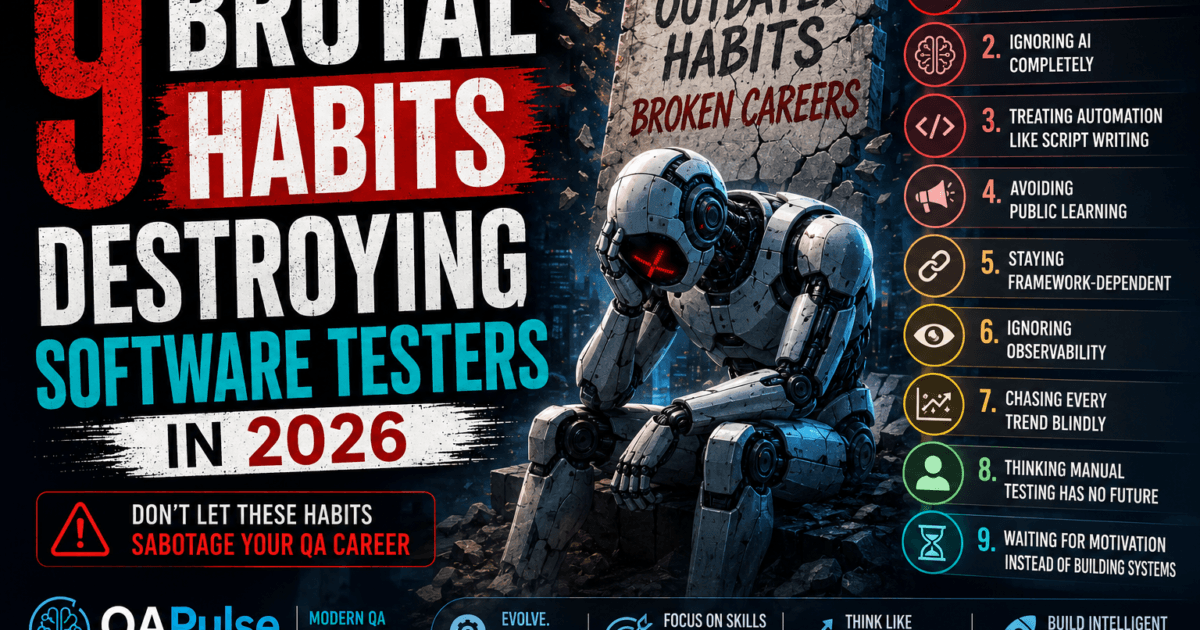
Software Testers Are Facing a Dangerous Reality in 2026
Software testers are entering one of the biggest transitions the QA industry has ever seen.
AI is evolving fast.
Automation is changing rapidly.
Engineering expectations are increasing every year.
And honestly?
Many software testers are still operating with:
- outdated workflows
- old learning habits
- fragile automation thinking
- manual-only mindsets
That creates a serious career risk.
Because modern QA engineering is no longer just:
executing test cases
It is increasingly about:
engineering intelligent systemsHuge difference.
Why Software Testers Must Evolve Faster Now
Modern software systems now involve:
- AI workflows
- cloud infrastructure
- distributed systems
- observability pipelines
- adaptive frontends
- autonomous agents
That means software testers increasingly need:
✅ systems thinking
✅ automation architecture
✅ debugging intelligence
✅ AI understanding
✅ engineering adaptability
The industry is changing whether people accept it or not.
Fast.
Habit #1 — Only Learning Through Courses
This is one of the biggest traps modern software testers fall into.
Many engineers endlessly consume:
- tutorials
- certifications
- YouTube videos
- bootcamps
But rarely:
build real systemsKnowledge without execution creates:
❌ fake confidence
The strongest software testers increasingly learn by:
✅ building frameworks
✅ debugging failures
✅ experimenting with AI tools
✅ creating automation systems
✅ shipping projects publicly
Because real engineering skill comes from:
👉 execution
Not endless content consumption.
Habit #2 — Ignoring AI Completely
Some software testers still believe:
AI is just hype
That mindset is becoming dangerous.
AI is already impacting:
- debugging workflows
- test generation
- observability
- CI/CD systems
- automation intelligence
- release analysis
You do NOT need to become:
an AI researcher
But modern software testers increasingly need:
✅ AI awareness
✅ prompt engineering
✅ agent workflow understanding
✅ intelligent automation thinking
Ignoring AI now is similar to ignoring automation years ago.
Habit #3 — Treating Automation Like Script Writing
Many software testers still think automation means:
click()
type()
assert()
But modern automation increasingly requires:
- architecture
- observability
- scalability
- maintainability
- telemetry
- intelligent workflows
The strongest SDETs now think like:
✅ platform engineers
✅ systems architects
✅ reliability engineers
Not:
❌ script operators
Habit #4 — Avoiding Public Learning
This habit silently slows career growth massively.
Many software testers:
- learn privately
- build privately
- struggle privately
But modern engineering visibility matters.
Publishing:
- blogs
- GitHub projects
- automation experiments
- technical breakdowns
creates:
✅ authority
✅ opportunities
✅ credibility
✅ networking
In 2026:
your public work increasingly becomes your resumeHabit #5 — Staying Framework-Dependent
This is a hidden problem.
Some software testers become emotionally attached to:
- one tool
- one framework
- one ecosystem
But tools evolve constantly.
The real long-term skill is:
✅ engineering adaptability
Because modern QA engineering increasingly values:
- problem-solving
- architecture thinking
- debugging ability
- system intelligence
More than:
framework memorizationHabit #6 — Ignoring Observability
Many software testers still rely only on:
- screenshots
- logs
- reruns
But modern systems increasingly require:
- traces
- telemetry
- distributed monitoring
- runtime visibility
- failure intelligence
Without observability:
debugging becomes:
slow guessingAnd honestly?
Many teams are already struggling because of this.
Habit #7 — Chasing Every Trend Blindly
This is becoming increasingly common.
New tool launches:
Everyone jumps immediatelyBut smart software testers increasingly focus on:
✅ foundational engineering skills
Because tools change constantly.
Core engineering thinking lasts much longer.
Habit #8 — Thinking Manual Testing Has No Future
This misunderstanding is huge.
Manual testing is NOT disappearing.
But repetitive manual execution increasingly is.
Human testers still provide:
✅ exploratory intelligence
✅ risk thinking
✅ user empathy
✅ product understanding
✅ business context
The role evolves.
It does not vanish.
Habit #9 — Waiting for Motivation Instead of Building Systems
This habit destroys consistency.
The strongest software testers increasingly rely on:
✅ execution systems
not:
❌ motivation spikes
Because careers are built through:
- consistency
- experimentation
- iteration
- long-term learning systems
Not occasional bursts of energy.
Why Modern Software Testers Must Think Differently
Modern software testers increasingly operate inside:
- AI-assisted systems
- autonomous workflows
- cloud-native environments
- intelligent CI/CD pipelines
- distributed architectures
That requires a completely different mindset than traditional QA alone.
The future belongs to engineers who combine:
✅ testing
✅ systems thinking
✅ AI understanding
✅ intelligent automation
✅ engineering adaptability
That combination is becoming incredibly valuable.
Why These Habits Are Dangerous for Software Testers in 2026
Modern software testers who ignore AI workflows, observability, adaptive automation, and engineering evolution may struggle in rapidly changing software environments. As intelligent systems, autonomous workflows, and AI-assisted engineering continue growing, modern software testers increasingly need system thinking, automation architecture, debugging intelligence, and continuous adaptability. Future-ready QA engineers will focus on scalable engineering skills rather than outdated testing-only workflows in 2026.
External Resources
Let’s Talk
👉 Which habit do you think is hurting software testers the most today?
👉 What skill will matter most for QA engineers in the next 3 years?
Drop your thoughts below 👇
Final Line
The future will not belong to software testers who execute the most tests.
It will belong to those who understand systems the deepest.
More Relevant Articles
- The Most Dangerous QA Engineer in 2026 Is the Comfortable One
- Why Most Test Automation Frameworks Collapse at Scale
- Most QA Engineers Are Learning the Wrong Skills in 2026