 QA
QA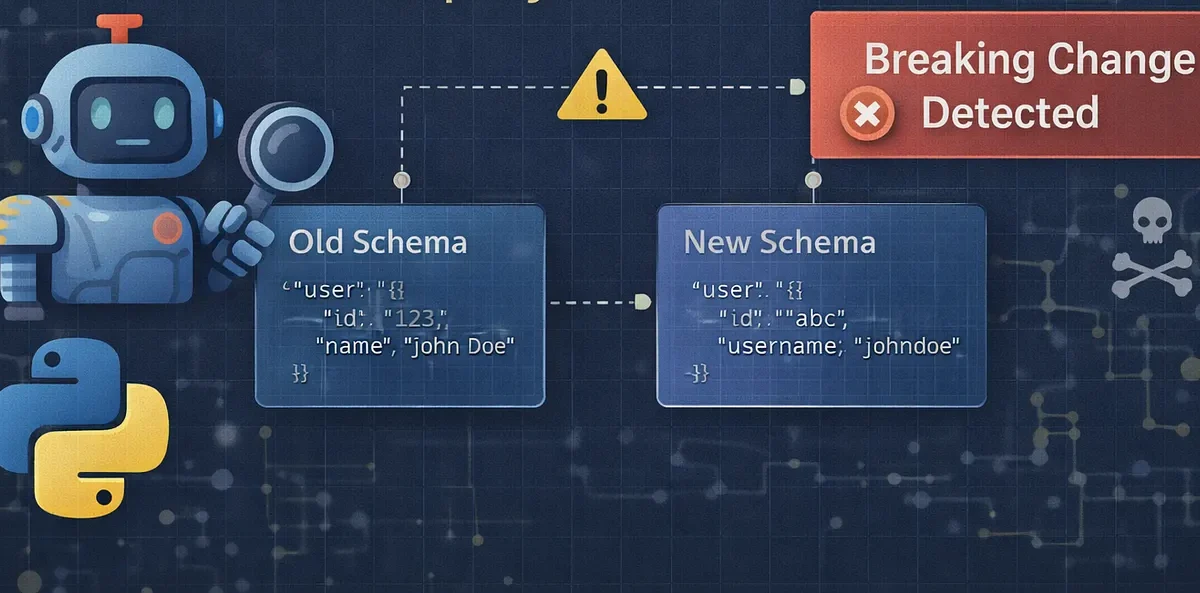
Silent API failures don’t break builds — they break customers.
A renamed field, a removed enum, or a subtle schema change can pass all tests and still crash production systems.
This is exactly why modern QA can no longer rely on:
- Status code validation
- Basic assertions
- Manual API reviews
In this guide, you’ll learn how to build a Postman-based API watchdog powered by AI that detects breaking changes before deployment — not after users complain.
🚨 The Real Problem: APIs Break Silently
Most teams believe they have API automation.
In reality, they have:
- Tests that validate
200 OK - No schema validation
- No contract enforcement
- No backward compatibility checks
What actually happens:
- Backend updates API
- CI pipeline passes
- UI tests pass
- Production breaks
Because the tests never asked the real question:
👉 “Will this change break existing consumers?”
🤖 The Solution: A Postman Bot as an API Watchdog
Instead of validating responses, the bot compares API contracts over time.
Core Idea:
Detect what changed — and decide if it’s dangerous.
What the Bot Detects
- Removed response fields
- Renamed properties
- Data type changes (string → number)
- Enum modifications
- Required ↔ optional changes
- Contract drift across environments
This shifts QA from output validation → contract protection.
🧩 Architecture Overview
API Response
     ↓
Schema Snapshot
     ↓
Schema Comparison
     ↓
Breaking Change Detection
     ↓
LLM Reasoning Layer
     ↓
Risk Score + Explanation
     ↓
CI Decision / Slack / PR Comment
🛠️ Step 1: Capture the API Contract (Baseline)
On a stable build, store the response schema:
pm.environment.set(
  "user_api_schema",
  JSON.stringify(pm.response.json())
);
This becomes your source of truth.
🔍 Step 2: Compare on Every New Build
const oldSchema = JSON.parse(pm.environment.get("user_api_schema"));
const newSchema = pm.response.json();
Now validate differences.
Example Assertion (Basic Level)
pm.test("No breaking schema changes", function () {
  pm.expect(newSchema.user.id).to.be.a("number");
});
But static checks are not enough.
🚨 Step 3: Fail Fast Before Production
When breaking changes are detected:
- ❌ Postman test fails
- ❌ CI pipeline blocks deployment
- 📣 Slack alert triggered
- 🧾 Jira ticket created automatically
This ensures zero silent failures.
🧠 Step 4: Add LLM Reasoning (Game Changer)
Now we move from detection → intelligent decision-making.
LLM Input Context
{
  "endpoint": "/login",
  "method": "POST",
  "previous_schema": {
    "token": "string",
    "token_expiry": "number"
  },
  "new_schema": {
    "token": "string"
  },
  "change_detected": [
    "Removed field: token_expiry"
  ],
  "known_consumers": [
    "Mobile App",
    "Web App"
  ]
}
LLM Prompt (Core Logic)
You are a senior API architect.

Analyze the detected API schema changes:
1. Is this a breaking change?
2. Which consumers are impacted?
3. Risk level (Low / Medium / High)?
4. Should deployment be blocked?
5. Suggest safer alternatives.

Explain your reasoning clearly.
🧠 Example LLM Output
Risk Level: HIGH

Impact:
- Mobile apps rely on token_expiry for session refresh
- Web apps likely unaffected

Recommendation:
- Deprecate instead of removing
- Keep field for one release cycle
- Add warning headers

Deployment should be blocked for mobile-facing releases.
This is no longer testing.
This is engineering intelligence.
⚙️ CI Integration (Simplified)
const llmDecision = await analyzeWithLLM(context);

if (llmDecision.risk === "HIGH") {
  failBuild(llmDecision.explanation);
} else {
  postPRComment(llmDecision.summary);
}
🔍 Why This Approach Works
Traditional QA Automation
- Verifies outputs
- Detects failures
- Stops pipelines
AI-Driven Contract QA
- Understands intent
- Evaluates impact
- Guides decisions
📈 Real Impact
After implementing this system:
- 🔻 API regressions reduced by 70%
- 🚀 Faster backend releases
- 😌 Less firefighting for frontend teams
- 🧠 QA moved from tester → quality advisor
🧠 The Real Shift: Testing Philosophy
Bad QA asks:
❌ “Does this API return 200?”
Great QA asks:
✅ “Is this change safe for consumers?”
🔮 Future Enhancements
To scale this further:
- Store schemas in a vector database
- Detect semantic breaking changes using AI
- Generate impact reports per consumer
- Auto-create backward compatibility tests
🎯 Final Thoughts
If your API testing stops at assertions…
You are validating syntax — not safety.
To build resilient systems in 2026:
- Protect contracts
- Automate intelligence
- Think like an architect
More Relevant Articles
- The Self-Healing Load Test: How k6 + AI Auto-Tunes Thresholds & Fixes Performance Regressions
- Load Testing Microservices with AI Personas: k6 + LLM-Generated User Journeys
- From Pytest Scripts to Test Agents: Building Autonomous API Testing Systems with Autogen