 QA
QA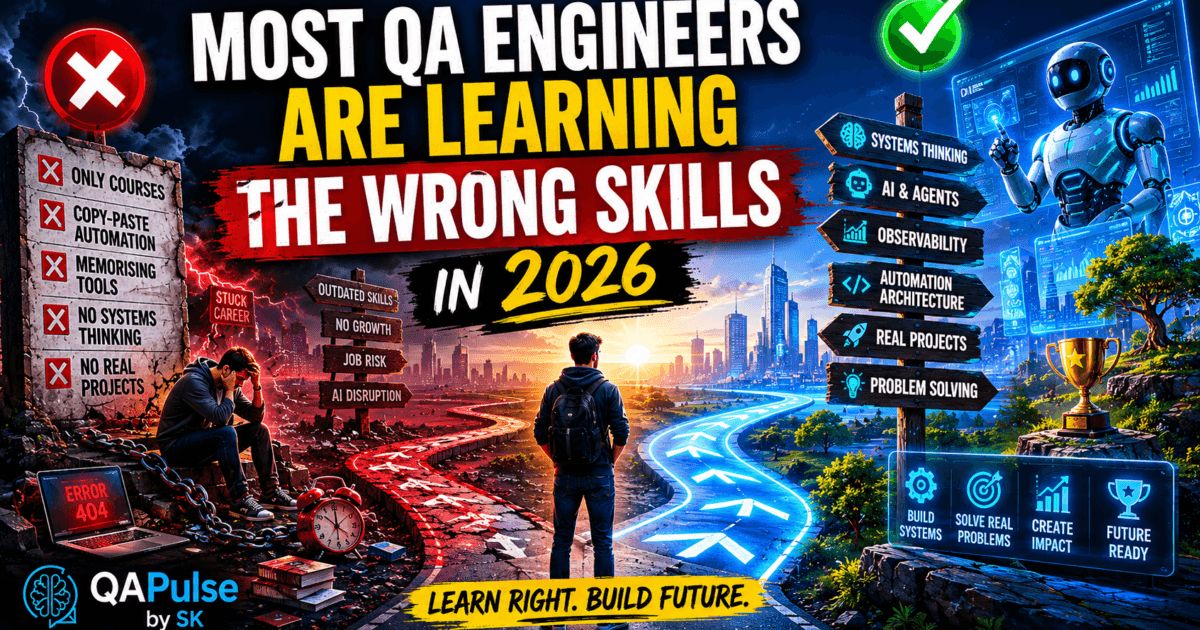
QA Engineers Are Facing a Massive Skill Shift in 2026
QA engineers are working in one of the fastest-changing periods in software engineering history.
AI is changing workflows.
Automation is evolving rapidly.
Engineering expectations are becoming far more demanding.
But honestly?
Most QA engineers are still learning skills that are slowly losing value.
That’s the uncomfortable reality.
Many engineers still spend months learning:
- tool syntax
- repetitive frameworks
- basic automation scripting
- outdated testing workflows
While the industry is increasingly moving toward:
- AI systems
- intelligent automation
- observability
- adaptive workflows
- engineering architecture
- autonomous agents
Huge difference.
Why QA Engineers Must Rethink Learning in 2026
The problem is not:
learning automation
Automation still matters.
The real problem is:
learning only automationBecause modern software systems now involve:
- cloud-native architectures
- AI-assisted engineering
- distributed systems
- telemetry pipelines
- intelligent debugging
- runtime observability
That means modern QA engineers increasingly need:
✅ systems thinking
✅ debugging intelligence
✅ architecture understanding
✅ AI awareness
✅ workflow design
✅ engineering adaptability
The role itself is evolving.
Fast.
Wrong Skill #1 — Memorizing Framework Syntax Only
This is one of the biggest traps many QA engineers fall into.
Some engineers spend years memorizing:
- Playwright APIs
- Cypress commands
- Selenium syntax
- assertion libraries
But tools change constantly.
The deeper engineering value comes from understanding:
- architecture
- reliability
- scalability
- debugging
- observability
- execution flows
Because future QA engineers will increasingly be evaluated on:
👉 engineering thinking
Not:
👉 API memorization
Wrong Skill #2 — Ignoring AI Completely
Many QA engineers still believe:
AI is only for developers
That assumption is becoming dangerous.
AI is already impacting:
- test generation
- CI/CD pipelines
- debugging workflows
- release analysis
- self-healing automation
- observability systems
You do NOT need to become:
a machine learning expert
But modern QA engineers increasingly need:
✅ AI-assisted workflow understanding
✅ prompt engineering
✅ agent systems awareness
✅ intelligent automation thinking
Ignoring AI today is similar to ignoring automation years ago.
Wrong Skill #3 — Learning Through Tutorials Forever
This habit quietly destroys growth.
Many QA engineers continuously:
- watch courses
- save tutorials
- bookmark threads
- consume content endlessly
But rarely:
build real systemsThe strongest engineers increasingly learn by:
✅ creating frameworks
✅ debugging production issues
✅ building public projects
✅ experimenting with AI workflows
✅ shipping automation systems
Because real engineering skill develops through:
👉 execution
Not passive learning.
Wrong Skill #4 — Avoiding System Design Thinking
Modern automation systems are becoming extremely complex.
Large-scale QA now involves:
- distributed execution
- cloud infrastructure
- parallel pipelines
- telemetry systems
- intelligent orchestration
- observability platforms
But many QA engineers still think only at:
test case level
Instead of:
system levelThat mindset becomes limiting very quickly in senior engineering roles.
Wrong Skill #5 — Depending Too Much on Tools
This is another hidden danger.
Some QA engineers become dependent on:
- one framework
- one platform
- one ecosystem
- one testing style
But engineering trends evolve rapidly.
The strongest long-term skill is:
✅ adaptability
Because future QA engineers increasingly succeed through:
- problem-solving
- architecture thinking
- debugging intelligence
- workflow understanding
- systems reasoning
Not tool dependency.
Wrong Skill #6 — Ignoring Observability and Telemetry
This skill gap is becoming massive.
Modern systems increasingly require:
- traces
- logs
- metrics
- runtime visibility
- distributed monitoring
- telemetry analysis
Without observability:
debugging becomes:
slow guessingModern QA engineers increasingly need to understand:
✅ system behavior
✅ runtime failures
✅ production visibility
✅ telemetry patterns
This is becoming a critical future skill.
Wrong Skill #7 — Staying Invisible Online
Many talented QA engineers still:
- learn privately
- build privately
- struggle privately
But modern engineering visibility matters more every year.
Publishing:
- blogs
- GitHub projects
- automation experiments
- technical insights
creates:
✅ authority
✅ credibility
✅ opportunities
✅ networking
In 2026:
your public work increasingly becomes your professional identityWhat Smart QA Engineers Are Learning Instead
The strongest QA engineers now increasingly study:
- AI systems
- observability
- distributed architectures
- debugging intelligence
- memory systems
- workflow orchestration
- adaptive automation
- engineering scalability
Because modern QA is shifting toward:
intelligent systems engineering
Not only:
automation scriptingThat distinction matters massively.
Why QA Engineers Must Build Engineering Thinking
Future-ready QA engineers increasingly think like:
✅ architects
✅ reliability engineers
✅ systems designers
✅ AI-integrated engineers
Not just:
❌ automation executors
That evolution is already happening across modern engineering teams.
Fast.
Why Learning the Wrong Skills Is Dangerous for QA Engineers
Modern QA engineers who focus only on framework syntax, repetitive tutorials, and outdated testing workflows may struggle in rapidly evolving AI-driven software environments. As intelligent automation, observability, distributed systems, and AI-assisted engineering continue growing, modern QA engineers increasingly need systems thinking, debugging intelligence, adaptive automation skills, and architectural understanding. Future-ready SDETs will focus on scalable engineering capabilities rather than tool-specific memorization alone in 2026.
External Resources
Let’s Talk
👉 Which outdated skill do you think wastes the most time today?
👉 What should modern QA engineers prioritize learning next?
Drop your thoughts below 👇
Final Line
The future will not belong to QA engineers who memorize the most tools.
It will belong to those who understand systems the deepest.
More Relevant Articles
- The Most Dangerous QA Engineer in 2026 Is the Comfortable One
- Why Most Test Automation Frameworks Collapse at Scale
- 9 Brutal Habits Destroying Software Testers in 2026