 QA
QA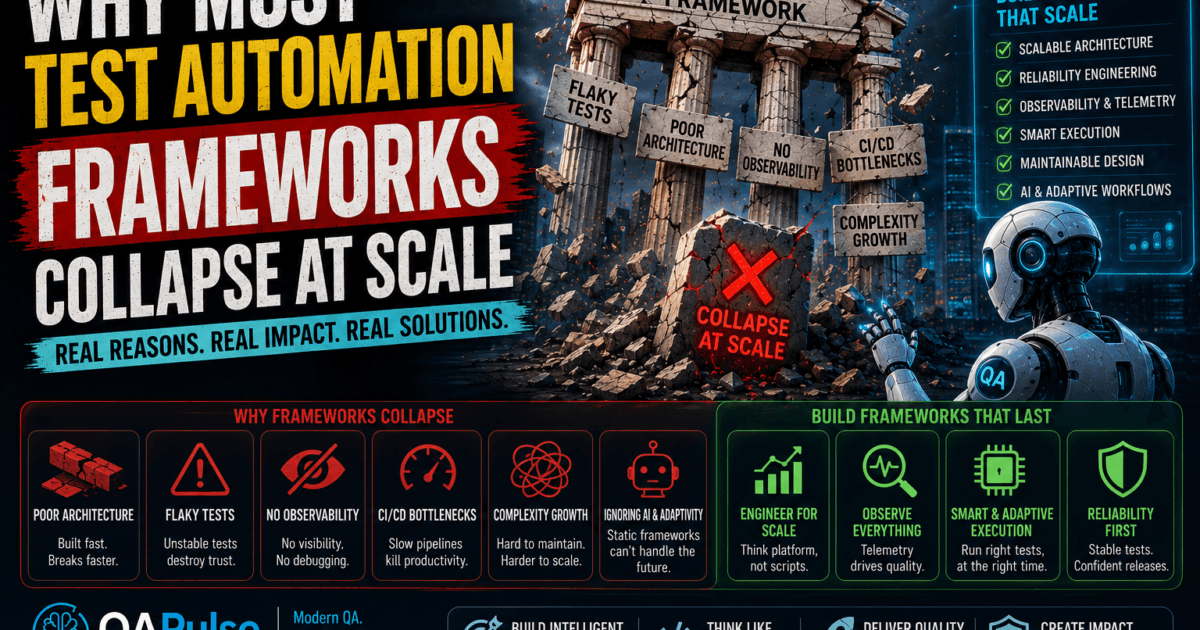
Test Automation Frameworks Often Fail for the Wrong Reasons
Most test automation frameworks do not collapse because of:
- Playwright
- Cypress
- Selenium
- Appium
- tooling limitations
That’s the biggest misconception in QA engineering.
The real reason most test automation frameworks fail at scale is:
poor engineering design
Not framework choice.
And honestly?
Many teams only realize this after:
- flaky pipelines
- unstable releases
- maintenance chaos
- exploding execution times
- unreliable reporting
- CI/CD failures
start becoming normal.
That’s when automation becomes:
an engineering burden
instead of an accelerator.
Why Scaling Test Automation Frameworks Is Hard
Small automation projects are easy.
Scaling them is where the real engineering begins.
Because modern systems now involve:
- distributed architectures
- parallel execution
- cloud infrastructure
- AI-assisted workflows
- microservices
- observability systems
- autonomous pipelines
That means modern test automation frameworks increasingly behave like:
👉 software platforms
Not:
👉 collections of scripts
Huge difference.
Problem #1 — Most Test Automation Frameworks Lack Architecture
This is one of the biggest issues in QA engineering.
Many teams start automation like this:
Create tests quickly
 ↓
Add more tests
 ↓
Add helper files
 ↓
Add utilities
 ↓
Duplicate patterns
 ↓
Chaos
Initially everything looks manageable.
Then scale arrives.
And suddenly:
- execution becomes slow
- debugging becomes painful
- dependencies explode
- maintenance becomes exhausting
Because architecture was never planned.
Problem #2 — Flaky Tests Destroy Framework Trust
Flaky tests are one of the fastest ways to destroy confidence in automation.
Modern test automation frameworks often fail because:
- waits are unstable
- environments differ
- selectors become fragile
- network conditions vary
- state handling breaks
Once teams stop trusting pipelines:
automation value collapses quickly.
The strongest automation systems increasingly focus on:
✅ reliability engineering
✅ deterministic execution
✅ observability
✅ intelligent retries
✅ stable architecture
Not just:
more test casesProblem #3 — Most Teams Ignore Observability
This is massively underrated.
Many automation pipelines still provide:
- screenshots
- stack traces
- generic logs
But modern systems increasingly require:
- traces
- telemetry
- execution graphs
- runtime insights
- failure intelligence
Without observability:
debugging becomes:
slow guessingModern test automation frameworks increasingly need:
✅ runtime visibility
✅ distributed tracing
✅ execution telemetry
✅ intelligent debugging systems
Because scale amplifies every hidden problem.
Problem #4 — CI/CD Becomes the Bottleneck
This happens constantly.
A framework starts small:
10 tests
Then becomes:
10,000 testsSuddenly teams face:
- long execution times
- parallelization issues
- unstable environments
- pipeline contention
- infrastructure cost explosions
Many frameworks collapse because:
they were never designed for scaleThe strongest systems increasingly optimize:
✅ test distribution
✅ smart execution
✅ selective regression
✅ adaptive retries
✅ infrastructure orchestration
Not brute-force execution.
Problem #5 — Framework Complexity Grows Quietly
This is dangerous because it happens gradually.
Over time many test automation frameworks accumulate:
- duplicate utilities
- conflicting abstractions
- inconsistent patterns
- legacy code
- outdated helpers
- unstable dependencies
Eventually the framework becomes:
harder to maintain than the application itselfThat’s a major warning sign.
Problem #6 — Teams Over-Engineer Too Early
This is another common mistake.
Some engineers build:
- massive abstractions
- unnecessary layers
- overcomplicated architectures
- excessive custom tooling
before the framework even proves value.
Good automation engineering balances:
✅ scalability
✅ simplicity
✅ maintainability
The best test automation frameworks evolve gradually through:
👉 real execution feedback
Not theoretical architecture alone.
Problem #7 — Most Frameworks Ignore AI and Adaptive Systems
Modern automation is changing rapidly.
Future-ready test automation frameworks increasingly include:
- AI-assisted debugging
- self-healing locators
- intelligent retries
- anomaly detection
- workflow orchestration
- adaptive execution systems
Static frameworks will increasingly struggle in:
- highly dynamic systems
- AI-generated UIs
- distributed environments
- autonomous workflows
The future is shifting toward:
intelligent automation systems
Not static script execution.
What Strong Test Automation Frameworks Do Differently
The strongest automation systems increasingly prioritize:
✅ observability
✅ reliability
✅ architecture
✅ scalability
✅ debugging intelligence
✅ execution visibility
✅ adaptive workflows
They think like:
👉 engineering platforms
Not:
👉 collections of tests
That mindset changes everything.
Why Modern SDETs Must Think Beyond Framework Syntax
The biggest shift happening right now is this:
Future-ready SDETs increasingly need:
- systems thinking
- infrastructure awareness
- AI understanding
- debugging intelligence
- architecture skills
- workflow orchestration
Because modern test automation frameworks are evolving into:
distributed engineering systems
Not just QA tooling.
That distinction matters massively in 2026.
Why Test Automation Frameworks Collapse at Scale
Modern test automation frameworks often fail at scale because of poor architecture, flaky execution, weak observability, infrastructure bottlenecks, and growing maintenance complexity. As software systems become increasingly distributed and AI-assisted, modern test automation frameworks require scalable engineering design, intelligent debugging, telemetry visibility, adaptive execution strategies, and reliability-focused architecture. Future-ready SDETs increasingly need systems thinking and observability knowledge to build automation platforms that remain stable at enterprise scale in 2026.
External Resources
Let’s Talk
👉 What is the biggest reason automation frameworks fail in real projects?
👉 Do you think observability is now more important than framework choice?
Drop your thoughts below 👇
Final Line
The future of automation will not belong to the framework with the most features.
It will belong to the systems engineered to survive scale.
More Relevant Articles
- The Most Dangerous QA Engineer in 2026 Is the Comfortable One
- Most QA Engineers Are Learning the Wrong Skills in 2026
- 9 Brutal Habits Destroying Software Testers in 2026