 QA
QA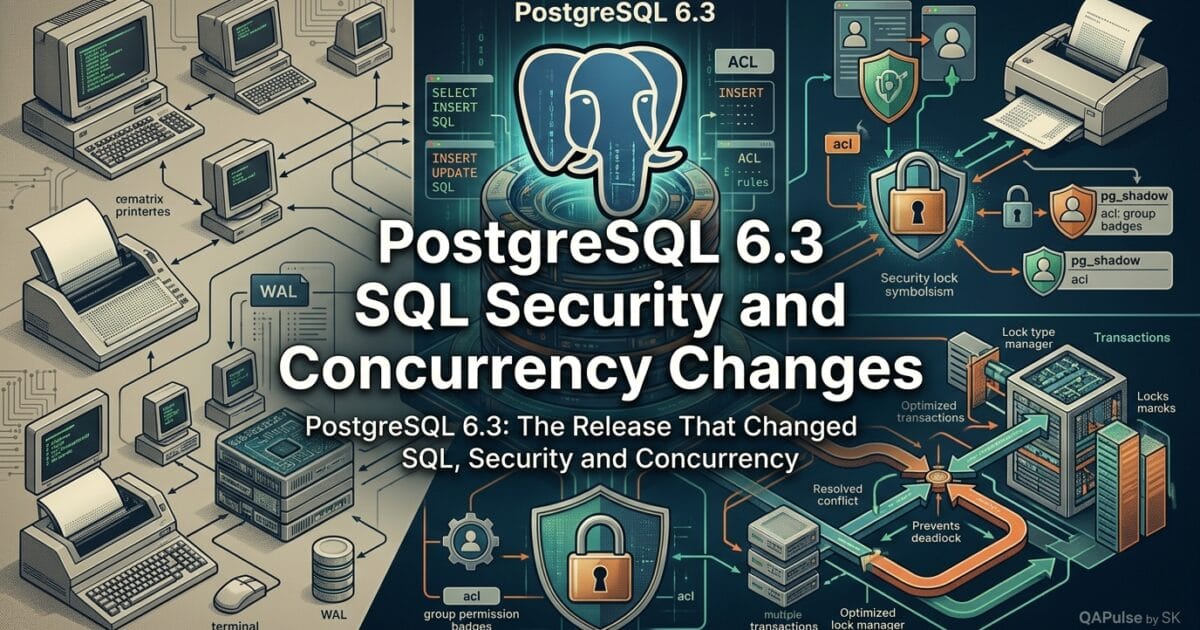
PostgreSQL 6.3 is not a modern release, but it is a fascinating release to examine because its changes introduced capabilities that became foundational to PostgreSQL’s evolution. The official PostgreSQL archive confirms that 6.3 introduced major SQL improvements, including SQL92 subselect capability, client-side environment variables for time zone and date style, a socket-based client/server interface, stronger password authorization, changed default table permissions, and performance improvements. (PostgreSQL)
The most important point before discussing the release is historical accuracy: PostgreSQL 6.3 is from 1998, not a current 2026 release. The official PostgreSQL release archive lists 6.3.0, 6.3.1, and 6.3.2 among the historical releases, while current PostgreSQL development is already around the PostgreSQL 19 cycle. (PostgreSQL)
That distinction matters if you’re publishing a release-focused article. Calling release-6-3 a newly released PostgreSQL version would create exactly the kind of search-intent and factual mismatch that can weaken an otherwise strong technical article.


Why PostgreSQL 6.3 Still Matters
The interesting story behind PostgreSQL 6.3 is not simply the version number. It is how several capabilities that developers now consider normal were becoming substantially more capable in this era.
The official release documentation highlights full SQL92 subselect capability, client-side environment variables for time zone and date style, a socket interface for client/server communication, stronger password authorization, changed default table permissions, removal of old-style time travel, and performance improvements. (PostgreSQL)
For someone learning database engineering today, this provides a useful lesson:
Mature database systems are built through many incremental improvements rather than a single revolutionary release.
That is particularly important when evaluating modern database releases. A patch number or historical version number tells you very little by itself. You need to examine what changed, what behavior changed, and what operational risk those changes introduce.
The Biggest Change: SQL Subselects
One of the most notable PostgreSQL 6.3 changes was the addition of subselect capability.
A subquery allows one SQL query to use the result of another query.
For example:
SELECT name
FROM employees
WHERE department_id IN (
    SELECT id
    FROM departments
    WHERE location = 'Lahore'
);
The inner query identifies the relevant departments, while the outer query retrieves employees belonging to those departments.
The PostgreSQL 6.3 release documentation specifically describes the release as adding full SQL92 subselect capability, with target-list subselects being the remaining exception mentioned in the historical notes. (PostgreSQL)
From a database-engineering perspective, this is significant because subqueries give developers another way to express relationships between datasets without manually materializing intermediate results.
Subqueries vs joins
A useful way to understand the change is to compare a subquery with a join.
SELECT e.name
FROM employees e
JOIN departments d
  ON e.department_id = d.id
WHERE d.location = 'Lahore';
Compared with:
SELECT name
FROM employees
WHERE department_id IN (
    SELECT id
    FROM departments
    WHERE location = 'Lahore'
);
Both can express similar logic, but the query planner and workload determine which formulation is preferable in a particular situation.
For modern PostgreSQL development, you should not assume that one syntax is automatically faster. Measure the actual query plan.
EXPLAIN ANALYZE
SELECT e.name
FROM employees e
JOIN departments d
  ON e.department_id = d.id
WHERE d.location = 'Lahore';
This is a valuable engineering principle:
Readable SQL should be validated with execution plans when performance matters.
Why Client-Server Connectivity Was Important
Another important PostgreSQL 6.3 change was the socket interface for client/server communication.
The historical documentation states that the socket interface became the default and notes the need for the -i option to enable the interface in that release context. (PostgreSQL)
Today, application developers take client/server database communication for granted.
A typical modern application might look conceptually like this:
Web Application
      |
      v
Database Driver
      |
      v
PostgreSQL Server
      |
      v
Storage
That architecture enables applications to communicate with a database process rather than embedding database execution directly into the application.
This separation became fundamental to enterprise application architecture.


Password Authentication and Permissions Became More Important
Security was another area affected by PostgreSQL 6.3.
The historical release notes mention better password authorization mechanisms and changed default table permissions. (PostgreSQL)
That is particularly interesting from a modern engineering perspective because database security is not only about authentication.
You need to consider at least three separate layers:
| Security Layer | Question |
|---|---|
| Authentication | Who are you? |
| Authorization | What are you allowed to do? |
| Data access | Which tables or records can you access? |
A modern application should therefore avoid assuming that successful database authentication means unrestricted database access.
For example:
CREATE ROLE reporting_user LOGIN PASSWORD 'strong-secret';

GRANT CONNECT ON DATABASE analytics TO reporting_user;
Then permissions should be granted deliberately rather than giving the application unnecessary privileges.
The historical change to default table permissions is a useful reminder that defaults matter. When database defaults change, applications and deployment scripts that relied on implicit behavior can behave differently.
PostgreSQL 6.3 vs Modern PostgreSQL
It would be misleading to compare PostgreSQL 6.3 with PostgreSQL 18 or 19 as though they were competing releases. They belong to completely different generations.
The better comparison is architectural.
| Capability | PostgreSQL 6.3 | Modern PostgreSQL |
|---|---|---|
| SQL subselects | Major capability introduced | Mature and extensively optimized |
| Client/server networking | Socket interface | Mature network architecture |
| Authentication | Improving password authorization | Extensive authentication ecosystem |
| Permissions | Default permission behavior changed | Granular role and privilege model |
| Query optimization | Much earlier generation | Highly sophisticated planner |
| JSON support | Not a modern feature | Rich JSON/JSONB capabilities |
| Replication | Early-era architecture | Mature replication ecosystem |
| Extensions | Much more limited ecosystem | Extensive extension ecosystem |
| Tooling | Early database tooling | Rich CLI, drivers, IDEs and observability |
| Current support | Unsupported | Active supported versions |
PostgreSQL explicitly classifies 6.3 as an unsupported historical version. (PostgreSQL)
The current PostgreSQL versioning policy also explains that modern major versions receive support for five years, with regular minor releases containing bug and security fixes. (PostgreSQL)
What This Teaches Modern Developers
The most useful lesson from PostgreSQL 6.3 isn’t that you should run it.
You absolutely should not deploy an unsupported 1998 database release for a modern production application.
Instead, the release provides a useful case study in software evolution.
Consider how a database feature progresses:
Experimental capability
        ↓
Initial implementation
        ↓
Compatibility improvements
        ↓
Performance optimization
        ↓
Security hardening
        ↓
Production maturity
        ↓
Modern abstraction
Subqueries are a good example.
What was once a significant SQL capability is now something developers routinely write without thinking about its historical complexity.
That is how infrastructure software evolves.
A Better Way to Evaluate Database Releases
When a database release arrives, don’t simply read the headline and upgrade immediately.
Use a structured evaluation process.
Step 1: Identify the version type
First determine whether the release is:
- major
- minor
- patch
- beta
- release candidate
- development snapshot
This matters because PostgreSQL’s versioning model distinguishes major versions from regular bug-fix and security releases. (PostgreSQL)
Step 2: Identify behavior changes
Search release notes for:
breaking
deprecated
removed
default
authentication
permissions
compatibility
migration
These terms often reveal more operational risk than the headline feature list.
Step 3: Test application assumptions
Suppose your application depends on a database default.
Create an automated test for it.
def test_database_user_has_expected_permissions(db):
    result = db.execute("""
        SELECT has_table_privilege(
            current_user,
            'orders',
            'SELECT'
        )
    """)

    assert result.fetchone()[0] is True
The principle is simple:
Don’t test only whether the database starts. Test whether your application still behaves correctly.
Database Testing Should Follow the Change
This is where release analysis becomes particularly valuable for engineers.
If a release changes:
SQL behavior → test representative queries.
Authentication → test login and credential flows.
Permissions → test positive and negative authorization cases.
Networking → test connection establishment and failure handling.
Performance → compare representative workload metrics.
For example:
def test_read_only_user_cannot_delete_order(db):
    with pytest.raises(Exception):
        db.execute(
            "DELETE FROM orders WHERE id = 100"
        )
The exact test implementation will depend on your database driver and test framework, but the strategy remains the same.
Don’t Confuse Historical Releases With Upgrade Recommendations
There is an important correction to the supplied release information.
The provided material suggests commands such as:
pip install postgresql --upgrade
and:
npm install postgresql@latest
Those are not appropriate PostgreSQL server upgrade commands.
PostgreSQL is a database server, not a Python or Node.js package that you upgrade using those commands.
For a real PostgreSQL installation, upgrade planning depends on the deployment model and version transition. PostgreSQL’s official documentation provides installation and release information separately, and its historical 6.3 documentation is explicitly marked unsupported. (PostgreSQL)
For a modern environment, determine how PostgreSQL is deployed first:
Bare metal
   ├── package manager
   ├── source build
   └── system service

Container
   └── PostgreSQL Docker image

Cloud
   └── Managed PostgreSQL service

Kubernetes
   └── Stateful workload/operator
The upgrade process should then follow the deployment platform’s supported procedure.
A Practical Regression Strategy
Before changing a production database version, create a small but representative regression suite.
Test:
Connection
   ↓
Authentication
   ↓
Schema access
   ↓
CRUD operations
   ↓
Transactions
   ↓
Constraints
   ↓
Indexes
   ↓
Queries
   ↓
Application workflows
A smoke test could begin with:
SELECT version();
Then validate connectivity:
SELECT current_database();
Then verify critical application behavior:
BEGIN;

INSERT INTO orders(customer_id, total)
VALUES (101, 250.00);

SELECT *
FROM orders
WHERE customer_id = 101;

ROLLBACK;
This gives you a repeatable foundation for database upgrade validation.
PostgreSQL 6.3 as a Software Engineering Case Study
The release is especially useful when viewed historically.
PostgreSQL 6.3 was released during a period when database capabilities were developing rapidly. The official documentation describes the release as containing many new features and improvements, while also noting that its release notes were historically incomplete in the documentation integration. (PostgreSQL)
The later 6.3.1 and 6.3.2 releases demonstrate another important engineering pattern: initial releases are followed by corrective releases.
For example, PostgreSQL 6.3.2 fixed configuration problems on some platforms and corrected specific SQL behavior, while noting that users already running 6.3 or 6.3.1 did not need a dump/restore for that bug-fix upgrade. (PostgreSQL)
That is exactly why modern teams should distinguish between:
Feature release
       vs
Maintenance release
       vs
Security release
Each deserves a different upgrade strategy.
The Strategic Takeaway for Engineers
If you are studying PostgreSQL today, don’t dismiss old releases as irrelevant.
They show you why modern database behavior exists.
Subqueries, client/server communication, authentication, permissions, query processing, and performance did not appear fully formed. They evolved through releases, bugs, compatibility work, and operational experience.
That is also how today’s AI frameworks, testing tools, programming languages, and developer platforms are evolving.
A feature that seems small today can become foundational tomorrow.

A Simple Release-Analysis Checklist
Before publishing or acting on any software release article, ask:
| Question | Why it matters |
|---|---|
| Is the version actually new? | Prevents historical/current confusion |
| Is the release supported? | Determines production suitability |
| What behavior changed? | Identifies regression risk |
| What defaults changed? | Finds hidden compatibility problems |
| Are migrations required? | Prevents deployment failures |
| What should be tested? | Converts release notes into engineering action |
| What should not be upgraded? | Protects unsupported/legacy environments |
| What is the official source? | Prevents inaccurate release claims |
This approach is much stronger than simply copying a changelog.
The official PostgreSQL archive provides the historical 6.3 documentation, while the current release archive provides the supported-version landscape. (PostgreSQL)
Mind Perspective
PostgreSQL 6.3 is best understood as a historical milestone, not a current upgrade target.
Its SQL improvements, networking changes, authentication work, permission changes, and performance improvements illustrate how PostgreSQL developed into the mature database platform developers use today. (PostgreSQL)
For anyone writing release analysis, the bigger lesson is even more important: never treat a version number as the story. Understand the behavior behind the version.
That mindset produces better upgrade decisions, better regression tests, and far more useful technical content.
PostgreSQL 6.3 Changed More Than You Think
If you are studying PostgreSQL 6.3, the interesting story is not simply an old database version. Released on March 1, 1998, PostgreSQL 6.3 introduced several foundational changes: SQL92 subselect support, client-side timezone and date-style environment variables, a socket-based client/server interface, stronger password authorization, changed default table privileges, real deadlock detection, and performance improvements. (PostgreSQL)
There is also an important correction to the supplied release information: release-6-3 is a historical PostgreSQL tag, not a new 2026 release. PostgreSQL’s official release archive lists 6.3 alongside its historical 6.3.1 and 6.3.2 releases, while the 6.3 documentation explicitly identifies the version as unsupported. (PostgreSQL)
That distinction matters because a good release article should tell readers not only what changed, but also whether the version is relevant to a production system today.

Why PostgreSQL 6.3 Was an Important Release
PostgreSQL 6.3 was released at a point where the project was removing several limitations from earlier versions.
The official release notes describe it as a release with many new SQL features and improvements. Among the headline changes were full SQL92 subselect capability, improved password handling, changed default table privileges, a socket interface for client/server connections, removal of old-style time travel, real deadlock detection, and performance improvements. (PostgreSQL)
For today’s developer, the interesting question is:
Which of these changes eventually became normal database behavior?
The answer is: quite a few of the architectural ideas introduced or strengthened around this era became part of the PostgreSQL model developers now take for granted.
That makes PostgreSQL 6.3 useful as a software-engineering case study.
SQL Subselects Made Queries More Expressive
One of the most important PostgreSQL 6.3 changes was support for full SQL92 subselect capability, with target-list subselects being the noted exception. (PostgreSQL)
A subselect lets one query use the result of another query.
For example:
SELECT name
FROM employees
WHERE department_id IN (
    SELECT id
    FROM departments
    WHERE location = 'Lahore'
);
The inner query produces department IDs:
SELECT id
FROM departments
WHERE location = 'Lahore';
The outer query then uses those IDs to find employees.
This sounds routine today, but expressive SQL matters because it allows application developers to describe data relationships declaratively instead of implementing every relationship through application-side loops.
Subselect vs JOIN
The same requirement can often be expressed with a join:
SELECT e.name
FROM employees AS e
JOIN departments AS d
  ON e.department_id = d.id
WHERE d.location = 'Lahore';
A useful engineering comparison is:
| Approach | Strength | Typical consideration |
|---|---|---|
| Subquery | Expresses nested logic clearly | Can become difficult to reason about when deeply nested |
| JOIN | Excellent for relational combinations | Can become complex with many relationships |
| EXISTS | Excellent for existence checks | Often preferable when you only need to know whether a match exists |
| CTE | Separates complex query stages | May improve readability and maintainability |
The important lesson is not that one syntax is universally better.
The database workload determines the right choice.
For modern PostgreSQL, validate performance using the execution plan rather than guessing.
EXPLAIN ANALYZE
SELECT e.name
FROM employees AS e
JOIN departments AS d
  ON e.department_id = d.id
WHERE d.location = 'Lahore';
This is one of the biggest differences between writing SQL as a beginner and engineering SQL professionally.
You don’t stop at:
“The query works.”
You ask:
“How does PostgreSQL execute this query under realistic data volume?”
PostgreSQL 6.3 Strengthened Client-Server Architecture
Another major change was the socket interface for client/server connections. The release notes state that this became the default and mention the -i startup option in that historical context. (PostgreSQL)
That architecture is fundamental to database applications.
Conceptually:
Application
    |
    v
Database Driver
    |
    v
Network / Socket
    |
    v
PostgreSQL Server
    |
    v
Database Storage
Modern developers rarely think about this layer because drivers, connection pools, frameworks, containers, and managed services hide much of the complexity.
But when something goes wrong, understanding the architecture becomes extremely valuable.
For example:
Application
    |
    X  connection refused
    |
Database
The failure might not be SQL at all.
It could be:
- wrong hostname
- wrong port
- firewall rules
- server unavailable
- authentication failure
- connection pool exhaustion
- TLS configuration
- network routing
That is why database testing should not focus exclusively on SQL statements.

Authentication Became a More Deliberate Concern
PostgreSQL 6.3 also introduced better password authorization mechanisms. The release notes explain that passwords could be defined independently of the Unix password file, with SQL user commands and the pg_shadow system table introduced for user information and passwords. (PostgreSQL)
This was a significant architectural shift because database identity could be managed independently from operating-system identity.
The broader principle remains relevant today:
Operating-system identity
          ≠
Database identity
          ≠
Application identity
Modern systems often have even more layers:
Human / Service Identity
        ↓
Application Authentication
        ↓
Database Authentication
        ↓
Database Authorization
        ↓
Object / Data Access
Testing these layers separately produces much stronger coverage.
Authentication vs authorization
These concepts are frequently confused.
| Concept | Question |
|---|---|
| Authentication | Who are you? |
| Authorization | What are you allowed to do? |
| Privilege | Which database operation can you perform? |
| Data access | Which records or objects can you access? |
For example, a user might successfully authenticate but still be unable to modify a table.
That is expected secure behavior.
Default Permissions Changed for a Reason
PostgreSQL 6.3 changed the default privileges of user-created tables so that SELECT was no longer automatically granted to PUBLIC. The release notes explain that this was done because the ANSI standard required it. (PostgreSQL)
That is an excellent example of why default behavior changes deserve special attention during upgrades.
Imagine an application that unknowingly depends on a default permission.
Before the change:
CREATE TABLE
      ↓
PUBLIC can SELECT
After the change:
CREATE TABLE
      ↓
PUBLIC does NOT automatically receive SELECT
An application that relied on the old behavior could suddenly fail.
This is why release testing should explicitly examine:
Defaults
Permissions
Authentication
Configuration
Compatibility
rather than testing only the new features.
PostgreSQL 6.3 Introduced Real Deadlock Detection
One particularly interesting change was the introduction of real deadlock detection.
The release notes explain that PostgreSQL moved away from simply relying on long timeout behavior and introduced actual deadlock detection, along with improvements to locking behavior intended to reduce resource starvation. (PostgreSQL)
Consider two transactions:
Transaction A                  Transaction B

Locks Row 1                    Locks Row 2
     |                              |
     v                              v
Requests Row 2                Requests Row 1
     |                              |
     +---------- DEADLOCK ----------+
Without appropriate deadlock detection, both transactions can wait indefinitely or until a timeout mechanism intervenes.
A database with deadlock detection can identify the cycle and terminate one transaction so the other can proceed.
Why this still matters
Modern distributed applications frequently perform multiple database operations inside transactions.
That makes concurrency testing essential.
A useful test scenario deliberately creates competing transactions and verifies that the system handles the conflict predictably.
Conceptually:
def transaction_a():
    lock(row_1)
    lock(row_2)


def transaction_b():
    lock(row_2)
    lock(row_1)
The exact implementation depends on the database driver and isolation configuration, but the testing principle is broadly applicable.
Concurrency bugs require concurrency tests.
PostgreSQL 6.3 Removed Old-Style Time Travel
PostgreSQL 6.3 also removed its old-style time-travel functionality for performance reasons. The release documentation notes that similar behavior could be implemented using triggers. (PostgreSQL)
This is an important example of a feature being removed because the trade-off was no longer considered worthwhile.
Modern engineers should recognize the pattern:
Feature exists
    ↓
Real-world usage evaluated
    ↓
Performance / maintenance cost identified
    ↓
Alternative mechanism available
    ↓
Feature removed
Feature removal isn’t necessarily failure.
Sometimes removing an old abstraction makes the overall system easier to maintain.
Views Also Became More Explicit About Privileges
Another change in PostgreSQL 6.3 was that views received their own privileges rather than inheriting privilege behavior directly from underlying tables. The release notes explicitly warn that privileges on views therefore needed to be configured separately. (PostgreSQL)
That is an important database security principle:
Base Table
     |
     +---- Application Role
     |
     v
View
     |
     +---- Reporting Role
A view can act as a controlled interface over underlying data.
For example:
CREATE VIEW public_customer_data AS
SELECT
    id,
    name,
    city
FROM customers;
You can then grant access to the view rather than exposing the entire underlying table.
This pattern remains useful for data isolation and controlled database interfaces.
PostgreSQL 6.3 Was Not Just About Features
The release also contained a significant collection of bug fixes and improvements.
The official historical release notes mention fixes involving binary cursors, arrays, aggregates, inherited tables, VACUUM ANALYZE, international identifiers, COUNT(*), views, BLOBs, JDBC, indexes, locking, and several psql commands. (PostgreSQL)
This highlights a critical point about release engineering:
A release is rarely defined only by its headline feature.
A more useful model is:
Release value =
New capabilities
+
Bug fixes
+
Performance
+
Security
+
Compatibility
+
Developer experience
This is exactly how you should analyze modern software releases too.
How PostgreSQL 6.3 Compares With 6.3.2
PostgreSQL 6.3 should also be distinguished from its later maintenance releases.
PostgreSQL 6.3.2 was released on April 7, 1998 as a bug-fix release for the 6.3.x series. It fixed automatic configuration support on some platforms, including Linux, and corrected function-call behavior on the left side of BETWEEN and LIKE. The official notes state that users already running 6.3 or 6.3.1 did not need a dump/restore for those particular fixes. (PostgreSQL)
| Version | Purpose | Migration implication |
|---|---|---|
| 6.3.0 | Feature release | Significant migration considerations |
| 6.3.1 | Maintenance release | Bug-fix focused |
| 6.3.2 | Bug-fix release | No dump/restore required from 6.3/6.3.1 for listed fixes |
| Modern PostgreSQL | Supported production generations | Follow current migration/upgrade documentation |
This distinction is important because feature upgrades and maintenance upgrades should not automatically receive the same testing strategy.
What PostgreSQL 6.3 Taught About Upgrade Testing
The historical documentation states that migration from pre-6.3 PostgreSQL installations required a dump/restore using pg_dump or pg_dumpall. (PostgreSQL)
That is a perfect example of why migration testing must be version-aware.
A robust database upgrade test plan should include:
Schema validation
SELECT table_name
FROM information_schema.tables
WHERE table_schema = 'public';
Data validation
SELECT COUNT(*)
FROM customers;
Constraint validation
SELECT
    COUNT(*)
FROM orders
WHERE customer_id IS NULL;
Application connectivity
Application
    ↓
Driver
    ↓
Connection
    ↓
Authentication
    ↓
Query
    ↓
Expected result
Permission validation
Read user
  → SELECT      PASS
  → INSERT      DENY

Write user
  → SELECT      PASS
  → INSERT      PASS
The goal is not simply to prove that PostgreSQL starts.
The goal is to prove that the application still behaves correctly after the database changes.
Don’t Use Python or npm to Upgrade PostgreSQL Server
The supplied material includes:
pip install postgresql --upgrade
and:
npm install postgresql@latest
These should not be presented as PostgreSQL server upgrade instructions.
PostgreSQL is a database server system, not a Python or Node.js package that should be upgraded through those commands.
For historical PostgreSQL 6.3, the official migration documentation described building/installing the server and using pg_dump or pg_dumpall for migration from earlier versions. (PostgreSQL)
For a modern PostgreSQL deployment, the correct upgrade path depends on whether the database runs through:
Operating-system packages
Docker
Kubernetes
Cloud-managed PostgreSQL
Source installation
That distinction should be made explicit in any professional release article.
A Practical PostgreSQL Release Validation Matrix
If you are evaluating any PostgreSQL upgrade, use a matrix like this:
| Area | Test | Risk |
|---|---|---|
| Connectivity | Application can establish connections | High |
| Authentication | Valid/invalid credentials behave correctly | High |
| Authorization | Roles retain expected permissions | High |
| Schema | Tables, indexes and constraints exist | High |
| SQL | Critical queries return expected results | High |
| Transactions | Commit/rollback behavior remains correct | High |
| Concurrency | Locking and deadlocks behave correctly | High |
| Performance | Critical queries meet baseline | Medium/High |
| Extensions | Required extensions remain compatible | High |
| Backup | Backup and restore succeed | Critical |
| Monitoring | Metrics and logs remain available | Medium |
This is more valuable than simply saying:
“The upgrade was successful.”
A production upgrade is successful only when the system behavior remains acceptable.

PostgreSQL 6.3 vs Modern PostgreSQL Thinking
The technology has changed enormously, but the engineering principles are surprisingly similar.
| 1998-era concern | Modern equivalent |
|---|---|
| Client/server communication | Connection pools and cloud networking |
| Password authorization | IAM, roles, secrets and authentication |
| Table privileges | RBAC and least privilege |
| Deadlock detection | Distributed transaction/concurrency testing |
| SQL compatibility | Application compatibility testing |
| Migration scripts | Automated database migration pipelines |
| Regression testing | CI/CD database test suites |
| Performance improvements | Query plans, observability and workload testing |
That is why studying old releases can be useful.
You are not learning obsolete commands.
You are learning why certain engineering practices became necessary.
Build Tests Around Behavior, Not Version Numbers
Suppose a modern PostgreSQL release changes a default.
Don’t create a test called:
test_postgresql_19_x()
Create a test around the actual contract:
test_application_role_cannot_modify_read_only_data()
That test remains meaningful even when the database version changes.
This is a powerful strategy for long-lived test automation.
Your tests should describe business and technical behavior, not merely implementation versions.
The Real Lesson Behind PostgreSQL 6.3
PostgreSQL 6.3 demonstrates an important software-engineering pattern.
A database becomes mature through repeated cycles:
New capability
      ↓
Real-world usage
      ↓
Bug discovery
      ↓
Performance improvements
      ↓
Security refinement
      ↓
Compatibility work
      ↓
Regression testing
      ↓
Maintenance release
The PostgreSQL 6.3 family shows this cycle clearly. The original release introduced substantial functionality, while 6.3.2 subsequently addressed configuration, SQL behavior, memory, buffer-overrun, indexing, and other bugs. (PostgreSQL)
That is exactly what modern engineers should look for when reading release notes.
Don’t ask only:
“What is new?”
Ask:
“What behavior changed, what could break, and what should I test?”
Internal Links
Internal Series Links
- Learn MCP – Zero to Hero
- Learn AI Agents for QA – Zero to Hero
- Playwright Automation – Zero to Hero
- TencentDB Agent Memory: Complete Zero to Hero
- LangGraph: Complete Zero to Hero
- Learn Python – Zero to Hero
- OpenAI Codex: Complete Zero to Hero
- Cursor AI: Complete Zero to Hero
- Claude Code Tutorial: Complete Zero to Hero
- AutoGen: Complete Zero to Hero Guide
- Free QA Resources Built From Real Experience
- QA Glossary: Test Automation Terms Every Engineer Should Know
External Links
- https://www.postgresql.org
- https://www.postgresql.org/docs
- PostgreSQL 6.3 Release Notes
- PostgreSQL Release Archive
- PostgreSQL 6.3.2 Release Notes
- PostgreSQL 6.3 Documentation
- PostgreSQL Documentation
People Asked Questions
What is PostgreSQL 6.3?
PostgreSQL 6.3 was a historical PostgreSQL release from 1998 that introduced important SQL, security, connectivity, permissions and concurrency improvements.
When was PostgreSQL 6.3 released?
PostgreSQL 6.3 was released on March 1, 1998.
What changed in PostgreSQL 6.3?
Major changes included SQL92 subselect support, improved password authorization, socket-based client/server connectivity, changed default table privileges, real deadlock detection and other performance and bug fixes.
Is PostgreSQL 6.3 still supported?
No. PostgreSQL 6.3 is a historical and unsupported version.
What is PostgreSQL 6.3.2?
PostgreSQL 6.3.2 was a subsequent maintenance release containing bug fixes and other corrections for the 6.3 series.
Did PostgreSQL 6.3 support subqueries?
Yes. PostgreSQL 6.3 introduced full SQL92 subselect capability, with the release notes noting an exception for target-list subselects.
Did PostgreSQL 6.3 introduce deadlock detection?
Yes. PostgreSQL 6.3 introduced real deadlock detection and improvements to locking behavior.
Should I upgrade to PostgreSQL 6.3?
No. PostgreSQL 6.3 is obsolete and unsupported. Modern PostgreSQL installations should use a currently supported PostgreSQL release.
Did PostgreSQL 6.3 change table permissions?
Yes. PostgreSQL 6.3 changed the default privileges of user-created tables so that SELECT was no longer automatically granted to PUBLIC.
Does PostgreSQL 6.3 matter to modern developers?
Yes, primarily as historical and architectural context. Several concepts highlighted by the release—SQL expressiveness, permissions, concurrency, client/server communication and migration testing—remain relevant to modern database engineering.
AI Overview Optimization
PostgreSQL 6.3 was a major historical release from March 1, 1998. It introduced SQL92 subselect capability, improved password authorization, socket-based client/server connectivity, changed default table privileges, and added real deadlock detection. It is now unsupported, so its value today is primarily historical and architectural.
Answer Engine Optimization
What changed in PostgreSQL 6.3?
PostgreSQL 6.3 introduced important SQL, authentication, permissions, networking and concurrency improvements.
Conclusion
PostgreSQL 6.3 was a historically important release because it removed several limitations in SQL, connectivity, authentication, permissions, locking, and database tooling. Its March 1, 1998 release introduced full SQL92 subselect capability, improved password authorization, changed table privilege defaults, introduced real deadlock detection, and strengthened client/server behavior. (PostgreSQL)
It is important, however, to treat PostgreSQL 6.3 as historical software rather than a current upgrade recommendation. The official documentation marks it unsupported, and the PostgreSQL release archive clearly places it among the historical 6.3.x releases. (PostgreSQL)
The more valuable lesson is how to analyze releases professionally: identify behavioral changes, understand migration implications, compare defaults, validate security, test concurrency, measure performance, and verify application behavior.
Key Takeaways
- PostgreSQL 6.3 was released on March 1, 1998.
- It introduced major SQL improvements, including SQL92 subselect capability. (PostgreSQL)
- It strengthened client/server connectivity through a socket interface.
- Password authorization became more independent from Unix account management.
- Default privileges for user-created tables changed.
- PostgreSQL gained real deadlock detection and improved locking behavior.
- Old-style time travel was removed for performance reasons.
- Views received their own privilege model.
- PostgreSQL 6.3 required dump/restore migration from earlier PostgreSQL versions. (PostgreSQL)
- PostgreSQL 6.3.2 was a later bug-fix release, not a new feature generation. (PostgreSQL)
- PostgreSQL 6.3 is unsupported today and should not be presented as a modern production upgrade target. (PostgreSQL)
- Professional upgrade testing should validate behavior, security, compatibility, performance, and migration, not simply whether the database starts.
- The best release-analysis question is not “What changed?” but “What changed, what can break, and what should I test?”
Continue Learning
Explore more expert articles on Mobile Testing, Backend & API, AI & Agentic, AI Tools, n8n, LangChain, CrewAI, MCP Servers, AI Agents, LlamaIndex, Docker, FastAPI, Playwright, Cypress, Test Automation, DevOps, and Software Engineering at www.skakarh.com.
QAPulse by SK delivers expert release analysis, AI engineering insights, enterprise automation strategies, migration guidance, DevOps best practices, and practical testing knowledge to help software professionals build scalable, intelligent, and production-ready software systems.