QA
QA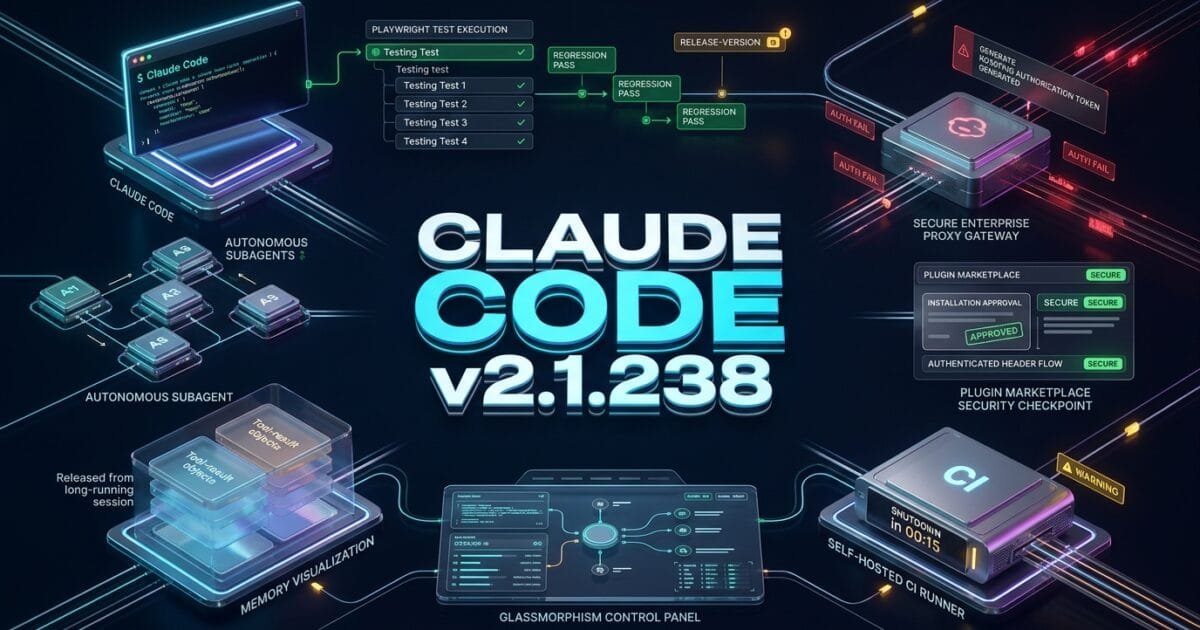
Claude Code v2.1.238 was released on August 20, 2026, and while several changes may initially look like CLI-level improvements, a closer look shows meaningful implications for QA engineers, SDETs, automation architects, and teams running Claude Code inside CI/CD and enterprise environments.
For an SDET, the interesting question is not simply “What changed?”
It is:
“Which of these changes can affect my test automation workflow, CI reliability, plugin security, long-running agent sessions, and production engineering setup?”
That distinction matters because Claude Code is increasingly being used as an engineering agent rather than simply a coding assistant. It can inspect repositories, modify files, execute tests, interact with tools, work with plugins, and participate in development workflows. Anthropic describes Claude Code as an agentic coding tool that operates directly in the terminal and can understand codebases and execute development tasks. (Claude Platform Docs)
The v2.1.238 release therefore deserves to be evaluated from an SDET and engineering reliability perspective, not just as a changelog.
Key Architectural Takeaways for SDETs
- Long-running Agent stability improved: Subagent tool results are now released after leaving the recent display window, addressing unbounded memory growth during long interactive sessions.
- Enterprise runners received operational controls: Deferred shutdown and dynamic proxy authorization support are particularly relevant to CI/CD and self-hosted execution environments.
- Plugin marketplace behavior became more security-aware:
headersHelperintroduces command execution for obtaining HTTP headers during plugin installation or updates, which deserves explicit supply-chain testing. - Developer ergonomics improved: The new
keybindingFlavorsetting provides Bash-likeCtrl+Wbehavior without changing the existing default. - The release is mostly additive/fix-oriented: I would not treat v2.1.238 as a breaking-change release for normal QA workflows, but plugin installation, self-hosted runners, and proxy environments deserve regression coverage.
⚡ Executive Summary: What v2.1.238 Means for QA Engineering
The most important way to evaluate Claude Code v2.1.238 is by separating developer convenience, Agent runtime reliability, and enterprise execution infrastructure.
The keybindingFlavor setting is useful but low-risk. The memory-growth fix is more interesting for SDETs because long-running Agent sessions can now release subagent tool results once they leave the recent display window. That directly targets a class of reliability problems that becomes more visible when Claude Code is used for extended debugging, test generation, repository analysis, or automation development.
The self-hosted-runner changes are arguably even more important for enterprise QA teams. --defer-shutdown-max-min changes how a runner behaves during SIGTERM, allowing attached sessions to continue serving before unfinished work is parked and the runner exits. Meanwhile, --proxy-authorization-command and --proxy-authorization-file address environments where proxy authorization must be freshly generated for each connection.
For QA organizations, these changes should be viewed as operational reliability improvements, not merely feature additions.
Claude Code already supports automated workflows through its CLI, including non-interactive claude -p execution, structured output, configurable turns, and tool permissions. (Claude Platform Docs)
That makes reliability around long-running sessions, authentication, network infrastructure, and plugin execution increasingly important.
What’s New in Claude Code v2.1.238
The v2.1.238 release contains a mixture of new configuration capabilities, plugin marketplace changes, self-hosted runner controls, and reliability fixes.
The major changes can be grouped into seven areas.
1. keybindingFlavor Adds Readline-Style Prompt Editing
Claude Code v2.1.238 now supports a keybindingFlavor setting.
When configured as:
{
  "keybindingFlavor": "readline"
}
Ctrl+W behaves more like Bash/readline by deleting back to the previous whitespace boundary.
The default remains:
classicThis means existing users are not forced into a new interaction model.
For an SDET who spends hours inside terminal-based workflows, this is a small but practical usability improvement.
Imagine a long Claude Code prompt:
Generate Playwright tests for the checkout/payment/subscription workflowWith readline-style behavior, deleting a previous word or whitespace-delimited segment becomes more consistent with the terminal interaction many Linux and macOS engineers already know.
This is not a major automation feature.
It is a developer ergonomics improvement.
From a QA perspective, I would classify it as:
| Area | Impact |
|---|---|
| Test execution | Low |
| CI/CD | None |
| Developer productivity | Medium |
| Existing configuration risk | Low |
| Regression priority | Low |
The important point is that the default remains unchanged, so teams should not expect existing prompt behavior to suddenly change.
2. Plugin Marketplaces Gain headersHelper
This is one of the changes I would pay much more attention to as an SDET.
Claude Code v2.1.238 now supports headersHelper for URL-based plugin marketplaces or catalog entries.
The helper can run a command that generates HTTP headers, such as a short-lived authentication token, for catalog and same-origin archive requests.
At first glance, this sounds like a convenience feature.
Architecturally, however, it introduces another executable step into the plugin acquisition process.
The simplified model becomes:
Claude Code
    ↓
Plugin Marketplace
    ↓
Catalog Entry
    ↓
headersHelper
    ↓
Generated HTTP Headers
    ↓
Catalog / Archive Request
    ↓
Plugin Installation
That deserves security testing.
A QA engineer should ask:
- What command is executed?
- Which user permissions does it inherit?
- What environment variables are visible?
- Can the helper access credentials?
- What happens if the helper fails?
- What happens if the helper returns malformed headers?
- Is output exposed to logs?
- Can a malicious marketplace entry manipulate the helper?
- What happens when a plugin is updated?
- Does the helper execute unexpectedly during ordinary browsing?
The release behavior is more constrained than a simple “every marketplace refresh executes arbitrary commands” interpretation.
According to the release notes you supplied, a catalog entry’s headersHelper runs when the plugin is installed or updated, after the command is shown, and claude plugin install/update now asks for confirmation with [y/N] unless -y is supplied.
That distinction is important.
For an enterprise QA team, I would turn this feature into a security regression suite.
Plugin Install
    ↓
Show Helper Command
    ↓
User Confirmation
    ↓
Execute headersHelper
    ↓
Generate Temporary Headers
    ↓
Fetch Archive
    ↓
Install Plugin
The test objective is not merely:
“Does the plugin install?”
It is:
“Does the plugin installation process execute only the expected command under the expected authorization boundary?”
3. Self-Hosted Runners Can Defer Shutdown
Claude Code v2.1.238 adds:
claude self-hosted-runner --defer-shutdown-max-minThis is particularly relevant to CI/CD infrastructure.
A runner receiving SIGTERM can now continue serving attached sessions for a configured period before parking remaining work and exiting.
For QA infrastructure, think about what happens during:
- Kubernetes pod termination
- VM replacement
- autoscaling
- CI worker recycling
- deployment rollouts
- infrastructure maintenance
- graceful shutdown
- runner upgrades
Without graceful handling, an active Agent session can be interrupted while it is:
- running tests
- analyzing failures
- modifying automation code
- executing a long test suite
- collecting diagnostic information
- calling external tools
The new behavior provides a controlled shutdown window.
Conceptually:
SIGTERM
   ↓
Keep Attached Sessions Alive
   ↓
Wait N Minutes
   ↓
Still Running?
   ├── No → Exit
   └── Yes
        ↓
      Park Work
        ↓
       Exit
This is much closer to how production-grade distributed workers should behave.
4. Dynamic Proxy Authorization Supports Enterprise Networks
Another enterprise-oriented addition is:
claude self-hosted-runner \
  --proxy-authorization-command
and:
claude self-hosted-runner \
  --proxy-authorization-file
These options support environments where the Proxy-Authorization header needs to be freshly generated for each connection.
This matters because enterprise QA environments frequently sit behind:
- authenticated HTTP proxies
- egress gateways
- security appliances
- identity-aware network layers
- rotating credentials
- short-lived authorization tokens
Anthropic’s current Claude Code documentation already describes corporate proxy configuration and authenticated proxy environments, including standard HTTP/HTTPS proxy variables and enterprise network requirements. (Claude Platform Docs)
The new runner capabilities extend the operational model for environments where static proxy credentials are insufficient.
For an SDET, the testing matrix should include:
| Scenario | Expected Result |
|---|---|
| Valid generated authorization | Connection succeeds |
| Expired token | Fresh token requested |
| Helper command failure | Clear failure |
| Empty header | Connection rejected safely |
| Proxy unavailable | Runner reports network failure |
| Token rotation | Subsequent connection uses new token |
| Concurrent connections | Authorization remains correct |
This is not just DevOps testing.
It is test infrastructure reliability testing.
5. Long Interactive Sessions No Longer Retain Unbounded Subagent Tool Results
This is arguably the most interesting reliability fix in the release.
The release fixes unbounded memory growth in long interactive sessions by releasing subagent tool results once they leave the recent display window.
This matters because Agent sessions can become surprisingly large.
Consider an SDET asking Claude Code to:
- inspect a repository,
- analyze 300 test files,
- create a test plan,
- launch subagents,
- inspect CI failures,
- modify Playwright tests,
- rerun the suite,
- inspect logs,
- refactor fixtures,
- rerun failed tests.
A long-running session can accumulate substantial tool output.
The problem is not simply the number of conversation messages.
Tool results can contain:
- terminal output
- test reports
- stack traces
- file contents
- search results
- subagent responses
- generated diagnostics
If old subagent results remain unnecessarily retained, memory consumption can grow over time.
The new behavior is conceptually:
Subagent Tool Result
        ↓
Recent Display Window
        ↓
Still Relevant?
   ├── Yes → Retain
   └── No  → Release
This is exactly the sort of change QA engineers should care about because long-session stability is part of the Agent’s reliability contract.
How I Would Test This
I would build a soak test.
Start Claude Code Session
        ↓
Execute Repeated Agent Tasks
        ↓
Spawn Subagents
        ↓
Generate Large Tool Results
        ↓
Continue Session
        ↓
Monitor Process Memory
        ↓
Repeat 100+ Cycles
        ↓
Compare Memory Trend
The important metric is not simply:
“Did Claude Code crash?”
Instead measure:
- RSS memory
- heap usage where observable
- session duration
- number of subagents
- tool-result volume
- response latency
- CPU utilization
- process stability
The expected result should be a bounded memory trend rather than continuously increasing consumption attributable to obsolete subagent tool results.
This is a classic soak/performance/reliability test.
7 Core Pillars of Claude Code v2.1.238 for SDETs
1. Agent Session Stability
Long-running sessions are becoming normal in Agent-assisted engineering.
A tester should therefore treat session longevity as a quality attribute.
The memory-growth fix is valuable because an Agent that performs well for ten minutes but becomes unstable after three hours is not production-ready for enterprise engineering workflows.
Test:
Short Session → Medium Session → Long Session → Soak SessionCompare resource consumption and behavior across each stage.
2. Plugin Supply-Chain Security
The headersHelper feature expands plugin marketplace capabilities but also increases the importance of plugin installation security.
Your test strategy should include malicious and malformed helper scenarios.
For example:
Valid Helper
Invalid Command
Unexpected Exit Code
Credential Access Attempt
Malformed Header
Expired Token
Unexpected Output
Network Failure
The key principle is:
Every new executable integration point deserves a security regression test.
3. Graceful CI Runner Shutdown
The new deferred shutdown option should be tested under controlled termination.
A realistic test:
SIGTERMwhile a long-running test operation is active.
Then verify:
- attached session remains available;
- configured grace period is respected;
- unfinished work is parked;
- runner eventually exits;
- no duplicate work is unexpectedly created;
- session state remains recoverable.
This is especially relevant for ephemeral CI infrastructure.
4. Proxy Authentication Reliability
Dynamic proxy authorization is useful, but rotating credentials create a new test surface.
A good QA strategy should simulate:
Token T1
   ↓
Connection 1
   ↓
Token expires
   ↓
Token T2
   ↓
Connection 2
The runner should not accidentally reuse an expired authorization header.
5. Prompt and Developer Experience
The new keybinding setting may appear trivial compared with runner functionality, but developer experience is still a quality concern.
A mature SDET team should verify both modes:
classic
readline
and ensure that existing behavior remains unchanged when no configuration is supplied.
This is a good example of backward compatibility testing.
6. Output-Style Persistence
The release fixes custom, project, and plugin output styles drifting back to the default voice during a session.
For teams using Claude Code with structured workflows, consistent output can matter more than aesthetics.
Suppose an engineering team expects a project-specific style that requires:
Test Objective
Risk
Implementation
Validation
Evidence
If the Agent silently returns to its default style halfway through a long workflow, downstream processes can become inconsistent.
The regression test should therefore verify:
Start Session
   ↓
Load Project Style
   ↓
Execute Multiple Turns
   ↓
Invoke Subagent
   ↓
Continue Session
   ↓
Verify Style Persistence
7. Usage-Limit and Runner Reliability Fixes
The release also fixes an issue involving:
CLAUDE_CODE_ENABLE_PROMPT_SUGGESTION=truewhere prompt suggestions could fail to remain enabled when an account was near, but not over, its usage limit.
There are also fixes around worktree-isolation Bash refusals and self-hosted runner lifecycle behavior.
For QA, these belong to a broader category:
state-dependent behavior.
The same feature can behave differently depending on:
- account usage state
- runner state
- worktree configuration
- session age
- authentication state
- plugin state
Those are exactly the conditions that traditional happy-path testing often misses.
Claude Code v2.1.238 QA Validation Flow
Claude Code v2.1.238
    --> Runtime Stability
    --> Plugin Marketplace Security
    --> Self-Hosted Runner Lifecycle
    --> Proxy Authentication
    --> Prompt Interaction
    --> Output Style Persistence
    --> Usage-Limit State Handling
    --> CI Quality Gate
What QA Engineers Should Actually Test After Upgrading
A release upgrade should never be validated only with:
claude --versionThat proves installation.
It does not prove compatibility.
I recommend a layered validation strategy.
Smoke Test
Start with:
claude --versionThen launch Claude Code inside a representative automation repository.
Run:
Read repository
→ inspect tests
→ make a small change
→ execute test
→ inspect result
Functional Test
Validate:
- prompt interaction
- project settings
- output styles
- plugins
- subagents
- worktrees
- Bash execution
- test execution
Integration Test
Validate:
- plugin marketplace
- proxy
- self-hosted runner
- CI environment
- authentication
- external tool integrations
Reliability Test
Run long sessions.
Do not terminate testing after the first successful response.
Security Test
Especially validate the new plugin marketplace behavior.
Check exactly what command is displayed and executed during installation/update.
Regression Test
Compare your most important existing workflows against the previous Claude Code version.
This matters because release changes frequently interact with existing configuration.
Production Scenario: Using Claude Code for Playwright Failure Analysis
Imagine an SDET team uses Claude Code in CI to investigate Playwright failures.
The workflow looks like:
CI Failure
    ↓
Claude Code Runner
    ↓
Read Playwright Report
    ↓
Inspect Trace
    ↓
Analyze Source
    ↓
Launch Subagent
    ↓
Identify Root Cause
    ↓
Modify Test
    ↓
Run Targeted Test
    ↓
Generate Summary
This is exactly where v2.1.238’s operational changes become interesting.
The session may be long.
The subagent may generate substantial tool output.
The runner may receive termination signals.
The environment may require an authenticated proxy.
The Agent may use plugins.
Suddenly, what looked like unrelated release-note items become part of one production system.
That is the mindset I recommend for SDETs:
Do not test features independently when the product is used as an Agent runtime. Test the workflow.
Benchmark Data: QA Impact of the v2.1.238 Changes
The following is an engineering impact matrix, not vendor benchmark data.
| Change | QA Impact | Automation Impact | Enterprise Impact | Priority |
|---|---|---|---|---|
keybindingFlavor | Low | Low | Low | P3 |
headersHelper | High | Medium | High | P1 |
| Deferred runner shutdown | High | High | High | P1 |
| Dynamic proxy authorization | High | High | High | P1 |
| Subagent memory release | High | High | High | P1 |
| Output-style persistence fix | Medium | Medium | Medium | P2 |
| Prompt suggestion usage-limit fix | Medium | Low | Medium | P2 |
| Worktree Bash refusal fix | Medium | Medium | Medium | P2 |
| Self-hosted runner stability fixes | High | High | High | P1 |
From an SDET perspective, I would prioritize runtime memory, self-hosted runners, plugin installation, and proxy authorization ahead of prompt-keybinding improvements.
That is where production failure is more expensive.
Production Implementation: Release Validation With Playwright
If your QA organization uses Playwright to validate engineering tools or internal developer platforms, you can turn release validation into an automated smoke suite.
For example:
import { test, expect } from '@playwright/test';
import { execFileSync } from 'node:child_process';

test.describe('Claude Code v2.1.238 release validation', () => {
  test('installed version is available', () => {
    const version = execFileSync('claude', ['--version'], {
      encoding: 'utf8'
    });

    expect(version).toContain('2.1.238');
  });

  test('Claude Code CLI responds to help', () => {
    const output = execFileSync('claude', ['--help'], {
      encoding: 'utf8'
    });

    expect(output).toContain('update');
  });
});
For enterprise environments, extend this into integration tests.
test.describe('Claude Code operational regression', () => {
  test('runner configuration is documented in CLI help', () => {
    const output = execFileSync(
      'claude',
      ['self-hosted-runner', '--help'],
      { encoding: 'utf8' }
    );

    expect(output).toContain('defer-shutdown');
  });

  test('proxy authorization options are exposed', () => {
    const output = execFileSync(
      'claude',
      ['self-hosted-runner', '--help'],
      { encoding: 'utf8' }
    );

    expect(output).toContain('proxy-authorization');
  });
});
These are smoke-level checks.
They should not be mistaken for complete functional validation.
The production suite should additionally launch controlled runner sessions and verify actual shutdown, proxy authentication, plugin installation, and long-session behavior.
Real-World Edge Cases & Pitfalls
Pitfall 1: Upgrading Only the Developer Laptop
A developer verifies:
claude --versionand considers the upgrade complete.
But CI runners may still use the previous version.
That creates environment drift.
Always validate:
Developer
CI
Self-hosted Runner
Container
Remote Environment
where applicable.
Pitfall 2: Testing Plugin Installation Only With Trusted Plugins
The new headersHelper behavior deserves negative testing.
Do not validate only:
Trusted Plugin → Installation succeedsAlso test:
Malformed Helper
Failed Helper
Unauthorized Helper
Expired Credential
Unexpected Header
Network Failure
User Rejects Prompt
Non-interactive Installation
This is where security and reliability defects appear.
Pitfall 3: Assuming Graceful Shutdown Means Zero Lost Work
Deferred shutdown improves runner lifecycle handling.
It does not mean every operation is magically resumable.
Test what happens when:
SIGTERMarrives during:
- Bash execution
- test execution
- subagent execution
- plugin operation
- network request
- file modification
Each operation may have different recovery characteristics.
Pitfall 4: Measuring Memory Only at Startup and Shutdown
A memory regression may not be obvious from two snapshots.
Use a time series.
Time →
0m   10m   20m   30m   60m   120m
│     │     │     │     │      │
RSS   RSS   RSS   RSS   RSS    RSS
The shape of the curve matters.
Pitfall 5: Ignoring State-Based Testing
The prompt-suggestion fix demonstrates why state matters.
Test:
Normal Usage
Near Usage Limit
At Usage Limit
After Limit Reset
State transitions are often where Agent tooling exposes unexpected behavior.
Comparison Matrix: v2.1.238 QA Priorities
| Area | Before v2.1.238 Concern | v2.1.238 Direction | SDET Recommendation |
|---|---|---|---|
| Long sessions | Memory growth risk | Tool results released outside recent window | Run soak tests |
| Self-hosted runner | Shutdown interruption | Deferred shutdown | Add lifecycle tests |
| Proxy | Static/difficult auth scenarios | Fresh proxy authorization support | Test token rotation |
| Plugins | Marketplace acquisition | headersHelper capability | Add security tests |
| Prompt | Classic interaction | Optional readline behavior | Low-priority regression |
| Output styles | Possible drift | Persistence fix | Verify multi-turn sessions |
| Prompt suggestions | Near-limit edge case | Reliability fix | Add usage-state tests |
| Worktrees | Bash refusal edge case | Specific refusal fixed | Add regression test |
Should QA Engineers Upgrade to Claude Code v2.1.238?
My recommendation: yes, but validate it through your engineering workflow before rolling it across every CI runner.
For an individual SDET using Claude Code locally, the release appears attractive because several changes are reliability and usability fixes rather than disruptive workflow changes.
For an enterprise QA platform, I would use a staged rollout.
Stage 1: Developer Validation
Upgrade a small group of SDETs.
Validate:
- normal Claude Code usage
- project settings
- plugins
- test execution
- output styles
- long sessions
Stage 2: CI Canary
Upgrade one self-hosted runner.
Run:
- Playwright
- API tests
- unit tests
- integration tests
- Agent-assisted diagnosis
Monitor failures.
Stage 3: Infrastructure Validation
Specifically test:
SIGTERM- deferred shutdown
- proxy authentication
- token rotation
- runner recovery
Stage 4: Plugin Security Validation
Review every plugin installation/update workflow that could invoke the new headersHelper mechanism.
Stage 5: Broad Rollout
Only after the canary environment passes should the version become the organization’s standard.
That is the difference between upgrading a developer tool and upgrading an engineering platform.
How to Upgrade Claude Code v2.1.238
One correction is important here.
The upgrade commands in the original draft:
pip install claude code --upgrade
npm install claude code@latest
are not the correct standard Claude Code CLI installation commands.
Anthropic’s current setup documentation uses the npm package:
npm install -g @anthropic-ai/claude-codeand the CLI provides:
claude updatefor updating Claude Code. (Claude Platform Docs)
For a version-specific QA validation environment, I would first record the currently installed version:
claude --versionThen update:
claude updateAfter the update:
claude --versionThen execute your smoke suite.
For npm-managed installations, Anthropic’s documented package is:
npm install -g @anthropic-ai/claude-codeDo not use sudo npm install -g simply to bypass permission problems; Anthropic specifically advises against that approach. (Claude Platform Docs)
If you use the Claude Code SDK from Python, that is a separate package concern from installing the Claude Code CLI itself. Anthropic’s SDK documentation distinguishes the CLI installation from the Python SDK package. (Claude Platform Docs)
Release Validation Checklist for SDETs
Before approving Claude Code v2.1.238 for your QA organization, I would use this checklist:
- Verify the installed version.
- Run basic CLI smoke tests.
- Validate project configuration.
- Validate custom/project/plugin output styles.
- Test long interactive sessions.
- Run subagent-heavy workflows.
- Monitor memory behavior during soak testing.
- Test self-hosted runner termination.
- Validate deferred shutdown.
- Test proxy authorization.
- Test proxy credential rotation.
- Validate plugin installation.
- Test
headersHelperfailure scenarios. - Test plugin installation confirmation behavior.
- Test worktree-isolation workflows.
- Test prompt suggestions near usage limits.
- Run the existing automation regression suite.
- Validate CI/CD integration.
- Compare failure rates against the previous version.
- Canary the release before broad rollout.
Conclusion: v2.1.238 Is More Important for Infrastructure Than It First Appears
Claude Code v2.1.238 is not simply another collection of small CLI changes.
From an SDET perspective, its most meaningful changes are concentrated around Agent runtime reliability, plugin execution, self-hosted infrastructure, and enterprise networking.
The keybindingFlavor option is convenient.
The output-style and prompt-suggestion fixes improve consistency.
But the changes I would prioritize in a production QA environment are different:
Subagent memory release.
Graceful self-hosted runner shutdown.
Dynamic proxy authorization.
Plugin headersHelper security.
Those features touch the boundaries where an AI coding Agent becomes part of a real engineering system.
The biggest lesson for QA engineers is therefore not simply to read a release note and click upgrade.
Treat Claude Code as a production engineering dependency.
When an Agent can execute code, invoke tools, interact with plugins, operate inside CI, and participate in automation workflows, its runtime behavior becomes part of your test strategy.
The right question after v2.1.238 is not:
“Does Claude Code still work?”
It is:
“Does Claude Code v2.1.238 remain reliable, secure, observable, and recoverable across the workflows where our engineering teams actually use it?”
That is the SDET-level release validation question.
Internal Blog Links
- Claude Code v2.1.233: GitLab MRs, Safer Builds, Smarter Sessions and MCP Fixes
- Claude Code 2.1.231 Released: Fixing the MCP OAuth Redirect Problem
Internal Series Links
- Learn MCP – Zero to Hero
- Learn AI Agents for QA – Zero to Hero
- Playwright Automation – Zero to Hero
- TencentDB Agent Memory: Complete Zero to Hero
- LangGraph: Complete Zero to Hero
- Learn Python – Zero to Hero
- OpenAI Codex: Complete Zero to Hero
- Cursor AI: Complete Zero to Hero
- Claude Code Tutorial: Complete Zero to Hero
- AutoGen: Complete Zero to Hero Guide
- Free QA Resources Built From Real Experience
- QA Glossary: Test Automation Terms Every Engineer Should Know
External Links
- Claude Code — Official Anthropic Setup Guide — Installation, authentication, update methods, and supported environments.
- Claude Code CLI Reference — Official CLI commands, flags, non-interactive execution, and update commands.
- Claude Code Corporate Proxy Configuration — Official guidance for proxy and enterprise network environments.
- Claude Code SDK Documentation — Official SDK usage for integrating Claude Code into engineering workflows.
- Claude Code Releases on GitHub — Official release history and changelog.
AI Overview & AEO Snippet
Claude Code v2.1.238 adds configurable readline-style keybindings, plugin marketplace header helpers, deferred self-hosted-runner shutdown, dynamic proxy authorization, and several reliability fixes. For QA engineers, the highest-value changes are long-session memory stability, CI runner resilience, proxy authentication, and plugin security.
Key Architectural Rules:
- Treat Claude Code as an engineering dependency, not just a developer utility.
- Validate long-running Agent sessions instead of relying only on smoke tests.
- Test self-hosted runner lifecycle behavior under
SIGTERM. - Treat plugin installation and
headersHelperexecution as a security-sensitive workflow. - Validate proxy authentication and credential rotation in enterprise environments.
- Canary new Claude Code versions before broad CI rollout.
People Asked Questions
Q1: What is new in Claude Code v2.1.238?
Claude Code v2.1.238 adds the keybindingFlavor setting, plugin marketplace headersHelper support, deferred self-hosted-runner shutdown, dynamic proxy authorization options, and several reliability fixes including reduced memory retention from old subagent tool results.
Q2: Is Claude Code v2.1.238 important for QA engineers?
Yes. The most relevant changes for QA engineers are the long-session memory improvement, self-hosted runner lifecycle controls, proxy authorization support, and plugin marketplace changes. These directly affect Agent reliability, CI/CD infrastructure, enterprise networking, and security testing.
Q3: Does Claude Code v2.1.238 introduce breaking changes?
The supplied release notes do not indicate a broad breaking change to normal Claude Code workflows. The keybindingFlavor default remains classic. However, teams using plugins, self-hosted runners, custom proxies, or automation around CLI behavior should run targeted regression tests before a broad rollout.
Q4: How should SDETs test the Claude Code v2.1.238 upgrade?
SDETs should test more than version installation. Validate long-running sessions, subagent behavior, memory consumption, plugin installation, runner shutdown, proxy authentication, output-style persistence, usage-limit states, worktrees, and existing CI automation.
Q5: How do I update Claude Code?
Anthropic’s current documentation supports claude update for manual updates and documents npm installation through @anthropic-ai/claude-code. (Claude Platform Docs)
Q6: What is the most important v2.1.238 change for enterprise QA?
For enterprise QA environments, I would prioritize the self-hosted runner and proxy changes, followed closely by the long-session memory fix and plugin headersHelper behavior. These features affect infrastructure reliability, network security, and software supply-chain testing.
Continue Learning
Explore more expert articles on Mobile Testing, Backend & API, AI & Agentic, AI Tools, n8n, LangChain, CrewAI, MCP Servers, AI Agents, LlamaIndex, Docker, FastAPI, Playwright, Cypress, Test Automation, DevOps, and Software Engineering at www.skakarh.com.
QAPulse by SK delivers expert release analysis, AI engineering insights, enterprise automation strategies, migration guidance, DevOps best practices, and practical testing knowledge to help software professionals build scalable, intelligent, and production-ready software systems.