QA
QA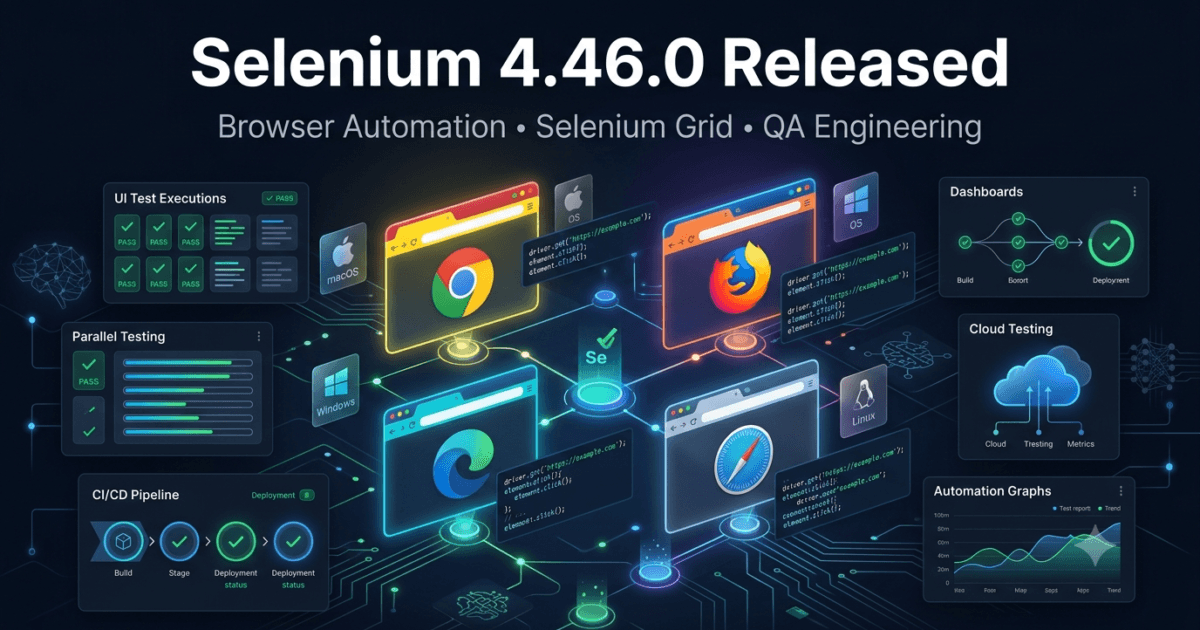
The Selenium project continues to evolve as one of the most widely adopted browser automation frameworks in software testing. Released on July 11, 2026, Selenium 4.46.0 is a maintenance-focused update that delivers important improvements across multiple language bindings, build infrastructure, and release engineering processes. While this version does not introduce major browser automation features or WebDriver API changes, it strengthens the stability and reliability of the Selenium ecosystem for enterprise automation teams.
As organizations continue adopting AI-assisted testing, cloud-based browser execution, scalable CI/CD pipelines, and cross-browser automation, maintaining a stable automation framework becomes increasingly important. Selenium remains a foundational technology powering millions of automated UI tests across industries, and even incremental improvements can significantly enhance long-term maintainability, platform compatibility, and developer productivity.
Selenium 4.46.0 includes updates across Java, Python, .NET, Ruby, and JavaScript bindings, along with enhancements to the project’s build system and release pipeline. Notable changes include upgraded Rust build tooling, thread-safe product information handling in the .NET bindings, and release workflow optimizations that improve package publishing reliability. Although these updates primarily target framework maintainers and contributors, they ultimately provide more dependable releases for QA Engineers and software teams.
For QA Engineers, SDETs, Automation Architects, Test Leads, DevOps Engineers, and Software Developers, Selenium 4.46.0 is a recommended maintenance upgrade that reinforces the reliability of enterprise browser automation without requiring significant migration effort.
Official Release Highlights
According to the official release notes, Selenium 4.46.0 delivers updates across all officially supported language bindings.
Component Updates
- Java
- Python
- .NET
- Ruby
- JavaScript
Notable Changes
- Upgraded rules_rs to version 0.0.90
- Improved Rust build process using LLVM on macOS
- Added thread-safe product information determination for .NET
- Improved release pipeline to prevent duplicate package publishing
- Multiple internal maintenance and build improvements
Although these enhancements are largely internal, they contribute to a more stable and maintainable Selenium ecosystem for all users.
Selenium 4.46.0 at a Glance
| Category | Details |
|---|---|
| Release Version | Selenium 4.46.0 |
| Release Date | July 11, 2026 |
| Release Type | Maintenance Release |
| Supported Languages | Java, Python, .NET, Ruby, JavaScript |
| Breaking Changes | None Reported |
| Upgrade Recommendation | Recommended |
| Enterprise Readiness | Excellent |
Why This Release Matters
Maintenance releases often receive less attention than feature-rich updates, but they are essential for organizations that depend on Selenium for business-critical automation.
Large enterprises frequently execute:
- Tens of thousands of regression tests
- Parallel browser sessions
- Distributed Selenium Grid executions
- Cloud browser testing
- Cross-platform validation
- Continuous Integration pipelines
- Nightly regression suites
- Release verification testing
In these environments, framework stability is often more valuable than introducing new APIs.
Selenium 4.46.0 strengthens the overall ecosystem by improving language bindings, modernizing build infrastructure, and refining release engineering. These enhancements reduce maintenance overhead, improve package consistency, and help ensure that future Selenium releases remain dependable across supported platforms.
For QA teams, this translates into fewer framework-related issues and greater confidence in long-running automation suites.
Deep Dive into the Key Improvements
Cross-Language Maintenance
One of Selenium’s greatest strengths is its extensive multi-language support.
Organizations build automation frameworks using:
- Java
- Python
- C#
- JavaScript
- Ruby
By updating multiple language bindings within a single release, Selenium maintains consistency across its ecosystem and minimizes version fragmentation.
This is particularly valuable for enterprises where different teams use different programming languages while sharing common testing infrastructure.
Improved .NET Thread Safety
The release introduces thread-safe product information determination within the .NET bindings.
For enterprise automation teams running highly parallel test execution, thread safety is critical. Although this change is internal, it improves reliability under concurrent workloads and reduces the likelihood of unexpected behavior in multithreaded environments.
As automation frameworks continue scaling across cloud infrastructure and Selenium Grid deployments, thread-safe operations become increasingly important for maintaining predictable execution.
Modernized Build Infrastructure
Selenium 4.46.0 upgrades its Rust build tooling and improves compilation using LLVM on macOS.
While most QA Engineers will never interact directly with the build pipeline, modern tooling ensures that framework maintainers can continue delivering reliable releases with improved compatibility across operating systems and development environments.
These infrastructure investments ultimately benefit every Selenium user through more stable releases and faster issue resolution.
Stronger Release Engineering
Another notable improvement is the enhancement to Selenium’s release workflow, which now skips package publication when artifacts have already been published.
Although this targets project maintainers rather than end users, it reduces release inconsistencies and helps ensure package repositories remain accurate and dependable.
Reliable release engineering is especially important for enterprise environments where package integrity and version consistency are critical.
Why QA Engineers Should Care
Selenium remains the backbone of browser automation for countless organizations. Whether teams use JUnit, TestNG, PyTest, NUnit, Mocha, Cucumber, or BDD frameworks, Selenium continues to power end-to-end testing across modern web applications.
The improvements in Selenium 4.46.0 reinforce the framework’s long-term stability rather than introducing disruptive changes. This makes the release particularly attractive for enterprises that prioritize predictable automation, reliable CI/CD execution, and low-risk framework upgrades.
QA Engineers should view this version as a maintenance release that strengthens the platform while preserving compatibility with existing automation suites.
Comparison with Previous Version
| Feature | Previous Version | Selenium 4.46.0 |
|---|---|---|
| Browser Automation | Stable | Stable |
| Java Support | Available | Updated |
| Python Support | Available | Updated |
| .NET Support | Available | Improved thread safety |
| Build Infrastructure | Existing | Modernized |
| Release Pipeline | Standard | Enhanced reliability |
| Breaking Changes | None | None |
Upgrade Recommendation
Based on the official release notes, Selenium 4.46.0 is a recommended maintenance upgrade for organizations already running Selenium 4.x.
The release introduces no reported breaking changes while improving internal reliability, language bindings, and build infrastructure.
Before production rollout, QA teams should execute their standard regression suite to validate:
- Browser compatibility
- Selenium Grid execution
- Parallel test execution
- Framework integrations
- CI/CD pipelines
- Cloud testing providers
- Existing Page Object Models
- Custom Selenium utilities
Successful validation should allow teams to adopt Selenium 4.46.0 with minimal risk.
How to Upgrade
Python
pip install --upgrade selenium
Java (Maven)
<dependency>
    <groupId>org.seleniumhq.selenium</groupId>
    <artifactId>selenium-java</artifactId>
    <version>4.46.0</version>
</dependency>
JavaScript
npm install selenium-webdriver@latest
After upgrading, execute your complete browser automation regression suite to verify compatibility across supported browsers, Selenium Grid nodes, cloud execution platforms, and CI/CD pipelines.
What Selenium 4.46.0 Means for QA Engineers
Browser automation continues to be one of the most critical pillars of modern software quality assurance. Despite the rapid rise of AI-assisted testing, autonomous QA agents, API-first validation, and low-code automation platforms, Selenium remains the industry’s most trusted framework for end-to-end web application testing. Millions of automated test cases executed every day across banking, healthcare, retail, telecommunications, government, SaaS, and enterprise software still depend on Selenium for reliable browser automation.
While Selenium 4.46.0 is not a feature-heavy release, it demonstrates something equally valuable—continuous investment in platform stability, language consistency, build infrastructure, and release engineering. Enterprise software teams rarely adopt automation frameworks because of flashy new features alone; they value predictable releases, backward compatibility, cross-platform reliability, and long-term maintainability.
For QA Engineers, SDETs, Automation Architects, Test Leads, DevOps Engineers, Platform Engineers, and Engineering Managers, Selenium 4.46.0 is a low-risk maintenance release that strengthens the ecosystem while ensuring existing automation frameworks continue operating with minimal disruption.
Enterprise Impact
Modern enterprise automation environments are significantly more complex than they were just a few years ago.
Organizations now execute browser automation across:
- Selenium Grid
- Docker containers
- Kubernetes clusters
- Cloud execution platforms
- GitHub Actions
- Azure DevOps
- Jenkins pipelines
- GitLab CI/CD
- BrowserStack
- Sauce Labs
- LambdaTest
- Playwright hybrid environments
Large regression suites often execute tens of thousands of UI tests every day, making framework stability more valuable than introducing experimental features.
The improvements delivered in Selenium 4.46.0 contribute to:
- Better release consistency
- Improved cross-language maintenance
- Enhanced build reliability
- More dependable package publishing
- Stable framework evolution
These improvements reduce operational risk while helping engineering teams confidently maintain long-running automation projects.
Key Improvements for QA Teams
Better Cross-Language Consistency
One of Selenium’s biggest advantages over many competing frameworks is its mature support for multiple programming languages.
The Java, Python, .NET, Ruby, and JavaScript bindings continue evolving together, allowing organizations to standardize browser automation across different technology stacks.
For enterprise teams, this means:
- Easier framework maintenance
- Consistent feature availability
- Reduced version fragmentation
- Improved documentation alignment
- Simplified knowledge sharing across teams
Organizations supporting multiple development teams benefit greatly from synchronized language updates like those included in Selenium 4.46.0.
Improved .NET Reliability
The addition of thread-safe product information determination within the .NET bindings may appear minor, but thread safety is essential for enterprise automation.
Large-scale automation commonly relies on:
- Parallel execution
- Distributed Selenium Grid
- Multi-threaded test runners
- Cloud browser sessions
- Concurrent CI/CD pipelines
Thread-safe internal operations improve framework robustness and reduce the likelihood of unpredictable issues under high execution loads.
Although end users may never directly notice the implementation, improvements like this contribute to long-term platform stability.
More Reliable Build Infrastructure
The upgraded Rust build tooling and LLVM improvements strengthen Selenium’s internal development ecosystem.
Healthy build infrastructure benefits the community by enabling:
- Faster release cycles
- Improved platform compatibility
- More reliable package generation
- Easier maintenance
- Higher contributor productivity
For QA teams, these backend improvements translate into more dependable Selenium releases over time.
Stronger Release Engineering
Enterprise organizations depend on consistent package distribution.
The improved release pipeline now prevents duplicate package publication, helping maintain package integrity across repositories.
Although this change targets Selenium maintainers rather than end users, reliable release engineering improves confidence in official packages and simplifies enterprise dependency management.
Selenium 4.46.0 Compared with Previous Releases
| Capability | Previous Releases | Selenium 4.46.0 |
|---|---|---|
| Browser Automation | Mature | Mature |
| Java Support | Stable | Updated |
| Python Support | Stable | Updated |
| .NET Thread Safety | Standard | Improved |
| Rust Build Tooling | Previous version | Updated |
| Release Pipeline | Existing | More reliable |
| Breaking Changes | None | None |
Practical Testing Scenarios
The improvements in Selenium 4.46.0 support several real-world automation scenarios.
| QA Scenario | Benefit |
|---|---|
| Cross-browser testing | Stable framework updates |
| Selenium Grid execution | Improved reliability |
| Parallel automation | Better thread safety |
| Enterprise CI/CD | More dependable releases |
| Cloud testing | Consistent package quality |
| Long regression suites | Lower framework maintenance risk |
| Multi-language automation | Better ecosystem alignment |
| Large enterprise projects | Simplified upgrades |
Although these improvements are mostly internal, they help reduce the operational complexity associated with maintaining enterprise-scale automation frameworks.
Regression Testing Checklist
Before upgrading Selenium in production environments, QA teams should validate:
- Chrome automation
- Edge automation
- Firefox automation
- Safari automation (where applicable)
- Selenium Grid execution
- Parallel test execution
- Remote WebDriver sessions
- Page Object Models
- Custom WebDriver utilities
- Explicit waits
- Implicit waits
- Browser capabilities
- File upload automation
- Authentication workflows
- Existing regression suites
Running comprehensive regression testing ensures framework updates do not introduce unexpected compatibility issues with existing automation code.
Migration Guidance
The official release notes report no breaking API changes, making Selenium 4.46.0 one of the safest upgrades in the Selenium 4.x lifecycle.
A recommended enterprise deployment strategy includes:
- Upgrade Selenium dependencies.
- Execute smoke tests.
- Run complete regression suites.
- Validate Selenium Grid.
- Verify cloud execution providers.
- Confirm CI/CD compatibility.
- Deploy to staging.
- Promote to production after successful validation.
Following this staged rollout approach minimizes operational risk while allowing organizations to benefit from the latest framework improvements.
Should You Upgrade?
Absolutely.
Although Selenium 4.46.0 does not introduce major WebDriver capabilities or browser automation APIs, it improves the overall quality of the Selenium ecosystem through better language support, stronger release engineering, enhanced build infrastructure, and improved .NET reliability.
Because there are no reported breaking changes, organizations already using Selenium 4.x should include this release within their regular maintenance cycle. Teams that prioritize framework stability, predictable automation execution, and long-term maintainability will benefit from adopting this version after completing standard regression validation.
Selenium 4.46.0: Key Takeaways
Selenium 4.46.0 is a maintenance-focused release that reinforces the framework’s reputation for stability and enterprise readiness. Instead of introducing disruptive changes, it delivers meaningful improvements across language bindings, build tooling, release automation, and .NET thread safety, ensuring Selenium remains a dependable foundation for browser automation.
For QA Engineers, SDETs, Automation Architects, DevOps teams, Platform Engineers, and enterprise software organizations, this update represents a safe and recommended upgrade that strengthens browser automation infrastructure without requiring significant migration effort. It reflects Selenium’s continued commitment to providing a mature, reliable, and future-ready testing platform for modern software engineering.
Selenium New Release Articles
- Selenium 4.45.0 Released: Important Stability Updates QA Engineers Should Know
- Selenium 4.44.0 Released: Why Selenium Still Refuses to Die
More Relevant Articles
- Why QA Observability Will Become Bigger Than Automation Frameworks in 2026
- What is Playwright? Powerful Beginner Guide for QA Engineers in 2026
- The Hidden Architecture Behind Scalable QA Platforms in 2026
- Why AI Agents Will Replace Fragile Test Frameworks Before They Replace QA Engineers
- AI Testing vs Traditional Automation in 2026: What Smart QA Teams Are Quietly Changing
External Resources
- Selenium Official Website: https://www.selenium.dev
- Selenium GitHub Repository: https://github.com/SeleniumHQ/selenium
- Selenium 4.45.0 Release Notes: https://github.com/SeleniumHQ/selenium/releases/tag/selenium-4.45.0
- WebDriver Specification: https://www.w3.org/TR/webdriver2
Frequently Asked Questions
Is Selenium 4.46.0 a major feature release?
No. It is a maintenance release focused on improving framework stability, language bindings, build infrastructure, and release engineering.
Are there any breaking changes?
No. The official release notes do not report any breaking changes or migration concerns.
Should enterprise automation teams upgrade?
Yes. Organizations already using Selenium 4.x should upgrade after completing their standard regression testing process.
Which users benefit the most?
QA Engineers, SDETs, Automation Engineers, .NET developers, Selenium Grid administrators, and enterprise teams maintaining large browser automation suites will benefit the most.
Does Selenium 4.46.0 require code changes?
In most cases, no. Existing Selenium 4.x automation frameworks should continue working without modification, making this a straightforward maintenance upgrade.
Continue Learning with QAPulse by SK
The future of quality engineering combines browser automation, AI-assisted testing, intelligent agents, cloud-native infrastructure, and modern DevOps practices. QAPulse by SK helps software professionals stay ahead with expert tutorials, release analyses, automation strategies, and practical engineering insights covering Selenium, Playwright, Cypress, Robot Framework, n8n, FastAPI, Docker, Node.js, LangChain, CrewAI, Model Context Protocol (MCP), Claude Code, Python, and Enterprise Test Automation.
Whether you’re modernizing legacy Selenium frameworks, designing scalable automation architectures, integrating AI into your testing strategy, or building next-generation quality engineering platforms, QAPulse by SK provides actionable guidance to help you deliver faster, more reliable, and higher-quality software.