 QA
QA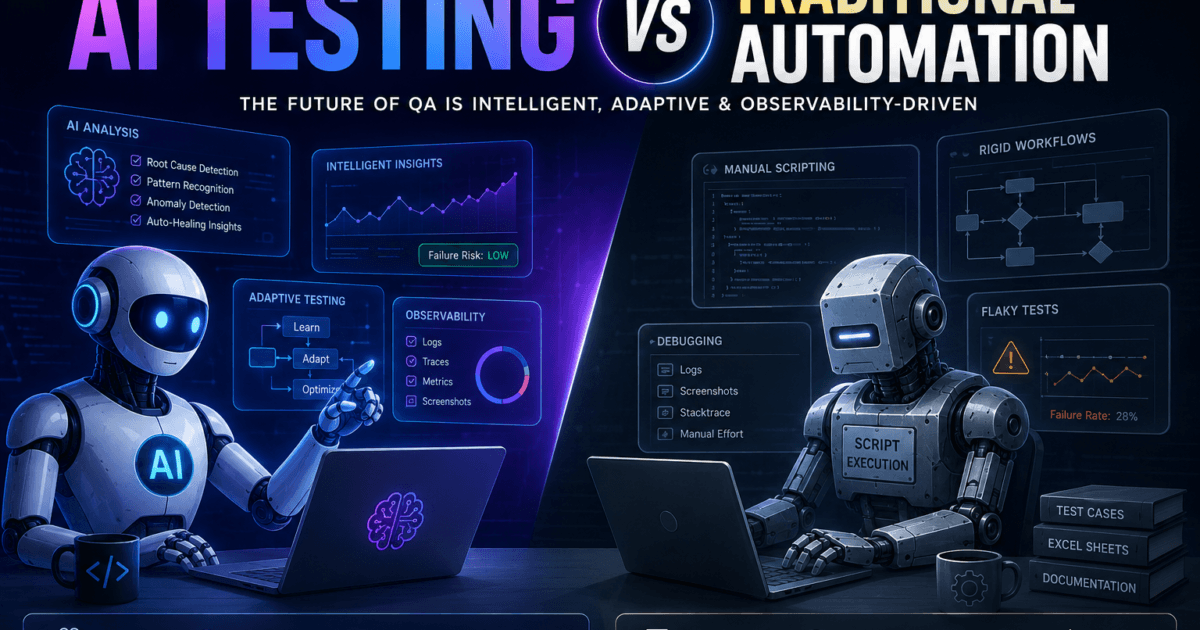
AI Testing vs Traditional Automation is Becoming the Biggest QA Shift of the Decade
The discussion around AI Testing vs Traditional Automation is no longer theoretical.
It is already happening quietly inside:
- enterprise engineering teams
- modern SaaS companies
- AI-native startups
- DevOps organizations
- cloud-scale QA platforms
And honestly?
Most QA engineers still underestimate how massive this shift actually is.
Because this is not simply:
“new testing tools”
This is a deeper transformation of:
- engineering workflows
- debugging systems
- automation strategy
- software delivery pipelines
- quality engineering culture
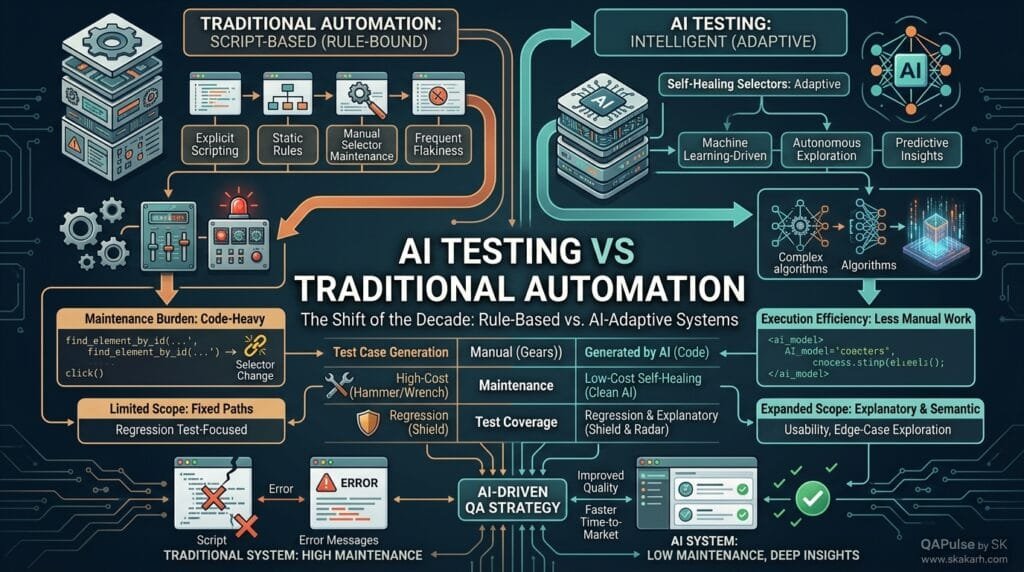
Traditional automation was built around:
- deterministic scripts
- fixed assertions
- manually designed workflows
- predictable execution paths
Modern AI-driven systems increasingly focus on:
- adaptive execution
- intelligent reasoning
- contextual understanding
- semantic workflows
- self-healing behavior
- orchestration intelligence
That changes everything.
Why Traditional Automation Still Exists Everywhere
Before discussing AI systems, something important must be understood clearly:
Traditional automation is not disappearing anytime soon.
In fact:
most enterprise QA systems still heavily depend on:
- Selenium
- Playwright
- Cypress
- REST API automation
- CI/CD orchestration
- deterministic regression testing
And for good reason.
Traditional automation is still excellent for:
- predictable workflows
- stable validations
- deterministic assertions
- repeatable regression suites
- compliance-heavy systems
Large organizations often require:
highly controlled execution behavior
especially in:
- banking
- healthcare
- insurance
- telecom
- government infrastructure
AI systems alone cannot replace that reliability immediately.
The Biggest Misconception About AI Testing
Many people imagine AI testing as:
“AI writes tests automatically.”
That is an extremely shallow understanding.
Modern AI testing increasingly involves:
- intelligent debugging
- adaptive orchestration
- semantic validation
- observability analysis
- flaky failure classification
- workflow reasoning
- execution optimization
- autonomous investigation systems
The real power of AI testing is not:
👉 replacing humans
The real power is:
👉 reducing operational complexity
That difference matters massively.
Traditional Automation Was Built for a Different Engineering Era
Most traditional automation frameworks were designed during a time when:
- applications were simpler
- releases were slower
- cloud infrastructure was smaller
- frontend complexity was lower
- AI systems barely existed
Modern software ecosystems became dramatically more complex.
Applications now increasingly involve:
- distributed microservices
- async rendering
- AI-generated content
- event-driven workflows
- cloud-native infrastructure
- real-time personalization
- dynamic UI systems
This creates enormous pressure on traditional automation models.
Many older automation ecosystems struggle because they rely heavily on:
rigid deterministic assumptions
while modern applications increasingly behave:
dynamicallyWhat AI Testing Actually Looks Like in 2026
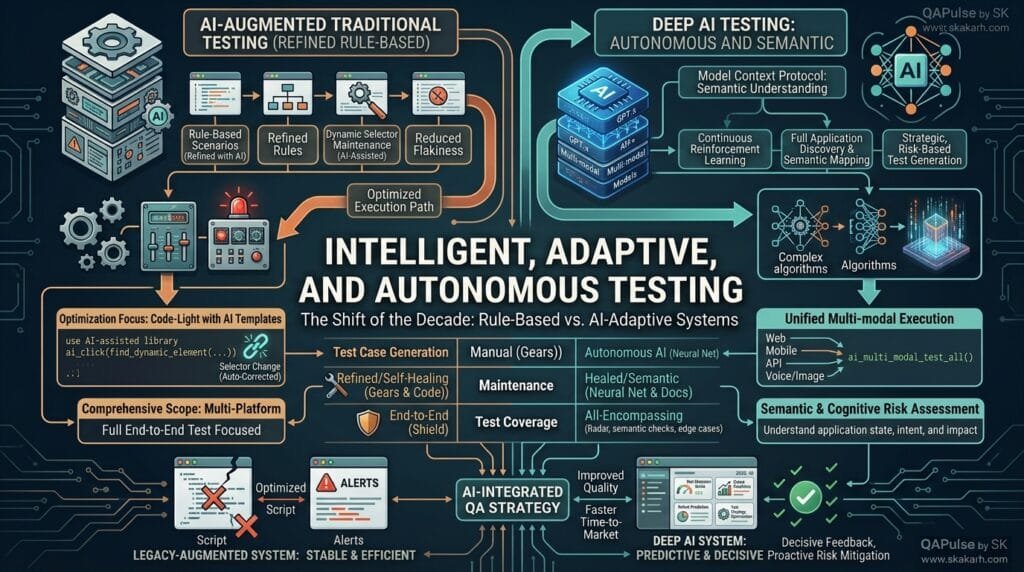
Modern AI testing systems are increasingly capable of:
- interpreting failures
- analyzing screenshots
- classifying flaky behavior
- generating debugging summaries
- correlating telemetry signals
- adapting workflows dynamically
For example:
an intelligent automation system may detect:
- unstable locators
- delayed rendering
- API degradation
- infrastructure instability
without engineers manually reviewing logs for hours.
That dramatically changes debugging efficiency.
Modern AI testing increasingly integrates:
- LLM reasoning
- observability systems
- vector retrieval
- telemetry pipelines
- orchestration frameworks
- browser automation tools
This creates:
intelligent automation ecosystems
instead of isolated scripts.
Why AI Testing Depends Heavily on Observability
This is one of the most misunderstood realities in modern QA.
Most engineers think AI testing success depends mainly on:
- better prompts
- bigger models
- more AI agents
But honestly?
AI systems fail primarily because:
they lack high-quality runtime visibility
Without:
- traces
- logs
- metrics
- screenshots
- execution telemetry
- distributed diagnostics
AI reasoning becomes weak.
That is why modern AI testing increasingly depends on:
👉 observability-first engineering
because intelligent systems require:
👉 rich execution context
Traditional Automation Is Deterministic
Traditional automation frameworks usually operate like this:
await page.click('#login');
await expect(page.locator('.dashboard')).toBeVisible();
The workflow is:
- predefined
- deterministic
- manually controlled
This is extremely powerful for:
- stable systems
- predictable validations
- regression consistency
But traditional automation also struggles with:
- unexpected UI behavior
- dynamic layouts
- semantic interpretation
- adaptive reasoning
The automation system only understands:
what engineers explicitly programmed
Nothing more.
AI Testing Introduces Contextual Reasoning
Modern AI-assisted testing increasingly introduces:
- semantic understanding
- contextual validation
- adaptive workflows
- intelligent decision-making
For example:
instead of hardcoded selectors:
await page.click('button.submit-order');
AI systems may increasingly reason using:
- page semantics
- visual understanding
- contextual workflows
- user intent
That creates far more adaptive automation behavior.
Especially in:
- rapidly changing UIs
- AI-generated applications
- dynamic interfaces
- personalized systems
Example: Traditional Automation Failure
Traditional systems often fail like this:
Error: Locator not found
Then engineers manually investigate:
- screenshots
- logs
- traces
- DOM changes
This consumes massive engineering time.
Example: AI-Assisted Failure Analysis
Modern AI systems increasingly generate summaries like:
The checkout button appears renamed after the latest deployment. Similar UI shifts were detected in previous responsive layout updates affecting mobile viewport rendering.
That dramatically reduces debugging overhead.
Why AI Testing Is Not Replacing Traditional Automation Completely
This is extremely important.
Many engineers assume:
AI testing will fully replace traditional frameworks
That is unlikely anytime soon.
Instead:
modern QA increasingly combines:
- deterministic automation
- intelligent reasoning
- adaptive workflows
- observability pipelines
- orchestration systems
The future is increasingly:
hybrid automation ecosystems
not:
fully autonomous magic systemsWhy Smart QA Teams Are Quietly Building Hybrid Systems
The strongest engineering teams increasingly combine:
- Playwright
- Selenium
- LangChain
- telemetry systems
- vector databases
- AI reasoning pipelines
because hybrid systems provide:
- deterministic reliability
- intelligent debugging
- adaptive orchestration
- scalable execution
For example:
a Playwright test may execute traditionally while:
- AI analyzes failures
- vector systems retrieve historical incidents
- telemetry pipelines correlate runtime instability
- LLMs summarize probable root causes
This creates:
AI-augmented automation
instead of:
AI replacing everythingExample Hybrid AI Testing Architecture
A modern intelligent QA system may include:
Layer 1 — Traditional Automation
Using:
- Selenium
- Playwright
- API automation
- CI/CD execution
Layer 2 — Observability Pipeline
Collecting:
- logs
- traces
- screenshots
- telemetry
- metrics
Layer 3 — AI Reasoning Layer
Using:
- LLMs
- LangChain
- vector search
- semantic retrieval
Layer 4 — Intelligent Failure Analysis
Generating:
- root cause summaries
- flaky classifications
- debugging recommendations
- incident prioritization
This architecture increasingly represents the future of scalable QA.
Example AI Testing Workflow Using LangChain
Below is a simplified conceptual example.
import { ChatOpenAI } from '@langchain/openai';

const model = new ChatOpenAI({
  modelName: 'gpt-4.1',
  temperature: 0
});

async function analyzeFailure(logs) {
  const prompt = `
  Analyze this Playwright test failure.

  Logs:
  ${logs}

  Return:
  1. Root cause
  2. Failure category
  3. Suggested fix
  `;

  const response = await model.invoke(prompt);

  return response.content;
}
This transforms debugging from:
manual log reading
into:
intelligent failure analysisWhy Maintenance Costs Matter More Than Test Counts
One of the biggest hidden problems in traditional automation is:
maintenance overhead
Many organizations proudly report:
- thousands of automated tests
- huge regression suites
- massive execution coverage
But secretly struggle with:
- flaky systems
- debugging fatigue
- unstable pipelines
- slow investigations
- low engineering trust
Modern QA success increasingly depends less on:
👉 number of tests
and more on:
👉 operational maintainability
AI systems increasingly help reduce:
- debugging cost
- triage overhead
- incident investigation time
That becomes extremely valuable at enterprise scale.
AI Testing vs Traditional Automation for CI/CD Pipelines
Modern CI/CD systems increasingly prioritize:
- fast feedback
- intelligent retries
- adaptive prioritization
- execution efficiency
- debugging visibility
Traditional automation pipelines often execute:
everything equally
AI-assisted systems increasingly optimize:
- execution ordering
- flaky prioritization
- risk analysis
- failure classification
This improves:
- deployment confidence
- debugging speed
- operational efficiency
Why QA Engineers Must Learn Systems Thinking
This shift changes the role of QA engineers dramatically.
Older QA workflows focused heavily on:
- writing test scripts
- validating flows
- maintaining assertions
Modern QA increasingly requires understanding:
- observability
- telemetry
- orchestration
- distributed systems
- AI reasoning workflows
- infrastructure pipelines
That is a completely different engineering mindset.
The future QA engineer increasingly behaves like:
an automation systems architect
not simply:
a test script writerWhy Many Teams Will Struggle During This Transition
Many organizations still:
- treat automation as secondary
- underinvest in observability
- ignore debugging systems
- rely on brittle architectures
These teams may struggle heavily as software systems become:
- more distributed
- more AI-generated
- more dynamic
- more complex
Because old deterministic automation alone increasingly becomes insufficient for modern engineering scale.
What Smart QA Teams Are Quietly Doing Already
The strongest teams are already investing heavily in:
- AI-assisted debugging
- telemetry systems
- vector databases
- semantic retrieval
- adaptive automation
- execution intelligence
Not because AI is trendy.
Because operational complexity is becoming overwhelming.
These teams increasingly optimize for:
- debugging speed
- observability quality
- execution intelligence
- engineering scalability
That becomes a massive long-term competitive advantage.
AI Testing vs Traditional Automation Is Really About Engineering Evolution
The modern AI Testing vs Traditional Automation debate is no longer simply about replacing scripts with AI agents. In 2026, engineering organizations increasingly combine deterministic automation, observability systems, telemetry pipelines, vector retrieval, intelligent debugging, and adaptive orchestration to build scalable QA ecosystems. Traditional automation remains critical for deterministic reliability and regression stability, while AI systems increasingly improve debugging intelligence, operational maintainability, semantic understanding, and execution optimization across modern distributed software systems.
More Related Blogs
- Learn MCP – Zero to Hero
- Learn AI Agents for QA – Zero to Hero
- Playwright Automation – Zero to Hero
- TencentDB Agent Memory: Complete Zero to Hero
- LangGraph: Complete Zero to Hero
- Learn Python – Zero to Hero
- OpenAI Codex: Complete Zero to Hero
- Cursor AI: Complete Zero to Hero
- Claude Code Tutorial: Complete Zero to Hero
- AutoGen: Complete Zero to Hero Guide
- Free QA Resources Built From Real Experience
- QA Glossary: Test Automation Terms Every Engineer Should Know
External Resources
Final Thoughts
The future of QA is not:
humans versus AI
The future is:
humans building intelligent automation ecosystems
Because the biggest challenge in modern QA is no longer:
👉 running tests
It is:
👉 understanding systems intelligently at scale
And that is exactly where AI-assisted testing is becoming transformational.
Traditional automation helped teams execute faster.
AI-assisted testing helps teams understand failures faster.
And in modern engineering, debugging speed increasingly becomes a competitive advantage.