QA
QA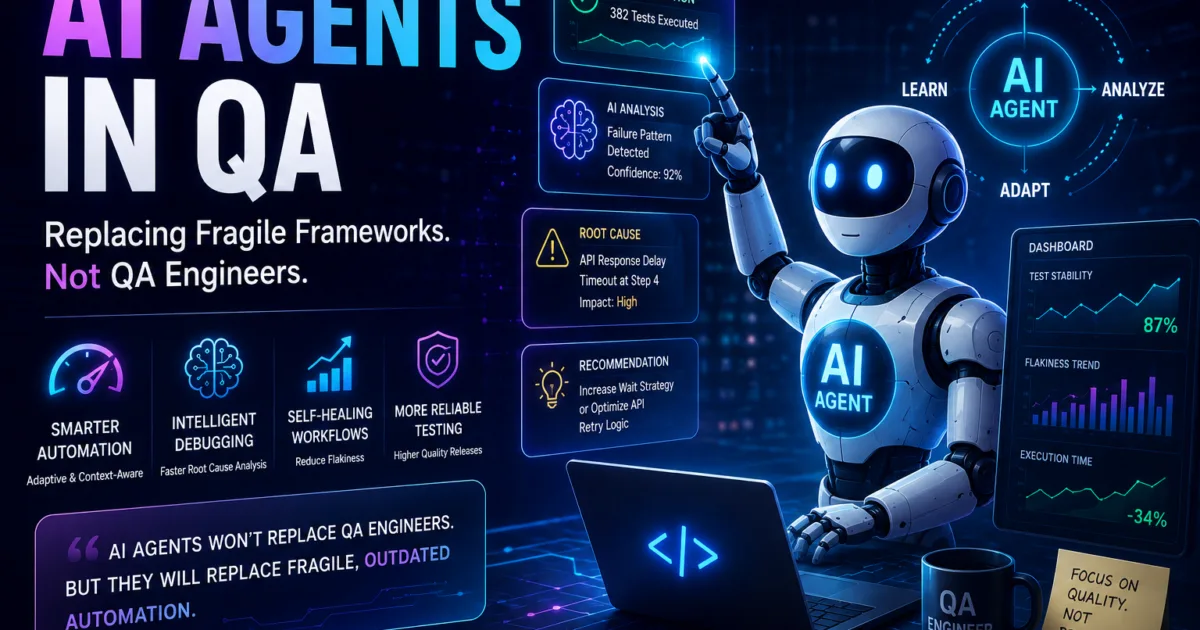
AI Agents in QA Are Changing Automation Faster Than Most Teams Realize
The conversation around AI Agents in QA is becoming increasingly chaotic.
Some people claim:
“AI will replace QA engineers.”
Others aggressively dismiss everything as:
“just another hype cycle.”
But honestly?
Both sides are missing the bigger engineering shift happening quietly underneath.
Because the first thing AI agents are likely replacing is not:
👉 QA engineers
It is:
👉 fragile automation frameworks
And that difference matters massively.
Modern QA systems are becoming:
- larger
- more distributed
- more AI-generated
- more dynamic
- more operationally complex
Traditional automation frameworks increasingly struggle under this complexity.
Not because automation itself is failing.
But because many frameworks were designed for:
a completely different software era
Traditional Automation Frameworks Were Built Around Determinism
Most traditional automation systems rely heavily on:
- fixed selectors
- predefined assertions
- rigid workflows
- static execution logic
For years, this worked extremely well.
Especially for:
- stable enterprise systems
- predictable applications
- regression-heavy environments
- controlled release cycles
A typical automation flow still looks like this:
await page.click('#login-button');
await expect(page.locator('.dashboard')).toBeVisible();
The system understands exactly:
- what to click
- what to validate
- what success means
Nothing more.
This deterministic model powered automation successfully for years.
But modern software ecosystems changed dramatically.
Why Modern Applications Are Becoming Harder to Automate
Modern applications increasingly involve:
- AI-generated UI components
- dynamic rendering
- adaptive interfaces
- real-time personalization
- async workflows
- distributed microservices
- event-driven systems
This creates enormous instability for rigid frameworks.
Because modern applications increasingly behave:
contextually
while older automation frameworks still operate:
mechanicallyThat gap keeps growing every year.
Why Fragile Test Frameworks Are Becoming Expensive
Many organizations quietly suffer from:
- flaky pipelines
- unstable locators
- debugging fatigue
- massive maintenance overhead
- unreliable regression suites
The problem is often not:
👉 test quantity
The problem is:
👉 operational fragility
Some automation ecosystems become so difficult to maintain that engineers spend:
more time fixing automation than validating products
At that point:
the framework itself becomes operational debt.
This is exactly where AI agents start becoming valuable.
What AI Agents in QA Actually Mean
Many engineers imagine AI agents as:
“ChatGPT writing test cases.”
That is an extremely limited interpretation.
Modern AI Agents in QA increasingly involve:
- autonomous orchestration
- intelligent debugging
- semantic reasoning
- adaptive execution
- contextual understanding
- workflow planning
- telemetry analysis
- dynamic decision-making
AI agents are increasingly designed to:
- understand context
- interpret failures
- adapt workflows
- retrieve historical incidents
- recommend actions
- optimize execution paths
This creates dramatically more intelligent QA ecosystems.
Why AI Agents Are Better at Handling Dynamic Systems
Traditional frameworks operate mainly on:
hardcoded assumptions
AI agents increasingly operate on:
contextual reasoning
That difference becomes extremely important in:
- dynamic UIs
- AI-generated applications
- rapidly changing frontend systems
- personalized user experiences
For example:
a traditional framework may fail because:
button selector changed
An AI-driven agent may still understand:
- the workflow intent
- the semantic meaning
- the page structure
- the business objective
That creates far more adaptive execution behavior.
Example of Traditional Framework Failure
Typical fragile automation failure:
Error: Locator not found
Engineers then manually inspect:
- screenshots
- traces
- logs
- DOM changes
- deployment differences
This creates massive debugging overhead.
Example of AI-Agent-Assisted Interpretation
An AI agent may increasingly generate reasoning like:
The checkout button appears relocated after responsive layout adjustments introduced in the latest deployment. Similar UI shifts affected mobile workflows in previous releases.
That dramatically changes debugging efficiency.
Instead of:
👉 raw failure data
engineers increasingly receive:
👉 contextual operational intelligence
Why Observability Is the Real Foundation of AI Agents in QA
This is one of the most misunderstood truths in modern automation engineering.
Most people think AI success depends mainly on:
- larger models
- better prompts
- smarter agents
But honestly?
AI agents fail primarily when:
they lack high-quality runtime visibility
Without:
- traces
- telemetry
- logs
- screenshots
- execution graphs
- distributed diagnostics
AI reasoning becomes weak.
That is why modern AI-agent ecosystems increasingly depend heavily on:
👉 observability-first architecture
because intelligent systems require:
👉 rich contextual execution signals
Example AI-Agent Workflow in QA
A modern AI-agent workflow may look like this:
Step 1 — Automation Executes
Using:
- Playwright
- Selenium
- API testing
- CI/CD orchestration
Step 2 — Failure Artifacts Collected
The system gathers:
- screenshots
- logs
- videos
- traces
- telemetry
Step 3 — AI Agent Analyzes Context
The agent:
- classifies failures
- identifies flaky patterns
- retrieves historical incidents
- summarizes probable causes
Step 4 — Intelligent Recommendations Generated
Instead of:
Timeout exceeded
engineers receive:
This failure resembles previous async rendering delays caused by API latency spikes after deployment rollouts.
This dramatically improves investigation speed.
Example AI-Agent Integration Using LangChain
Below is a simplified conceptual example.
import { ChatOpenAI } from '@langchain/openai';

const model = new ChatOpenAI({
  modelName: 'gpt-4.1',
  temperature: 0
});

async function analyzeFailure(logs) {
  const prompt = `
  Analyze this Playwright test failure.

  Logs:
  ${logs}

  Return:
  1. Root cause
  2. Failure category
  3. Suggested fix
  `;

  const response = await model.invoke(prompt);

  return response.content;
}
This transforms debugging workflows into:
AI-assisted operational reasoning
instead of manual investigation loops.
Why AI Agents Will Replace Fragile Layers First
This is critical to understand.
AI agents are most likely to replace:
- brittle orchestration layers
- unstable debugging workflows
- repetitive investigation systems
- flaky maintenance processes
before replacing:
👉 experienced QA engineers
Because experienced engineers still provide:
- strategic thinking
- risk analysis
- architectural judgment
- business understanding
- systems reasoning
AI agents currently excel more at:
- acceleration
- orchestration
- summarization
- contextual analysis
- workflow assistance
not:
👉 full engineering ownership
Why Smart QA Engineers Are Becoming Automation Architects
The role of QA engineers is evolving rapidly.
Older QA roles focused heavily on:
- writing scripts
- executing tests
- validating UI flows
Modern QA increasingly requires understanding:
- telemetry
- observability
- orchestration
- AI workflows
- distributed systems
- infrastructure reliability
The strongest engineers increasingly think like:
automation systems architects
not:
test script maintainers
That shift is enormous.
AI Agents in QA Will Create Smaller but Smarter Teams
This trend is already starting quietly.
Modern intelligent QA systems increasingly allow:
- fewer repetitive tasks
- faster debugging
- smarter execution prioritization
- better operational visibility
This does not necessarily eliminate QA.
Instead it changes:
- team structure
- engineering responsibilities
- workflow expectations
Smaller teams with:
- stronger systems thinking
- AI orchestration knowledge
- observability expertise
- debugging intelligence
may outperform much larger traditional automation teams.
Why Hybrid Systems Will Dominate the Future
The future of QA is unlikely to become:
fully autonomous AI replacing everyone
More realistically:
modern QA ecosystems increasingly combine:
- deterministic automation
- intelligent orchestration
- AI-assisted debugging
- telemetry systems
- adaptive workflows
- contextual reasoning
This creates:
hybrid intelligent automation systems
which balance:
- reliability
- adaptability
- scalability
- operational intelligence
Why AI Agents in QA Are Really About Reducing Operational Complexity
The modern AI Agents in QA movement is not simply about replacing engineers with AI. In 2026, intelligent automation systems increasingly focus on reducing operational fragility, debugging overhead, flaky maintenance costs, and execution complexity across distributed software ecosystems. AI agents increasingly enhance observability, contextual reasoning, semantic understanding, intelligent orchestration, and failure analysis, while experienced QA engineers continue driving architectural strategy, systems thinking, risk analysis, and quality engineering leadership.
AI agents in QA managing intelligent automation workflows with observability dashboards and adaptive testing systems
More Relevant Articles
- Learn MCP – Zero to Hero
- Learn AI Agents for QA – Zero to Hero
- Playwright Automation – Zero to Hero
- TencentDB Agent Memory: Complete Zero to Hero
- LangGraph: Complete Zero to Hero
- Learn Python – Zero to Hero
- OpenAI Codex: Complete Zero to Hero
- Cursor AI: Complete Zero to Hero
- Claude Code Tutorial: Complete Zero to Hero
- AutoGen: Complete Zero to Hero Guide
- Free QA Resources Built From Real Experience
- QA Glossary: Test Automation Terms Every Engineer Should Know
External Resources
Final Thoughts
The future of QA is not:
humans versus AI
The future is:
humans building intelligent engineering ecosystems
Because modern software complexity is growing faster than manual operational workflows can handle.
And that is exactly why AI agents are becoming transformational across modern QA engineering.
AI agents will not eliminate strong QA engineers.
But they will increasingly eliminate fragile workflows, repetitive debugging, and operational inefficiency.
And that shift is already happening quietly across the industry.