 QA
QA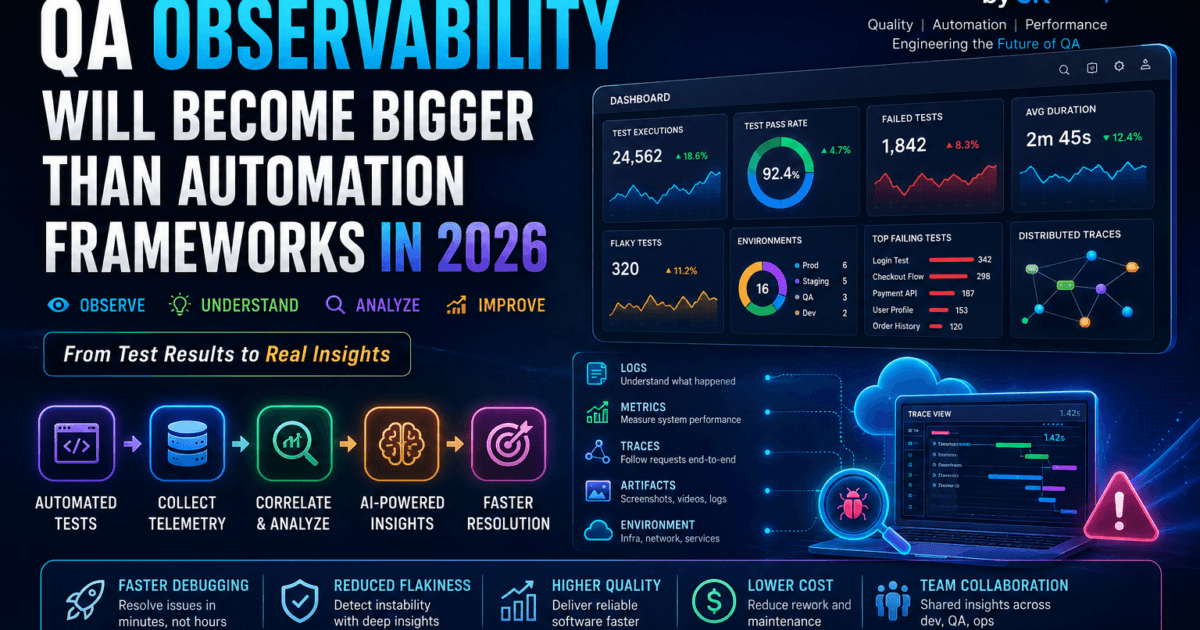
Something Massive is Quietly Changing in Modern QA
For years, the software testing industry obsessed over:
- Selenium vs Playwright
- Cypress vs Selenium
- Java vs TypeScript
- automation frameworks
- execution speed
But something much bigger is now happening quietly inside engineering organizations.
Modern QA teams are discovering that:
automation alone does not solve testing complexity anymore
Because the real challenge in 2026 is no longer:
👉 writing tests
It is increasingly:
👉 understanding why systems fail
And that shift is creating one of the most important trends in modern engineering:
QA Observability
What is QA Observability?
Short Answer
QA Observability is the practice of collecting, analyzing, correlating, and visualizing testing telemetry, execution traces, runtime diagnostics, logs, metrics, and failure intelligence to understand:
- why tests fail
- where systems break
- how applications behave during execution
In Simple Words
Traditional automation tells you:
A test failed
QA Observability tells you:
WHY the test failed, WHERE it failed, WHAT changed, and HOW the system behaved during failure
That difference is enormous.
Why Automation Frameworks Alone Are No Longer Enough
Most automation frameworks focus heavily on:
- execution
- assertions
- reporting
- browser control
But modern software systems became:
- distributed
- asynchronous
- cloud-native
- event-driven
- AI-assisted
- microservice-heavy
This dramatically increases system complexity.
Modern Systems Generate Massive Runtime Signals
| Runtime Signal | Example |
|---|---|
| Logs | API errors |
| Metrics | CPU spikes |
| Traces | Distributed execution paths |
| Screenshots | UI state |
| Videos | Failure replay |
| Network events | API latency |
| Telemetry | Runtime behavior |
Traditional automation reports cannot fully explain these ecosystems anymore.
Why Flaky Tests Are Really Observability Problems
Most teams still treat flaky tests as:
👉 automation issues
But increasingly:
flaky tests are observability failures
because teams cannot properly observe:
- execution behavior
- timing instability
- distributed delays
- infrastructure bottlenecks
- asynchronous rendering
Common Flaky Test Causes
| Cause | Observability Need |
|---|---|
| Slow APIs | Network telemetry |
| Timing instability | Distributed tracing |
| Async rendering | Runtime diagnostics |
| Environment inconsistency | Infrastructure metrics |
| Parallel execution conflicts | Execution correlation |
Without observability:
teams simply retry tests blindly.
Traditional Automation vs QA Observability
Core Comparison Table
| Area | Traditional Automation | QA Observability |
|---|---|---|
| Main Goal | Execute tests | Understand failures |
| Focus | Pass/fail | Runtime intelligence |
| Visibility | Limited | Deep telemetry |
| Debugging | Manual investigation | Correlated diagnostics |
| Scaling | Framework scaling | System visibility |
| Root Cause Analysis | Slower | Faster |
| Distributed Systems Support | Limited | Strong |
| AI Integration | Minimal | Strong future potential |
Why Distributed Systems Changed Everything
Older applications were simpler:
- monoliths
- synchronous workflows
- predictable rendering
Modern systems increasingly involve:
- microservices
- distributed APIs
- asynchronous events
- edge computing
- serverless infrastructure
This creates:
massive debugging complexity
And automation frameworks alone cannot solve that.
Modern QA Teams Need Runtime Intelligence
Modern testing increasingly requires:
- telemetry pipelines
- distributed traces
- execution correlation
- runtime diagnostics
- infrastructure visibility
This is exactly why QA Observability is exploding in importance.
What QA Observability Actually Collects
Observability Components
| Component | Purpose |
|---|---|
| Logs | Runtime debugging |
| Metrics | Performance visibility |
| Traces | Distributed workflow tracking |
| Screenshots | UI validation |
| Videos | Failure replay |
| Network telemetry | API diagnostics |
| Execution metadata | Pipeline intelligence |
What is Distributed Tracing?
Distributed tracing tracks:
how requests move across systems
This is critical in:
- microservices
- cloud systems
- distributed APIs
- modern frontend architectures
Example Distributed Workflow
Frontend
↓
API Gateway
↓
Authentication Service
↓
Payment Service
↓
Notification Service
Without tracing:
debugging becomes extremely difficult.
OpenTelemetry Is Becoming Extremely Important
One of the biggest industry shifts is adoption of:
OpenTelemetry
Why OpenTelemetry Matters
OpenTelemetry helps organizations collect:
- traces
- logs
- metrics
- runtime telemetry
using standardized observability pipelines.
OpenTelemetry Benefits
| Benefit | Why It Matters |
|---|---|
| Standardized telemetry | Easier scaling |
| Distributed tracing | Better debugging |
| Vendor-neutral design | Flexible ecosystems |
| Cloud-native compatibility | Modern infrastructure support |
| AI analytics support | Future-ready systems |
Example OpenTelemetry Integration
const tracer = opentelemetry.trace.getTracer('qa-tests');

const span = tracer.startSpan('checkout-flow');

await page.goto('https://example.com');

span.end();
This creates execution intelligence instead of simple logs.
Why CI/CD Pipelines Need Observability
Modern CI/CD systems now execute:
- thousands of tests
- across containers
- across regions
- across browsers
- across distributed environments
Without observability:
pipelines become:
extremely difficult to debugCI/CD Challenges Without Observability
| Problem | Impact |
|---|---|
| Random failures | Slower releases |
| Pipeline instability | Lower confidence |
| Weak diagnostics | Longer debugging |
| Hidden bottlenecks | Delayed delivery |
| Infrastructure blind spots | Operational chaos |
QA Observability vs Test Reporting
Many teams confuse observability with reporting.
They are NOT the same.
Key Difference Table
| Area | Test Reporting | QA Observability |
|---|---|---|
| Focus | Results | Runtime behavior |
| Information Depth | Basic | Deep |
| Failure Analysis | Limited | Advanced |
| System Correlation | Weak | Strong |
| Distributed Insights | Minimal | Excellent |
| AI Analytics Potential | Low | High |
Why AI Will Accelerate QA Observability
AI systems require:
- structured telemetry
- historical patterns
- execution traces
- behavioral data
- runtime context
This strongly favors observability-driven testing systems.
Traditional Failure Example
Timeout exceededAI-Assisted Observability Example
Checkout instability occurred after delayed payment API responses caused asynchronous rendering failures similar to previous deployment regressions.
That is dramatically more useful.
Why Modern QA Engineers Must Learn Observability
Modern QA increasingly overlaps with:
- platform engineering
- cloud systems
- telemetry pipelines
- distributed systems
- AI diagnostics
This is changing the entire QA role.
Skills Modern QA Engineers Increasingly Need
| Skill | Why It Matters |
|---|---|
| OpenTelemetry | Runtime visibility |
| Grafana | Metrics dashboards |
| Prometheus | Infrastructure monitoring |
| Kubernetes | Distributed execution |
| CI/CD | Pipeline observability |
| Cloud systems | Scalability |
The Hidden Cost of Weak Observability
Organizations underestimate how expensive weak observability becomes.
Weak Observability Causes
| Issue | Business Impact |
|---|---|
| Slow debugging | Delayed releases |
| Flaky pipelines | Reduced confidence |
| Blind infrastructure failures | Production risk |
| Weak telemetry | Poor root-cause analysis |
| Manual investigations | Engineering inefficiency |
Eventually:
poor visibility becomes:
👉 a delivery bottleneck
Why Modern QA Is Becoming Telemetry-Driven
Modern engineering ecosystems increasingly operate on:
runtime intelligence
instead of:
simple pass/fail execution
This is one of the biggest engineering transformations happening right now.
Example Modern QA Observability Stack
Observability Architecture
| Layer | Technology |
|---|---|
| Automation | Playwright |
| CI/CD | GitHub Actions |
| Tracing | OpenTelemetry |
| Metrics | Prometheus |
| Dashboards | Grafana |
| Logs | Elasticsearch |
| AI Analytics | LLM-based diagnostics |
This creates:
intelligent testing ecosystems
instead of isolated test execution.
Why Playwright Accelerated Observability Trends
Playwright became popular partly because it improved:
- tracing
- debugging
- screenshots
- videos
- network inspection
This aligned well with modern observability-driven engineering.
Playwright Observability Features
| Feature | Benefit |
|---|---|
| Trace Viewer | Visual replay |
| Screenshots | Failure visibility |
| Videos | Runtime inspection |
| Console logs | JS debugging |
| Network tracing | API diagnostics |
Example Trace Configuration
use: {
  trace: 'on',
  screenshot: 'only-on-failure',
  video: 'retain-on-failure'
}
This dramatically improves failure analysis.
Why Enterprise QA Teams Are Investing in Observability
Large organizations increasingly realize:
you cannot scale what you cannot observe
This applies directly to:
- CI/CD pipelines
- distributed execution
- cloud testing
- automation infrastructure
Enterprise QA Priorities in 2026
| Priority | Importance |
|---|---|
| Pipeline visibility | Critical |
| Distributed tracing | Critical |
| Telemetry analytics | Growing rapidly |
| AI-assisted debugging | Emerging |
| Runtime diagnostics | Essential |
Observability Is Quietly Becoming a Competitive Advantage
Teams with strong observability achieve:
- faster releases
- faster debugging
- higher pipeline confidence
- lower operational cost
- better delivery stability
Teams without observability increasingly struggle with:
- flaky systems
- release delays
- debugging chaos
- operational blind spots
QA Observability and AI-Native Engineering
The future of QA increasingly involves:
- AI-assisted debugging
- semantic failure analysis
- execution intelligence
- anomaly detection
- predictive analytics
None of this works effectively without:
👉 observability data
This is why observability will become foundational.
Beginner FAQ — QA Observability
What Is QA Observability?
QA Observability is the practice of collecting runtime telemetry, logs, traces, metrics, and execution diagnostics to understand testing behavior and failure root causes in modern software systems.
Why Is QA Observability Important?
Because modern applications are:
- distributed
- asynchronous
- cloud-native
- highly dynamic
Traditional automation reporting is often insufficient for debugging these systems.
Is QA Observability Different From Monitoring?
Yes.
Monitoring tells you:
something failed
Observability helps explain:
why it failedWhich Tools Are Used for QA Observability?
Common technologies include:
- OpenTelemetry
- Grafana
- Prometheus
- Elasticsearch
- Playwright Trace Viewer
Will QA Observability Replace Automation Frameworks?
No.
Automation frameworks still matter.
But observability is becoming equally important because execution alone is no longer sufficient in complex distributed systems.
QA Observability Is Really About Understanding Systems
The modern QA Observability movement is no longer simply about improving debugging. In 2026, QA Observability increasingly represents the shift toward telemetry-driven engineering ecosystems where distributed tracing, runtime diagnostics, execution intelligence, AI-assisted failure analysis, infrastructure visibility, and operational awareness become foundational parts of scalable software quality engineering.
More Related Blogs
- Learn MCP – Zero to Hero
- Learn AI Agents for QA – Zero to Hero
- Playwright Automation – Zero to Hero
- TencentDB Agent Memory: Complete Zero to Hero
- LangGraph: Complete Zero to Hero
- Learn Python – Zero to Hero
- OpenAI Codex: Complete Zero to Hero
- Cursor AI: Complete Zero to Hero
- Claude Code Tutorial: Complete Zero to Hero
- AutoGen: Complete Zero to Hero Guide
- Free QA Resources Built From Real Experience
- QA Glossary: Test Automation Terms Every Engineer Should Know
External Resources
Final Thoughts
Modern QA engineering is evolving far beyond:
script execution
The future increasingly belongs to teams that understand:
- telemetry
- tracing
- observability
- runtime intelligence
- AI-assisted diagnostics
- distributed systems behavior
Because eventually:
every large automation ecosystem becomes:
👉 an observability problem
not merely:
👉 a framework problem.
The future of QA will not belong only to teams that automate tests.
It will belong to teams that truly understand system behavior at runtime.