 QA
QA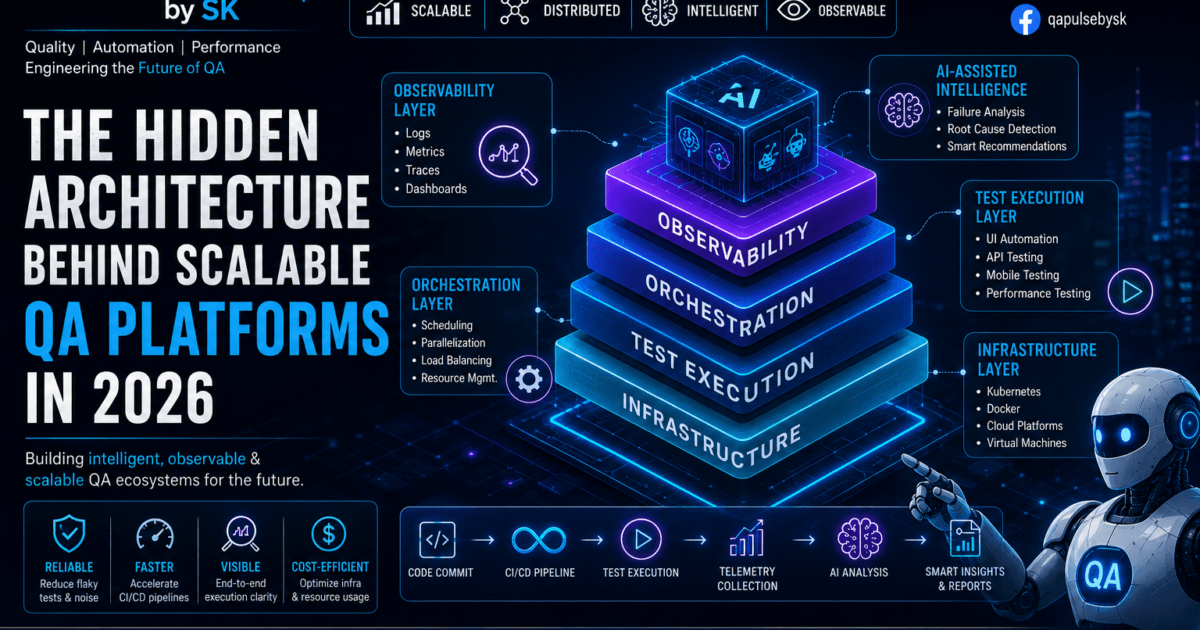
QA Platform Architecture is Quietly Becoming the Most Important Skill in Modern Testing
Most QA engineers still think automation success depends mainly on:
- better frameworks
- faster execution
- more tests
- stronger assertions
But modern engineering teams are discovering something very different.
The biggest testing bottleneck in 2026 is no longer:
writing automation scripts
It is:
building scalable QA platform architecture
And honestly?
This shift is changing the entire software testing industry.
Modern QA systems are no longer small isolated automation projects.
They increasingly behave like:
- distributed engineering platforms
- telemetry ecosystems
- orchestration systems
- observability pipelines
- intelligent execution networks
That means modern testing increasingly requires:
👉 systems thinking
not simply:
👉 test-writing skills
What Is QA Platform Architecture?
Short Answer
QA Platform Architecture refers to the design of scalable testing infrastructure, execution systems, observability pipelines, automation orchestration, telemetry collection, and intelligent debugging workflows used across modern software engineering ecosystems.
In Simpler Words
Older automation looked like this:
Run tests → Generate report → Done
Modern QA platforms increasingly involve:
- distributed execution
- cloud infrastructure
- AI-assisted debugging
- telemetry systems
- flaky-test analytics
- intelligent retries
- orchestration layers
- execution visibility
That is a completely different engineering challenge.
Why Traditional Automation Frameworks Start Failing at Scale
Most automation frameworks work well:
- initially
- in small teams
- on stable systems
But problems appear rapidly when organizations scale.
Common Scaling Problems
| Problem | What Happens |
|---|---|
| Flaky tests | Pipelines become unreliable |
| Slow execution | CI/CD delays increase |
| Weak debugging | Failures become hard to investigate |
| No observability | Engineers lack execution visibility |
| Parallelization issues | Infrastructure becomes unstable |
| Environment inconsistency | Tests fail randomly |
| Massive logs | Root-cause analysis becomes painful |
The problem is usually not:
👉 Selenium
👉 Playwright
👉 Cypress
The real problem is:
weak QA platform architectureThe Hidden Evolution of Modern QA Teams
Modern QA engineering quietly evolved through multiple phases.
Phase 1 — Manual Testing Era
Focus:
- exploratory testing
- human validation
- manual regression
Phase 2 — Automation Framework Era
Focus:
- Selenium
- test scripts
- CI/CD execution
- regression automation
Phase 3 — Distributed QA Systems
Focus:
- cloud execution
- parallel pipelines
- orchestration
- observability
- telemetry
Phase 4 — AI-Native QA Platforms
Focus:
- intelligent debugging
- AI agents
- execution analytics
- adaptive automation
- operational intelligence
This is where the industry is moving rapidly now.
Why QA Platform Architecture Matters More Than Framework Choice
A lot of engineers still obsess over:
- Selenium vs Playwright
- Cypress vs Playwright
- Java vs TypeScript
- framework popularity
But high-performing engineering teams increasingly focus on:
execution systems architecture
instead.
Because eventually:
every automation framework struggles without:
- observability
- orchestration
- telemetry
- debugging systems
- scalable infrastructure
This is why some organizations succeed with Selenium at massive scale while others fail badly with newer frameworks.
The difference is usually:
👉 platform engineering maturity.
Core Components of Modern QA Platform Architecture
Modern scalable QA ecosystems increasingly include multiple architectural layers.
1. Test Execution Layer
This layer handles:
- browser execution
- API execution
- mobile testing
- distributed runtime orchestration
Common Technologies
| Category | Examples |
|---|---|
| Web automation | Playwright, Selenium |
| API testing | Postman, REST Assured |
| Mobile testing | Appium |
| Performance testing | K6, JMeter |
Example Playwright Execution
test('login test', async ({ page }) => {
  await page.goto('https://example.com');
  await page.fill('#email', 'admin@test.com');
  await page.fill('#password', 'password');
  await page.click('#login');
});
At small scale:
this is manageable.
At enterprise scale:
thousands of these execute simultaneously.
That changes everything.
2. Orchestration Layer in QA Platform Architecture
This layer coordinates:
- execution scheduling
- distributed workers
- retries
- environment allocation
- resource balancing
Why Orchestration Matters
Without orchestration:
- pipelines become chaotic
- retries become uncontrolled
- infrastructure costs increase
- debugging becomes fragmented
Modern Orchestration Tools
| Tool | Purpose |
|---|---|
| Kubernetes | Container orchestration |
| Jenkins | CI/CD pipelines |
| GitHub Actions | Workflow automation |
| Argo Workflows | Distributed execution |
| Docker | Environment consistency |
Example Kubernetes Test Runner
apiVersion: batch/v1
kind: Job
metadata:
  name: playwright-tests
spec:
  template:
    spec:
      containers:
      - name: tests
        image: playwright:latest
        command: ["npm", "run", "test"]
      restartPolicy: Never
This is where QA increasingly overlaps with:
👉 platform engineering
3. Observability Layer in QA Platform Architecture
This is one of the most important modern shifts.
Most older automation systems focused heavily on:
- pass/fail reports
Modern QA systems increasingly require:
- distributed traces
- execution telemetry
- runtime diagnostics
- flaky analytics
- debugging intelligence
What is QA Observability?
QA observability means:
understanding WHY tests fail
not simply:
knowing THAT they failed
That difference is massive.
Modern QA Observability Components
| Component | Purpose |
|---|---|
| Logs | Runtime debugging |
| Metrics | Execution performance |
| Traces | Distributed workflow visibility |
| Screenshots | UI state inspection |
| Videos | Failure replay |
| Telemetry | Behavioral analytics |
Example OpenTelemetry Integration
const tracer = opentelemetry.trace.getTracer('qa-tests');

const span = tracer.startSpan('login-flow');

await page.goto('https://example.com');

span.end();
This creates:
execution intelligence
instead of simple reporting.
4. Data Layer in QA Platform Architecture
Large-scale QA systems generate enormous data volumes:
- logs
- screenshots
- traces
- metrics
- execution artifacts
Without proper data architecture:
systems become impossible to maintain.
Modern QA Data Systems
| System | Purpose |
|---|---|
| Elasticsearch | Log search |
| Grafana | Visualization |
| Prometheus | Metrics |
| S3 Storage | Artifact storage |
| Vector DBs | Semantic retrieval |
This becomes especially important for:
👉 AI-assisted debugging systems
Why AI Changes QA Platform Architecture Completely
AI systems increasingly require:
- runtime context
- historical failures
- telemetry pipelines
- semantic retrieval
- distributed diagnostics
This creates entirely new architectural requirements.
Older automation ecosystems were designed around:
deterministic execution
Modern AI-native QA systems increasingly depend on:
contextual operational intelligenceExample AI-Assisted Failure Analysis
Traditional automation failure:
Timeout exceeded
AI-assisted analysis:
The checkout workflow failed after delayed API responses introduced asynchronous rendering instability similar to previous deployment regressions.
That dramatically improves debugging efficiency.
Why Flaky Tests Are Really Architecture Problems
Most teams treat flaky tests as:
👉 automation issues
But many flaky systems are actually:
👉 architecture failures
Root Causes of Flakiness
| Cause | Architectural Problem |
|---|---|
| Timing issues | Weak orchestration |
| Random failures | Environment instability |
| Slow APIs | Infrastructure bottlenecks |
| Async rendering | Weak synchronization |
| Resource contention | Poor scaling design |
This is why retry-heavy systems often become dangerous.
Retries hide:
underlying architectural instability
instead of fixing it.
Modern QA Platform Architecture for CI/CD
Modern CI/CD ecosystems increasingly prioritize:
- execution speed
- scalability
- deterministic deployment
- debugging visibility
- intelligent orchestration
Modern QA Pipeline Flow
Code Commit
↓
Build Pipeline
↓
Distributed Test Execution
↓
Telemetry Collection
↓
AI Failure Analysis
↓
Observability Dashboard
↓
Release Decision
This is dramatically more advanced than older:
run-and-report automation modelsWhy Distributed Testing Changes Everything
Small QA systems execute:
- locally
- sequentially
- predictably
Enterprise systems increasingly execute:
- globally
- in parallel
- across containers
- across cloud infrastructure
This creates:
- synchronization complexity
- telemetry scaling problems
- orchestration challenges
- debugging fragmentation
Example Distributed Playwright Execution
projects: [
  { name: 'chromium' },
  { name: 'firefox' },
  { name: 'webkit' }
]
Now imagine:
- thousands of executions
- dozens of pipelines
- multiple regions
- distributed environments
That requires:
👉 platform architecture thinking
Why QA Engineers Must Learn Infrastructure
Modern QA increasingly overlaps with:
- DevOps
- cloud systems
- platform engineering
- observability
- distributed systems
This is one of the biggest industry shifts happening quietly right now.
Skills Modern QA Engineers Increasingly Need
| Skill | Why It Matters |
|---|---|
| Docker | Environment consistency |
| Kubernetes | Distributed execution |
| OpenTelemetry | Observability |
| CI/CD | Automation orchestration |
| Cloud systems | Scalability |
| AI workflows | Intelligent debugging |
The future QA engineer increasingly behaves like:
an automation systems architect
not:
a script executorWhat Smart QA Teams Are Quietly Building
High-performing organizations increasingly invest heavily in:
- telemetry-first QA systems
- intelligent debugging
- execution analytics
- flaky detection systems
- distributed orchestration
- AI-assisted failure analysis
Because modern software ecosystems are becoming:
- more dynamic
- more distributed
- more AI-generated
- more operationally complex
Example Scalable QA Platform Architecture
Modern Architecture Stack
| Layer | Responsibility |
|---|---|
| UI Automation | Playwright/Selenium |
| API Testing | REST validation |
| Execution Layer | Kubernetes |
| CI/CD | GitHub Actions |
| Observability | OpenTelemetry |
| Metrics | Prometheus |
| Dashboards | Grafana |
| AI Layer | LangChain/LLMs |
This creates:
a scalable intelligent QA ecosystem
instead of:
isolated automation scriptsWhy QA Platform Architecture Becomes a Competitive Advantage
Organizations with mature QA architecture increasingly achieve:
- faster releases
- better debugging
- lower operational cost
- more stable pipelines
- stronger developer confidence
Meanwhile weak QA architecture creates:
- flaky systems
- slow releases
- debugging chaos
- CI/CD instability
- engineering frustration
At enterprise scale:
QA architecture directly impacts:
👉 delivery speed
which impacts:
👉 business competitiveness
Beginner FAQ — QA Platform Architecture
What Is QA Platform Architecture?
QA Platform Architecture is the design of scalable automation infrastructure, execution systems, telemetry pipelines, observability layers, and orchestration workflows used to support modern software testing ecosystems.
Why Is QA Platform Architecture Important?
Because modern testing increasingly involves:
- distributed execution
- cloud systems
- observability
- AI-assisted debugging
- scalable CI/CD pipelines
Without strong architecture:
automation systems become unstable at scale.
How Is Modern QA Different From Traditional Automation?
Traditional automation focused mainly on:
- scripts
- assertions
- execution
Modern QA increasingly focuses on:
- systems engineering
- observability
- orchestration
- telemetry
- intelligent debugging
Which Tools Are Common in QA Platform Architecture?
Common technologies include:
- Playwright
- Selenium
- Kubernetes
- Docker
- OpenTelemetry
- Grafana
- Prometheus
- LangChain
QA Platform Architecture Is Really About Systems Thinking
The modern QA Platform Architecture movement is not simply about scaling test execution. In 2026, scalable QA systems increasingly combine distributed orchestration, observability pipelines, telemetry analytics, AI-assisted debugging, intelligent execution systems, cloud-native infrastructure, and operational engineering practices to build resilient, maintainable, and scalable quality engineering ecosystems across modern software platforms.
More Relevant Articles
- How I Reduced Flaky Tests by 40% Using Self-Healing Locators + AI
- The Architecture Mistake 90% of Playwright Projects Make And How the Top 1% Quietly Avoid it
External Resources
Recommended Video Section
Suggested embedded videos:
- Kubernetes for QA engineers
- OpenTelemetry explained
- Playwright scaling tutorials
- CI/CD orchestration architecture
- AI-assisted debugging systems
Final Thoughts
The future of QA is no longer about:
who writes the most test scripts
The future increasingly belongs to teams that understand:
- orchestration
- observability
- telemetry
- distributed systems
- intelligent debugging
- scalable engineering architecture
Because eventually:
every large automation ecosystem becomes:
👉 a platform engineering problem
And the QA engineers who understand that shift early will become incredibly valuable in the AI-native software era
Modern QA success is no longer defined by test count alone.
It is increasingly defined by the intelligence, scalability, and observability of the platform underneath the tests.