 QA
QA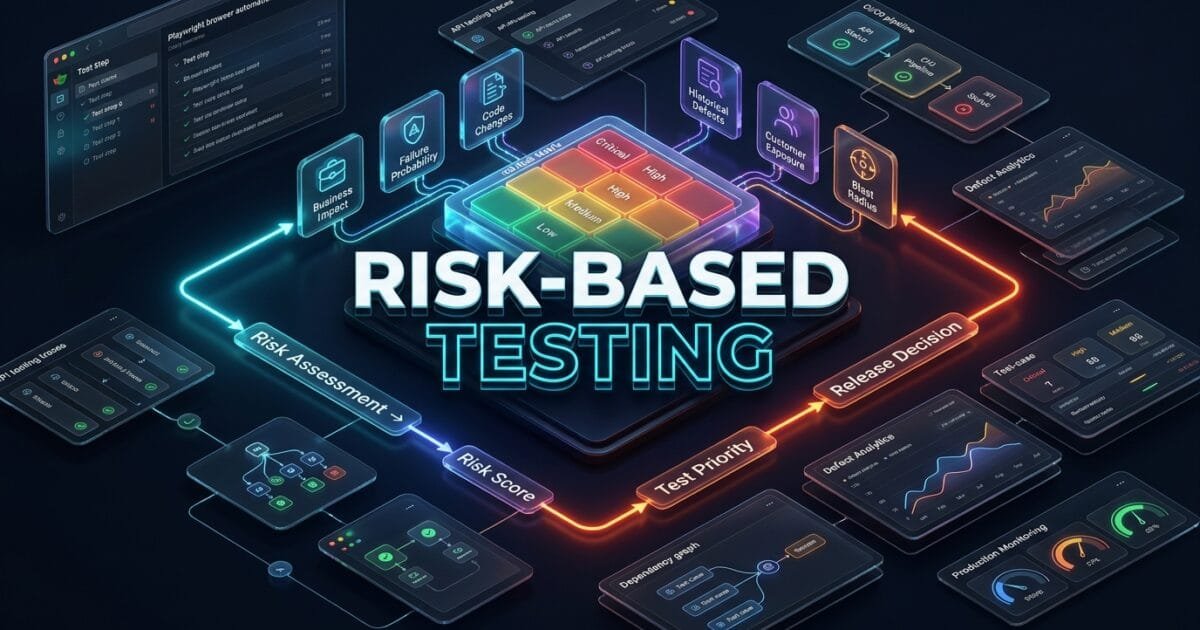
Risk-Based Testing is not about testing everything equally. It is about identifying where a product can fail most seriously, estimating the likelihood and impact of those failures, and directing testing effort toward the areas that matter most.
Experienced QA engineers rarely begin a regression cycle by simply opening the test-case list and executing cases from top to bottom. They first ask: What changed? What can break? Which failures would hurt customers or the business? Which areas have historically been unstable? What must be tested before we can confidently release?
That thinking turns testing from a checklist exercise into a risk-management discipline.
What is Risk-Based Testing?
Risk-based testing is a testing approach that prioritizes test activities according to the probability and business impact of potential failures.
Instead of assigning the same testing effort to every feature, QA engineers evaluate risk across several dimensions:
- Business criticality
- Probability of failure
- Technical complexity
- Change scope
- Customer usage
- Historical defect frequency
- Integration dependencies
- Security exposure
- Regulatory or compliance requirements
- Recovery difficulty
- Production blast radius
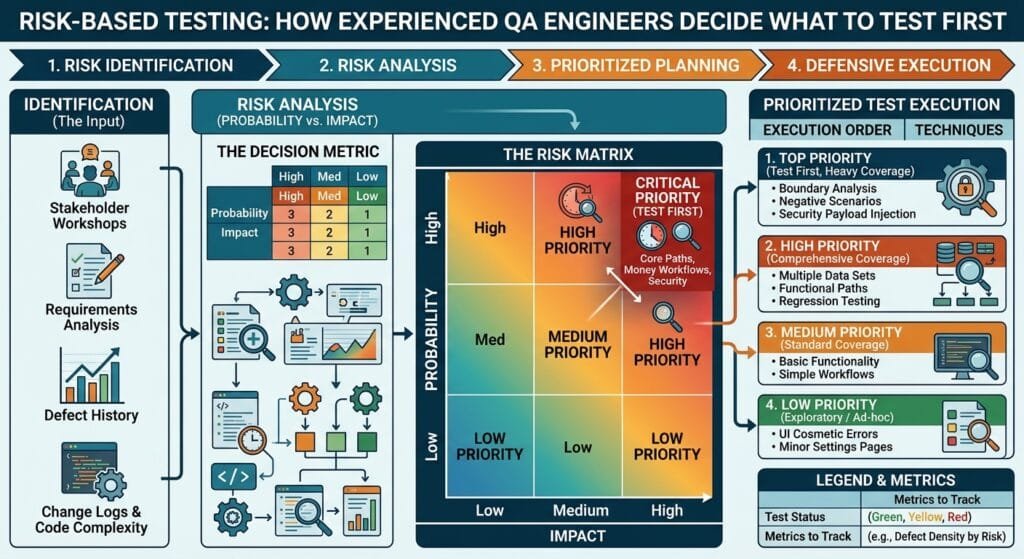
A simple risk model can be expressed as:
Risk Score = Probability × Impact
For example, imagine an e-commerce application with these features:
| Feature | Probability | Impact | Risk Score |
|---|---|---|---|
| Login | 3 | 5 | 15 |
| Product search | 2 | 3 | 6 |
| Checkout | 4 | 5 | 20 |
| User profile theme | 2 | 1 | 2 |
| Payment processing | 4 | 5 | 20 |
The payment and checkout workflows immediately become higher-priority testing targets.
This does not mean the profile theme should never be tested. It means testing depth and execution order should reflect risk.
An experienced QA engineer therefore does not ask only:
“What test cases do we have?”
The better question is:
“Where would failure hurt us the most?”
Why Experienced QA Engineers Test Differently
Two testers can receive exactly the same build and make completely different testing decisions.
A junior tester may start with the first test case in the regression spreadsheet.
An experienced QA engineer starts by understanding the system.
They look at:
- What changed in this release?
- Which services are affected?
- Which customer journeys depend on those services?
- Which components have changed the most?
- Which areas have produced production incidents?
- Which APIs or integrations are critical?
- Which features generate revenue?
- Which workflows contain irreversible operations?
- Which failures would block other testing?
- Which areas are difficult to recover after failure?
This is the difference between test execution and test strategy.
Risk-based testing requires testers to continuously build a mental model of the product.
For example, suppose a release changes the authentication service.
A simplistic regression approach might execute:
Login → Search → Profile → Settings → Checkout → Logout
A risk-driven approach asks:
Authentication service changed.
What depends on authentication?
Login, session management, authorization, account APIs, checkout identity, profile access, password reset, token refresh and potentially every protected API.
The testing strategy changes immediately.
Risk is Not the Same as Complexity
A technically complex feature is not automatically the highest-risk feature.
Consider two components.
Component A contains 50,000 lines of complicated backend code but is used internally by three administrators.
Component B contains 5,000 lines of relatively simple payment code used by thousands of customers.
Component A may have greater technical complexity.
Component B may have greater business risk.
Risk-based testing therefore considers the consequences of failure, not just the difficulty of understanding the implementation.
Risk Changes Over Time
Risk is dynamic.
A feature that was low-risk last month can become high-risk after a major architecture change.
For example:
Before release:
Search → stable → low risk
After release:
Search engine migration → new indexing pipeline → new caching layer → new ranking algorithm
The risk profile changes.
Experienced QA engineers continuously reassess risk rather than creating a risk matrix once and forgetting it.
The 7 Core Pillars of Risk-Based Testing
Risk-based testing becomes much more practical when risk is evaluated through multiple dimensions instead of a single probability-impact score.
1. Business Impact
Ask what happens if the feature fails.
A failure in a cosmetic preference may inconvenience a user.
A failure in payment processing may prevent revenue generation.
A failure in an administrator permission system may expose sensitive business data.
Business impact can include:
- Revenue loss
- Customer churn
- Data loss
- Security exposure
- Reputation damage
- Operational disruption
- SLA violations
- Regulatory consequences
- Support workload
The more severe the business consequence, the higher the testing priority should generally be.
2. Probability of Failure
Impact alone is not enough.
A highly critical component that almost never changes may require less immediate regression attention than a moderately critical component that was heavily modified yesterday.
Probability can be estimated from:
- Historical defects
- Recent code changes
- Complexity
- New dependencies
- Developer experience
- Architecture changes
- New technologies
- Integration instability
- Previous production incidents
A practical QA team should treat historical defect data as evidence rather than relying entirely on intuition.
3. Change Risk
One of the strongest indicators of regression risk is change.
Ask:
“What changed since the last stable version?”
A small UI text change may have minimal regression potential.
A database migration, authentication refactor or API contract change can have a much larger blast radius.
Change-risk analysis should examine:
- Modified services
- Changed APIs
- Database migrations
- Configuration changes
- Dependency upgrades
- Infrastructure changes
- Feature flags
- Authentication changes
- Authorization changes
- Third-party integrations
A useful principle is:
The larger the change surface, the larger the regression investigation should become.
4. Customer Exposure
Not every feature has the same usage volume.
A feature used by 95% of customers deserves more attention than an internal administrative function used twice per month.
Useful signals include:
- Daily active users
- Transaction volume
- API request volume
- Geographic distribution
- Device distribution
- Browser distribution
- Peak traffic periods
- Customer segment
- Enterprise usage
Usage data can significantly improve risk prioritization.
5. Technical Complexity
Complexity increases the number of ways a component can fail.
High-risk technical areas often contain:
- Distributed workflows
- Asynchronous processing
- Concurrent operations
- Complex state transitions
- External APIs
- Message queues
- Caching
- Database transactions
- Event-driven architecture
- Retry mechanisms
- Feature flags
- Multi-service dependencies
Complexity should not automatically determine priority, but it should influence the probability assessment.
6. Historical Defect Density
Past behavior is valuable evidence.
If a module has repeatedly generated severe defects, treating it as low risk simply because the current release contains a small change can be dangerous.
Track:
- Defect count
- Severity
- Production incidents
- Regression defects
- Reopened defects
- Escaped defects
- Mean time to resolution
- Frequency of failures
A simple defect-history score can be incorporated into the overall risk model.
7. Blast Radius
Blast radius asks:
“If this component fails, how much of the system is affected?”
A failure in one optional reporting widget may affect one page.
A failure in an authentication provider could affect:
- Login
- API access
- User sessions
- Authorization
- Payments
- Account management
- Mobile applications
- Third-party integrations
Blast radius is particularly important in microservices and distributed systems.
A component with a large dependency graph deserves stronger testing even when its individual business function appears simple.
Risk-Based Testing Flow
A practical risk-based testing workflow can be represented as follows:
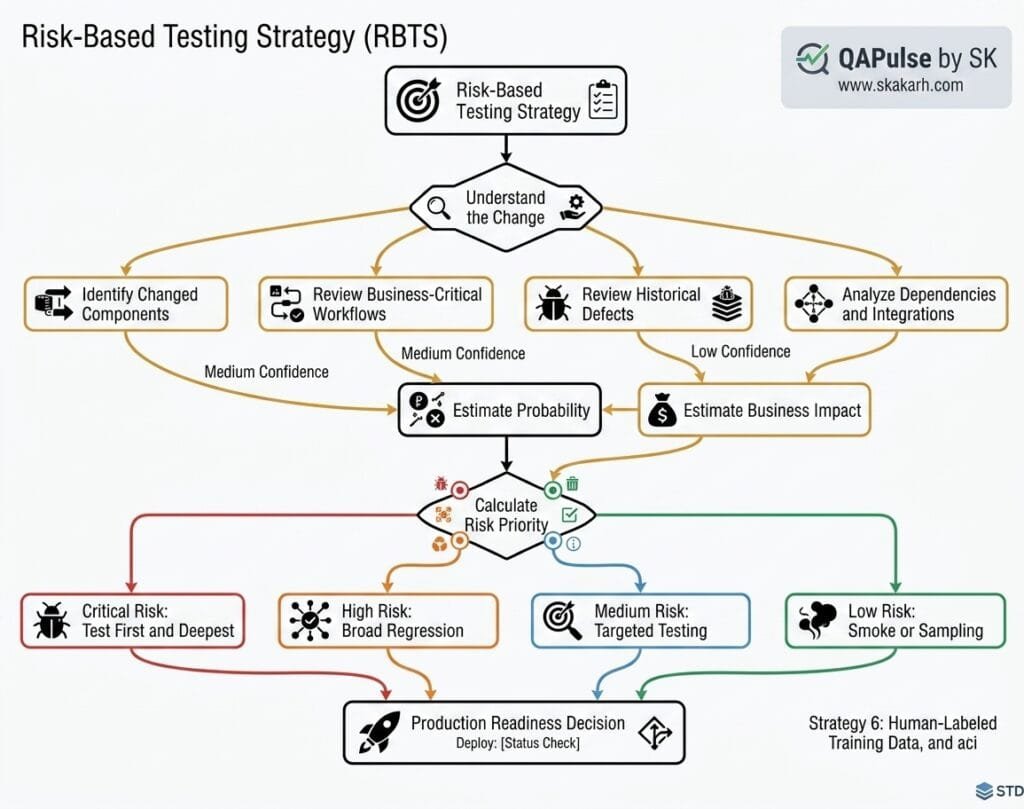
This model shows why risk-based testing is more than assigning numbers to test cases.
The process starts with understanding the system and ends with a release decision.
How to Build a Practical Risk Matrix
A risk matrix provides a repeatable way to prioritize testing.
The simplest model uses two dimensions:
Probability:
1 = Rare
2 = Unlikely
3 = Possible
4 = Likely
5 = Very likely
Impact:
1 = Negligible
2 = Minor
3 = Moderate
4 = Major
5 = Critical
Risk Score:
Probability × Impact
This produces a score between 1 and 25.
| Score | Risk Level | Typical Testing Response |
|---|---|---|
| 1–4 | Low | Basic validation |
| 5–9 | Moderate | Targeted testing |
| 10–16 | High | Broad functional and regression testing |
| 17–25 | Critical | Deep testing, automation and release scrutiny |
These boundaries are examples, not universal standards.
Organizations should define their own thresholds according to their product, industry and tolerance for failure.
Example: Banking Application
Suppose a banking application introduces four changes.
| Area | Probability | Impact | Score | Priority |
|---|---|---|---|---|
| Login | 3 | 5 | 15 | High |
| Fund transfer | 4 | 5 | 20 | Critical |
| Account color preference | 2 | 1 | 2 | Low |
| Transaction history | 3 | 4 | 12 | High |
The experienced QA engineer should not spend the first two hours testing account colors while fund transfers remain unvalidated.
Testing effort follows risk.
How Experienced QA Engineers Decide What to Test First
The risk matrix provides structure, but experienced testers use additional signals to decide execution order.
Start With Revenue-Critical Paths
Identify workflows that directly affect money.
Examples:
- Purchase
- Checkout
- Subscription
- Payment
- Refund
- Invoice generation
- Fund transfer
- Order creation
If these workflows fail, the business may immediately lose revenue.
Test Authentication and Authorization Early
Authentication failures can block the entire application.
Authorization failures can create an even more serious security problem.
Test:
- Login
- Logout
- Session expiration
- Token refresh
- Password reset
- Role-based access
- Permission boundaries
- Privilege escalation scenarios
Security-sensitive paths should not be pushed to the end of regression simply because they are technically difficult.
Test Changed Components Before Unchanged Components
This is one of the simplest ways to optimize regression.
If ten modules exist and only three changed significantly, start with those three.
Then test their dependent workflows.
This is often more efficient than executing the entire regression suite blindly.
Test Integration Boundaries
Many production failures occur at boundaries between systems.
Examples:
Frontend → Backend API
Backend → Database
Application → Payment Gateway
Service A → Service B
Application → Message Queue
Application → Identity Provider
Testing individual components is not enough.
The interaction between components must also be tested.
Test Failure and Recovery Paths
Experienced testers do not only test:
“What happens when everything works?”
They also test:
“What happens when something fails?”
For example:
- Payment gateway timeout
- Database connection failure
- API returns 500
- Token expires during checkout
- Network disconnects during upload
- Queue message is delayed
- Third-party service becomes unavailable
Failure handling often reveals more serious defects than the happy path.
Risk-Based Testing vs Traditional Test Execution
Traditional execution often follows the order of a predefined suite.
Risk-based testing dynamically changes the order according to risk.
| Area | Traditional Testing | Risk-Based Testing |
|---|---|---|
| Test order | Predefined | Risk-driven |
| Priority | Test-case sequence | Business and technical risk |
| Change analysis | Often limited | Central activity |
| Historical defects | Optional | Strong input |
| Business impact | Sometimes ignored | Core factor |
| Regression | Broad execution | Targeted and adaptive |
| Release decision | Pass/fail oriented | Risk-informed |
| Tester role | Executor | Decision-maker |
The key difference is not that traditional testing is wrong.
The problem occurs when teams execute every test with equal priority regardless of risk.
Risk-Based Testing in Agile and CI/CD
Risk-based testing becomes even more valuable when deployment frequency increases.
Imagine a team deploying 20 times per day.
Executing a massive regression suite after every small change may become impractical.
Instead, the pipeline can classify changes and select testing layers dynamically.
A simplified strategy could be:
Code change detected
→ Identify affected components
→ Determine risk
→ Select test suite
→ Execute critical tests
→ Expand regression when risk is high
→ Apply release gate
For example:
Low-risk documentation change:
- Lint
- Build validation
- Minimal smoke tests
Medium-risk UI change:
- Unit tests
- Component tests
- Targeted UI regression
- Accessibility checks
High-risk payment change:
- Unit tests
- API tests
- Database validation
- Payment integration tests
- End-to-end checkout tests
- Security tests
- Failure-path testing
- Regression suite
This is how risk-based testing can coexist with continuous delivery.
Turning Risk Into Test Selection
Risk becomes useful only when it changes testing behavior.
A team can define rules such as:
If authentication code changes:
Run authentication, authorization, session, protected API and critical user journey tests.
If payment code changes:
Run payment API, checkout, transaction, refund, failure recovery and end-to-end tests.
If database schema changes:
Run migration validation, CRUD tests, integration tests, data integrity checks and affected workflow regression.
If CSS-only changes occur:
Run targeted UI validation, visual checks and selected smoke tests.
The important concept is traceability:
Change → Risk → Test Scope → Evidence → Release Decision
Without this connection, a risk matrix becomes documentation theater.
Using Automation to Support Risk-Based Testing
Automation is especially useful when risk-based testing determines which tests should execute.
A mature automation framework can organize tests by:
- Risk level
- Business domain
- Feature
- Service
- Test type
- Execution time
- Criticality
- Environment
For example, Playwright tests can use tags or project configuration to separate critical paths from broader regression coverage.
A conceptual test organization might look like:
tests/
smoke/
critical/
regression/
checkout/
authentication/
payments/
accessibility/
A CI pipeline can then execute different groups based on the risk classification of the change.
For example:
Critical change:
Run smoke + critical + regression.
Medium-risk change:
Run smoke + affected feature tests.
Low-risk change:
Run smoke + targeted validation.
The goal is not to automate everything.
The goal is to automate the right evidence for the risk being evaluated.
Risk-Based Testing With Production Data
One of the biggest improvements a QA organization can make is connecting production information with testing decisions.
Useful production signals include:
- Error rates
- Failed transactions
- API latency
- Crash reports
- Customer complaints
- Support tickets
- Usage patterns
- Conversion rates
- Security alerts
- Incident history
Suppose production telemetry shows that 70% of checkout failures occur on mobile Safari.
That information should influence future testing priority.
Risk is not purely theoretical.
Production behavior provides evidence.
Risk-Based Testing Example: E-Commerce Checkout
Consider an e-commerce platform preparing for a major release.
The checkout flow contains:
- Cart
- Address
- Shipping
- Discount
- Payment
- Order creation
- Confirmation email
A weak regression strategy may execute all scenarios in alphabetical order.
An experienced QA engineer creates a risk model.
| Area | Risk | Why |
|---|---|---|
| Cart | High | Core purchase journey |
| Address | Medium | Required before shipping |
| Shipping | High | Pricing and fulfillment dependency |
| Discount | Medium | Revenue-impacting calculations |
| Payment | Critical | Direct revenue impact |
| Order creation | Critical | Transaction completion |
| Medium | Post-purchase communication |
Testing begins with payment and order creation because those areas have the greatest consequences.
Then the team validates the dependencies leading into them.
This is important.
Risk-based testing does not mean ignoring low-risk areas.
It means ordering and scaling the testing effort intelligently.
Risk-Based Testing for APIs and Microservices
In API-heavy systems, risk should be evaluated at the service and contract level.
Consider:
User Service
Order Service
Payment Service
Notification Service
A notification failure may delay an email.
A payment-service failure can prevent transactions.
An authentication-service failure can prevent access to the entire platform.
Therefore, service criticality should influence:
- Contract testing
- Integration testing
- Failure testing
- Performance testing
- Security testing
- Monitoring validation
- End-to-end testing
Dependency maps can make risk easier to visualize.
A service with ten downstream consumers generally deserves more attention than an isolated internal service.
Risk-Based Testing for Security
Security risk deserves special treatment because impact can be disproportionately high.
Examples include:
- Authentication bypass
- Authorization flaws
- Privilege escalation
- Sensitive-data exposure
- Injection vulnerabilities
- Insecure file uploads
- Session-management weaknesses
Even if the probability appears moderate, the impact may be critical.
For security-sensitive areas, teams may intentionally apply stricter thresholds.
This is why a simple probability × impact calculation should not become a rigid mathematical formula.
Some risks are inherently unacceptable.
Risk-Based Testing Metrics That Actually Matter
Teams often measure testing with metrics such as:
- Number of test cases executed
- Percentage passed
- Automation percentage
- Regression duration
These metrics are useful, but they do not tell the complete risk story.
Better metrics include:
Risk Coverage
How much of the identified high-risk functionality has been tested?
Risk Coverage = Tested High-Risk Areas / Identified High-Risk Areas × 100
Defect Escape Rate
How many important defects reached production?
High-Risk Defect Detection Rate
How effectively does the testing process identify severe defects before release?
Risk Reduction
How much identified risk has been mitigated by testing, fixes or controls?
Production Incident Correlation
Which risk categories most frequently correspond to production incidents?
These metrics help QA leadership understand whether testing is actually reducing business risk.
Common Mistakes in Risk-Based Testing
Risk-based testing can fail when teams misunderstand what it means.
Mistake 1: Treating the Risk Matrix as Permanent
Risk changes when the code, architecture, users or business changes.
Reassess it.
Mistake 2: Giving Everything a High Score
If every feature is marked critical, the matrix provides no prioritization.
A useful risk model must differentiate.
Mistake 3: Ignoring Business Context
QA cannot accurately prioritize risk without understanding the business.
Ask product managers, developers, architects and support teams for context.
Mistake 4: Prioritizing Only Recent Code
A changed component may affect an unchanged but critical workflow.
Always consider dependencies.
Mistake 5: Ignoring Production Evidence
Production incidents and customer behavior are valuable risk signals.
Use them.
Mistake 6: Equating Risk With Defects
Risk is not the same as the number of known bugs.
A feature can have zero known defects and still be high-risk.
Mistake 7: Using Risk to Justify Skipping Testing
Risk-based testing is not an excuse to test less carelessly.
It is a method for allocating limited testing resources intelligently.
A Practical Risk-Based Testing Decision Framework
When deciding what to test first, experienced QA engineers can use this sequence:
What changed?
What is business-critical?
What can fail?
How likely is failure?
What happens if it fails?
How many customers are exposed?
What dependencies are involved?
What has failed before?
What is the blast radius?
What evidence do we need before release?
These questions produce a much stronger testing strategy than simply asking how many test cases remain.
A practical prioritization formula can combine multiple signals:
Risk Priority = Impact × Probability × Change Exposure × Dependency Exposure
The numbers do not need to be mathematically perfect.
Consistency matters more than false precision.
The objective is to create a defensible testing decision.
From Test Case Execution to Risk Decisions
The biggest mindset change is simple:
A QA engineer should not measure success by how many test cases were executed.
The better question is:
“Did our testing reduce the most important risks before release?”
Imagine a regression suite containing 5,000 tests.
The team executes all 5,000 tests and finds no defects.
That sounds impressive.
But suppose the suite did not adequately cover the new payment integration.
The testing volume was high.
The risk coverage was poor.
Now imagine a targeted 800-test execution that thoroughly validates payment, authentication, authorization, order creation, database integrity and affected integrations.
The second approach may provide stronger release confidence despite executing fewer tests.
That is the essence of risk-based testing.
7 Core Principles Experienced QA Engineers Follow
Experienced QA engineers generally follow these principles:
- Test business-critical functionality first.
- Investigate changed components before unchanged areas.
- Use historical defects as evidence.
- Consider dependency and blast radius.
- Prioritize high-impact failure paths.
- Use production data to continuously refine risk.
- Convert risk assessment into actual test-selection decisions.
Risk-based testing is therefore not simply a test-management technique.
It is a way of thinking.
The tester becomes responsible not only for executing tests but also for determining where testing can produce the greatest reduction in uncertainty.
Final Takeaway
Risk-based testing answers one of the most important questions in software quality:
“What should we test first when we cannot test everything?”
The answer is not always the newest feature, the most complicated feature or the first test case in the regression suite.
Start with the areas where failure is most likely to occur and where failure would matter most.
- Analyze change.
- Understand business impact.
- Study historical defects.
- Map dependencies.
- Consider customer exposure.
- Evaluate blast radius.
Then turn those findings into a prioritized testing strategy.
That is how experienced QA engineers make testing decisions under real-world constraints.
The strongest QA teams do not simply execute more tests.
They make better decisions about which tests provide the most valuable evidence.
AI Overview & Answer Enginer Optimisation
Risk-based testing is a software testing approach that prioritizes testing activities and resources according to identified risk levels. Experienced QA engineers evaluate factors such as likelihood of failure, business impact, recent changes, customer exposure, technical complexity, historical defects, dependencies, and blast radius to determine what should be tested first, what requires deeper coverage, and what can receive lighter validation.
Key Architectural Rules:
- Identify product risks before deciding the depth and order of testing.
- Prioritize areas where failure has the greatest business or customer impact.
- Consider both likelihood and impact when determining risk level.
- Give additional attention to changed, unstable, complex, or highly connected components.
- Use historical defects and production evidence to refine risk assessments.
- Map identified risks to specific test conditions, scenarios, test cases, and automation coverage.
- Reassess risk continuously because risk levels can change during development and testing.
- Use risk to determine not only test execution order but also test depth, techniques, resources, and regression scope.
- Report residual risk when available testing time ends instead of treating unexecuted tests as the only measure of quality.
Internal Blog Links
- What is QA Engineering? A Practical Guide to Modern Software Quality — connect risk-based testing with the broader QA engineering role.
- QA Engineer vs SDET vs Quality Engineer: What’s the Difference? — reinforce the distinction between test execution and engineering-level quality decisions.
- 50 Playwright Commands Every QA Engineer Should Know — connect risk-prioritized test execution with Playwright automation.
- Agentic Test Creation vs AI Test Generation: What’s the Real Difference? — connect risk-based prioritization with AI-assisted test creation.
- AI Test Automation With Humans in the Loop: Governance, Metrics, and the Practical Guide — connect risk assessment with AI automation governance.
- Graph Testing: The Critical QA Layer After Loop-Based Test Automation — useful for discussing dependency graphs and blast-radius analysis.
- Graph Engineering: The Powerful Layer After Loop Engineering — connect system dependency analysis with risk prioritization.
Internal Series Links
- Learn AI Agents for QA – Zero to Hero
- Playwright Automation – Zero to Hero
- Learn MCP – Zero to Hero
- LangGraph: Complete Zero to Hero
- Claude Code Tutorial: Complete Zero to Hero
- AutoGen: Complete Zero to Hero Guides
- Free QA Resources Built From Real Experiences
- QA Glossary: Test Automation Terms Every Engineer Should Know
External Links
- ISTQB Official Website — authoritative source for software-testing terminology, certifications, syllabi, and testing practices.
- ISTQB Certified Tester Foundation Level Syllabus — useful reference for risk management, risk analysis, risk control, and risk-based testing.
- ISTQB Advanced Level Test Analyst Syllabus — detailed reference for risk-based test prioritization, depth-first and breadth-first approaches, and continuous risk reassessment.
- ISTQB Risk-Based Testing Definition — concise reference for the formal definition of risk-based testing.
- ISTQB Risk Management Guidance — reference for likelihood, impact, risk level, risk analysis, and risk control.
People Asked Questions: Risk-Based Testing
What is risk-based testing?
Risk-based testing is a testing strategy that prioritizes test activities according to the likelihood and impact of potential failures. High-impact and high-probability risks receive greater testing attention.
How do QA engineers prioritize test cases?
QA engineers consider business impact, probability of failure, recent changes, customer exposure, technical complexity, historical defects, dependencies and blast radius.
What should be tested first in a regression cycle?
Start with critical business workflows, recently changed components, high-risk integrations, historically unstable areas and functionality with a large production blast radius.
Is risk-based testing suitable for Agile teams?
Yes. It is particularly useful for Agile and CI/CD environments because testing scope can be adjusted according to the risk introduced by each change.
Does risk-based testing mean skipping low-risk tests?
Not necessarily. It means allocating testing depth and execution priority according to risk. Low-risk functionality may receive lighter or later validation.
How is risk calculated in testing?
A common starting model is Probability × Impact. Organizations can extend this with factors such as change exposure, dependency exposure, customer usage and historical defect data.
What is the difference between risk-based testing and regression testing?
Regression testing focuses on verifying that existing functionality still works after changes. Risk-based testing determines which areas deserve the greatest testing priority based on their potential risk. The two approaches work well together.
Continue Learning
Explore more expert articles on Mobile Testing, Backend & API, AI & Agentic, AI Tools, n8n, LangChain, CrewAI, MCP Servers, AI Agents, LlamaIndex, Docker, FastAPI, Playwright, Cypress, Test Automation, DevOps, and Software Engineering at www.skakarh.com.
QAPulse by SK delivers expert release analysis, AI engineering insights, enterprise automation strategies, migration guidance, DevOps best practices, and practical testing knowledge to help software professionals build scalable, intelligent, and production-ready software systems.